ROLECE Registration in Spain: Complete Guide for Suppliers
21 Sep 2026
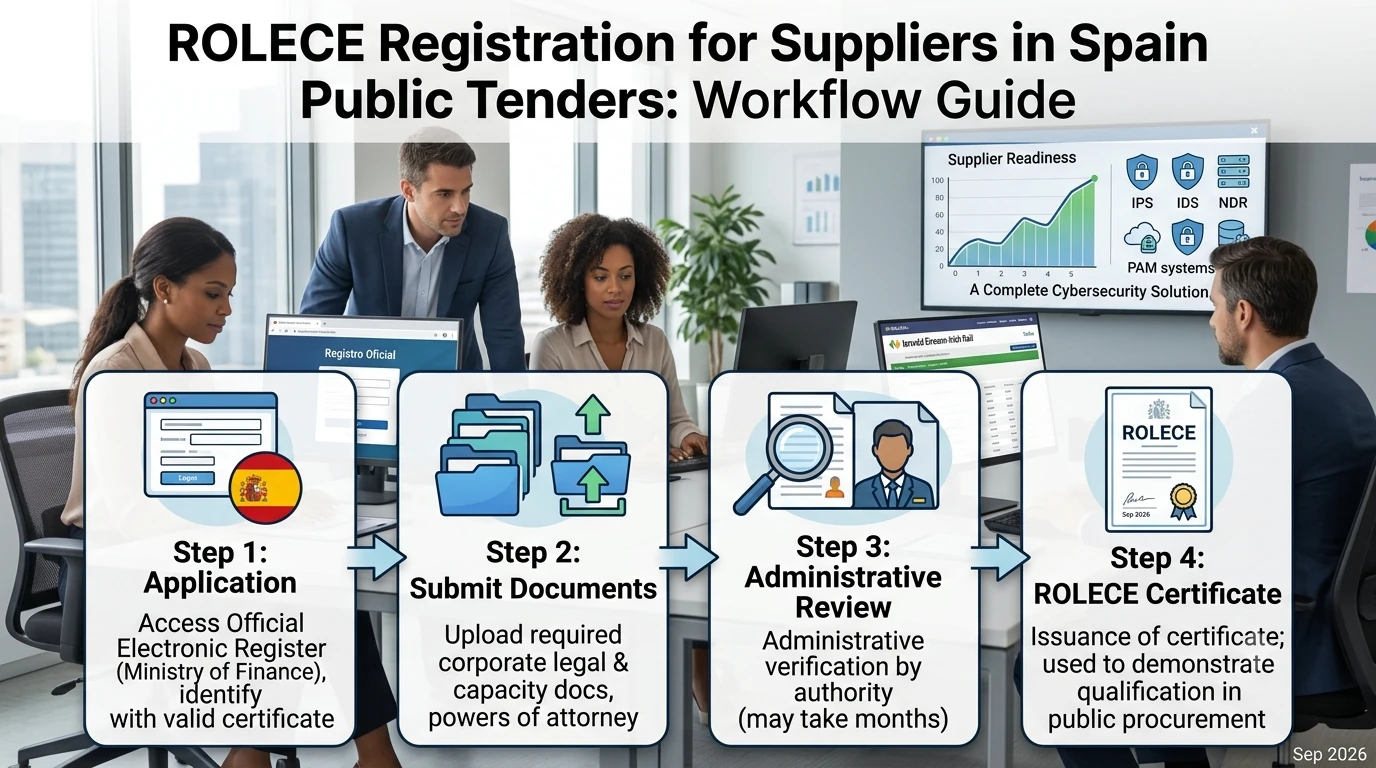
Introduction For companies planning to participate in Spain public tenders, understanding supplier registration and qualification requirements is an important part of preparing for public procurement. One of the key systems for suppliers is the Registro Oficial de Licitadores y Empresas Clasificadas del Sector Público, commonly known as ROLECE or ROLECSP. ROLECE provides an official record of information about businesses and economic operators that can be relevant when participating in Spanish public procurement. ROLECE is particularly important for companies looking for licitaciones España, licitaciones públicas España, contratación pública España and Spain government tenders. Depending on the procurement procedure and the requirements established in the tender documents, information recorded in ROLECE can help demonstrate aspects of a company's legal capacity, representation, professional authorisations, economic and financial solvency, technical or professional solvency and classification. This complete guide explains what ROLECE is, who can register, what information can be recorded, how the registration process works, what documents may be required, how ROLECE certificates are used and what suppliers should understand before participating in Spanish public tenders. Table of Contents What Is ROLECE in Spain? Why Is ROLECE Important for Spain Public Tenders? Who Can Register in ROLECE? What Information Can Be Recorded in ROLECE? ROLECE Registration and Supplier Eligibility How to Register in ROLECE Electronic Identification for ROLECE Documents Required for ROLECE Registration How to Submit Supporting Documents ROLECE Certificate: What Is It? How ROLECE Can Help in Spanish Tender Participation ROLECE and the Simplified Open Procedure ROLECE and Economic and Financial Solvency ROLECE and Technical or Professional Solvency ROLECE and Company Classification ROLECE Registration vs ROLECE Classification Keeping ROLECE Information Updated What Happens If ROLECE Information Is Outdated? ROLECE for SMEs and Regular Tender Bidders ROLECE for Foreign Companies ROLECE and Regional Supplier Registers ROLECE Registration Checklist for Spanish Tender Suppliers Common ROLECE Registration Mistakes How ROLECE Fits Into the Spain Tender Workflow How SpainTenders.com Helps Businesses Discover Spain Tenders ROLECE Registration and Tender Readiness Conclusion What Is ROLECE in Spain? ROLECE is the Registro Oficial de Licitadores y Empresas Clasificadas del Sector Público, the Official Register of Tenderers and Classified Companies of the Public Sector. It is an official electronic register used within the Spanish public procurement system. The register is regulated by Articles 337 to 345 of Ley 9/2017, de Contratos del Sector Público. Companies can register information relating to their legal personality and capacity to act, professional or business authorisations, solvency and company classification where applicable. ROLECE is therefore an important part of the supplier side of Spanish public procurement. It provides a structured official record that can be relevant when companies demonstrate their suitability for public contracts. Why Is ROLECE Important for Spain Public Tenders? Public contracting authorities need to establish whether bidders satisfy the applicable requirements before awarding contracts. ROLECE can help by providing official evidence of information that has been registered for an economic operator. For suppliers participating regularly in Spain public tenders, maintaining accurate registration information can make the qualification process more organised. A company can establish a recognised procurement profile covering relevant corporate, legal and qualification information. ROLECE can be particularly important in certain procurement procedures. For example, Spanish procurement legislation establishes specific registration requirements for bidders participating in the procedimiento abierto simplificado, subject to the conditions set out in the law. However, ROLECE registration should not be interpreted as automatic qualification for every Spanish government tender. Each procurement can contain additional requirements that must be reviewed separately. Who Can Register in ROLECE? Companies and other eligible economic operators can use the ROLECE registration system to record information relevant to public procurement. The appropriate process depends on the legal form of the applicant and the information that needs to be registered. Spanish companies can use ROLECE to maintain their procurement-related company information. Foreign companies may also need to consider the Spanish registration framework when participating in public procurement, although the applicable requirements can differ according to their status, country of establishment and the particular tender. A supplier should always examine the individual procurement documents before deciding which registration or qualification evidence is required. What Information Can Be Recorded in ROLECE? ROLECE allows relevant information concerning an economic operator to be registered. This can include information that helps establish the company's legal capacity and suitability to participate in public procurement. Company identity and legal personality Capacity to act Legal representation Professional or business authorisations Economic and financial solvency Technical or professional solvency Company classification where applicable Other procurement-related circumstances covered by the registration framework The exact information applicable to a company depends on its legal form, business activities and circumstances. Suppliers should make sure that the information submitted is accurate and reflects their current situation. ROLECE Registration and Supplier Eligibility ROLECE registration forms part of supplier qualification but does not replace the eligibility assessment for an individual tender. A company may have valid ROLECE registration and still need to demonstrate additional requirements for a particular contract. For example, a public tender may require specific professional licences, previous experience, minimum turnover, technical personnel, equipment, certifications or other capabilities. These requirements can be linked directly to the subject and complexity of the procurement. For this reason, companies should distinguish between being registered as a supplier and being qualified for a specific procurement opportunity. How to Register in ROLECE ROLECE registration is conducted through an electronic administrative process. The applicant must identify itself using an accepted electronic identification method and complete the appropriate registration application. The applicant needs to provide the information requested by the registration system and submit the supporting documentation required to establish the circumstances being registered. The registration procedure includes the submission and examination of the application followed by a resolution. The official procedure currently identifies a resolution period of up to three months, subject to the applicable administrative rules and circumstances of the application. Companies should therefore begin registration sufficiently early when they intend to participate in public tenders where ROLECE registration may be relevant. Electronic Identification for ROLECE Because ROLECE operates electronically, appropriate electronic identification is required to access and use the system. The official Ministry of Finance information identifies electronic certificates for individuals, representatives and other authorised users as relevant identification methods. The person carrying out the procedure should have the appropriate authority to act for the company. Businesses should also check that their electronic certificate is valid and correctly installed before beginning an application. Electronic identification should be treated as part of general tender readiness because many Spanish public procurement processes also use electronic systems for submission and communication. Documents Required for ROLECE Registration The documents required depend on the applicant and the information that the company wants to register. For companies such as sociedades anónimas and sociedades de responsabilidad limitada, the official procedure identifies incorporation documents and subsequent amendments reflecting the current circumstances requested for registration. Other legal entities may need to provide constitutive documents, statutes and relevant amendments. Individual entrepreneurs may need to provide identity and other documentation demonstrating their capacity to act and applicable registrations. Other supporting evidence can include documents relating to powers of representation, professional authorisations, financial information and other circumstances that the company wishes to register. Documents submitted to support registration must satisfy the applicable authenticity requirements. Suppliers should therefore prepare current and properly authenticated documentation before submitting the application. How to Submit Supporting Documents The ROLECE procedure allows supporting documentation to be submitted through the mechanisms established by the administration. Depending on the document, this can include electronically signed files issued by an appropriate authority, original documents or authenticated copies and other permitted submission methods. For certain financial information, annual accounts can be transmitted through the relevant commercial register process. Companies should follow the current official instructions for the specific ROLECE procedure because acceptable document formats and administrative processes can change. ROLECE Certificate: What Is It? A ROLECE certificate provides official evidence of information recorded in the register. The certificate can be relevant when a company needs to demonstrate its registered circumstances to public contracting authorities. Depending on the information registered, ROLECE certificates can evidence aspects relating to personality and capacity to act, representation, professional or business authorisation, economic and financial solvency, classification and other relevant circumstances. The official Ministry of Finance states that ROLECE certificates have evidentiary effect before public-sector contracting authorities within the scope of the information reflected in the certificate, subject to the applicable legal conditions. How ROLECE Can Help in Spanish Tender Participation ROLECE can help suppliers organise the evidence associated with their public procurement status. When a tender permits registered information or a ROLECE certificate to be used for a particular qualification requirement, the supplier can rely on the official registration instead of repeatedly establishing the same information through separate documentation. This can be particularly useful for companies that participate in multiple licitaciones públicas España. A regularly maintained ROLECE profile can become part of the company's wider tender-readiness process. Nevertheless, suppliers must always follow the specific instructions in the tender documents. ROLECE does not remove the need to review the complete procurement documentation. ROLECE and the Simplified Open Procedure ROLECE has a particularly important connection with the procedimiento abierto simplificado. Article 159 of Ley 9/2017 establishes that bidders participating through this procedure must generally be registered in ROLECE or, where applicable, the corresponding official register of an Autonomous Community by the final offer submission date, provided that competition is not restricted. The same legal provision also contains circumstances concerning applications for registration and supporting evidence. This means that suppliers should not wait until the final stages of a tender to investigate whether their registration status satisfies the applicable requirement. Companies that frequently target simplified Spanish public tenders should therefore consider ROLECE registration as part of their advance procurement preparation. ROLECE and Economic and Financial Solvency Economic and financial solvency is an important element of supplier qualification. ROLECE can record relevant information concerning a company's economic and financial solvency. Where the procurement rules permit the registered information to be used, the corresponding ROLECE certificate can provide evidence of the circumstances recorded in the register. However, each tender can establish its own minimum requirements. Suppliers should compare the information recorded in ROLECE with the specific financial requirements stated in the tender documents. ROLECE and Technical or Professional Solvency Technical and professional solvency relates to a company's ability and experience to perform the required contract. Depending on the circumstances, relevant information can be recorded in ROLECE. A tender may nevertheless require specific evidence of previous contracts, technical personnel, professional qualifications, equipment, certifications or other capabilities. Companies should therefore use ROLECE as one part of their qualification documentation and not assume that general registration satisfies every technical requirement. ROLECE and Company Classification Company classification is another area connected with Spanish public procurement. Classification can be particularly relevant for certain works contracts and can provide a formal mechanism for demonstrating specified levels of economic, financial and technical solvency. The requirement for classification depends on the type and value of the contract and the applicable procurement rules. Suppliers should check the current legislation and the individual tender documents before relying on classification as evidence of their capacity. ROLECE Registration vs ROLECE Classification ROLECE registration and company classification are not the same thing. ROLECE registration records information about an economic operator, including relevant legal and qualification circumstances. Classification is a formal procurement status that can be used to establish particular forms of solvency for contracts where the applicable rules recognise it. A company may therefore need to understand both concepts when preparing for Spain government tenders. The tender documents should always be used to determine what the contracting authority requires. Keeping ROLECE Information Updated Registration should not be treated as a one-time administrative exercise. Companies should keep their registered information aligned with their current circumstances and communicate relevant changes through the applicable procedures. Changes to company representation, legal structure, professional authorisations, financial information or other registered circumstances can affect the information that a supplier presents during procurement. A regular internal review of ROLECE information can therefore help companies maintain accurate procurement documentation. What Happens If ROLECE Information Is Outdated? Outdated information can create problems when a supplier relies on its registration to demonstrate a particular qualification or company circumstance. If company information has changed, the supplier should review whether an update or additional evidence is required before using the information in a public tender. This is particularly important where a procurement has strict qualification requirements or where the contracting authority needs evidence that reflects the company's current circumstances. ROLECE for SMEs and Regular Tender Bidders Small and medium-sized enterprises can face considerable administrative work when entering public procurement markets. Maintaining a structured supplier registration can help organise the information required across multiple procurement opportunities. For SMEs that regularly search for licitaciones España, ROLECE can become part of a repeatable procurement workflow covering company documentation, qualifications, electronic identification, tender discovery and bid preparation. The practical benefit depends on the specific procurement and should always be considered together with the requirements of each tender. ROLECE for Foreign Companies Foreign companies interested in Spanish public procurement should understand the relationship between supplier registration, qualification and tender-specific eligibility. Depending on the procurement and the company's circumstances, the applicable evidence may involve ROLECE, a recognised equivalent register or other documentation accepted under Spanish procurement rules. International suppliers should review requirements concerning legal capacity, professional authorisations, financial and technical solvency, taxation, electronic identification, language, local regulatory requirements and submission procedures. A foreign company should never assume that registration in another country automatically satisfies every Spanish public procurement requirement. ROLECE and Regional Supplier Registers Spain's public procurement system also includes official registers associated with certain Autonomous Communities. The relevant registration framework can depend on the supplier's circumstances and the contracting authority. The official ROLECE procedure explains that companies with registered offices in certain Autonomous Communities can have their registration processed by the competent regional administration while using the same electronic registration environment. Suppliers should therefore check the applicable authority and registration requirements when targeting regional Spanish government tenders. ROLECE Registration Checklist for Spanish Tender Suppliers Confirm the company's legal and corporate information. Check the identity and authority of the person completing the application. Obtain a valid electronic certificate or other accepted electronic identification. Prepare current incorporation and constitutional documents. Prepare representation and power-of-attorney documents where applicable. Check professional licences and business authorisations. Review economic and financial solvency information. Review technical and professional solvency information. Determine whether company classification is applicable. Submit the ROLECE registration application. Retain the application acknowledgement. Provide the required supporting documentation. Review the registered information after the application is processed. Obtain the applicable ROLECE certificate. Update registered information when relevant company circumstances change. Compare ROLECE information with the requirements of every target tender. Common ROLECE Registration Mistakes One common mistake is assuming that ROLECE registration automatically qualifies a company for all Spanish public tenders. Registration provides evidence of registered circumstances but does not eliminate contract-specific qualification requirements. Another mistake is submitting outdated company information. Corporate changes, changes in representation and changes to professional authorisations should be reviewed against the information held in the register. Companies may also confuse ROLECE registration with company classification. Although both are connected to public procurement, they have different purposes and should be assessed separately. Waiting until a tender deadline approaches before checking registration status can also create unnecessary risk. Businesses targeting procedures where ROLECE registration is relevant should prepare their registration in advance. How ROLECE Fits Into the Spain Tender Workflow ROLECE is one component of a broader Spanish tender workflow. A company may first discover a procurement opportunity, identify the contracting authority, review the CPV classification and study the tender documents. The supplier then needs to determine whether it satisfies the eligibility and qualification requirements. ROLECE information can support this stage where the procurement rules permit it. After qualification, the company may need to prepare technical documentation, financial information, declarations and other tender files before submitting the offer through the required electronic procurement system. Therefore, ROLECE should be viewed as part of supplier readiness rather than as a replacement for tender analysis. How SpainTenders.com Helps Businesses Discover Spain Tenders ROLECE prepares a company for supplier qualification, but businesses also need a systematic way to identify relevant procurement opportunities. SpainTenders.com can support businesses looking for Spain tenders by helping them discover procurement opportunities across different categories, authorities and locations. Businesses can use tender discovery to identify relevant licitaciones España and then evaluate each opportunity against their capabilities, qualifications, ROLECE information, technical resources and commercial objectives. This creates a connection between supplier readiness and opportunity discovery: a company can prepare its procurement credentials in advance while continuously identifying relevant Spanish public procurement opportunities. ROLECE Registration and Tender Readiness Successful participation in public procurement requires more than finding an opportunity before its submission deadline. Suppliers need organised documentation, appropriate registrations, electronic identification, relevant qualifications and a clear understanding of the tender requirements. ROLECE can provide an important foundation for this preparation by maintaining official information about the economic operator. Keeping that information accurate and current can help suppliers respond more efficiently when relevant Spanish public tenders become available. Companies should nevertheless verify all requirements against the official procurement documents because the specific tender remains the authoritative source for its eligibility, qualification, submission and contractual conditions. Conclusion ROLECE is an important part of the Spanish public procurement system for companies participating in government tenders and public contracts. The register provides an official mechanism for recording information relating to company identity, legal capacity, representation, professional authorisations, solvency and classification where applicable. For businesses targeting licitaciones públicas España, registration can form an important part of procurement readiness. It can be particularly relevant where Spanish procurement legislation establishes registration requirements for a particular procedure, including the applicable rules for the procedimiento abierto simplificado. However, ROLECE registration is not a universal qualification for every Spain tender. Suppliers must still examine each procurement carefully and verify its technical, professional, financial and administrative requirements. Keeping ROLECE information accurate, maintaining the required electronic credentials and preparing supporting documentation in advance can help companies create a more organised approach to Spanish public procurement. Combined with systematic tender discovery and detailed document review, ROLECE readiness can become an important part of a supplier's overall Spain tender strategy.
View Details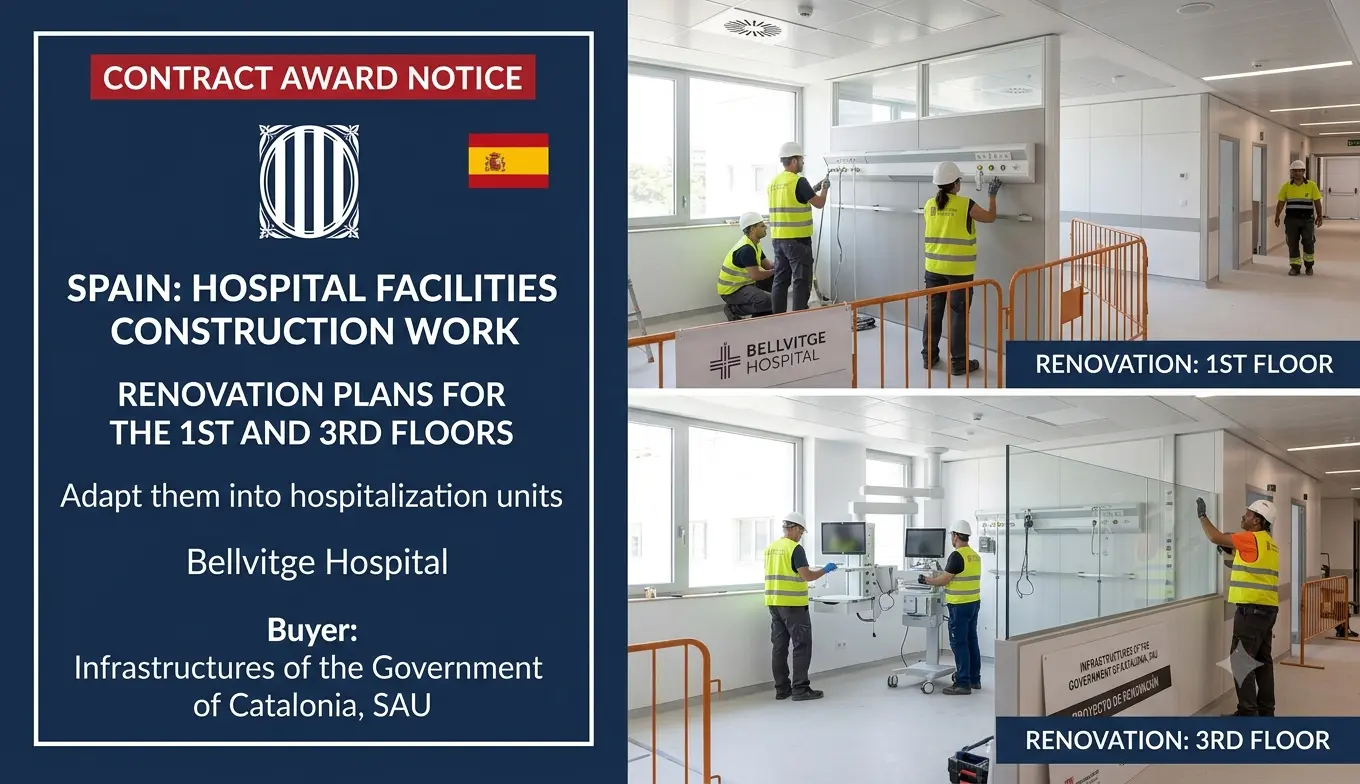
UTE VILOR Secures 13.53 Million Euro Hospital Renovation Contract for Bellvitge University Hospital
21 Sep 2026
Standfirst A consortium led by VILOR has been awarded a major 13.53 million euro contract to renovate the first and third floors of Bellvitge University Hospital in L Hospitalet de Llobregat, Spain. The procurement, managed by Infraestructures de la Generalitat de Catalunya, SAU, is divided into two lots to modernize critical hospitalization units. This award highlights the Catalan government commitment to upgrading public healthcare infrastructure with stringent environmental and methodological standards. Introduction The modernization of public healthcare facilities remains a critical priority for regional governments aiming to improve patient care and operational efficiency. In Catalonia, the regional government has initiated a targeted procurement strategy to upgrade the hospitalization units at Bellvitge University Hospital. This recent contract award represents a significant investment in the physical infrastructure of one of the region most important medical centers, ensuring that the facility can meet the growing demands of the local population. By executing this procurement through a transparent open procedure, the contracting authority ensured rigorous evaluation of both technical and financial proposals. The selection criteria heavily emphasized methodological excellence and environmental sustainability, reflecting a broader shift toward green public procurement in the construction sector. This approach guarantees that public funds are deployed efficiently while prioritizing long term operational resilience and patient safety. Why This Contract Matters This procurement is vital for ensuring that Bellvitge University Hospital can provide modern, safe, and efficient care environments for its patients. The inclusion of stringent environmental criteria, such as commitments on carbon dioxide emissions and certified materials, directly elevates the standard of public construction projects. For the domestic construction sector, securing this high value public procurement validates the capability of specialized consortia to deliver complex healthcare renovations. It also demonstrates how regional authorities can leverage public procurement to drive continuous improvement in sustainable community development. Contract Timeline The procurement process culminated in the formal selection of the winning bidders in mid 2026. Following standard administrative procedures, the formal contracts for the respective lots were concluded on August 6, 2026, and September 17, 2026. The official contract awards notice was published in the Official Journal of the European Union on September 21, 2026. This timeline reflects a standard and transparent execution of public procurement regulations in the Spanish regional sector. Contract Overview The agreement is structured into two distinct lots covering the renovation of the first and third floors to adapt them into modern hospitalization units. The total value of all contracts awarded in this notice is approximately 13.53 million euros. The suppliers are responsible for executing construction works, including structural reforms, installations, and finishing works, in strict accordance with the provided technical documentation and quality standards. Key Contract Details Contract Title Ejecución de los abres de reforma de los plantes 1.ª y 3.ª para adecuar los a unidades de hospitalización del Hospital de Bellvitge Contracting Authority Infraestructures de la Generalitat de Catalunya, SAU Total Contract Value 13,528,238.86 EUR Procedure Type Open Procedure Number of Bids Received 2 for Lot 1, 6 for Lot 2 Winners UTE VILOR AIP (Lot 1), UTE VILOR COMELEC (Lot 2) Contract Conclusion Dates August 6, 2026 and September 17, 2026 Main CPV Code 45215140 (Hospital facilities construction work) Project Scope The core scope involves the renovation of specific floors within Bellvitge University Hospital to create modern hospitalization units. This includes structural adaptations, installation of specialized medical infrastructure, and high quality finishing works. The contractors must also implement advanced Building Information Modeling methodologies and adhere to strict environmental commitments regarding material sourcing and carbon emissions. About the Contracting Authority Infraestructures de la Generalitat de Catalunya, SAU is the primary buyer for this procurement. It is a public undertaking controlled by the regional authority, responsible for managing and executing major public infrastructure and construction projects across Catalonia. About the Organisations Involved Infraestructures de la Generalitat de Catalunya, SAU is the contracting authority and buyer. It manages regional public infrastructure and drives the procurement of essential construction services for public facilities. UTE VILOR AIP is the successful bidding consortium for Lot 1. This temporary association of enterprises combines the resources and expertise of its members to deliver complex hospital renovation projects. UTE VILOR COMELEC is the successful bidding consortium for Lot 2. This joint venture leverages the specialized construction and electrical engineering capabilities of its partners to execute the hospitalization unit upgrades. Tribunal Català de Contractes del Sector Públic is the review organisation. This Catalan Public Sector Contracts Tribunal handles any legal appeals or disputes related to public procurement procedures in the region. Procurement Analysis The open procedure attracted multiple bids, demonstrating healthy competition in the Spanish healthcare construction market. The award criteria were heavily weighted toward quality at 70 percent, with price accounting for only 30 percent. This balanced evaluation method indicates that the technical, methodological, and environmental baselines were strict, ensuring that only highly capable firms with proven track records could advance. Additional Procurement Facts The procurement project is not financed with European Union funds, relying entirely on the regional budget of the Generalitat de Catalunya. The procurement is covered by the Government Procurement Agreement, allowing international competition, though the successful bidders are domestic entities. Market and Industry Perspective The Spanish public construction market is characterized by established operators capable of meeting stringent technical and environmental specifications. The success of specialized consortia highlights the importance of combining diverse expertise to win major public hospital contracts. Suppliers must continuously innovate to meet evolving accessibility standards and integrate advanced digital tools into their project delivery models. Economic Significance An investment of over 13.5 million euros represents a substantial injection of capital into the regional construction sector. This spending supports local jobs in engineering, specialized construction, and project management within the Barcelona metropolitan area. By securing these services through a competitive tender, the public sector ensures cost predictability while stimulating continuous investment in green infrastructure. Future Procurement Opportunities Suppliers who were not successful should monitor the official Tenders Portal for upcoming healthcare facility renewals in other Catalan regions. As hospital networks expand, public institutions will continuously generate new tenders opportunities for specialized medical construction and maintenance services. Stakeholders should also track the Latest Active Tenders Procurement notices to anticipate upcoming infrastructure projects in the broader Spanish public sector. Opportunities for Suppliers While the primary construction contracts have been awarded, specialized subcontractors can find valuable opportunities. Firms offering eco labeled paints, certified wood products, or advanced carbon emission tracking software may position themselves to support the primary contractors in fulfilling the strict environmental requirements of the agreement. What Businesses Should Watch Industry observers should monitor the execution of these renovation projects to gauge the effectiveness of the mandated Building Information Modeling methodologies and environmental commitments. The enforcement of strict green criteria will be a key metric for future live tender evaluations in the healthcare construction sector. Stakeholders should also review Live Notices for Tenders to anticipate upcoming medical modernization projects funded by regional health programs. SpainTenders.com Procurement Intelligence This contract represents a clear trend in European public procurement toward the strategic integration of environmental and digital mandates into core construction projects. By weighting the award criteria heavily toward quality and methodology at 70 percent, the contracting authority signaled that operational reliability and sustainable practices are far more critical than marginal cost savings. This approach is highly effective for mission critical healthcare facilities, allowing public buyers to secure high quality solutions that ensure long term operational stability and regulatory compliance. Strategically, this award is important because it demonstrates how regional authorities can leverage specialized consortia to meet the complex demands of hospital renovations. Suppliers can learn that forming strategic partnerships is often necessary to combine the technical, environmental, and managerial expertise required for such tenders. To position themselves for future contracts, relevant suppliers must invest in robust digital modeling capabilities and develop transparent supply chains that can verify eco friendly material sourcing. Supplier Takeaways Quality and methodological criteria now dominate award evaluations in complex public construction tenders. Forming specialized consortia is essential to meet the diverse technical and environmental requirements of hospital renovations. Subcontractors offering certified green materials and digital tracking tools have strong opportunities to support primary winners. Monitoring the official Tenders Portal is crucial for anticipating future healthcare infrastructure RFPs and RFQs. Key Takeaways UTE VILOR led consortia won both lots of the 13.53 million euro hospital renovation contract. The procurement prioritized quality and methodology at 70 percent, with price weighted at only 30 percent. Strict environmental commitments, including carbon emission limits and certified materials, were mandatory. The project relies entirely on regional funding and is not financed by European Union funds. Advanced Building Information Modeling methodologies are now a standard requirement in major public healthcare construction. Conclusion This contract secures vital renovation capabilities for Bellvitge University Hospital, enhancing patient care environments and operational efficiency. The transparent procurement process ensures optimal value for public money while supporting the domestic construction industry and advancing regional sustainability goals. Source: Tenders Electronic Daily (TED), Contract Award Notice 649487-2026, Official Journal of the European Union, published on 21/09/2026.
View Details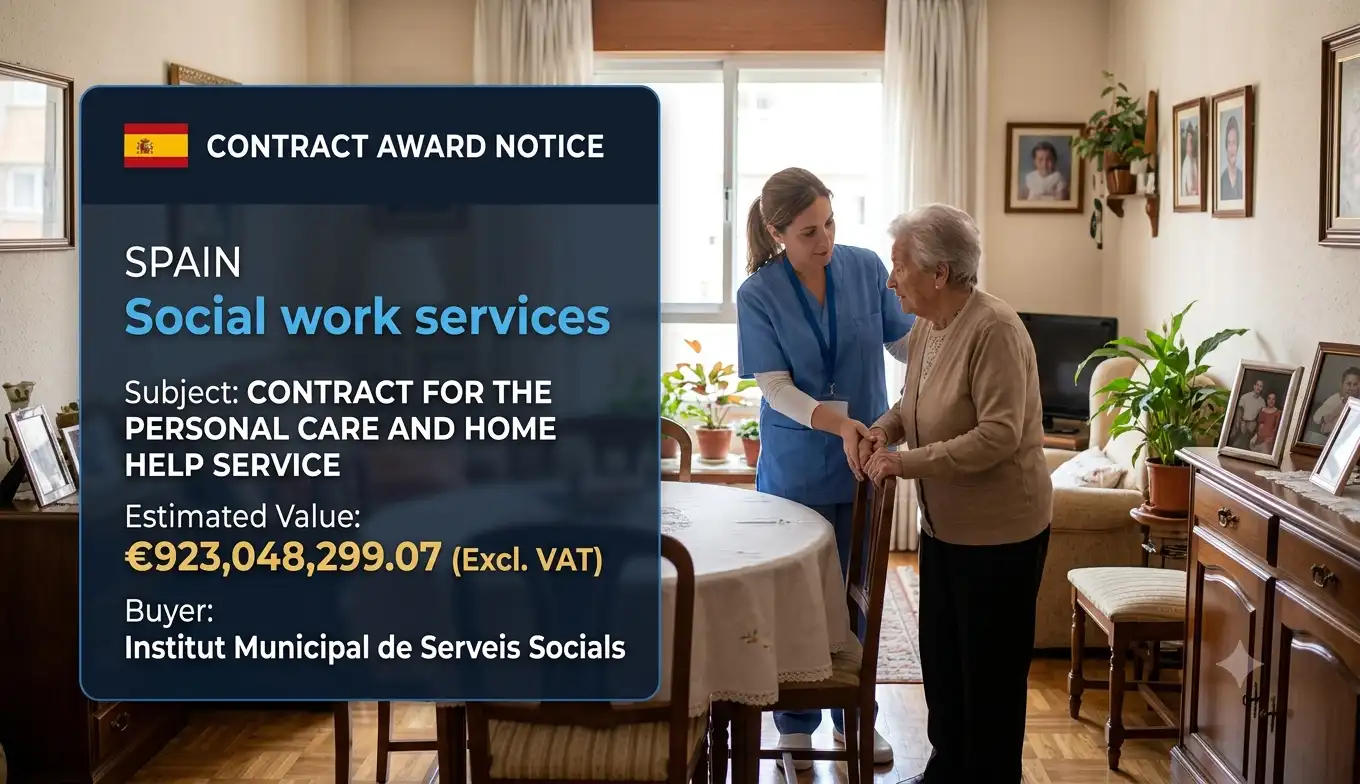
Barcelona Awards €435.46 Million Home Care Service Contracts Across Four Zones
18 Sep 2026
Standfirst Barcelona has awarded contracts worth a combined €435.46 million for the management of its Social Home Care Service across four geographic zones. The procurement, led by the Institut Municipal de Serveis Socials, covers personal care and household assistance within Barcelona's domiciliary care services. Each contract has an initial duration of three years and may be extended by up to two additional years. The procurement has an estimated total value of €923.05 million excluding VAT and was conducted through an open procedure. Introduction The Institut Municipal de Serveis Socials, a local authority responsible for social protection activities, has completed a major procurement for Barcelona's Social Home Care Service. The contract covers two principal service categories: personal care as the main service and household assistance as a complementary service. The procurement was divided into four geographic lots covering different groups of Barcelona districts. The result notice, published in the Official Journal of the European Union under OJ S 181/2026 on 18 September 2026, records a combined value of all awarded contracts of €435,458,097.57. The procurement has an estimated value of €923,048,299.07 excluding VAT at the overall procedure level. The four individual lots have estimated values ranging from approximately €218.89 million to €250.23 million. The contracts are subject to sustainable public procurement and social efficiency measures, making the procurement relevant not only from a financial perspective but also for suppliers operating in Spain's social care services market. Why This Contract Matters The Barcelona home care procurement represents a significant public sector requirement in the social services market. The service is designed to provide personal support, social and family assistance and help with household activities to people receiving domiciliary care. Because the procurement is divided geographically, suppliers must consider operational capacity across specific groups of districts rather than treating Barcelona as a single undifferentiated service area. The scale of the procurement also demonstrates the importance of long term service delivery capacity in municipal social care contracts. Each lot has an initial three year duration with an option to extend the duration by up to two years. This creates a potential contractual relationship extending beyond the initial term, subject to the applicable extension arrangements. Contract Timeline The procurement was previously published under notice 301834-2026 and was conducted using an open procedure. The contracting authority selected the recorded winning tender for Lot 1 on 4 August 2026 and concluded the contract on 15 September 2026. The same winner selection and contract conclusion dates are recorded for Lot 3. The final result notice was dispatched on 17 September 2026 and published on 18 September 2026. Contract Overview The procurement covers the management of the Servicio de Atención Domiciliaria, known as SAD, within the social services of Barcelona. Its two service types are personal care, which is described as the principal service and includes social and family support and interaction with the surrounding environment, and household assistance as a complementary service. The main CPV classification is 85310000, Social work services. The procurement was not financed with European Union funds and is covered by the Government Procurement Agreement. No framework agreement and no dynamic purchasing system were used. Key Contract Details Contracting AuthorityInstitut Municipal de Serveis Socials LocationBarcelona, Spain ProcurementSocial Home Care Service Notice Number643518-2026 ProcedureOpen procedure Main CPV85310000, Social work services Number of Lots4 Estimated Overall Value€923,048,299.07 excluding VAT Value of All Awarded Contracts€435,458,097.57 Initial Duration3 years per lot ExtensionUp to 2 additional years EU FundingNo GPA CoveredYes Framework AgreementNo Dynamic Purchasing SystemNo Project Scope The project provides a structured municipal service for people requiring support at home. Personal care is the primary service and incorporates social and family support together with assistance connected to the user's relationship with the surrounding environment. Household assistance forms the complementary component of the service. The four lots divide Barcelona into geographic service areas. Lot 1 covers the Ciutat Vella and Sant Martí districts. Lot 2 covers Eixample, Sants Montjuïc and Les Corts. Lot 3 covers Sarrià Sant Gervasi, Gràcia and Horta Guinardó. Lot 4 covers Nou Barris and Sant Andreu. About the Contracting Authority The Institut Municipal de Serveis Socials is the contracting authority identified in the TED notice. It is classified as a local authority and its contracting activity is associated with social protection. Its registered address is Carrer València, 344, 2a planta, Barcelona. About the Organisations Involved Institut Municipal de Serveis Socials: The municipal social services organisation is the buyer and the organisation signing the contracts. It is responsible for procuring the domiciliary care service for Barcelona and is identified as the organisation responsible for the procurement and contract execution. SERVEO SOCIAL SLU: The TED notice identifies SERVEO SOCIAL SLU as the leader of the tendering party recorded for the winning tender information. The company is classified as a large economic operator and is registered in Madrid. The organisation section identifies it as a tenderer and records it as a winner for Lots 1 and 3. ATENDE SERVICIOS INTEGRADOS SL: ATENDE SERVICIOS INTEGRADOS SL is also identified in the tendering party associated with the recorded winning tender. It is classified as a large economic operator and is registered in Sevilla. The organisation section records it as a tenderer and identifies it as a winner for Lots 1 and 3. Tribunal Català de Contractes del Sector Públic: This organisation is identified as the review body for the procurement. The TED notice states that information concerning review deadlines is contained in the administrative tender documents. Publications Office of the European Union: The Publications Office of the European Union is identified as the TED eSender for the notice. The result notice was published under publication number 643518-2026 in OJ S issue 181/2026. Procurement Analysis The procurement is notable for its combination of substantial financial scale and geographic segmentation. The overall estimated value of €923.05 million is distributed across four lots, with Lot 1 estimated at €229.67 million, Lot 2 at €218.89 million, Lot 3 at €224.26 million and Lot 4 at €250.23 million excluding VAT. The award methodology was not based exclusively on price. The notice records three categories of criteria: price with a stated weight of 20, automatic criteria with a stated weight of 50 and qualitative criteria based on value judgement with a stated weight of 30. The notice also explicitly states that price is not the only award criterion and that the complete criteria are specified in the procurement documents. Additional Procurement Facts The procurement attracted electronically submitted tenders. For Lot 1, the result section records eight tenders, including one tender from an SME. Lot 2 records six tenders, including one from an SME. Lot 3 records five tenders, including one from an SME, while Lot 4 also records five tenders, including one from an SME. The notice records no tenders from countries outside the European Economic Area for these results. The notice states that subcontracting was not yet known for the recorded tender submissions. It also confirms that the procurement was not financed through EU funds. Market & Industry Perspective The Barcelona procurement illustrates the scale at which municipal authorities can source social care services through structured competitive procurement. The use of four geographic lots creates multiple procurement opportunities within one broader municipal requirement while allowing service delivery to remain connected to defined groups of districts. For social care providers, the procurement also demonstrates that large public contracts can combine financial, automatic and qualitative assessment criteria. The stated methodology means suppliers need to address more than price when preparing bids. Service delivery arrangements, compliance with tender requirements and the quality of the proposed approach can therefore form important components of a competitive submission. Economic Significance The €435.46 million value of awarded contracts represents a substantial municipal expenditure commitment in the social work services sector. At the same time, the estimated procurement value of €923.05 million indicates the much larger scale of the requirement specified by the contracting authority compared with the value of contracts awarded in this result notice. The difference should not be interpreted as an immediate additional award because the TED notice reports these figures under separate procurement and result fields. The four contracts also support an extended service horizon. With an initial duration of three years and a possible extension of up to two years, suppliers operating in the domiciliary care sector need to consider staffing, operational continuity and service quality over a multi year period. Future Procurement Opportunities The procurement provides a useful indicator for companies tracking municipal social services opportunities in Spain. Future requirements may continue to be structured around specific service areas, particularly where a contracting authority needs to maintain local operational coverage across a large urban population. Suppliers monitoring this market should therefore track Barcelona municipal procurement announcements as well as wider Spanish opportunities under CPV 85310000 and related social care classifications. Early monitoring can help businesses identify forthcoming competitions before the final submission stage. Opportunities for Suppliers The procurement demonstrates opportunities for established social care operators as well as smaller specialist providers participating directly or through appropriate tendering arrangements. The result statistics show participation by SMEs in all four lots, indicating that smaller economic operators were represented among the submitted tenders. Companies considering similar contracts should evaluate geographic coverage, workforce capacity, quality management, compliance capabilities and their ability to prepare evidence against both automatic and qualitative evaluation requirements. What Businesses Should Watch Businesses should closely monitor future Barcelona and Spanish social services tenders for changes in lot structure, contract duration, extension provisions and award methodology. The current procurement shows that a major municipal requirement can be divided into geographically defined service packages with different estimated values. Suppliers should also pay attention to administrative amendments. The notice records that material errors in the justification memorandum and administrative specifications were corrected following decisions dated 29 April 2026 and 30 April 2026. It also records an issue in the Barcelona procurement processing application that prevented questions and answers from being published in the contracting profile. SpainTenders.com Procurement Intelligence From a procurement intelligence perspective, this award demonstrates why suppliers should analyse a tender beyond its headline contract value. The most useful signals include the geographic segmentation of the requirement, CPV classification, duration, extension provisions, bidder participation and the evaluation structure. In this case, four separate lots create four distinct procurement records within one major municipal social care programme. The procurement also shows the importance of distinguishing estimated procurement value from awarded contract value. The estimated overall value is €923.05 million excluding VAT, while the result notice records €435.46 million as the value of all contracts awarded in the notice. Treating these figures as interchangeable could produce an inaccurate assessment of the actual award. For suppliers, another important lesson is the need to prepare for multi dimensional evaluation. The notice identifies price, automatic criteria and qualitative criteria with respective stated weights of 20, 50 and 30. Therefore, a supplier preparing for similar opportunities should build its bid strategy around documented compliance and demonstrable service quality as well as commercial competitiveness. The geographic lot structure also provides a useful supplier positioning signal. Companies can assess whether their workforce, management infrastructure and service coverage align with individual districts rather than assuming that participation requires citywide operational capability. This can make procurement intelligence more useful for identifying suitable opportunities before significant bid preparation resources are committed. Future contracts in this segment could continue to place emphasis on sustainable public procurement, social efficiency and measurable service quality. Suppliers that maintain strong documentation, operational evidence and scalable workforce capabilities will be better positioned to respond when comparable municipal opportunities enter the market. Supplier Takeaways Monitor Barcelona municipal procurement for future social work service requirements. Track CPV 85310000 and related social care classifications. Review geographic lot structures carefully before deciding which opportunities match operational coverage. Prepare for evaluation methods that combine price, automatic criteria and qualitative assessment. Maintain documented evidence of service capability, workforce capacity and quality processes. Monitor procurement amendments and administrative notices during the tender process. Distinguish estimated procurement values from actual awarded contract values when analysing market opportunities. Consider multi year resource planning when contracts include extension options. Key Takeaways Barcelona has awarded contracts with a combined value of €435.46 million under its Social Home Care Service procurement. The overall estimated procurement value was €923.05 million excluding VAT. The procurement was divided into four geographic lots covering Barcelona districts. Each lot has an initial duration of three years with an option to extend the contract by up to two years. The main CPV classification is 85310000, Social work services. The procurement was conducted through an open procedure. The award methodology records price, automatic criteria and qualitative criteria. SERVEO SOCIAL SLU and ATENDE SERVICIOS INTEGRADOS SL are identified in the recorded winning tender information for Lots 1 and 3. The notice records participation by SMEs across all four lots. The procurement was not financed with EU funds and is covered by the Government Procurement Agreement. Conclusion Barcelona's €435.46 million Social Home Care Service award represents a major municipal procurement covering personal care and household assistance across four geographic zones. The combination of significant contract value, multi year duration, geographic lotting and multiple award criteria makes the procurement relevant to suppliers tracking Spain's public social services market. The result also provides valuable procurement intelligence on how large municipal social care requirements can be structured, evaluated and awarded through competitive tendering. Source: TED, Contract or concession award notice 643518-2026, OJ S 181/2026, published 18 September 2026. The article is based on the uploaded TED result notice.
View Details