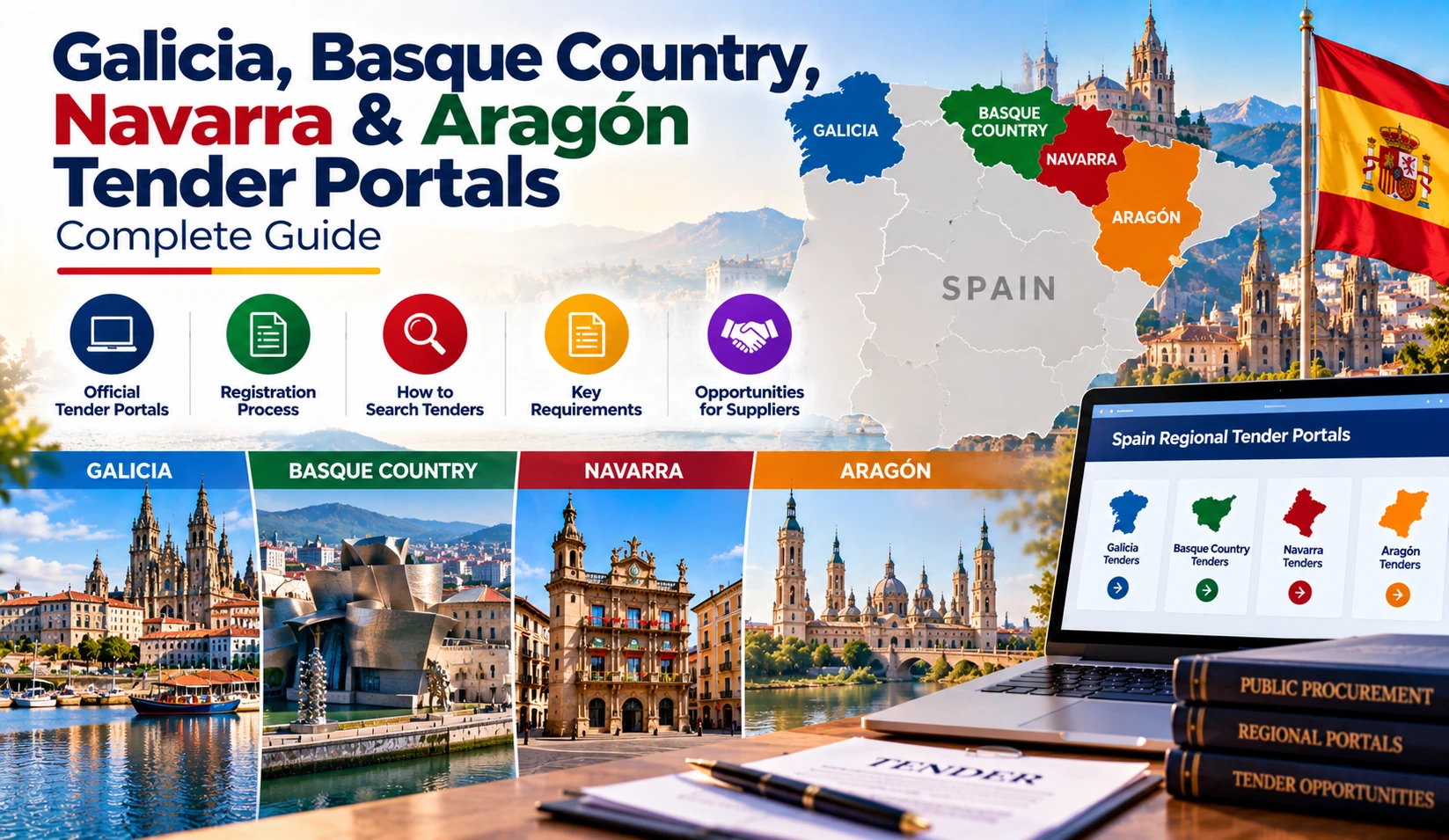
Galicia, Basque Country, Navarra & Aragón Tender Portals: Complete Guide
19 Oct 2026
Introduction Spain's regional procurement systems offer access to government contracts issued by autonomous communities, municipalities, public agencies, healthcare organisations, universities and other public sector entities. For suppliers seeking opportunities beyond the national procurement platform, understanding the regional portals can improve tender discovery and help identify buyers with recurring requirements. Four regions with distinct procurement environments are Galicia, the Basque Country, Navarra and Aragón. Each provides official procurement information, but the portal structure, terminology, electronic submission arrangements and regional administrative requirements differ. This guide explains where to find public tenders in these four regions, how to search by contracting authority and CPV code, how to locate tender documents and contract awards and what suppliers should check before submitting an offer. Table of Contents Why Regional Tender Portals Matter Galicia Public Tender Portal How to Search Galicia Tenders SILEX and Electronic Tendering in Galicia Basque Country Public Tender Portal How to Search Euskadi Tenders KontratazioA and Electronic Bidding Navarra Public Tender Portal How to Search Navarra Tenders PLENA Electronic Tendering in Navarra Aragón Public Tender Portal How to Search Aragón Tenders Aragón Contractor Register Compare the Four Regional Tender Portals How to Find Tenders Across All Four Regions Documents and Eligibility Requirements Common Regional Tender Search Mistakes How SpainTenders.com Helps Suppliers Conclusion Why Regional Tender Portals Matter Spain's public procurement market is not limited to one website. The national Plataforma de Contratación del Sector Público (PLACSP) is an important discovery source, while autonomous communities operate regional procurement services or use arrangements that connect with the national platform. Regional portals can help suppliers discover opportunities published by local and regional authorities, access the official documents and monitor changes to a procurement procedure. They are particularly useful when a business targets a specific geography or wants to identify repeat buyers in a defined sector. For regional research, suppliers should combine location-specific searches with contracting authority names, CPV codes, contract types and current submission status. Search in the relevant regional language as well as Spanish where appropriate. Galicia Public Tender Portal The official regional platform is Contratos Públicos de Galicia, available through the Xunta de Galicia's procurement services. It provides procurement notices and search tools for businesses looking for licitaciones Galicia, Xunta contracts and other public sector opportunities in the region. The portal offers access to prior notices, preliminary market consultations, tender announcements and other procurement information. Its search interface includes filters for contracting authority, CPV subject area, procedure type, contract type, procurement system and the status of the procedure. Suppliers can also find links to the Sistema de Licitación Electrónica (SILEX), the Registro General de Contratistas de Galicia and other procurement resources. The precise process for participating in a tender depends on the authority and the instructions published with the individual contract. How to Search Galicia Tenders Start with the official Contratos Públicos de Galicia search page. Use a precise product or service keyword, then refine the results with the available filters. Keyword: search for the service, product, project or works category. Contracting authority: identify Xunta departments, public bodies or other buyers. CPV classification: narrow results by the relevant Common Procurement Vocabulary category. Procedure: review the available procurement procedure filters. Status: focus on notices that are still within the offer submission period. Galician and Spanish terms may both be useful. For example, a supplier may try both “servizos informáticos” and “servicios informáticos” when searching for IT services. Open each relevant expediente to inspect the contract description, estimated value, submission deadline, award criteria and tender documents. Do not rely only on the short search result. SILEX and Electronic Tendering in Galicia SILEX is the electronic tendering system associated with Galicia's procurement services. When a tender requires electronic submission, suppliers should follow the link and technical instructions provided in the official procurement record. Before preparing the final bid, confirm the accepted electronic identification and signature method, account requirements, file formats and document-upload process. Requirements may differ between procurement procedures and systems. Galicia also provides access to its General Register of Contractors. Suppliers who regularly participate in regional procurement can review the register's purpose, eligibility conditions and current registration process. Registration should not be assumed to replace every document required by an individual tender. Always submit early enough to resolve technical issues and retain the system's evidence of successful submission. Basque Country Public Tender Portal The Basque Country's official procurement environment is Contratación Pública en Euskadi, also known through its Basque-language name, Kontratazio Publikoa Euskadin. The associated platform is commonly referred to as KPE-CPE or KontratazioA. The portal provides contracting profiles, tender announcement searches, electronic bidding services and information about the public procurement activities of authorities in the Basque Autonomous Community. The platform covers a broad network of contracting authorities, including regional, provincial and local public bodies. The official site also provides access to the Registro de Empresas Licitadoras y Clasificadas de la Comunidad Autónoma de Euskadi and public contract register information known as REVASCON. Because the Basque Country has its own regional procurement infrastructure, suppliers should check the Euskadi platform even when they already search the national PLACSP. How to Search Euskadi Tenders Use the portal's “Búsqueda de anuncios” option to locate procurement notices. Search by contracting authority, contract description or other available criteria, and filter by the status “Abierto / Plazo de presentación de ofertas” when seeking opportunities that are currently accepting bids. When you open a notice, review its contract details, contracting organisation, CPV code, place of execution, award criteria, submission location and language information. The official help pages explain how to search announcements and navigate the notice details. Basque and Spanish search terms can expand coverage. For example, suppliers may search using both “obras” and “obrak” for works-related opportunities, then verify the contract description and scope. The Basque procurement portal and PLACSP have an interoperability arrangement through which procurement notices may be presented on both platforms. Even so, suppliers should follow the official notice and submission instructions for the specific procedure. KontratazioA and Electronic Bidding The Basque procurement platform provides electronic tendering services for eligible procedures. The individual tender's administrative specifications determine whether electronic submission is mandatory and explain the process to follow. The regional site recommends that companies consider registration in the Basque Country's Register of Tenderers and Classified Companies, the national ROLECE register or the platform's internal register, as applicable. Registration can reduce repeated document requests, but the precise requirement depends on the procedure. Check digital certificate compatibility, representative authority, account access and technical requirements before starting the final submission. The official platform provides instructions, training resources and support information for companies. If bidding as a temporary union of businesses (UTE), check the platform's specific procedure for joint participation and any temporary authorisation requirements. Navarra Public Tender Portal The official Portal de Contratación de Navarra is the principal public procurement publication and transparency portal for the Chartered Community of Navarra. It provides procurement information for entities subject to Navarra's regional public contracts law. The portal includes sections for tender announcements, prior information notices, awards, cancelled or unsuccessful procedures, contract extensions, preliminary market consultations and other procurement information. Unlike the procurement environments in the other three regions, Navarra operates under its own regional public contracts legislation, including Ley Foral 2/2018, de Contratos Públicos. Suppliers should therefore pay particular attention to the applicable legal framework and the instructions in each tender. The portal also provides information about PLENA electronic tendering, supplier registration, the voluntary register of tenderers and the bodies responsible for procurement oversight and complaints. How to Search Navarra Tenders Use the portal's tender announcement search and choose the relevant procurement category. Suppliers can review current notices for works, supplies, services and concessions and access information about other public contracting activities. For a practical search: Search by the contract's description or relevant product and service terms. Identify the contracting authority and its procurement profile. Review current tender announcements and the submission period. Examine award notices to research previous procurement outcomes. Check preliminary notices and consultations for potential future demand. Use available subscriptions or alert features where useful. Navarra's portal provides information across different stages of procurement. A notice that is no longer open may still be valuable for competitor research or identifying the authority's recurring requirements. PLENA Electronic Tendering in Navarra PLENA is the electronic tendering environment referenced by Navarra's procurement portal. The portal provides routes for tenderers to register, access their private area and submit electronic offers. Suppliers should confirm which version or workflow is relevant to the particular procedure, because the official portal provides access to PLENA 2.0 and legacy PLENA resources. Follow the instructions in the procurement file rather than choosing a system independently. Check the requirements for electronic identification, signatures, documentation and final submission. Ensure that the person submitting the offer has the necessary authority and that the required files are complete. Navarra's regional framework can differ from the general state procurement regime in important respects. When assessing a tender, read the applicable *pliegos* and relevant regional legal provisions instead of assuming that every rule is identical across Spain. Aragón Public Tender Portal The Government of Aragón's Plataforma de Contratación del Sector Público de la Comunidad Autónoma de Aragón is the regional reference point for procurement information and services. The regional procurement area provides information about contracting profiles, standard administrative specifications, contractor and contract registers, centralised procurement and the regional legal framework. Aragón's procurement framework includes national legislation and the regional Ley 11/2023, de 30 de marzo, de Uso Estratégico de la Contratación Pública de la Comunidad Autónoma de Aragón. Suppliers should check which provisions and procurement instructions apply to the authority issuing a particular contract. An important operational point is that Aragón's official guidance states that, since 9 March 2018, contracting profiles for the regional public sector and participating local authorities have been hosted on the national PLACSP. As a result, suppliers should use the Aragón regional information pages to understand the system and then follow the relevant contracting profile and official publication. How to Search Aragón Tenders Start with the Government of Aragón's procurement information page to identify the relevant contracting profile, register or centralised procurement resource. For individual notices, follow the link to the appropriate profile hosted on PLACSP where applicable. Search by contract description, contracting authority, CPV code, procedure and publication status. Review the official tender record for the contract value, submission deadline, award criteria and required documents. Suppliers interested in repeat purchases should also examine Aragón's centralised procurement information. Centralised arrangements can cover goods and services that public entities require regularly, although participation rules depend on the specific framework or procurement mechanism. Aragón Contractor Register Aragón operates a regional Register of Tenderers, known as the Registro de Licitadores de Aragón. According to the regional government's guidance, registration can simplify administrative procedures by allowing certain company information and supporting documentation to be verified through the register. The register can include details such as the company's legal name, business purpose, registered address, contractor classification, representative powers, grounds affecting eligibility and annual accounts for the specified periods. Registration is generally voluntary, but Aragón's official guidance identifies simplified open procedures, including the abbreviated form, as procedures where registration in the regional register or ROLECE is required by the applicable rules at the relevant deadline. Companies should verify the current requirements for the tender they intend to enter. The register's existence does not mean that every procurement in Aragón uses identical registration rules. Compare the Four Regional Tender Portals RegionOfficial procurement environmentKey features GaliciaContratos Públicos de GaliciaSearch filters, current notices, SILEX and contractor register information Basque CountryContratación Pública en Euskadi / KPE-CPE / KontratazioAContracting profiles, announcement search, electronic bidding and tenderer register NavarraPortal de Contratación de NavarraRegional procurement publication, awards, notices, subscriptions and PLENA AragónGovernment of Aragón procurement information and relevant PLACSP profilesRegional procurement guidance, contractor register, centralised procurement and national-platform profiles The most important difference is not simply the portal's design. It is the way each region organises its contracting information, electronic bidding services and regional legal framework. Navarra has a distinct regional public contracts law, while Aragón's official guidance directs suppliers to PLACSP-hosted profiles for many contracting authorities. How to Find Tenders Across All Four Regions Suppliers that serve multiple Spanish regions should adopt a consistent discovery process rather than treating every portal as an unrelated source. Define your target categories: list the products, services and works your company can deliver. Map relevant CPV codes: include primary and related codes to reduce missed opportunities. Search regional portals: use the official search tools in Galicia, Euskadi, Navarra and Aragón. Search PLACSP: include national-platform notices and contracting profiles, particularly for Aragón. Use local terminology: try Spanish and the relevant regional language where applicable. Monitor deadlines: record the final submission date and check amendments before bidding. Review awards: use historical procurement outcomes to understand buyers and competitors. Maintain one opportunity register with the authority, region, expediente number, CPV code, estimated value, deadline, procurement platform and bid decision. This makes it easier to compare opportunities and allocate bid preparation resources. Documents and Eligibility Requirements Although the exact rules vary by procedure, suppliers commonly need to review the administrative specifications (*PCAP*), technical specifications (*PPT*), declarations, solvency evidence and electronic submission instructions. Depending on the contract, requirements may include proof of legal capacity, representative authority, financial solvency, technical experience, professional licences, insurance or certificates. Electronic signatures and platform registration may also be required. Foreign suppliers should confirm document translation and authentication requirements. Businesses operating across regions should not assume that a registration or technical workflow used for one procurement authority automatically satisfies the requirements of another. Common Regional Tender Search Mistakes Searching only PLACSP: regional portals can provide useful search tools and context even where publication is interoperable. Ignoring regional language terms: relevant opportunities may use Galician or Basque wording. Assuming all regions use the same law: Navarra has its own regional public contracts law, and Aragón has additional regional procurement legislation. Confusing a notice with a live opportunity: always check the current submission status. Overlooking electronic bidding requirements: SILEX, Euskadi's bidding services and PLENA have their own instructions. Ignoring amendments: revised documents or deadlines can change a bid's requirements. Skipping award research: past awards can reveal recurring buyers and competitive patterns. How SpainTenders.com Helps Suppliers Searching several regional portals can take time, particularly for suppliers targeting multiple sectors or regions. SpainTenders.com offers an additional discovery and research channel for businesses exploring public procurement opportunities across Spain. Suppliers can explore Spain tender listings, review contract award information, research contracting authorities and browse procurement sectors. Businesses can register with SpainTenders.com or log in to an existing account. For assistance with the platform or procurement research, use the contact page. Use SpainTenders.com alongside official regional procurement systems. Always verify the current tender notice, legal requirements, amendments and electronic submission instructions with the relevant contracting authority. Conclusion Galicia, the Basque Country, Navarra and Aragón each provide important routes into Spain's regional public procurement market. Galicia offers the Contratos Públicos de Galicia platform and SILEX; Euskadi operates its KPE-CPE procurement environment and electronic bidding services; Navarra publishes opportunities through its regional Portal de Contratación and PLENA; and Aragón combines regional procurement guidance with relevant contracting profiles hosted on PLACSP. Suppliers should understand each portal's search tools, regional terminology, registration options and electronic submission procedures. Combining regional searches with CPV classification, contracting authority research and contract award analysis can help businesses build a more complete tender pipeline. For organisations pursuing public contracts across Spain, a structured process that combines official sources with broader market research can improve opportunity discovery and help reduce missed deadlines or avoidable submission errors.
View Details
Spain Awards €6.74 Million Defence Backup Software Contract to Inetum España
19 Oct 2026
Standfirst Spain has awarded a €6,737,830 contract to Inetum España, S.A. for the renewal, migration and acquisition of software subscriptions supporting the Ministry of Defence’s I3D backup system during the 2026–2029 period. The award was published in TED notice 721858-2026 on 19 October 2026 and records a restricted procurement procedure managed by the country’s centralised procurement authority. The notice lists one tender and identifies Inetum España as a large enterprise. It also includes environmental considerations linked to reducing environmental impacts and transitioning towards a circular economy. Introduction Spain has awarded a contract worth €6,737,830 to Inetum España, S.A. for software subscriptions and related activities supporting the Ministry of Defence’s backup system. The requirement covers the renewal, migration and acquisition of new subscriptions for the base software of the I3D backup system over the 2026–2029 period. The contract award appears in TED notice 721858-2026, published in the Official Journal of the European Union’s Supplement, OJ S 202/2026, on 19 October 2026. The contracting authority is the Dirección General de Racionalización y Centralización de la Contratación-Junta de Contratación Centralizada, Spain’s central government procurement body identified in the notice. The buyer is classified as a central government authority operating in the area of general public services. The contract is classified as a supply procurement under the Common Procurement Vocabulary code CPV 48000000, covering software packages and information systems. The award notice identifies Inetum España as the successful tenderer and records the contract conclusion date as 15 October 2026. The procurement is significant for suppliers monitoring Spanish public-sector IT expenditure because it combines software subscription renewal with migration and the acquisition of additional subscriptions. However, the notice does not identify the software product, subscription quantities, technical architecture or the detailed allocation of the contract value between renewal, migration and new subscriptions. Why This Contract Matters Backup software is an important component of information technology operations because organisations use it to support the protection and recovery of data. For a defence ministry, the continuity and reliability of information systems can be particularly important. Nevertheless, the TED notice provides only a general description of the I3D backup system and does not disclose its technical configuration, operational scope or specific recovery requirements. The procurement’s 2026–2029 title indicates that the requirement covers a multi-year period. The stated activities include renewing existing subscriptions, migrating software and obtaining new subscriptions. These activities can involve different commercial and technical requirements, but the published award notice does not provide a detailed breakdown of the work or the products involved. The contract also demonstrates the role of centralised purchasing in Spanish government procurement. Rather than naming a separate military unit as the buyer, the notice identifies the Junta de Contratación Centralizada through the Dirección General de Racionalización y Centralización de la Contratación. This makes the award relevant to companies tracking procurement managed by central government purchasing bodies. For market analysts, the award provides a documented contract value, supplier name, procurement method and software classification. It should not, however, be treated as a benchmark for all defence backup software contracts because the notice does not disclose the exact product or the number of subscriptions purchased. Contract Timeline The award notice records the conclusion of the contract on 15 October 2026. The notice was dispatched on 16 October 2026 and published on 19 October 2026 in OJ S 202/2026. The main dates published in the notice are: 15 October 2026: Contract concluded with Inetum España, S.A. 16 October 2026: Award notice dispatched for publication. 19 October 2026: TED notice 721858-2026 published in OJ S 202/2026. 2026–2029: Period referenced in the procurement title for the renewal, migration and acquisition of new software subscriptions. The notice does not provide a separate software delivery date, implementation milestone, start date, end date or detailed migration schedule. Although the procurement title refers to the 2026–2029 period, the published record does not specify the exact dates within that period or explain how the subscription and migration activities will be phased. The notice identifies a previous notice by the identifier 22a14bcd-1b69-4747-a679-62dfd5a199d8-01. The available award notice does not reproduce the full contents of that earlier notice, so the original procurement timetable and any earlier-stage details should be checked against the associated procurement record. Contract Overview The contract concerns the renewal, migration and acquisition of new subscriptions for the base software of the Ministry of Defence’s I3D backup system. The Spanish title explicitly associates the procurement with the Ministry of Defence and its Subdirección General de Contratación de Tecnologías de la Información y de las Comunicaciones (TIC), although the formal buyer recorded in the notice is the centralised procurement authority. The procurement is classified as a supply contract, with CPV 48000000 used as the main classification. The place of performance is recorded as Madrid, Spain. The legal basis listed in the notice is Directive 2014/24/EU, and the procedure type is restricted. The total value of the contract awarded in the notice is €6,737,830. The same amount is recorded as the value of Inetum España’s tender. The notice identifies the contract under the identifier A4484/2026 and lists no subcontracting for the successful tender. The procurement is not financed with European Union funds. The notice indicates that the procurement is covered by the Government Procurement Agreement. It also states that there is no framework agreement and no dynamic purchasing system associated with this award. Key Contract Details DetailPublished information TED notice number721858-2026 Official Journal issueOJ S 202/2026 Publication date19 October 2026 Contracting authorityDirección General de Racionalización y Centralización de la Contratación-Junta de Contratación Centralizada End-user context in titleSpanish Ministry of Defence Contract titleRenewal, migration and acquisition of new subscriptions for the base software of the Ministry of Defence’s I3D backup system, 2026–2029 Contract natureSupplies Main CPV48000000 – Software package and information systems ProcedureRestricted Successful supplierInetum España, S.A. Supplier sizeLarge enterprise Contract value€6,737,830 Number of tenders received1 Contract identifierA4484/2026 Contract conclusion date15 October 2026 EU fundingNo Government Procurement Agreement coverageYes Framework agreementNo Dynamic purchasing systemNo Environmental objectiveReduction of environmental impacts, with transition to a circular economy identified as the approach Project Scope The published title identifies three principal activities: renewal of software subscriptions, migration and acquisition of new subscriptions. These activities relate to the base software used by the I3D backup system of Spain’s Ministry of Defence. Subscription renewal typically concerns continued access to software under an existing commercial arrangement. Migration refers to moving software, services or associated configurations from one environment or arrangement to another. The acquisition of new subscriptions indicates an additional requirement beyond renewal. These are general descriptions of the activities named in the notice, not a substitute for the procurement’s detailed technical specification. The notice does not state the name of the software vendor or product. It also does not disclose subscription volumes, licence types, server or storage capacity, the number of systems covered, migration destinations, service levels or support response times. There is no published cost allocation separating renewal, migration and new subscriptions. As a result, the award value cannot be reliably converted into a per-licence cost or annual software expenditure. Such calculations would require information about the subscription quantities, commercial terms and contract period. The title’s 2026–2029 reference provides a broad timeframe but does not establish the exact billing or delivery schedule. About the Contracting Authority The formal contracting authority is the Dirección General de Racionalización y Centralización de la Contratación-Junta de Contratación Centralizada. The notice classifies the organisation as a central government authority whose main activity is general public services. The authority is based in Madrid, postcode 28014. Its published contact email is secretaria.contratacioncentralizada@hacienda.gob.es, and its telephone number is +34 915958100. The notice includes a buyer profile on Spain’s Public Sector Procurement Platform. The procurement title refers to the Ministry of Defence and its information and communications technology contracting subdirectorate. That wording provides the context for the requirement, while the formal buyer field identifies the centralised procurement authority. The notice does not separately identify the individual operational unit responsible for administering the backup system after the award. Businesses tracking similar public-sector opportunities can monitor new notices through the SpainTenders tender listings and review completed awards through the SpainTenders contract awards section. About the Organisations Involved Inetum España, S.A. is the successful tenderer. The award notice classifies the company as a large enterprise and records its registration number as A28855260. Its address is in Madrid, postcode 28050. The published email address is iconecta@inetum.world, and the telephone number is 913874700. The tender identifier is REF TEN-0001/LOT-0000, and the relevant lot is LOT-0000. The tender value is recorded as €6,737,830. The notice states that subcontracting was not indicated for the successful tender. The award record does not identify the software publisher, any separate technology manufacturer or other companies involved in delivering the subscriptions. It would therefore be inappropriate to assume from the award alone that Inetum España developed the software or owns the underlying product. The notice establishes the company as the successful tenderer, not necessarily as the software manufacturer. Dirección General de Racionalización y Centralización de la Contratación-Junta de Contratación Centralizada is the buyer named in the notice. Its role is to conduct the procurement recorded in the award notice. The procurement title associates the requirement with the Ministry of Defence’s I3D backup system, but the formal contracting authority and the end-user context should not be treated as interchangeable. Tribunal Administrativo Central de Recursos Contractuales (TACRC) or Tribunal Superior de Justicia (TSJ) is identified in the notice as the review organisation or organisations for procurement-related challenges. The notice refers readers to the relevant appeal information rather than providing a specific review deadline in the available field. Procurement Analysis The award was conducted through a restricted procedure. In a restricted procedure, participation is structured around a selection stage followed by an invitation for selected candidates to submit tenders. The notice identifies the procedure type but does not provide a complete account of the selection process, the number of candidates initially considered or the criteria used to shortlist participants. The award notice records one tender received. It separately identifies the tender as electronically submitted and lists one tender under the general tender count. The statistical section also contains a field for tenders from micro, small or medium-sized tenderers with a count of zero. This does not conflict with the named award winner’s classification as a large enterprise, but it means the count should not be reported as one SME tender. The award criteria section lists two criteria, both classified as quality and each assigned a weight of 50 points. One description refers to automatically quantifiable criteria defined in the tender documents, while the other refers to criteria assessed through judgement, also defined in those documents. The notice does not separately list a price criterion in the displayed award-criteria fields. Consequently, the published record supports reporting two quality-related criteria at 50 points each, but it does not provide the detailed scoring methodology or the actual evaluation scores. The full tender documents would be needed to understand the specific metrics, scoring rules and how the final result was calculated. The notice also records that the tender was not ranked, using the published ranking indicator. This field should be preserved as part of the record, rather than interpreted as evidence that the contract lacked an evaluation or that no award decision was made. The notice explicitly identifies Inetum España as the winner and provides the contract value and conclusion date. Additional Procurement Facts The procurement’s internal identifier is CEA4484/2026, and the procedure identifier is e79f073a-bbcd-4d2c-a82f-94ebccf42b59. The notice also references a previous notice identifier, 22a14bcd-1b69-4747-a679-62dfd5a199d8-01. The contract is not part of a framework agreement and does not use a dynamic purchasing system, according to the published notice. It is also recorded as not being financed by EU funds, while the Government Procurement Agreement coverage field is marked “yes”. The strategic procurement section identifies the reduction of environmental impacts as an objective. It names the transition to a circular economy as the approach to reducing environmental impacts. A social objective field is also present and marked “Other”, but the notice does not explain what that category means in practice. These fields indicate that environmental considerations were included in the procurement record. They do not disclose specific environmental performance requirements, sustainability targets, product lifecycle conditions or measurable outcomes. Any claim about the contract’s actual environmental benefits would require further supporting documentation. Market and Industry Perspective The award is relevant to the market for enterprise software subscriptions, backup systems and public-sector IT support. The procurement combines continued subscription access with migration and new subscription acquisition, suggesting that the buyer required more than a simple renewal. The notice does not, however, identify the product or the technical changes involved. For suppliers, the CPV classification 48000000 is the main published category to monitor. It covers software packages and information systems and may be used across a wide range of public-sector technology purchases. It should therefore be combined with specific search terms relating to backup software, subscription renewal, software migration, data protection and public-sector IT services to identify more closely related opportunities. The award to a large enterprise is a factual feature of this procurement. It does not establish that only large suppliers can compete for similar requirements, nor does the notice explain whether company size influenced the evaluation. The result is also based on one tender, meaning the published record does not provide a meaningful comparison of competing prices or technical proposals. Centralised procurement can be relevant to suppliers because it creates a route through which government purchasing requirements are managed by a designated central authority. However, this notice does not establish that future backup software purchases will use the same procedure or be awarded through the same authority. Companies should monitor new procurement notices rather than assume the current arrangement will continue unchanged. Economic Significance The contract value of €6,737,830 provides a financial reference for this specific software subscription, migration and acquisition requirement. The notice records the same value as both the total awarded amount and the successful tender value. The publication does not provide a breakdown of expenditure between existing subscription renewals, migration activities and new subscriptions. It also does not state annual payments, the number of licences or any separately priced implementation services. The total value should therefore not be divided evenly across the 2026–2029 period without evidence of the contractual payment schedule. The award demonstrates a procurement commitment by a Spanish central government authority connected to the Ministry of Defence’s backup software system. It does not, on its own, establish the contract’s impact on public-sector productivity, supplier employment or the wider software market. Those conclusions would require additional information about delivery, usage and performance. Future Procurement Opportunities The award may help suppliers identify the types of software requirements that Spanish public-sector buyers procure, including subscription renewals, migration and additional software access. It does not announce a follow-on tender, an extension, a renewal option or a new competition after the 2026–2029 period. Suppliers should monitor notices from the centralised procurement authority and other public-sector buyers for opportunities involving backup software, data protection, infrastructure software and subscription management. Searches should use both CPV classifications and descriptive keywords, since similar requirements may be categorised differently depending on the primary purpose of the contract. Businesses should also distinguish between a contract award notice and an open opportunity. TED notice 721858-2026 reports a completed award; it is not an invitation for suppliers to submit tenders for this same contract. For ongoing market monitoring, suppliers can use the SpainTenders tender search and consult the contract awards database to review comparable results and purchasing patterns. Opportunities for Suppliers Software vendors, resellers, systems integrators and IT service providers can use the award as a reference point when tracking Spanish public-sector software procurement. Companies involved in backup platforms or software migration may find the subject relevant, although the notice does not identify the product or establish which technical capabilities were decisive. Suppliers preparing for similar competitions should maintain clear documentation of their software licensing arrangements, migration experience, support capacity and ability to meet any security or continuity requirements stated in the procurement documents. These are general preparation measures; the notice itself does not publish the detailed technical requirements for this contract. Companies should review the tender documents for evaluation criteria before deciding whether to participate. The award notice lists two quality criteria with weights of 50 points each but does not disclose their detailed scoring rules. It would be premature to assume that future competitions will use the same balance or criteria. Businesses can register with SpainTenders to support their procurement monitoring, or log in to access their account. For platform-related assistance, the SpainTenders contact page provides a point of contact. What Businesses Should Watch Several details in the award notice are particularly relevant to suppliers and procurement analysts. One tender received: The notice records one tender. This limits the published evidence available for comparing prices and technical proposals. Restricted procedure: The procurement used a restricted procedure. The notice does not provide the full candidate-selection record or the number of candidates initially considered. Quality criteria: Two quality-related criteria are each assigned 50 points. Their detailed descriptions and scoring methods are stated to be in the tender documents. Software product not identified: The notice does not name the backup software product, its publisher or the specific subscription types purchased. 2026–2029 timeframe: The period appears in the procurement title, but exact implementation dates, annual payments and delivery milestones are not specified in the award notice. Environmental objective: The notice identifies reduction of environmental impacts and a transition to a circular economy, but it does not disclose measurable targets or specific performance requirements. Contract award status: The notice records the contract as concluded on 15 October 2026. It is a result notice, not a live tender invitation. SpainTenders Procurement Intelligence From a procurement intelligence perspective, the award offers a structured record of Spanish public-sector spending on software subscriptions and backup-system support. The contracting authority, successful supplier, contract value, CPV classification and procedure type can be used to track related procurement activity over time. The award value of €6,737,830 is a useful reference point for this specific contract. However, because the notice does not identify the software product, subscription volumes or cost breakdown, the figure cannot be used reliably as a per-licence benchmark or as an annual expenditure estimate. The restricted procedure and single-tender result are also relevant to interpreting the procurement. The notice records the process type and number of submissions, but does not disclose enough information to determine the size of the potential supplier pool or explain why only one tender was received. Those questions require additional procurement records. The award criteria fields deserve careful handling in structured data analysis. The notice lists two quality criteria, each weighted at 50 points, with descriptions referring to criteria defined in the tender documents. It does not provide the detailed scoring rules or a separate price criterion in the displayed fields. An accurate procurement summary should preserve those details rather than assume a conventional price-quality split. The environmental procurement fields also create a potential monitoring signal. The stated objective is to reduce environmental impacts, with a transition to a circular economy listed as the approach. Yet the award notice does not specify measurable outcomes, so the presence of the field should not be interpreted as proof of a particular environmental benefit. For suppliers, the most practical use of this result is to monitor the centralised procurement authority and related software categories, identify comparable awards and prepare for future opportunities where technical requirements are published. It is a record of a completed contract, not confirmation that another competition is planned. Supplier Takeaways Spain awarded a €6,737,830 contract to Inetum España, S.A. for software subscriptions and related activities supporting the Ministry of Defence’s I3D backup system. The procurement covers renewal, migration and acquisition of new subscriptions during the period referenced as 2026–2029. The formal contracting authority is the Dirección General de Racionalización y Centralización de la Contratación-Junta de Contratación Centralizada. The procurement used a restricted procedure and the notice records one tender. Inetum España is classified as a large enterprise in the award notice. The award criteria section lists two quality criteria, each weighted at 50 points, with detailed rules contained in the tender documents. The notice identifies environmental impact reduction and a transition to a circular economy as strategic procurement considerations. The software product, subscription quantities, cost allocation and detailed delivery schedule are not disclosed in the award notice. Key Takeaways Contract value: €6,737,830. Successful supplier: Inetum España, S.A. Procurement subject: Renewal, migration and acquisition of new subscriptions for the Ministry of Defence’s I3D backup system base software. Procurement period in title: 2026–2029. Contracting authority: Dirección General de Racionalización y Centralización de la Contratación-Junta de Contratación Centralizada. Procedure: Restricted. Tenders received: One. Contract conclusion date: 15 October 2026. Notice publication date: 19 October 2026, OJ S 202/2026. Environmental consideration: Reduction of environmental impacts through a transition to a circular economy. Conclusion Spain’s award of a €6.74 million contract to Inetum España marks a significant software procurement connected to the Ministry of Defence’s I3D backup system. The contract covers subscription renewal, migration and the acquisition of new subscriptions for the 2026–2029 period identified in the procurement title. The award was managed by the centralised procurement authority through a restricted procedure, with one tender recorded in the published notice. The result provides useful information for suppliers tracking Spanish public-sector IT procurement, including the successful company, contract value, procedure type and environmental procurement fields. However, the notice does not identify the software product, subscription volumes, detailed implementation schedule or allocation of costs. It also does not provide the complete scoring methodology behind the two quality criteria. Businesses should use the award as a factual market reference, consult the associated procurement documents for technical detail and monitor future notices rather than infer a forthcoming competition from this result alone. Source TED – Tenders Electronic Daily, contract or concession award notice 721858-2026, “Spain – Software package and information systems – Renovación, Migración Y Adquisición De Nuevas Suscripciones Del Software Base Del Sistema De Backup De La I3d Del Ministerio De Defensa 2026-2029”, published in OJ S 202/2026 on 19 October 2026. Official notice: https://ted.europa.eu/en/notice/-/detail/721858-2026 Contracting authority buyer profile: Spain’s Public Sector Procurement Platform.
View Details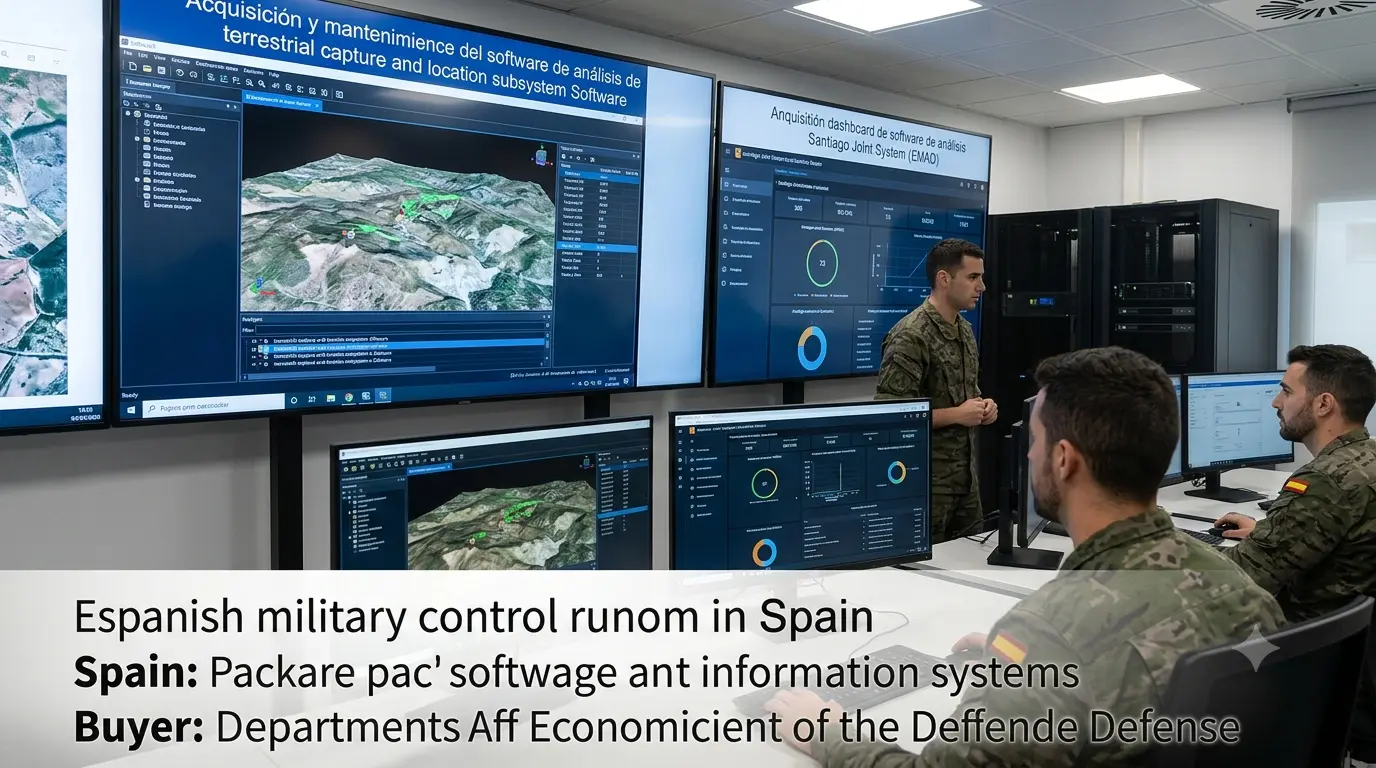
Spain Awards €3.47 Million Defence Intelligence Software Contract to SIADDE SOLUCIONES
16 Oct 2026
Standfirst Spain’s defence procurement authority has awarded a €3.47 million contract to SIADDE SOLUCIONES, S.A. for analytical software intended to complement the ground collection and location subsystems of the Sistema Conjunto Santiago. The contract was awarded through a negotiated procedure without prior publication, with the contracting authority citing technical reasons and the absence of competition as the justification. The award notice records one tender and identifies the winning company as a micro, small or medium-sized enterprise. Published on 16 October 2026, the notice provides the award value and procurement classification but does not disclose detailed software specifications or a contract duration. Introduction Spain has awarded a defence-related software supply contract valued at €3,468,670.53 to SIADDE SOLUCIONES, S.A., according to contract award notice 718143-2026 published in the Official Journal of the European Union’s Supplement to the Official Journal, issue OJ S 201/2026, on 16 October 2026. The contracting authority is the Jefatura de Asuntos Económicos del Estado Mayor de la Defensa, the economic affairs office of Spain’s Defence Staff. The authority is classified in the notice as a central government body whose main activity is defence. The procurement concerns the acquisition and ongoing support of analytical software designed to complement the ground collection and location subsystems associated with the Sistema Conjunto Santiago, identified in the notice with the acronym EMAD. The award is relevant to suppliers operating in defence software, electronic intelligence systems, systems integration and associated installation services. However, the notice provides only a high-level description of the requirement. It does not identify the software product, disclose its technical architecture, specify the number of licences or installations, or detail the precise support arrangements included in the contract. The notice records a negotiated procedure without prior call for competition. Its stated justification is that the contract can be supplied only by a particular economic operator because of an absence of competition for technical reasons. This is an important feature of the award and should be considered separately from the contract’s financial value. Why This Contract Matters The contract concerns software supporting a defence intelligence capability rather than a general-purpose information technology purchase. The official procurement classification includes software packages and information systems under CPV 48000000, with electronic intelligence systems under CPV 35721000 and installation services, excluding software, under CPV 51000000. These classifications indicate that the procurement sits at the intersection of specialised software and defence-related technical systems. The stated objective is to complement existing ground collection and location subsystems. That wording suggests an integration requirement, but the notice does not explain the system’s operational functions or the precise capabilities being added. It would therefore be inappropriate to infer specific surveillance, targeting, geolocation or data-processing functions beyond the description supplied by the contracting authority. The award also illustrates a procurement route used where the buyer considers that technical circumstances prevent effective competition. Unlike an open tender or a negotiated procedure preceded by a call for competition, this award notice records no prior competitive call. The authority’s justification is stated in the published record, but the notice does not provide a detailed technical assessment explaining why alternative suppliers could not meet the requirement. For companies considering Spain’s defence procurement market, the case highlights the importance of understanding incumbent systems, compatibility requirements and the legal grounds used for restricted procurement. It does not establish that the same justification would apply to future contracts or that other suppliers are generally excluded from this market. Contract Timeline The published notice provides several key dates in the award process. The notice was dispatched on 15 October 2026 and published on 16 October 2026. The contracting authority records 17 September 2026 as the date on which the winner was selected and 13 October 2026 as the date on which the contract was concluded. The available timeline is as follows: 17 September 2026: SIADDE SOLUCIONES was selected as the winning tenderer. 13 October 2026: The contract was concluded, according to the award notice. 15 October 2026: The contract award notice was dispatched for publication. 16 October 2026: Notice 718143-2026 appeared in OJ S 201/2026. The notice does not provide a contract commencement date, delivery deadline, implementation schedule or end date. It also does not state a duration for software support or maintenance. Suppliers and market analysts should avoid assuming that the contract began on the conclusion date or that the award value is spread over a particular number of years. Contract Overview The procurement title, translated from Spanish, concerns the acquisition and support of analytical software to complement the ground collection and location subsystems belonging to the Sistema Conjunto Santiago associated with EMAD. The contract is classified as a supply contract. Its main CPV classification is 48000000, covering software packages and information systems. The additional classifications are CPV 35721000 for electronic intelligence systems and CPV 51000000 for installation services, excluding software. The procurement took place in Madrid, Spain, as recorded by the notice’s place-of-performance information. The notice identifies Directive 2014/24/EU as its legal basis, while the stated award procedure is a negotiated procedure without prior call for competition. The notice also contains a specific reference to Article 44.2(e) of Spain’s LCSPDS in the contracting authority’s explanation of the procedure. The procurement was not financed with European Union funds. The notice indicates that the Government Procurement Agreement does not cover this procurement. It also records no framework agreement and no dynamic purchasing system. These details distinguish the contract from recurring purchasing arrangements through which multiple orders or subsequent awards may be made. Key Contract Details DetailPublished information TED notice number718143-2026 Official Journal issueOJ S 201/2026 Publication date16 October 2026 Contracting authorityJefatura de Asuntos Económicos del Estado Mayor de la Defensa CountrySpain Place of performanceMadrid, Spain Contract titleAcquisition and support of analytical software for the Sistema Conjunto Santiago ground collection and location subsystems Contract natureSupplies Main CPV48000000 – Software package and information systems Additional CPVs35721000 – Electronic intelligence system; 51000000 – Installation services, except software ProcedureNegotiated without prior call for competition Awarded supplierSIADDE SOLUCIONES, S.A. Supplier classificationMicro, small or medium-sized enterprise Reported contract value€3,468,670.53 Number of tenders received1 Winner selected17 September 2026 Contract concluded13 October 2026 Framework agreementNo EU fundingNo Project Scope The stated scope combines the acquisition of analytical software with its support. The software is intended to complement the ground collection and location subsystems associated with the Sistema Conjunto Santiago. The title therefore indicates that the requirement is linked to an existing defence system rather than being described as a standalone software purchase. The inclusion of electronic intelligence systems and installation services in the CPV classifications provides further context about the procurement’s technical category. However, CPV codes identify the general subject matter of a contract and should not be treated as a complete technical specification. The published notice does not specify the software manufacturer, product name, deployment architecture, number of users, hardware requirements, licensing model, service-level commitments or exact support period. It does not provide a bill of quantities, a detailed implementation plan or a breakdown between software acquisition, installation and ongoing support costs. For that reason, suppliers should not use this award notice alone to estimate the precise technical requirements of the project. The contracting authority’s procurement documents, where available, would be needed to establish the detailed deliverables and any proprietary compatibility conditions. About the Contracting Authority The contracting authority is the Jefatura de Asuntos Económicos del Estado Mayor de la Defensa. The notice classifies it as a central government authority operating in the defence sector. Its recorded location is Madrid, postcode 28006, Spain. The authority’s contact email is emadjaecontratacion@oc.mde.es, and its telephone number is 917455088. The notice also lists a buyer profile on Spain’s Public Sector Procurement Platform, providing a route for suppliers to locate the authority’s procurement information. As the purchasing body identified in the notice, the authority is responsible for the reported award. The published record does not separately identify a technical end-user organisation, software operator or individual military unit that will receive the system. Such roles should not be inferred from the name of the procurement alone. Businesses interested in related Spanish public-sector opportunities can monitor new notices through the SpainTenders tender listings and review completed procurement activity through its contract awards section. About the Organisations Involved SIADDE SOLUCIONES, S.A. is the successful tenderer named in the award notice. The notice identifies the company as a micro, small or medium-sized enterprise and records its address in Madrid, postcode 28041. Its registration number is A81286759. The contact email published in the notice is siadde@siadde.es, and the listed telephone number is +034 915003829. The supplier’s tender identifier is REF TEN-0001/LOT-0000. The notice records the tender value as €3,468,670.53, matching the total value of all contracts awarded in the notice. It also states that subcontracting was not indicated for this tender. The notice identifies the beneficial owner’s nationality as Spanish. It does not provide further information about the company’s software portfolio, subcontractor arrangements beyond the reported response, technical partners or role in developing the Sistema Conjunto Santiago. TACRC Tribunal Administrativo Central de Recursos Contractuales is listed as the review organisation. Its published contact details include an address in Madrid and the email tribunal_recursos.contratos@minhap.es. The notice refers to Article 50 of Spain’s LCSP for information on review deadlines. Procurement Analysis The most significant procedural feature is the use of a negotiated procedure without prior publication. The notice gives the justification as an absence of competition for technical reasons because the contract can be provided only by a particular economic operator. It additionally references Article 44.2(e) of the LCSPDS in the Spanish-language explanation. This route differs from an open procedure in which interested suppliers can submit tenders following a published call. In a procedure without prior competition, the justification for not publishing such a call is central to understanding the procurement record. The notice states the authority’s reason, but does not reproduce a detailed technical case demonstrating why other suppliers could not provide an acceptable solution. The reported submission count is one tender. That figure is consistent with the notice’s description of the result but does not, by itself, establish the full extent of the supplier market or prove that no alternative products exist. The procedure type and the stated technical justification are the more direct indicators of how the award was conducted. The notice also records price as the award criterion, weighted at 100 points. It does not publish a separate quality score, a multi-criteria scoring table or a comparative evaluation of competing offers. Given that one tender was recorded, the published data does not allow a meaningful comparison of winning and losing prices. There is an important data-quality caveat. The notice lists the lowest and highest admissible tender values as €0.00, while separately recording the winning tender and total awarded contract value as €3,468,670.53. These entries are inconsistent if interpreted as the actual price range for the awarded contract. The zero values should therefore not be presented as evidence that the software was supplied free of charge or that the contract was awarded at no cost. Additional Procurement Facts The contract carries internal identifier 2026/SP02002001/00001361E. The procedure identifier recorded in the notice is dfcb052b-12b9-4cbd-a1aa-1c07e42ad688. The notice also carries a separate publication identifier and version information, including notice version 01. The procurement was not divided into multiple lots in the published result. The single lot is identified as LOT-0000. The award record indicates that at least one winner was chosen, with SIADDE SOLUCIONES identified as the successful supplier. The notice states that the procurement was not financed by EU funds and was not covered by the Government Procurement Agreement. It records no strategic procurement designation, no framework agreement and no dynamic purchasing system. The environmental-impact and social-objective fields each contain the category “Other”, but the notice does not explain what measures those entries represent. The review organisation is identified as the TACRC Tribunal Administrativo Central de Recursos Contractuales. The notice refers to the applicable Spanish legal provision for review deadlines rather than specifying a precise number of days within the published text. Market and Industry Perspective The award falls within a specialised segment of public-sector technology procurement where software must complement existing systems and operate within a defence environment. Such contracts may involve compatibility, configuration, installation and ongoing support requirements that differ from standard commercial software purchases. In this particular case, however, the notice does not publish enough technical detail to determine which specific requirements shaped the supplier selection. The use of CPV 48000000 alongside CPV 35721000 and CPV 51000000 gives suppliers several classification routes for identifying comparable procurement notices. Companies that monitor only broad software categories may miss opportunities classified primarily under defence equipment or installation services. Conversely, a CPV match should be treated as an initial discovery signal, not proof that a new tender will have the same technical scope. The award to an SME is also a notable data point. It demonstrates that the successful operator is classified as a micro, small or medium-sized enterprise in this notice. It does not establish that SMEs generally have an advantage in defence intelligence procurement or that the same eligibility conditions will apply to future requirements. For market intelligence teams, the award can be used to track a contracting authority, supplier, subject category and procedure type. The value of that tracking increases when the award is compared with other published notices, while keeping differences in technical scope and procurement route clear. Economic Significance The reported contract value of €3.47 million represents the financial scale recorded for this specific software supply and support award. The notice does not provide a cost breakdown, payment schedule, annual expenditure forecast or distinction between initial acquisition costs and recurring support charges. It is therefore not possible to determine from the notice alone how the value will be distributed across software licensing, installation, maintenance or other services. Nor does the published record establish the contract’s effect on the supplier’s revenue, employment or wider Spanish defence technology market. For procurement analysts, the value is most useful as a reference point for a single awarded contract. It should not be treated as a market-wide estimate for analytical software or electronic intelligence systems. Any comparison with other defence software awards would require attention to differences in scope, delivery periods, support obligations and procurement conditions. Future Procurement Opportunities The award may be relevant to suppliers monitoring future requirements for defence software, system support, electronic intelligence technology and installation services in Spain. However, the notice does not announce a follow-on procurement, an extension, a planned renewal or a future competition related to the Sistema Conjunto Santiago. Suppliers should watch for notices from the same contracting authority and use the CPV classifications in this award as part of a broader search strategy. Related opportunities may be published under software, electronic intelligence or technical installation categories, depending on the buyer’s description of the requirement. Businesses should also distinguish between a result notice, which records an award already made, and a future tender notice inviting suppliers to compete. This publication is a contract award notice and does not itself provide an opportunity to submit a new bid. Companies can use the SpainTenders tender search to monitor relevant opportunities and the contract awards database to follow comparable procurement outcomes. Opportunities for Suppliers For suppliers seeking to enter or expand within Spain’s defence technology market, this award provides information about the buyer, the procurement subject and the supplier selected. It does not, however, establish an open route to participate in the awarded contract or identify any subcontracting opportunity. Software developers and systems integrators can use the published CPV codes to identify potentially related notices. Companies specialising in technical support may also monitor procurement descriptions that refer to sustaining or complementing existing information systems. These are search and market-monitoring approaches rather than evidence of a confirmed upcoming requirement. Suppliers should prepare for defence procurement by maintaining accurate company records, documenting relevant technical capabilities and reviewing the applicable procurement documents for each new opportunity. Where a requirement involves an existing system, businesses should pay particular attention to compatibility, intellectual property, security, integration and support provisions if these are specified in the tender documentation. Businesses can register with SpainTenders to support their tender-monitoring workflow, or log in to access their account. For assistance with the platform, suppliers can use the SpainTenders contact page. What Businesses Should Watch Several points deserve attention when interpreting this award and monitoring similar contracts. Technical justification: The authority cites an absence of competition for technical reasons. Suppliers should review the stated basis carefully and avoid assuming that the same justification will govern future procurement. Limited tender participation: The notice records one tender. This is a fact about the reported procedure, not proof that no other company could offer related software. Zero-value tender-range fields: The published lowest and highest admissible tender values are both €0.00, despite the winning tender being valued at €3,468,670.53. These fields should be treated as an apparent reporting inconsistency. Missing technical detail: The notice does not identify the software product, licensing model, detailed deliverables or duration of support. Those details cannot be reliably inferred from the CPV codes. Contract duration and delivery: No commencement date, delivery deadline or contract end date is stated in the notice. Suppliers should not assume a delivery or support schedule. Future market signals: Comparable notices from the same authority may help suppliers understand subsequent requirements, but a future competition should not be assumed from this award alone. SpainTenders Procurement Intelligence From a procurement intelligence perspective, the award provides a useful record of a specialised Spanish defence software purchase. The contracting authority, winning supplier, reported value, CPV classifications and procedure type can all be used to build a structured procurement profile. These attributes can help businesses identify relevant authorities and compare contract awards over time. The procedure is particularly relevant to analysis of restricted procurement. The notice expressly states that the contract was negotiated without prior publication and attributes the approach to technical reasons and the absence of competition. For procurement monitoring, this distinction matters because an award notice published after contract conclusion is not equivalent to an open tender inviting bids. The one-tender result also needs context. A low submission count can be relevant to market analysis, but it should not be interpreted in isolation as evidence of market concentration or supplier capability. In this case, the procedure itself was conducted without a prior call for competition, which is essential context when interpreting the number of submissions. The discrepancy between the recorded contract value and the zero-value admissible tender range is another important intelligence point. Automated procurement systems should preserve the published fields while flagging their inconsistency, rather than replacing one figure with another or using the zero values to calculate savings. The reported €3,468,670.53 is the value explicitly assigned to the awarded contract and the winning tender. For suppliers, the practical value of this notice lies in monitoring the contracting authority and related technology classifications, understanding the procurement route and maintaining awareness of similar awards. It is a historical award record, not confirmation of a new bidding opportunity or a forecast of future spending. Supplier Takeaways Spain awarded a defence analytical software contract valued at €3,468,670.53 to SIADDE SOLUCIONES, S.A. The requirement concerns software supporting ground collection and location subsystems associated with the Sistema Conjunto Santiago. The contracting authority is the Jefatura de Asuntos Económicos del Estado Mayor de la Defensa, based in Madrid. The negotiated procedure was conducted without prior publication, with technical reasons and absence of competition cited as the justification. The notice records one tender and identifies the successful supplier as an SME. Price was the stated award criterion, weighted at 100 points. The notice’s €0.00 lowest and highest admissible tender fields conflict with the reported winning tender value and should not be used as the actual contract price. No contract duration, delivery deadline, detailed technical specification or future procurement schedule is provided in the award notice. Key Takeaways Contract value: €3.47 million, as reported in TED notice 718143-2026. Successful supplier: SIADDE SOLUCIONES, S.A., a company classified as an SME. Procurement subject: Acquisition and support of analytical software for the Sistema Conjunto Santiago ground collection and location subsystems. Procedure: Negotiated without prior call for competition. Selection date: 17 September 2026. Contract conclusion: 13 October 2026. Publication: 16 October 2026, OJ S 201/2026. Important caveat: The notice contains zero-value tender-range entries that do not align with the awarded contract value. Conclusion Spain’s award of a €3.47 million analytical software contract to SIADDE SOLUCIONES highlights a specialised defence technology procurement involving software and electronic intelligence system classifications. The contracting authority selected the supplier through a negotiated procedure without prior publication, citing technical reasons and an absence of competition. The published notice records one tender and identifies the supplier as an SME. The award offers suppliers and market analysts a documented reference point for tracking Spanish defence software procurement, the relevant contracting authority and associated CPV categories. Nevertheless, the notice leaves important questions unanswered about the software’s detailed functions, implementation schedule and support duration. Its zero-value admissible tender-range entries also require caution when interpreting the financial data. Businesses should rely on the reported award value, preserve the notice’s procedural context and consult the official procurement record for any additional documentation. Source TED – Tenders Electronic Daily, contract or concession award notice 718143-2026, “Spain – Software package and information systems – Adquisición y sostenimiento de software de análisis para la complementación de los subsistemas de captación y localización terrestre perteneciente al Sistema Conjunto Santiago (EMAD)”, published in OJ S 201/2026 on 16 October 2026. Official notice: https://ted.europa.eu/en/notice/-/detail/718143-2026 Contracting authority’s buyer profile: Spain’s Public Sector Procurement Platform.
View Details