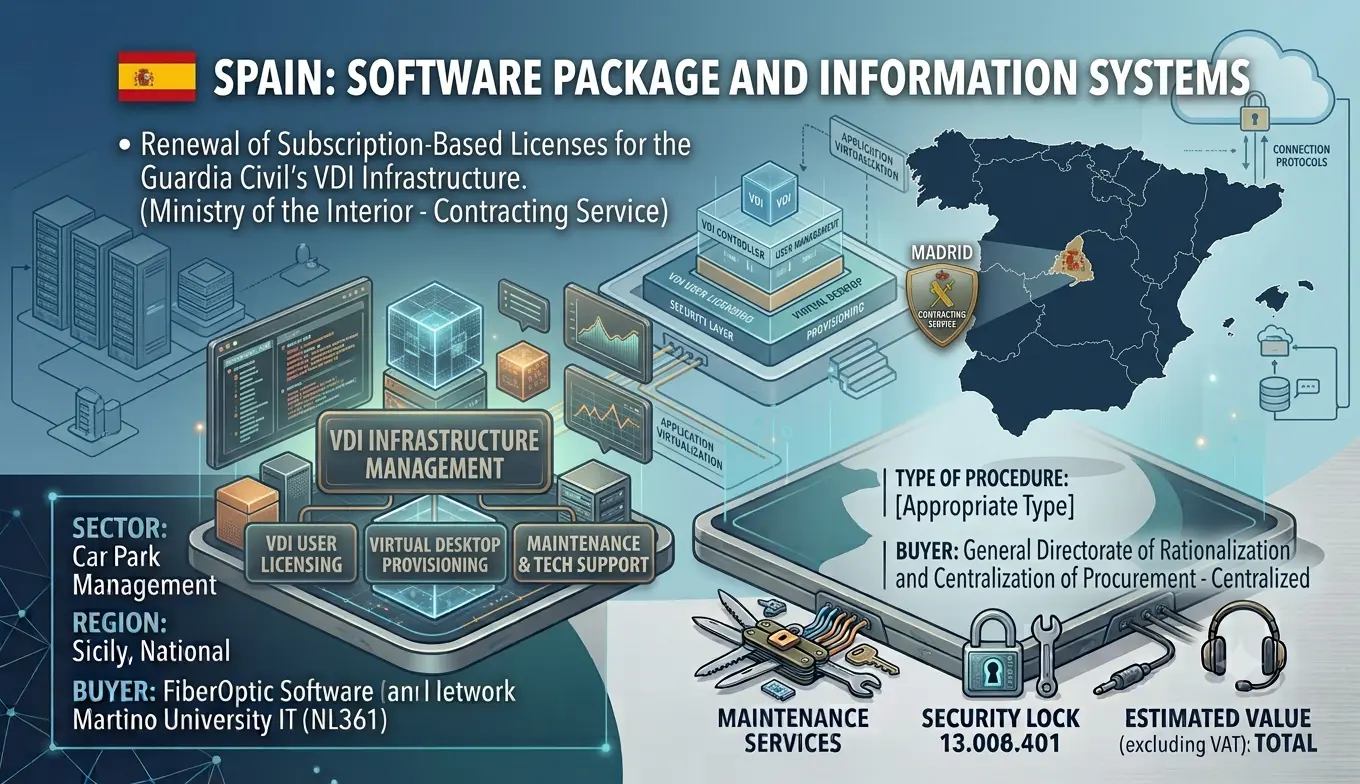
Spain's Civil Guard Renews Its Virtual Desktop Licensing in a EUR 417,501 Deal Won by Telefónica
07 Oct 2026
Standfirst Spain's centralised procurement body has awarded a contract to renew the subscription licences for the Civil Guard's Virtual Desktop Infrastructure, or VDI. The contract, worth EUR 417,501.04, went to Telefónica Soluciones de Informática y Comunicaciones de España S.A.U. Two bids were received, neither from an SME. The procurement was run as a restricted procedure under the centralised framework managed by the Dirección General de Racionalización y Centralización de la Contratación, and the winning bid came in below the estimated value. Introduction Virtual Desktop Infrastructure is one of those technologies that is invisible when it works and disruptive when it does not. A VDI system allows an organisation to run desktop environments on central servers rather than on individual physical computers. Users access their desktop remotely, from a thin client, a laptop or a mobile device. For large organisations, VDI offers centralised management, stronger security, easier updates and greater flexibility in how staff work. For a national law enforcement agency like Spain's Guardia Civil, those benefits matter. Officers and support staff need access to secure, standardised desktops across hundreds of locations, from rural barracks to headquarters buildings. Managing that estate with individual physical computers would be costly and difficult. VDI allows the agency to centralise control, enforce security policies and deploy updates across the entire organisation at once. The Spanish Civil Guard's VDI infrastructure runs on licensed software, and those licences are held on a subscription basis. The subscription must be renewed periodically to maintain access, updates and support. The Dirección General de Racionalización y Centralización de la Contratación, Spain's centralised procurement body, has now awarded a contract to renew those licences for the Civil Guard. The contract, worth EUR 417,501.04, has gone to Telefónica Soluciones de Informática y Comunicaciones de España S.A.U. Two bids were received, and the procurement was conducted as a restricted procedure under the centralised procurement framework. This article explains what was procured, who was involved, how the procurement was structured and what the award signals for suppliers in the Spanish public sector software market. Why This Contract Matters This contract matters because it keeps a critical piece of the Civil Guard's IT infrastructure running. Without valid subscription licences, the VDI platform would lose access to updates, support and possibly the right to operate. For a law enforcement agency, that is not an option. The renewal ensures continuity of a system that thousands of officers depend on. It also matters because it is a centralised procurement. The Dirección General de Racionalización y Centralización de la Contratación exists to consolidate public sector purchasing in Spain, reducing duplication and achieving better prices through scale. This contract is an example of that model in action: a single award covering the Civil Guard's VDI licences, managed centrally rather than by the agency itself. The procurement also matters because of its environmental dimension. The notice records that the contract includes a strategic procurement objective for reducing environmental impacts, specifically through a transition to a circular economy. That is a notable feature in a software licensing contract, and it suggests that the centralised procurement body is integrating sustainability criteria into its awards. Finally, the contract matters because of its competitive structure. Two bids were received, and the procurement used a restricted procedure rather than an open one. In a restricted procedure, suppliers must first be selected through a pre-qualification process before they can submit a tender. That limits the field to pre-qualified suppliers and can make competition less broad, but it also ensures that bidders meet the buyer's qualification standards. Contract Timeline Previous notice: 22a14bcd-1b69-4747-a679-62dfd5a199d8-01 Contract concluded: 1 October 2026 Notice dispatched: 6 October 2026 Notice published: 7 October 2026 Contract Overview The contract covers the renewal, on a subscription basis, of the licences for the Civil Guard's Virtual Desktop Infrastructure. It is a supplies contract, classified under CPV 48000000 (software package and information systems). It is a single-lot procurement, identified as LOT-0000, with the internal identifier CEA4226/2026. The place of performance is Madrid (ES300), Spain. The contract is not financed with EU funds. It is covered by the Government Procurement Agreement. The procurement was conducted as a restricted procedure under Directive 2014/24/EU. It is not a framework agreement and does not use a dynamic purchasing system. The awarded value is EUR 417,501.04, which was also the value of the winning tender. The notice does not disclose the estimated value of the contract, so it is not possible to compare the awarded value to the buyer's pre-tender estimate. The contract includes a strategic procurement objective for the reduction of environmental impacts, specifically through a transition to a circular economy. The notice also records a social objective promoted as "Other," but does not describe it further. Key Contract Details Notice ID 691444-2026 OJ S issue 194/2026 Publication date 7 October 2026 Contracting authority Dirección General de Racionalización y Centralización de la Contratación – Junta de Contratación Centralizada Contract type Supplies Main CPV code 48000000 – Software package and information systems Procedure type Restricted procedure Legal basis Directive 2014/24/EU Lot LOT-0000 Winner Telefónica Soluciones de Informática y Comunicaciones de España S.A.U. Winning bid EUR 417,501.04 Number of bids 2 Award criteria Quality – 50 points for automatically quantifiable criteria; 50 points for value-judgement criteria Framework agreement No Dynamic purchasing system No EU funding No GPA covered Yes Subcontracting No SME participation 0 SME tenders received Strategic procurement Reduction of environmental impacts – transition to a circular economy Contract identifier A4226/2026 Project Scope The scope is the renewal, on a subscription basis, of the licences for the Civil Guard's Virtual Desktop Infrastructure. The notice describes it in Spanish as "Renovación De Las Licencias, En Modalidad De Suscripción, De La Infraestructura Vdi De La Guardia Civil." This is a licence renewal, not a new deployment. The Civil Guard already operates a VDI platform, and the contract ensures that the subscription licences that support it remain valid. Subscription licensing has become the standard model for many enterprise software products, including VDI platforms. Rather than buying perpetual licences, organisations pay an annual or multi-year subscription that includes the right to use the software, access to updates and technical support. The notice does not disclose the specific VDI product involved, the number of licences, the subscription period, or the technical details of the Civil Guard's VDI infrastructure. Those details would be in the procurement documents, which are not included in the TED notice. The contracting authority has not disclosed this information. The notice also does not disclose what the automatically quantifiable quality criteria and the value-judgement quality criteria actually assess. The award criteria section states that if such criteria exist, they are defined in the tender documents along with their weight, but it does not describe them. The contracting authority has not disclosed this information. About the Contracting Authority The buyer is the Dirección General de Racionalización y Centralización de la Contratación – Junta de Contratación Centralizada, part of Spain's Ministry of Finance. It is classified as a central government authority with general public services activity. Its registration numbers are 10000380072701 and S2801213F, and its address is in Madrid, postcode 28014. This body is responsible for centralising and rationalising public procurement across Spain's central government. It runs framework agreements and centralised contracts that other public bodies can use, and it manages the Junta de Contratación Centralizada, the central procurement board. Its role is to aggregate demand, standardise terms and achieve better value for money across the public sector. Its contact email is secretaria.contratacioncentralizada@hacienda.gob.es, and its telephone number is +34 915958100. Its buyer profile is hosted on the Spanish national procurement platform at contrataciondelestado.es. The centralised procurement body is both the buyer and the review organisation for this contract. It also lists the Tribunal Administrativo Central de Recursos Contractuales (TACRC) and the Tribunal Superior de Justicia (TSJ) as review bodies in its other contact points. That dual role reflects the centralised nature of the procurement: the same body that runs the tender also handles the first level of review. About the Organisations Involved Dirección General de Racionalización y Centralización de la Contratación – Junta de Contratación Centralizada This is the contracting authority. It is a central government body within Spain's Ministry of Finance, responsible for centralising public procurement. Its role in this procurement is as buyer, manager of the tender process and review organisation. It is registered in Madrid, with registration numbers 10000380072701 and S2801213F. It runs the centralised procurement framework through which the Civil Guard's VDI licences are renewed. It will manage the contract and ensure that the licences remain valid for the subscription period. The centralised body's involvement means the Civil Guard itself is not the direct buyer. Instead, the centralised procurement body acts on behalf of the wider public sector, including the Civil Guard. That is the point of centralised procurement: to aggregate demand and manage contracts centrally. Telefónica Soluciones de Informática y Comunicaciones de España S.A.U. Telefónica Soluciones de Informática y Comunicaciones de España S.A.U. is the winning bidder. It is classified as a large economic operator. Its registration number is A78053147, and its registered office is in Madrid, postcode 20850, in the Madrid NUTS region (ES300). Its beneficial owner is of Spanish nationality. Telefónica Soluciones is the IT services and communications subsidiary of the Telefónica group, one of Spain's largest telecommunications and technology companies. It provides a wide range of IT services to public and private sector clients, including infrastructure, cloud, security and software licensing. The company submitted the winning tender for LOT-0000, valued at EUR 417,501.04. It declared no subcontracting, meaning it will deliver the full scope itself. The notice does not disclose which VDI product it is licensing, how the licences will be delivered, or what value-added services it will provide. The contracting authority has not disclosed this information. Its role is as tenderer and winner of LOT-0000. It will supply the renewed VDI subscription licences to the Civil Guard through the centralised procurement framework. Review bodies The notice lists two review bodies. The first is the Dirección General de Racionalización y Centralización de la Contratación itself, which acts as the review organisation within the centralised procurement framework. The second is listed as the Tribunal Administrativo Central de Recursos Contractuales (TACRC) or the Tribunal Superior de Justicia (TSJ). The TACRC is Spain's central administrative tribunal for public procurement disputes. The TSJ is the regional high court. Together, they provide the legal routes through which bidders can challenge procurement decisions. The notice refers suppliers to the general information on review procedures rather than specifying deadlines. Other organisations The notice does not identify the non-winning bidder by name. It records that two tenders were received, neither from an SME, but only the winner is named. No consortium members, framework participants or subcontractors are disclosed. No other organisation materially affects the understanding of this award. Procurement Analysis The procurement was conducted as a restricted procedure under Directive 2014/24/EU. In a restricted procedure, suppliers must first submit a request to participate and be selected through a pre-qualification process. Only those selected are invited to submit a tender. That limits the field to pre-qualified suppliers, but it also ensures that bidders meet the buyer's qualification standards. The award criteria were split into two equal halves. Quality criteria that can be quantified automatically carried 50 points, and quality criteria based on value judgements carried 50 points. Price is not listed as an award criterion in the notice. That is unusual: in most public procurement, price carries at least some weight. The notice states that automatically quantifiable criteria and value-judgement criteria are defined in the tender documents along with their weight, but it does not list price among the criteria it describes. This is a significant point. If price is not an award criterion, then the contract was awarded on quality alone. That might be because the licence renewal is tied to a specific product, so price competition is limited, or because the centralised framework already fixes the commercial terms and the evaluation focuses on service quality. The contracting authority has not explained this in the notice. Two bids were received, both submitted electronically, and neither from an SME. The absence of SME bids is notable. VDI licence renewals at this scale typically require authorised partner status with the software vendor, which limits the field to large resellers and integrators. That may explain why no SMEs bid. The contract is covered by the Government Procurement Agreement, which means it is open to suppliers from GPA member countries on the same terms as EU suppliers. That is consistent with the contract's value and the centralised nature of the procurement. The contract includes a strategic procurement objective for reducing environmental impacts, specifically through a transition to a circular economy. The notice does not explain how this objective is applied to a software licence renewal. It may relate to the reuse or recycling of hardware associated with the VDI infrastructure, or to energy efficiency requirements in the data centre environment. The contracting authority has not disclosed this information. The notice also records a social objective promoted as "Other," but does not describe it. The contracting authority has not disclosed this information. The contract is not a framework agreement and does not use a dynamic purchasing system. The winning bidder declared no subcontracting. The awarded value is EUR 417,501.04, which was also the value of the winning tender. The notice does not disclose the estimated value, so it is not possible to assess whether the awarded price represents good value relative to the buyer's expectations. Additional Procurement Facts Legal basis: Directive 2014/24/EU. Procedure: Restricted procedure. Award criteria: Quality – 50 points for automatically quantifiable criteria; 50 points for value-judgement criteria. Price is not listed as a separate criterion in the notice. Number of bids: 2, both submitted electronically. SME participation: 0 SME tenders received. Awarded value: EUR 417,501.04. Estimated value: Not disclosed. EU funding: The procurement project is not financed with EU funds. GPA: Covered by the Government Procurement Agreement. Framework agreement: None. Dynamic purchasing system: None. Subcontracting: The winning tenderer declared no subcontracting. Strategic procurement: Reduction of environmental impacts through a transition to a circular economy. Review bodies: The centralised procurement body, the Tribunal Administrativo Central de Recursos Contractuales (TACRC) and the Tribunal Superior de Justicia (TSJ). Market & Industry Perspective Spain's public sector software market is large and centralised. The Dirección General de Racionalización y Centralización de la Contratación runs framework agreements for software, hardware and IT services that public bodies can use without running their own tenders. That model reduces administrative burden and gives the public sector greater purchasing power. The VDI market is dominated by a small number of vendors, with VMware, Citrix and Microsoft among the leading providers. Licensing for these platforms is typically channelled through authorised partners and resellers. That means public sector VDI renewals are often restricted to a small number of suppliers with the necessary vendor authorisation. This contract reflects that structure. Two bids were received, both from large suppliers, and no SMEs participated. The winner, Telefónica Soluciones, is a large IT services company with the scale and vendor relationships needed to supply enterprise software licences to a national law enforcement agency. The subscription model is significant. Perpetual software licences are increasingly rare in enterprise software. Vendors prefer subscription models because they generate recurring revenue and give them ongoing relationships with customers. For public buyers, subscriptions convert a capital cost into an operating cost and ensure access to the latest versions and support. But they also create an ongoing dependency on the vendor and its authorised partners. The environmental objective attached to the contract is notable. Public procurement in Spain, as across the EU, is increasingly expected to support environmental and social goals. In a software licence renewal, the scope for environmental improvement is limited, but it may relate to data centre efficiency, hardware reuse or the broader sustainability practices of the supplier. Suppliers bidding for similar contracts should be prepared to demonstrate their environmental credentials. Economic Significance At EUR 417,501.04, this is a modest contract by the standards of national IT procurement. It is a licence renewal rather than a new deployment, so it does not involve significant implementation or integration work. Its economic significance lies mainly in what it sustains: the VDI platform that supports the Civil Guard's operations. The contract also has a direct economic effect. The money flows to Telefónica Soluciones, a large Spanish company, and through it to the software vendor whose licences are being renewed. Because the winner declared no subcontracting, the economic benefit is concentrated in the winning company rather than spread across a supply chain. The centralised procurement model has an economic rationale. By aggregating demand across the public sector, the centralised body can negotiate better terms than individual agencies could achieve on their own. That is the theory behind centralised procurement, and it is why Spain, like many EU countries, has invested in central purchasing bodies. The absence of SME participation has an economic dimension. SMEs are often the most competitive bidders in software and IT services, but in specialist licensing markets they may lack the vendor authorisations needed to bid. That limits competition and may reduce the price pressure that SMEs would otherwise provide. Future Procurement Opportunities The most likely future opportunity is the next renewal of these licences. VDI subscriptions typically run for one or more years, and the Civil Guard will need to renew them again when the current subscription expires. The notice does not disclose the subscription period, so it is not possible to say when the next renewal will be due. Suppliers should monitor the centralised procurement body's buyer profile for future notices. There may also be opportunities arising from upgrades or expansion of the VDI infrastructure. If the Civil Guard adds users, deploys new VDI capabilities or migrates to a different platform, that would generate additional procurement. More broadly, other Spanish public bodies use VDI and similar desktop virtualisation technologies. The centralised procurement body may run similar renewals for other agencies. Suppliers with vendor authorisation and public sector experience should monitor its procurement activity. Suppliers should also watch for framework agreements covering software licensing and IT services, because these often provide the route through which individual renewals are procured. Being on the right framework can be a precondition for bidding on specific contracts. Opportunities for Suppliers Authorised software resellers: Suppliers with vendor authorisation for major VDI platforms are the most likely candidates for similar renewals. IT services integrators: Large integrators with public sector experience and vendor relationships are well positioned to bid for centralised software licensing contracts. Framework participants: Suppliers already on relevant centralised framework agreements may be invited to bid for specific renewals. Sustainability-focused suppliers: The contract includes an environmental objective. Suppliers that can demonstrate strong environmental credentials may have an advantage in similar procurements. Monitoring the buyer: The centralised procurement body's buyer profile on contrataciondelestado.es is the best source for future opportunities. Adjacent services: Suppliers offering VDI implementation, migration, security or support services may find opportunities if the Civil Guard expands or upgrades its VDI infrastructure. What Businesses Should Watch Whether the subscription is renewed again: The notice does not disclose the subscription period. Suppliers should watch for the next renewal as the current term ends. Whether the VDI platform changes: If the Civil Guard decides to migrate to a different VDI platform, that would create a much larger opportunity for suppliers. Whether the environmental objective is explained: The notice records an environmental objective but does not explain how it applies to a software licence renewal. Suppliers should watch for clarification. Whether the award criteria are clarified: The notice does not list price as an award criterion. Suppliers should check the tender documents to understand how the evaluation works. Whether other public bodies renew similar licences: The centralised procurement body may run similar renewals for other agencies. Suppliers should monitor its activity. Whether SME participation increases: No SMEs bid for this contract. If future procurements attract SMEs, that would indicate a more open market. SpainTenders.com Procurement Intelligence This contract represents a broader procurement trend in European public administration: the shift from perpetual software licences to subscription-based licensing, managed through centralised purchasing bodies. Rather than each agency buying and renewing its own software, centralised bodies aggregate demand and run renewals on behalf of the wider public sector. That model reduces administrative burden, standardises terms and gives the public sector greater purchasing power. It also means that individual agencies like the Civil Guard depend on centralised bodies to keep their software licences valid. The award is strategically important because it keeps a critical piece of law enforcement IT infrastructure running. The Civil Guard's VDI platform supports secure, standardised desktops across the organisation, and the subscription licences are what make that platform operational. The contract also matters because of its environmental dimension: the centralised procurement body has attached a circular economy objective to a software licence renewal, which is an unusual but increasingly common feature of EU public procurement. Suppliers can learn several things from this procurement. First, vendor authorisation matters. VDI licence renewals at this scale are restricted to suppliers with the necessary vendor relationships, which is why no SMEs bid. Second, centralised frameworks matter. Being on the right framework can be a precondition for bidding on specific renewals. Third, quality can outweigh price. The notice does not list price as an award criterion, which suggests the evaluation focused on service quality and technical merit. Fourth, environmental credentials are increasingly relevant, even in software licensing. Fifth, competition can be thin. Only two bids were received, both from large suppliers. Suppliers should position themselves accordingly. They should secure vendor authorisation for major VDI platforms and maintain relationships with the software vendors. They should ensure they are on relevant centralised framework agreements, because that is often the route to bidding on specific contracts. They should be prepared to demonstrate environmental credentials, even for software renewals. And they should monitor the centralised procurement body's buyer profile for future renewal opportunities. Future contracts in this market are likely to evolve in two directions. First, subscription licensing will continue to replace perpetual licensing, creating a steady pipeline of renewal contracts. Second, centralised procurement bodies will play an even greater role in managing software licensing across the public sector, which means suppliers must engage with centralised frameworks rather than individual agencies. Suppliers that understand this structure, hold the necessary vendor authorisations and can demonstrate quality and sustainability will be well positioned. Suppliers that do not will find themselves locked out of a market that is modest in individual contract value but significant in aggregate. Supplier Takeaways The contract is a subscription licence renewal for the Civil Guard's Virtual Desktop Infrastructure. The contract value is EUR 417,501.04, awarded to Telefónica Soluciones de Informática y Comunicaciones de España S.A.U. Two bids were received, neither from an SME. Vendor authorisation likely limited the field to large suppliers. The procurement was a restricted procedure under Directive 2014/24/EU, run by Spain's centralised procurement body. Award criteria were quality-based: 50 points for automatically quantifiable criteria and 50 points for value-judgement criteria. Price is not listed as a separate criterion in the notice. The contract is not a framework agreement and does not use a dynamic purchasing system. The winning bidder declared no subcontracting. The contract includes an environmental objective for reducing impacts through a transition to a circular economy. The contract is covered by the Government Procurement Agreement and is not financed with EU funds. The review bodies include the centralised procurement body, the Tribunal Administrativo Central de Recursos Contractuales (TACRC) and the Tribunal Superior de Justicia (TSJ). Key Takeaways Spain's Dirección General de Racionalización y Centralización de la Contratación awarded a contract to renew the Civil Guard's VDI subscription licences to Telefónica Soluciones de Informática y Comunicaciones de España S.A.U. The contract value is EUR 417,501.04. Two bids were received, both from large suppliers. No SME tenders were submitted. The procurement was a restricted procedure under Directive 2014/24/EU. Award criteria were split equally between automatically quantifiable quality criteria and value-judgement quality criteria. Price is not listed as a separate criterion in the notice. The contract is not a framework agreement, not a dynamic purchasing system and not EU-funded. It is covered by the Government Procurement Agreement. The winning bidder declared no subcontracting. The contract includes a strategic procurement objective for reducing environmental impacts through a transition to a circular economy. The place of performance is Madrid, Spain. The review bodies include the Tribunal Administrativo Central de Recursos Contractuales (TACRC) and the Tribunal Superior de Justicia (TSJ). Conclusion Spain's centralised procurement body has renewed the subscription licences for the Civil Guard's Virtual Desktop Infrastructure, awarding a EUR 417,501.04 contract to Telefónica Soluciones de Informática y Comunicaciones de España S.A.U. The contract ensures that the Civil Guard's VDI platform continues to operate with valid licences, updates and support. The procurement was run as a restricted procedure through Spain's centralised procurement framework, with two bids received and no SME participation. The evaluation was based entirely on quality, split equally between automatically quantifiable criteria and value-judgement criteria. The contract also includes an environmental objective for reducing impacts through a circular economy, an increasingly common feature of EU public procurement. For suppliers, the contract reinforces the importance of vendor authorisation, centralised framework participation and quality differentiation in the Spanish public sector software market. For the Civil Guard, the renewal ensures continuity of a system that supports secure, standardised desktops across the organisation. The notice leaves some questions unanswered — the estimated value, the specific VDI product, the subscription period, the nature of the environmental objective — but the core award is clear: Telefónica will supply the renewed licences, and the Civil Guard's VDI platform will remain operational. Source: Tenders Electronic Daily (TED), Contract Award Notice 691444-2026, Official Journal of the European Union, OJ S 194/2026, published on 7 October 2026.
View Details
Andalucía Public Tenders & Procurement Portal
06 Oct 2026
Introduction Andalucía is one of Spain’s largest autonomous communities and an important market for companies seeking public procurement opportunities in Spain. Government departments, public agencies, healthcare organisations, municipalities and other public-sector entities regularly publish contracts for works, supplies and services. For suppliers, finding these opportunities requires more than simply searching for the word “tender”. Companies need to understand the official contracting profiles, tender search tools, procurement procedures, contract documents, deadlines and electronic submission systems used in Andalucía. The Junta de Andalucía provides a dedicated public procurement environment where suppliers can access contracting profiles, current tenders, historical procurement information, contract awards and electronic tendering services. The platform also provides tools for subscriptions and monitoring opportunities. This guide explains how the Andalucía public procurement portal works, how to search for Andalucía tenders, where to find tender documents, how electronic bidding works through SiREC and how companies can develop a practical Andalucía tender research strategy. Table of Contents What Is the Andalucía Public Procurement Portal? Why Andalucía Tenders Matter for Suppliers Andalucía Contracting Profiles What Can You Find on the Andalucía Procurement Portal? How to Search Andalucía Public Tenders Search Tenders by Contracting Authority Search by Contract Type and Procedure Search Andalucía Tenders by Province Search by Tender Value Search Andalucía Tenders by CPV Code How to Find Tenders Currently Open How to Access Tender Documents How to Check Tender Deadlines SiREC-Portal de Licitación Electrónica How to Register for Electronic Tendering How to Submit an Andalucía Tender Electronically Andalucía Tender Subscriptions and Alerts How to Search Andalucía Contract Awards Andalucía Tenders for Foreign Companies Common Mistakes When Searching Andalucía Tenders Andalucía Tender Research Strategy SpainTenders.com Procurement Intelligence Conclusion What Is the Andalucía Public Procurement Portal? The Andalucía public procurement portal is the procurement information environment operated by the Junta de Andalucía. It brings together contracting profiles and different procurement search and electronic tendering services for the administration and its contracting entities. The official procurement area provides access to contracting profiles, tenders that are currently within their submission period, a general tender search, planned procurement, minor contracts, contracts entrusted to own means and preliminary market consultations. It also provides subscription functionality for suppliers interested in following procurement opportunities. The platform is therefore important for businesses searching for Andalucía public tenders, Andalucía procurement opportunities and licitaciones Andalucía. Why Andalucía Tenders Matter for Suppliers Andalucía represents a substantial public-sector market covering areas such as infrastructure, healthcare, education, transport, information technology, construction, environmental services, professional services, supplies and maintenance. For a supplier, the opportunity is not limited to a single central procurement authority. Different departments, agencies and public bodies can publish their own procurement requirements. Understanding the contracting authority behind an opportunity can therefore be as important as understanding the contract subject itself. Companies can also study previous procurement activity to identify recurring requirements, contract values, procurement procedures and previous awardees. This makes historical tender information useful for both bid preparation and market intelligence. Andalucía Contracting Profiles A Perfil de Contratante, or contracting profile, is the official procurement information area associated with a contracting authority. The Junta de Andalucía states that these profiles allow citizens and companies to access information and documents concerning the contractual activity of contracting bodies. Contracting profiles can contain information relating to procurement announcements, tender documents, procedures, awards and other stages of the procurement process. The Junta also maintains historical procurement information through its search facilities. When researching an Andalucía tender, suppliers should identify the relevant contracting profile and verify the information published there before preparing an offer. What Can You Find on the Andalucía Procurement Portal? Procurement informationCurrent and historical tender information Contracting profilesInformation published by contracting authorities Tender documentsAdministrative and technical procurement documents Contract awardsInformation about awarded contracts Electronic tenderingSubmission through SiREC where applicable SubscriptionsTools for following procurement opportunities Planned procurementPublished information about planned contracting Minor contractsInformation on relevant minor contracts The official procurement area also provides a general search covering tenders processed by the Junta de Andalucía from 2008 onward. How to Search Andalucía Public Tenders Start with the official Andalucía procurement area and select the tender search function. A broad search can be useful when you are exploring a new market, while advanced filtering is more effective when you already know your target sector, authority, location or contract type. Searches should ideally combine several criteria rather than relying on one keyword. For example, a supplier providing cybersecurity services could combine relevant keywords with CPV classifications, contracting authority and location. The official search system provides multiple filtering options and supports detailed procurement research. Search Tenders by Contracting Authority Searching by contracting authority is particularly useful when a company already knows which public body purchases its products or services. A supplier can study a particular contracting profile and review its current and historical procurement activity. This can reveal recurring contracts, procurement categories, typical contract values and previous award activity. Authority-based research is also valuable for account-based procurement strategies because companies can focus their business development efforts on public entities that regularly purchase within their target category. Search by Contract Type and Procedure Andalucía tender searches can be refined according to procurement characteristics such as the type of contract and procurement procedure. Depending on the opportunity, suppliers may encounter works, supplies or services contracts and different procedures established under Spanish public procurement legislation. The procedure affects eligibility, submission requirements, evaluation and the way the contracting authority manages the procurement process. Suppliers should always confirm the exact procedure and requirements in the tender notice and PCAP rather than relying only on the search-result summary. Search Andalucía Tenders by Province Andalucía consists of eight provinces: Almería, Cádiz, Córdoba, Granada, Huelva, Jaén, Málaga and Sevilla. Location-based filtering can help suppliers identify opportunities where local presence, service coverage or project execution capability is important. For companies entering the Andalucía market, province-based searches can also reveal differences in procurement activity between geographical markets and help identify contracting authorities that repeatedly purchase within a particular sector. Search by Tender Value Contract value is an important filter for procurement research. Companies can use value ranges to identify contracts that match their commercial capacity and operational resources. The Junta's procurement search guidance explains that the search system can be used to identify contracts within specified amount ranges. Historical searches can therefore be used to examine contracts of different financial sizes and understand the market more precisely. Suppliers should distinguish between estimated value, tendered amount and awarded amount because these figures can have different meanings within the procurement process. Search Andalucía Tenders by CPV Code CPV codes provide a structured way of identifying the subject matter of public procurement. Searching by CPV can be particularly useful when tender titles use Spanish terminology that differs from the terminology normally used by an international supplier. For example, a company can create a CPV-based search set covering its principal products, services or technical activities and combine those codes with Spanish keywords and target contracting authorities. However, CPV should be treated as a discovery mechanism rather than the only qualification criterion. The actual scope must always be checked against the tender notice and technical specifications. How to Find Tenders Currently Open The Junta de Andalucía provides a dedicated section for licitaciones en plazo de presentación de ofertas, meaning tenders currently within their offer-submission period. This is one of the most useful starting points for suppliers looking for immediate Andalucía tender opportunities because it focuses on procurement procedures for which submissions are still open. Nevertheless, companies should verify the precise submission deadline, time and submission method in the individual procurement documentation before starting a bid. How to Access Tender Documents Finding the tender notice is only the first stage. Suppliers must review the documents associated with the procurement procedure. The Pliego de Cláusulas Administrativas Particulares (PCAP) contains administrative and contractual requirements and instructions relating to participation and submission. The Pliego de Prescripciones Técnicas (PPT) describes the technical characteristics and requirements of the goods or services being procured. The Junta de Andalucía advises suppliers to confirm that the contract object corresponds to their business activity and then prepare the documentation required in the procurement documents. Depending on the procurement, suppliers may need administrative documentation, technical proposals, economic offers, evidence of solvency and other supporting documents. How to Check Tender Deadlines Deadline management is critical when bidding for Spanish public contracts. A tender may appear in a search result even though only a short period remains for submission. Before allocating bid resources, check: Final date for submitting offers Exact submission time Electronic submission requirements Required electronic certificate Required documents and electronic envelopes Questions or clarification deadlines Any amendments or corrigenda The deadline stated in the official tender documentation should be treated as controlling for bid preparation. SiREC-Portal de Licitación Electrónica SiREC-Portal de Licitación Electrónica is the Junta de Andalucía's electronic tendering environment for submitting and managing electronic procurement relationships where the system applies. The Junta states that suppliers must register with SiREC to participate in an electronic tender and that access requires identification using a recognised or qualified electronic certificate. SiREC supports electronic tender participation and the Junta provides manuals and tutorials covering registration, offer submission and other electronic tendering processes. The current official page lists a SiREC manual updated in February 2026. How to Register for Electronic Tendering Companies planning to bid electronically should prepare their digital identity and electronic signing environment before the submission deadline. A practical preparation process includes: Confirm that the company or authorised representative has an appropriate electronic certificate. Complete the required SiREC registration or authorisation process. Verify access to the electronic tendering environment. Review the relevant SiREC instructions and technical requirements. Prepare tender documents in the required electronic formats. Allow sufficient time for uploading and final submission. Companies should not wait until the final minutes before the deadline to resolve certificate, browser, software or document-upload problems. How to Submit an Andalucía Tender Electronically The exact submission workflow depends on the procurement procedure and the instructions in the tender documentation. In general, the supplier must prepare the required information, upload the relevant documents and complete the electronic submission through the designated system. SiREC provides official instructions and tutorials for presenting offers. The Junta also provides a specific protocol for uploading large documentation through the electronic tendering application. Before final submission, suppliers should check that every required document has been uploaded correctly, the appropriate electronic signatures have been applied and the submission has been completed successfully. The submission should never be considered complete merely because documents have been selected or uploaded. The supplier should follow the platform's finalisation and confirmation process. Andalucía Tender Subscriptions and Alerts The Andalucía procurement environment includes subscription functionality designed for companies and individuals that participate in public tenders. The Junta describes subscriptions as a way to discover new tenders and follow opportunities of interest, with an account required to manage subscriptions. For regular suppliers, subscriptions can reduce the need to manually repeat the same searches every day. However, companies should still periodically review their search strategy because new procurement categories, contracting authorities and terminology may create opportunities outside the original subscription criteria. How to Search Andalucía Contract Awards Contract award information is useful for understanding who wins public contracts and what types of procurement are being purchased. The Andalucía procurement search tools allow users to investigate completed procurement activity using criteria such as contracting profile, contract name, publication reference, expediente number, procedure, contract system, awardee name, NIF, amount ranges and province. Historical award research can help suppliers identify competitors, recurring buyers, typical contract values and procurement patterns. The public contract register also provides searchable information on contracts formalised from 2023 and their updates, including fields such as contracting authority, contract object, procedure, awardee, awarded amount and formalisation date. Andalucía Tenders for Foreign Companies Foreign companies can participate in Spanish public procurement subject to the applicable legal and tender requirements. The Junta de Andalucía states that Spanish and foreign individuals or legal entities can contract with the public sector if they have full legal capacity, are not prohibited from contracting and demonstrate the required economic, financial, technical or professional solvency or classification where required. For EU companies, the relevant rules can facilitate cross-border participation. Depending on the procurement and jurisdiction of the bidder, additional documentation may be required to establish legal capacity, representation, professional authorisation or other eligibility conditions. Foreign suppliers should also pay particular attention to electronic identification, digital certificates, document language requirements and the practical requirements for electronic submission. Common Mistakes When Searching Andalucía Tenders Using only English keywords: Spanish procurement terminology can produce substantially different search results. Searching only by tender title: CPV codes and contracting authorities can reveal additional opportunities. Ignoring historical procurement: previous contracts can provide useful market intelligence. Not reading the PCAP: administrative requirements can determine whether a company is eligible. Not reviewing the PPT: technical requirements may eliminate an apparently relevant opportunity. Leaving electronic registration until the deadline: certificate and platform issues can delay submission. Ignoring amendments: changes to tender documents can affect the bid. Relying only on a search summary: the official tender documentation should be reviewed before bidding. Andalucía Tender Research Strategy A structured search process can make Andalucía procurement research considerably more effective. StepAction Market definitionDefine products, services, sectors and geographical coverage. Keyword researchCreate Spanish and English procurement keyword groups. CPV mappingIdentify relevant CPV codes for the target offering. Authority researchIdentify Andalucía contracting authorities purchasing the target category. Active tender searchReview tenders currently accepting submissions. Historical researchStudy previous tenders, awardees and contract values. Qualification checkReview eligibility, solvency and professional requirements. Bid preparationAnalyse PCAP, PPT, deadlines and electronic submission requirements. MonitoringTrack new tenders, updates and procurement activity. This approach is particularly useful for companies that want to build a long-term presence in the Andalucía public procurement market rather than responding to individual tenders on an ad hoc basis. SpainTenders.com Procurement Intelligence Finding every relevant Andalucía opportunity can be difficult when procurement information is distributed across contracting profiles, tender search systems and electronic procurement environments. A broader procurement intelligence workflow can help suppliers discover opportunities based on keywords, sectors, CPV codes, contracting authorities and other procurement characteristics. Suppliers researching Spain tenders can use SpainTenders.com to explore procurement opportunities across Spain. The platform can also be used alongside official procurement portals when companies need a wider tender discovery and monitoring approach. For businesses analysing market competition, Spain contract awards can provide an additional starting point for researching previous procurement activity and winning companies. Companies can register on SpainTenders.com or log in to access the platform and use its procurement research capabilities. Businesses needing assistance can also contact SpainTenders.com. Supplier research can be organised by procurement authorities and industry sectors, helping companies create a more focused Spain tender monitoring strategy. Conclusion The Andalucía public procurement portal is an important source of government contracting opportunities for companies targeting southern Spain. The Junta de Andalucía provides contracting profiles, current tender listings, historical tender search, procurement information and subscription functionality to help suppliers discover and follow opportunities. For electronic procurement, suppliers should understand SiREC, prepare the required electronic certificate and become familiar with the platform before attempting to submit an offer. The Junta provides current manuals and guidance for electronic tendering. The most effective approach is to combine keyword research, CPV analysis, contracting-authority research, historical award analysis and regular monitoring. Suppliers should always verify eligibility, technical requirements, administrative conditions and deadlines in the official tender documentation before submitting a bid. For companies looking beyond individual Andalucía procurement notices, SpainTenders.com can provide a broader approach to researching and monitoring public tender opportunities across Spain.
View Details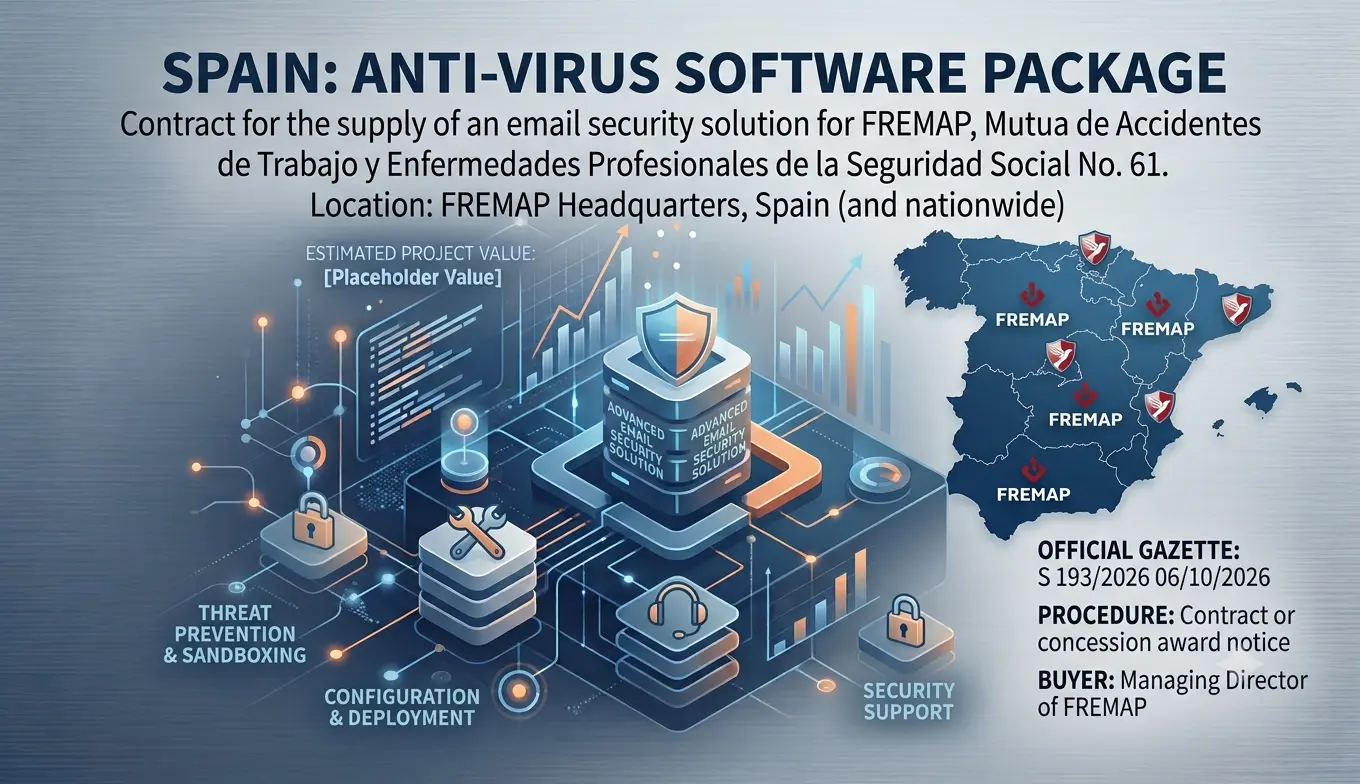
FREMAP Awards EUR 349,000 Email Security Solution Contract to NTT DATA Spain
06 Oct 2026
Standfirst: FREMAP, Mutua Colaboradora con la Seguridad Social nº 61, has awarded a EUR 349,000 contract to NTT DATA SPAIN SL for the supply of an email security solution. The procurement covers anti-virus software under CPV 48761000 and was conducted through an open procedure. The contract covers a wide geographic footprint across Spain, including mainland regions and the autonomous cities of Ceuta and Melilla as well as the Balearic and Canary Islands. NTT DATA SPAIN SL was selected on 4 September 2026 and the contract was concluded on 2 October 2026. Introduction FREMAP has completed the procurement of an email security solution designed to provide protection for its electronic mail environment. The contract was awarded to NTT DATA SPAIN SL following an open procurement procedure and has a total value of EUR 349,000. The result was published by the European Union's Tenders Electronic Daily system under notice 688673-2026 in OJ S issue 193/2026 on 6 October 2026. The procurement is classified as a supplies contract with the main CPV code 48761000, covering anti-virus software packages. The procurement is notable for its broad implementation geography. The TED notice lists performance locations across numerous Spanish NUTS regions, effectively covering FREMAP's nationwide operational footprint. The award demonstrates the continued importance of centrally procured cybersecurity and email protection solutions for organisations operating across multiple locations. Why This Contract Matters Email remains one of the most important attack surfaces for organisations handling sensitive operational and personal information. A centralised email security solution can help organisations establish consistent security controls across geographically distributed offices and operational locations. For FREMAP, the procurement provides a dedicated security solution for email communications across its broad Spanish footprint. The nationwide nature of the listed performance locations means that the requirement extends beyond a single office or region and requires a solution capable of supporting a distributed organisation. The EUR 349,000 award also demonstrates continuing public-sector and public-law demand for specialised cybersecurity software. For technology suppliers, cybersecurity companies and systems integrators, contracts of this nature represent an important segment of the European public procurement market. Contract Timeline Procurement title: Contratación del suministro de una solución de seguridad de correo electrónico para FREMAP, Mutua Colaboradora con la Seguridad Social nº 61 Internal identifier: LICT/99/032/2025/0165 Procedure identifier: 61406284-affa-44ce-b23e-b263e50a0aa6 Procedure: Open Winner selected: 4 September 2026 Contract concluded: 2 October 2026 Notice dispatched: 5 October 2026 TED publication: 6 October 2026 Notice number: 688673-2026 OJ S issue: 193/2026 Contract Overview The contract covers the supply of an email security solution for FREMAP. The TED notice identifies the main classification as CPV 48761000, Anti-virus software package. The procurement is a supplies contract rather than a services or works contract. The procurement consists of one lot, LOT-0000. The winning supplier is NTT DATA SPAIN SL, a large economic operator based in Madrid. The value of the winning tender and the value of all contracts awarded under the notice are both recorded as EUR 349,000. The procurement was conducted under an open procedure. The award criterion was price, carrying 100 points. The notice confirms that there was no framework agreement and no dynamic purchasing system. Key Contract Details BuyerDirector Gerente de FREMAP OrganisationFREMAP, Mutua Colaboradora con la Seguridad Social nº 61 CountrySpain Contract typeSupplies ProcurementEmail security solution Main CPV48761000 - Anti-virus software package ProcedureOpen LotLOT-0000 Winning companyNTT DATA SPAIN SL Winning tender valueEUR 349,000 Contract identifierLICT/99/032/2025/0165/L1 Winner selected4 September 2026 Contract concluded2 October 2026 Award criterionPrice, 100 points EU fundingNo GPA coveredYes Framework agreementNo Dynamic purchasing systemNo Project Scope The purpose of the procurement is the supply of an email security solution for FREMAP. The official procurement description states that the needs to be satisfied through the procedure are specified, described in detail and justified in the associated Needs Memorandum published with the procurement. The principal CPV classification, 48761000, identifies the requirement as an anti-virus software package. This places the contract within the wider cybersecurity software market, specifically the protection of email and related communications infrastructure. The performance area is extensive. The TED notice identifies locations covering a large number of Spanish NUTS regions, including A Coruña, Lugo, Ourense, Pontevedra, Asturias, Cantabria, Araba/Álava, Gipuzkoa, Bizkaia, Navarra, La Rioja, Huesca, Teruel, Zaragoza, Madrid, Barcelona, Girona, Lleida, Tarragona, Alicante, Castellón, Valencia, the Balearic Islands, Andalusia, Murcia, Ceuta, Melilla and the Canary Islands. This geographic distribution indicates that the procurement is intended to support FREMAP's operations across multiple Spanish territories rather than a single local installation. About the Contracting Authority The buyer identified in the TED notice is the Director Gerente de FREMAP. The contracting authority is classified as a body governed by public law and controlled by a central government authority. Its activity is classified under social protection. FREMAP, Mutua Colaboradora con la Seguridad Social nº 61, is the organisation behind the procurement. Its registered location is Majadahonda in Madrid, Spain. The contracting authority is responsible for the procurement process and is also identified in the notice as the organisation providing the relevant procurement and review information. About the Organisations Involved FREMAP: FREMAP, Mutua Colaboradora con la Seguridad Social nº 61, is the contracting organisation. The TED notice identifies its Director Gerente as the official buyer. The organisation is based in Majadahonda, Madrid. NTT DATA SPAIN SL: NTT DATA SPAIN SL is the successful tenderer and winner of LOT-0000. The notice classifies the company as a large economic operator. It is registered as B82387770 and is based in Madrid, Spain. The company submitted the winning tender valued at EUR 349,000. Tribunal Administrativo Central de Recursos Contractuales: The Tribunal Administrativo Central de Recursos Contractuales is identified as the review organisation. It is based in Madrid and provides information concerning review procedures for the procurement. Procurement Analysis The procurement followed an open procedure, allowing the market to participate in the tendering process. Unlike a negotiated or direct award, the open procedure provides a competitive procurement route in which interested economic operators can submit tenders in accordance with the published requirements. The award methodology was based entirely on price. The TED notice assigns 100 points to the economic offer. This means the published award structure did not allocate separate scoring to technical quality, methodology or other qualitative criteria within the reported award criteria. The winning tender was submitted by NTT DATA SPAIN SL at EUR 349,000. The notice records the winning tender as not ranked, while separately confirming that at least one winner was chosen. The procurement result therefore establishes the successful supplier and contract value without providing a comparative ranking table. The notice records one tender under the general tender submission statistics. It also contains a separate statistical field showing zero tenders from micro, small or medium tenderers. These fields are reproduced as recorded in the TED notice and should not be independently reconciled beyond the official record. Additional Procurement Facts The procurement is governed by Directive 2014/24/EU. It is not financed with European Union funds and is covered by the Government Procurement Agreement. The procurement has one lot and no framework agreement. It also does not use a dynamic purchasing system. The contract identifier is LICT/99/032/2025/0165/L1. No subcontracting is declared for the winning tender. NTT DATA SPAIN SL was selected as winner on 4 September 2026 and the contract was concluded on 2 October 2026. The TED notice was dispatched on 5 October 2026 and published on 6 October 2026 in OJ S issue 193/2026 under notice number 688673-2026. Market & Industry Perspective The FREMAP award reflects the increasing importance of email security within organisational cybersecurity strategies. Email remains a key channel for business communication and is frequently targeted by malware, phishing, malicious attachments and other cyber threats. Organisations operating across numerous locations require security controls that can be centrally managed and consistently deployed. The procurement also illustrates the role of systems integrators and large technology companies in delivering cybersecurity solutions to complex organisations. The winning supplier is a large enterprise, indicating that the requirement was awarded to a provider capable of supporting a broad institutional deployment. For cybersecurity vendors, the opportunity extends beyond anti-virus products. Email security procurement can encompass threat detection, malware protection, filtering, security monitoring, policy enforcement, administration and integration with existing information technology environments. Suppliers should therefore assess both direct software opportunities and associated technology requirements. Economic Significance The EUR 349,000 contract demonstrates that cybersecurity remains a material procurement category for organisations operating in the social protection sector. While the contract is focused specifically on email security, the investment forms part of the wider requirement to protect digital communications and organisational information systems. The nationwide geographic coverage adds another dimension to the procurement. Deploying a security solution across numerous Spanish regions can require consistent administration, operational resilience and the ability to support users and infrastructure in geographically distributed locations. For technology suppliers, contracts with this profile can provide opportunities for long-term institutional relationships and can create additional demand for related cybersecurity services, software upgrades and technical support in future procurement cycles. Future Procurement Opportunities The cybersecurity procurement market is expected to continue generating opportunities for suppliers serving public-law organisations and social protection institutions. Future procurements may cover email security, endpoint protection, identity management, network security, cloud security, security monitoring and threat intelligence. Organisations with geographically distributed operations may increasingly seek integrated security platforms rather than isolated products. Suppliers capable of demonstrating interoperability with existing infrastructure and centralised security management may therefore be well positioned for future opportunities. Public procurement teams may also increasingly evaluate security requirements in the context of evolving cyber threats and regulatory expectations. Suppliers should monitor changes in technical specifications, security standards and procurement criteria when preparing for future tenders. Opportunities for Suppliers Cybersecurity software providers: Monitor Spanish public procurement opportunities involving email, anti-virus and endpoint protection. Email security specialists: Position solutions around malware prevention, phishing protection, filtering and secure communications. Systems integrators: Develop capabilities for large-scale cybersecurity deployment across geographically distributed organisations. Managed security providers: Monitor complementary opportunities involving security monitoring and operational support. Technology vendors: Track CPV 48761000 and related cybersecurity classifications for relevant procurement notices. International suppliers: Review GPA-covered opportunities where eligibility permits participation by international companies. What Businesses Should Watch Suppliers should monitor Spanish procurement notices for cybersecurity requirements that use CPV 48761000 or related software and information-security classifications. The FREMAP procurement demonstrates how a requirement initially described as an email security solution can cover a broad operational geography. Companies should also pay attention to the selected award methodology. In this procurement, price accounted for the full 100 points. Suppliers competing for similar opportunities should therefore understand how pricing strategy interacts with the technical minimum requirements established by the tender documentation. Another important signal is the scale of deployment. Where a procurement covers multiple NUTS regions, suppliers should assess their ability to deliver consistent implementation, support and security management across all relevant locations. SpainTenders.com Procurement Intelligence The FREMAP email security contract represents a broader procurement trend in which cybersecurity is becoming an operational requirement across public-law organisations rather than a specialised concern limited to central IT departments. Email protection is particularly important because it sits at the intersection of communication, identity, data exchange and cyber risk. The broad geographic coverage of this contract further demonstrates the need for centrally managed security solutions across distributed organisations. The strategic importance of the EUR 349,000 award is not limited to the software package itself. For suppliers, the procurement demonstrates the value of institutional cybersecurity opportunities where a single contract can support operations across numerous Spanish territories. Companies targeting this market should therefore demonstrate scalability, deployment capability and the ability to maintain consistent security controls across distributed environments. Suppliers should position themselves around clear security outcomes, reliable implementation and operational continuity. The fact that price carried 100 points also highlights the importance of competitive commercial positioning when the procurement documentation establishes price as the sole published award criterion. However, suppliers must still meet all mandatory technical and security requirements before price can determine the final result. Future cybersecurity contracts may increasingly combine email protection with broader endpoint, identity, cloud and threat-management capabilities. Procurement intelligence can help suppliers identify these emerging requirements early, understand which organisations are investing in cybersecurity and prepare before formal tenders reach the market. Supplier Takeaways FREMAP awarded a EUR 349,000 email security contract to NTT DATA SPAIN SL. The procurement covers an anti-virus software package under CPV 48761000. The procurement was conducted through an open procedure. The award criterion was price with a weight of 100 points. The contract consists of one lot, LOT-0000. The winner was selected on 4 September 2026. The contract was concluded on 2 October 2026. The procurement covers a broad range of Spanish NUTS regions. The contract is not financed with EU funds. The procurement is covered by the Government Procurement Agreement. No framework agreement or dynamic purchasing system was used. No subcontracting was declared by the winning tenderer. Key Takeaways Buyer: Director Gerente de FREMAP Organisation: FREMAP, Mutua Colaboradora con la Seguridad Social nº 61 Winner: NTT DATA SPAIN SL Contract value: EUR 349,000 Contract type: Supplies Main CPV: 48761000 - Anti-virus software package Procedure: Open Lots: One Award criterion: Price, 100 points Winner selected: 4 September 2026 Contract concluded: 2 October 2026 EU funding: No GPA: Yes Conclusion FREMAP has awarded a EUR 349,000 contract to NTT DATA SPAIN SL for the supply of an email security solution covering its broad Spanish operational footprint. The procurement was conducted through an open procedure and evaluated entirely on price under the published award criteria. The contract highlights the continuing importance of cybersecurity procurement for organisations operating in the social protection sector. With performance locations extending across numerous Spanish regions, the requirement demonstrates the scale and geographic complexity that can accompany institutional cybersecurity deployments. For suppliers, the award provides a useful market signal. Email security, anti-virus software and related cybersecurity solutions remain active areas of public procurement. Companies seeking similar contracts should combine competitive pricing with strong deployment capabilities, nationwide support and the technical capacity required to secure distributed organisational environments. Source European Union, Tenders Electronic Daily, Contract or concession award notice 688673-2026, OJ S 193/2026, published 6 October 2026.
View Details