Regional Public Procurement Portals in Spain: Complete Guide
29 Sep 2026
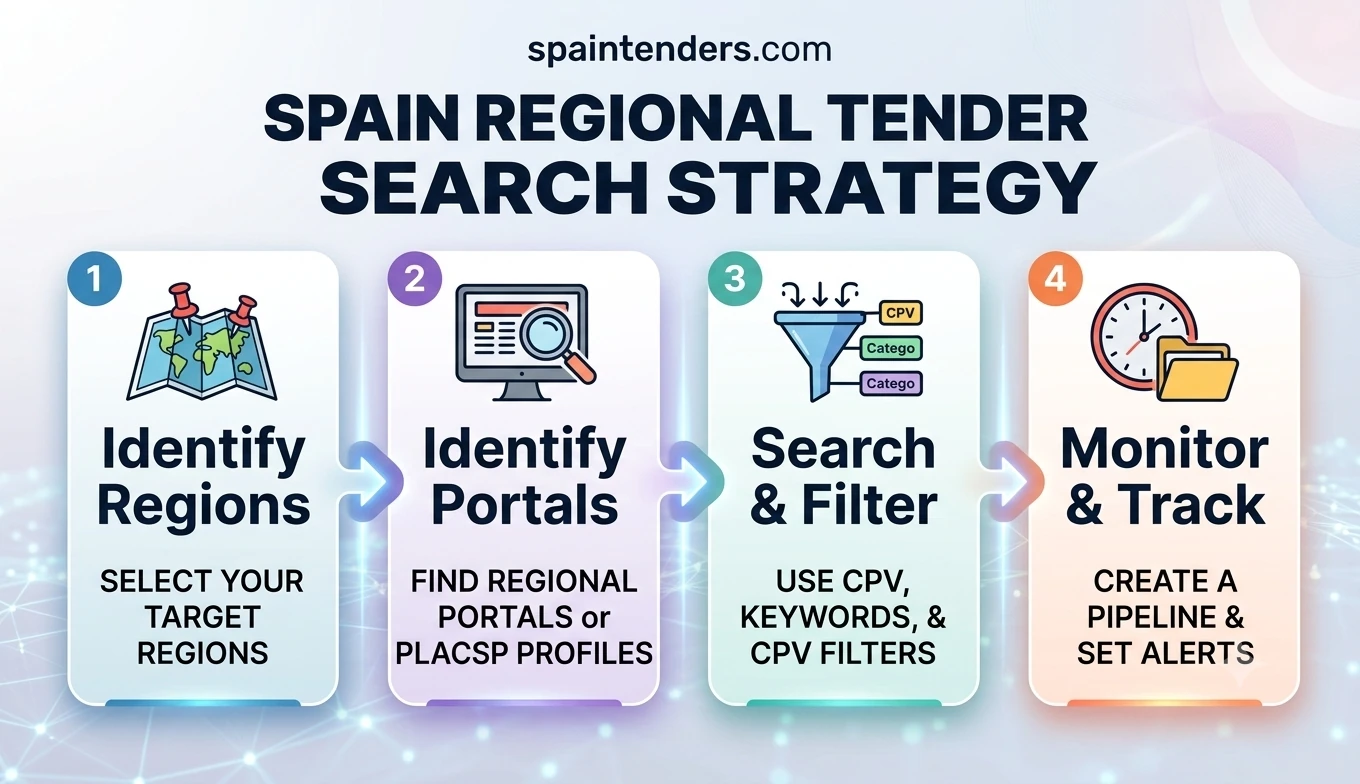
Introduction Spain's public procurement market is not limited to one type of contracting authority or one geographic area. Public contracts are published by the national government, autonomous communities, provincial and local authorities, public organisations, universities, hospitals and other public-sector entities. For companies targeting Spanish public tenders, understanding the regional procurement landscape is therefore important. Spain's autonomous communities have developed different systems for publishing, searching and managing procurement information. Some operate dedicated regional platforms, while others integrate or publish contracting profiles through the national Plataforma de Contratación del Sector Público (PLACSP). Examples include the Plataforma de serveis de contractació pública (PSCP) in Catalonia, the Plataforma de Contratación of Andalusia, the Portal de la Contratación Pública of Madrid and the Portal de Contratación of Navarra. Other regions provide contracting information through regional government portals and the national platform. This guide explains the regional public procurement portals in Spain, what suppliers can find on them, how the systems differ and how businesses can build a regional tender-search strategy. Table of Contents What Are Regional Public Procurement Portals in Spain? Why Regional Procurement Portals Matter PLACSP and Regional Procurement Portals Andalusia Public Procurement Portal Aragon Public Procurement Asturias Public Procurement Balearic Islands Public Procurement Basque Country Public Procurement Canary Islands Public Procurement Cantabria Public Procurement Castile-La Mancha Public Procurement Castile and León Public Procurement Catalonia Public Procurement Portal Valencian Community Public Procurement Extremadura Public Procurement Galicia Public Procurement Portal Madrid Public Procurement Portal Region of Murcia Public Procurement Navarra Public Procurement Portal La Rioja Public Procurement Regional Portal Comparison How to Search Regional Tenders Electronic Bidding on Regional Portals Regional Tender Alerts and Monitoring Regional Portals for Foreign Companies Common Regional Tender Search Mistakes SpainTenders.com Procurement Intelligence Conclusion What Are Regional Public Procurement Portals in Spain? Regional public procurement portals are online systems used by autonomous communities and their public-sector entities to publish and manage information about public contracts. Depending on the region, a portal may provide access to tender notices, contracting profiles, procurement documents, contract awards, procurement plans, electronic tendering services and other public procurement information. The terminology can also differ. A regional system may be called a Plataforma de Contratación, Portal de Contratación, Perfil del Contratante or another regional name. For suppliers, the important point is not the name of the platform but what procurement information and electronic services it provides. Why Regional Procurement Portals Matter Regional procurement represents an important part of the Spanish public-sector market. Autonomous communities are responsible for public services and organisations that procure a wide range of works, supplies and services. Depending on the region, procurement can involve healthcare, education, transport, infrastructure, construction, information technology, environmental services, social services, energy, security, facilities management and many other categories. A company searching only national-level opportunities may therefore miss relevant regional procurement activity if it does not understand how regional contracting information is published. Regional portals can also provide useful information about contracting authorities, procurement documents, awards and the status of procedures. PLACSP and Regional Procurement Portals The Plataforma de Contratación del Sector Público, or PLACSP, is the national public procurement platform. However, the relationship between PLACSP and regional systems is not identical in every autonomous community. Some regions maintain dedicated procurement platforms that provide a regional point of access and may also interoperate with PLACSP. Catalonia, for example, describes its PSCP as the single and comprehensive portal for disseminating contracting activity and contracting profiles of public contracting bodies in Catalonia. Other regions place their contracting profiles directly on PLACSP. Aragón states that since March 2018 the contracting profiles of its autonomous public-sector contracting bodies and participating local entities have been hosted on the national platform. This means suppliers should not assume that every region requires a completely separate search workflow. Instead, they should understand the publication model used by each target region. Andalusia Public Procurement Portal Andalusia operates the Plataforma de Contratación through the Junta de Andalucía. The platform provides access to contracting information including prior notices, tenders, awards, formalised contracts, cancelled procedures, deserted procedures, suspended procedures and other procurement categories. The platform also provides contracting-profile information and allows users to subscribe to publications from contracting profiles. For businesses targeting licitaciones Andalucía, the regional platform can therefore be an important source for identifying opportunities issued by the Junta and its contracting entities. Aragon Public Procurement Aragón provides information about its contracting profiles through the national PLACSP. The Government of Aragón states that the profiles of the relevant autonomous public-sector contracting bodies and participating local entities are hosted on the national platform. The regional government also provides access to information from earlier procurement tools for historical or complementary reference. Suppliers targeting Aragón should therefore include the relevant Aragón contracting profiles in PLACSP searches rather than assuming that a separate current regional search platform is required. Asturias Public Procurement The Principality of Asturias publishes information about its contracting activity through its public procurement resources and contracting profiles. Asturias provides information on tenders, minor contracts, procurement plans, contract extensions and modifications, emergency contracts and other procurement-related information. The regional government states that the information published in its contracting section is also published simultaneously on PLACSP. For suppliers, this makes both the regional government information and PLACSP relevant when researching Asturias procurement activity. Balearic Islands Public Procurement The Balearic Islands public administration publishes procurement information through its contracting profiles and public procurement resources. Suppliers targeting the Balearic Islands should monitor procurement issued by the autonomous administration and its public-sector entities as well as relevant local authorities. As with other regions, the publication route for individual contracting bodies should be checked in the official procurement record. For businesses operating in tourism, construction, infrastructure, healthcare, transport, environmental services, technology and facilities management, regional and local procurement can represent relevant areas of research. Basque Country Public Procurement The Basque Country has its own public procurement environment, including the Kontratazio Publikoa Euskadin / Contratación Pública en Euskadi system. The Basque Government states that its contracting-profile system provides free, direct and complete access to procurement information and tender documents. It also states that its regional platform is interoperable with PLACSP and that its tenders are presented on both platforms. Businesses targeting licitaciones País Vasco should therefore understand both the regional system and its connection with PLACSP. Canary Islands Public Procurement The Canary Islands public administration publishes contracting information through the procurement resources of the Government of the Canary Islands and the relevant contracting profiles. Suppliers targeting the islands should pay particular attention to the location and operational requirements of contracts. Transport, logistics, infrastructure, tourism, environmental services, healthcare and public facilities can involve geographical considerations that differ from mainland procurement. Companies should verify the official contracting profile and submission platform associated with each procurement before preparing an offer. Cantabria Public Procurement Cantabria publishes public procurement information through the regional government's contracting resources and contracting profiles. Suppliers searching the Cantabrian market should review opportunities issued by the regional administration and its public entities and should also use PLACSP when the relevant contracting profile is hosted or mirrored there. For regional procurement research, companies should check both the procurement object and the contracting body rather than relying only on geographic keywords. Castile-La Mancha Public Procurement Castile-La Mancha provides public procurement information through its regional government procurement resources and contracting profiles. The region covers a broad geographic area and includes procurement activity across healthcare, education, infrastructure, public administration, environmental services, social services and other sectors. Businesses targeting licitaciones Castilla-La Mancha should identify relevant contracting bodies and use the applicable regional and national publication channels when searching for opportunities. Castile and León Public Procurement Castile and León publishes procurement information through the regional administration's public procurement resources and contracting profiles. The region's large geographic area means that suppliers may encounter opportunities from both regional-level organisations and local contracting authorities. Companies should therefore combine autonomous-community searches with searches for relevant provincial and municipal buyers. Checking the official contracting profile associated with each opportunity is important before beginning electronic bid preparation. Catalonia Public Procurement Portal Catalonia has one of the most clearly defined regional procurement platforms in Spain. The Plataforma de serveis de contractació pública (PSCP) is described by the Generalitat as the single and comprehensive portal for disseminating contracting activity and contracting profiles of public contracting bodies in Catalonia. The Catalan system also integrates electronic tendering tools including Sobre digital, telematic offer submission and electronic auction functionality. The regional system includes procurement information and electronic services for Catalan public administration and its public sector. Catalonia also maintains the RELIC supplier registration system and a public contracts register as components of its broader electronic procurement environment. Companies targeting licitaciones Cataluña should therefore become familiar with PSCP and the electronic submission tools applicable to individual tenders. Valencian Community Public Procurement The Valencian Community publishes procurement information through its regional public procurement resources and contracting profiles. Businesses searching licitaciones Comunidad Valenciana should identify relevant regional contracting authorities and public entities and verify the official procurement platform associated with each opportunity. Healthcare, infrastructure, public services, education, technology, construction and environmental procurement can all be relevant areas for regional tender research. Extremadura Public Procurement Extremadura provides public procurement information through the regional administration's contracting resources and profiles. Companies interested in Extremadura tenders should consider both regional government opportunities and procurement from local authorities and public entities. As with other autonomous communities, suppliers should verify whether the individual contracting profile is accessed through the regional environment, PLACSP or an interconnected system. Galicia Public Procurement Portal Galicia operates the Plataforma de Contratos Públicos de Galicia. The Xunta describes the platform as a resource for information about public procurement procedures and contracting activity in Galicia. The platform allows users to filter tenders according to criteria including contracting body, subject matter, processing type and procedure status. Galicia's procurement information can also be accessed through contracting profiles and is connected with the broader Spanish procurement environment. Official procurement notices can identify the relevant Galician contracting profile and the corresponding PLACSP access route. For businesses targeting licitaciones Galicia, the regional platform is therefore an important source for tender discovery and procurement research. Madrid Public Procurement Portal The Community of Madrid operates the Portal de la Contratación Pública. The regional government states that the portal publishes the contracting profiles of the contracting bodies of the Community of Madrid. The portal provides access to prior information notices, public contract calls, associated documentation, awards, contract formalisation information and contact details. The Madrid portal is interconnected with PLACSP. Madrid states that information about contract calls and results is also automatically published on the national platform. Businesses targeting licitaciones Madrid should therefore understand both the regional portal and its connection to PLACSP. Region of Murcia Public Procurement The Region of Murcia provides public procurement information through the regional administration's procurement resources and contracting profiles. Companies targeting Murcia should search opportunities according to contracting authority, sector, contract type, CPV and geographic requirements. Relevant procurement can originate from the regional administration and its public-sector organisations as well as local authorities. As always, the individual tender record should be checked to establish the official submission channel and current procurement documentation. Navarra Public Procurement Portal Navarra operates a dedicated Portal de Contratación. The portal describes itself as the official means of publicity and transparency for public procurement in the Comunidad Foral de Navarra. The portal provides tender information for entities subject to Navarra's public procurement framework and includes functionality for electronic tendering. It also provides information for bidders, contracting entities and other procurement users. Navarra's electronic tendering environment includes PLENA. In 2026, Navarra introduced PLENA 2.0 while maintaining coexistence with the previous version during the transition. Companies targeting licitaciones Navarra should therefore check the specific electronic submission instructions associated with each tender. La Rioja Public Procurement La Rioja provides public procurement information through regional contracting resources and contracting profiles. Procurement records can also be linked to the national PLACSP environment. For example, current municipal procurement information in La Rioja can provide direct access to relevant expedientes on PLACSP together with tender documents and other procurement records. Suppliers searching licitaciones La Rioja should therefore include both regional procurement resources and PLACSP-based contracting profiles in their research process. Regional Portal Comparison RegionProcurement EnvironmentKey Supplier Consideration AndalusiaRegional Plataforma de ContrataciónSearch tenders, profiles and procurement publications AragonContracting profiles hosted on PLACSPUse PLACSP for current profile information AsturiasRegional procurement resources plus PLACSP publicationCheck regional information and PLACSP Balearic IslandsRegional contracting resourcesCheck contracting profile and submission channel Basque CountryRegional KPE-CPE system interoperable with PLACSPRegional and national access may both be relevant Canary IslandsRegional contracting resourcesCheck geographic and delivery requirements CantabriaRegional contracting resourcesCheck relevant contracting profiles Castile-La ManchaRegional contracting resourcesSearch regional and relevant local authorities Castile and LeónRegional contracting resourcesCombine regional and local procurement research CataloniaPSCP and integrated e-Licita toolsUnderstand PSCP and electronic submission tools Valencian CommunityRegional procurement resourcesCheck contracting body and official submission system ExtremaduraRegional contracting resourcesVerify regional or PLACSP publication route GaliciaPlataforma de Contratos Públicos de GaliciaUse regional filters and contracting profiles MadridPortal de la Contratación Pública interconnected with PLACSPUse regional and national procurement information MurciaRegional contracting resourcesCheck regional contracting profiles NavarraPortal de Contratación and PLENACheck current electronic tendering system La RiojaRegional resources and PLACSP-linked profilesCheck both regional and national publication channels This comparison is intended as a supplier-search guide rather than a substitute for checking the official procurement record of an individual tender. How to Search Regional Tenders A practical regional tender-search process can follow these steps: Step 1: Identify the Spanish regions relevant to your business. Step 2: Identify the main regional procurement portal or contracting-profile system. Step 3: Search using relevant keywords and CPV codes. Step 4: Filter by contracting authority where possible. Step 5: Review active tenders and deadlines. Step 6: Open the complete tender record. Step 7: Download the procurement documents. Step 8: Check the submission platform. Step 9: Monitor corrections and updates. Step 10: Record relevant opportunities in the company's tender pipeline. Companies covering the whole Spanish market should not rely on one geographic keyword. A regional strategy should combine region, authority, CPV, sector and contract-type searches. Electronic Bidding on Regional Portals Regional procurement portals may provide or connect to electronic tendering systems. The exact process can vary by region and procurement platform. Catalonia, for example, provides electronic tendering through tools integrated into its PSCP, including Sobre digital and telematic offer submission. Navarra's Portal de Contratación provides electronic bidding through PLENA, with the current platform transition involving PLENA 2.0. Suppliers should therefore check the electronic submission instructions for every tender rather than assuming that the same technical workflow applies throughout Spain. Regional Tender Alerts and Monitoring Some regional procurement systems provide subscription or notification functionality. Andalusia, for example, provides subscription to publications from contracting profiles. Alert systems can be useful when a company repeatedly searches for tenders from a particular region or contracting authority. However, businesses covering multiple regions may find it more efficient to maintain a central tender-monitoring workflow that combines regional sources, PLACSP information and other procurement intelligence sources. Regional Portals for Foreign Companies Foreign companies can use Spanish regional procurement portals to research opportunities issued by autonomous-community authorities and their public-sector entities. The main challenge is not necessarily finding the opportunity but understanding the applicable participation requirements and electronic submission process. Foreign suppliers should check: Eligibility requirements. Economic and financial solvency. Technical and professional capacity. Required registrations or classifications. Language requirements. Electronic signature requirements. Electronic submission platform. Required supporting documents. Delivery or service location. Contract-specific local requirements. The tender documentation remains the authoritative source for determining the requirements of an individual procurement. Common Regional Tender Search Mistakes Searching only PLACSP: Although PLACSP is an important national platform, regional systems can provide additional search, information or electronic tendering functionality. Searching only regional portals: Some regional contracting profiles are hosted or interconnected with PLACSP, so regional-only searches may not provide the complete picture. Assuming every region works the same way: Electronic tendering, registration and notification processes can differ. Ignoring local authorities: A regional market includes more than the autonomous government itself. Municipalities and other public entities can issue relevant tenders. Not checking the latest tender version: Corrections and amendments can change procurement information. Confusing discovery with bidding: Finding a tender does not mean that the supplier has completed the registration, signature or electronic submission requirements. SpainTenders.com Procurement Intelligence Companies targeting the Spanish procurement market can use SpainTenders.com as a central tender-discovery resource when searching across regions, sectors and contracting authorities. Businesses can explore Spain Tenders to identify procurement opportunities and use SpainTenders.com Authorities to research public buyers. Companies can also use SpainTenders.com Sectors to explore procurement opportunities by business category. Registered users can access their account through SpainTenders.com Login, while new users can use SpainTenders.com Registration. Procurement intelligence should not stop at live tenders. Businesses can also review Spain contract awards to research purchasing activity and awarded contracts. For assistance or questions regarding Spain procurement intelligence, businesses can use the SpainTenders.com Contact page. Conclusion Spain's regional public procurement landscape consists of different procurement environments, contracting profiles and electronic systems. Some autonomous communities operate dedicated platforms, while others rely heavily on PLACSP or maintain systems that interoperate with the national platform. For suppliers, the most effective approach is to understand the publication model of each target region rather than assuming that one search method works everywhere. Companies should identify relevant autonomous communities, monitor their procurement platforms and contracting profiles, use CPV and sector-based searches and verify the official tender record before bidding. For businesses targeting licitaciones España, combining regional procurement research with national tender intelligence can create a broader view of opportunities across the Spanish public sector.
View Details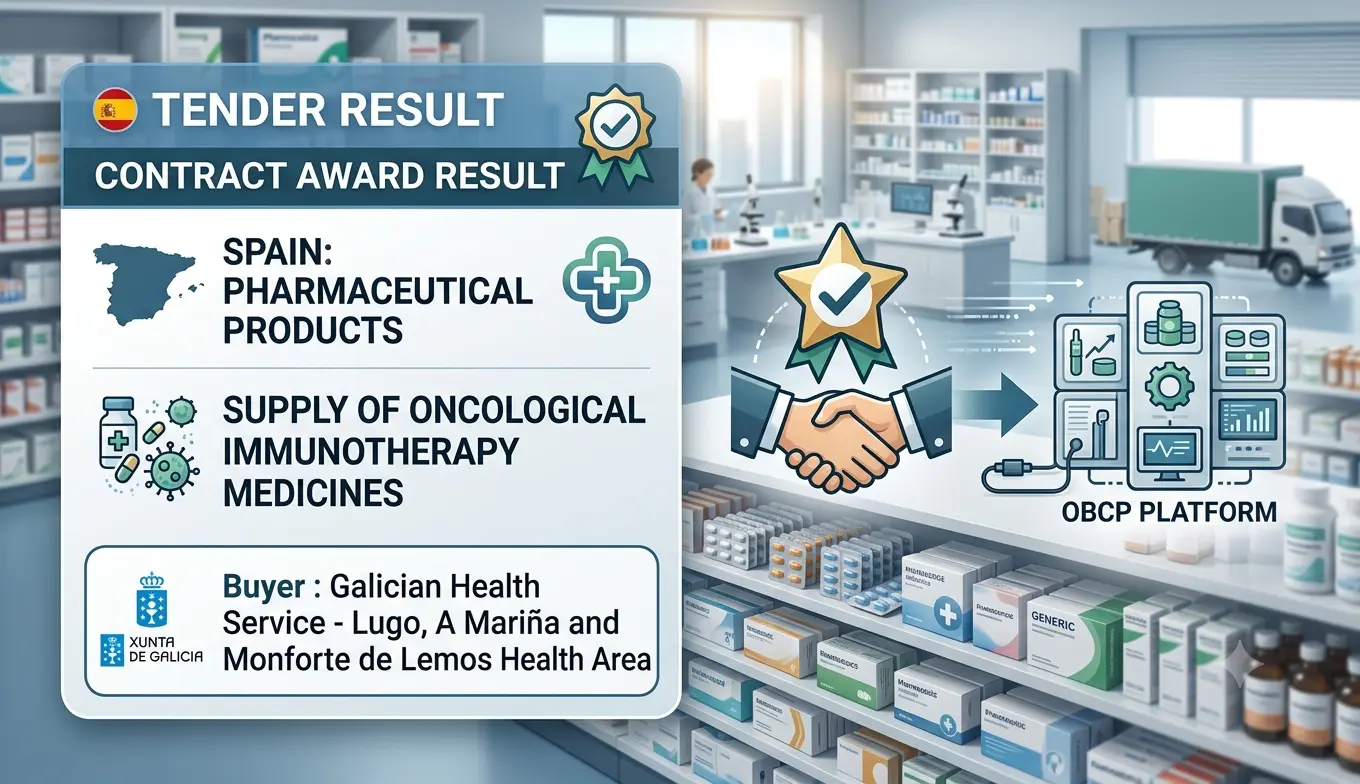
Major Pharmaceutical Giants Secure 15 Million Euro Oncology Immunotherapy Framework for Galician Health Authority
29 Sep 2026
Standfirst Eight specialized pharmaceutical manufacturers have been awarded a 15 million euro framework agreement to supply oncology immunotherapy drugs to the Servicio Gallego de Salud in the Lugo health area. The negotiated procedure without prior publication relies on technical exclusivity to secure continuous access to life saving cancer treatments across regional hospital centers. Introduction The continuous supply of specialized oncology medications remains a critical priority for regional health authorities aiming to maintain high standards of patient care and operational efficiency. In Spain, the Servicio Gallego de Salud has initiated a targeted procurement strategy to secure essential immunotherapy drugs for hospital centers within the Lugo, A Mariña and Monforte de Lemos health area. This recent tender result highlights the strategic reliance on direct negotiations with original manufacturers to guarantee uninterrupted access to highly specialized cancer treatments where technical exclusivity applies. By executing this procurement through a negotiated procedure without prior call for competition, the contracting authority ensures compliance with public procurement regulations while addressing the unique clinical requirements of regional oncology units. The selection of eight distinct pharmaceutical companies across eight specific lots reflects a mature market environment where intellectual property and technical specifications dictate supplier availability. Monitoring the official Tenders Portal for such contract awards provides valuable market intelligence for stakeholders tracking public procurement activities in the European healthcare sector. Why This Contract Matters This procurement is vital for ensuring that regional hospitals have uninterrupted access to advanced immunotherapy treatments for cancer patients. The inclusion of technical exclusivity justifications demonstrates the complex nature of pharmaceutical sourcing where specific biological mechanisms require exact manufacturer matches. For the medical device and pharmaceutical distribution sector, securing these framework agreements validates the clinical necessity and market dominance of specialized oncology drugs. It also demonstrates how public health authorities leverage direct negotiations to maintain supply chain stability for life saving medications. Contract Timeline The procurement process concluded with the formal selection of the winning bidders on September 16, 2026. Following standard administrative procedures and the validation of technical exclusivity claims, the formal framework agreements were concluded on the same date. The official contract awards notice was published in the Official Journal of the European Union on September 29, 2026. This timeline reflects a standard execution of negotiated public procurement regulations in the Spanish healthcare sector. Contract Overview The procurement is structured as a framework agreement without reopening of competition, divided into eight distinct lots covering specific immunotherapy active ingredients. The total maximum awarded value of the framework agreements is 15,016,421.68 euros. The suppliers are responsible for delivering these specialized pharmaceutical products in accordance with strict clinical specifications and maintaining consistent supply levels throughout the agreement duration. Key Contract Details Contract Title SUMINISTRO SUCESIVO DE LOS MEDICAMENTOS DE INMUNOTERAPIA ONCOLÓGICA Contracting Authority Servicio Gallego de Salud Área Sanitaria de Lugo, A Mariña y Monforte de Lemos Total Contract Value 15,016,421.68 EUR Procedure Type Negotiated without prior call for competition Number of Lots 8 Winners Roche Farma, Merck, Regeneron Spain, Glaxosmithkline, AstraZeneca, Bristol Myers Squibb, Merck Sharp and Dohme, Beone Medicines Contract Conclusion Date September 16, 2026 Main CPV Code 33600000 (Pharmaceutical products) Project Scope The core scope involves the successive supply of highly specialized medical products for oncology departments. This includes Atezolizumab, Avelumab, Cemiplimab, Dostarlimab, Durvalumab, Nivolumab, Pembrolizumab and Tislelizumab. These biological agents are critical for treating various advanced malignancies through targeted immune system modulation. The framework structure allows the health authority to draw upon these supplies as needed, ensuring that hospitals maintain adequate inventory levels for both routine and emergency patient treatments. The contracting authority requires strict adherence to cold chain logistics and regulatory compliance for all delivered batches. About the Contracting Authority The Servicio Gallego de Salud is the primary buyer for this procurement. It is a regional public authority responsible for managing and delivering healthcare services across the autonomous community of Galicia, ensuring high standards of medical care for the local population. About the Organisations Involved Servicio Gallego de Salud is the primary contracting authority and buyer. It manages regional public health services and drives the procurement of essential medical supplies for public hospitals. ROCHE FARMA, S.A.U. is a successful bidder and a large economic operator. It secured Lot 1 for Atezolizumab, demonstrating strong market presence in oncology treatments. MERCK, S.L., unipersonal is a successful bidder and a large economic operator. It secured Lot 2 for Avelumab, providing critical immunotherapy solutions. REGENERON SPAIN, S.L.U. is a successful bidder and a micro, small, or medium enterprise. It secured Lot 3 for Cemiplimab, highlighting its role in specialized cancer care. GLAXOSMITHKLINE S.A. is a successful bidder and a large economic operator. It secured Lot 4 for Dostarlimab. ASTRAZENECA FARMECEUTICA SPAIN, S.A. is a successful bidder and a large economic operator. It secured Lot 5 for Durvalumab. BRISTOL MYERS SQUIBB, S.A.U. is a successful bidder and a micro, small, or medium enterprise. It secured Lot 6 for Nivolumab. MERCK SHARP & DOHME DE ESPAÑA, S.A. is a successful bidder and a micro, small, or medium enterprise. It secured Lot 7 for Pembrolizumab. BEONE MEDICINES ESP, S.L.U. is a successful bidder and a large economic operator. It secured Lot 8 for Tislelizumab. Tribunal Administrativo de Contratación Pública de la Comunidad Autónoma de Galicia is the review organisation. This administrative court handles any legal appeals or disputes related to public procurement procedures in the region. Procurement Analysis The negotiated procedure without prior publication attracted direct bids from the original manufacturers, justified by the absence of competition for technical reasons. The award criteria relied entirely on the economic offer, carrying a weight of 100 percent, which is standard for exclusive pharmaceutical supplies where technical compliance is a strict pass or fail requirement dictated by patent protections and biological specificity. This binary evaluation method indicates that the clinical baselines in the bidding documents were sufficiently rigorous to filter out non compliant proposals. Consequently, the competition focused purely on financial efficiency, driving down the cost for the public buyer while ensuring all baseline clinical requirements were met. Additional Procurement Facts The procurement project is not financed with European Union funds, relying entirely on the regional healthcare budget of the Galician government. The procedure is covered by the Government Procurement Agreement, allowing international suppliers to participate, although the successful bidders are established domestic entities or subsidiaries of multinational corporations. Market and Industry Perspective The Spanish public pharmaceutical market is characterized by strict regulatory compliance and rigorous evaluation standards, making it a challenging environment for suppliers. The reliance on technical exclusivity highlights the ongoing challenges buyers face when navigating complex regional tender frameworks for patented biological drugs. Manufacturers must continuously update their documentation and ensure their products meet the exact specifications demanded by public health authorities to remain competitive. Stakeholders monitoring Active Tenders will notice that original manufacturers dominate these specific therapeutic categories, limiting the entry of generic competitors until patent expirations occur. Understanding the specific BOQs and GPNs associated with regional health authorities is essential for any firm hoping to compete effectively in this niche segment of the medical market. Economic Significance An investment of over 15 million euros represents a substantial allocation of public healthcare spending. This spending supports local distribution networks, logistics operations and clinical training programs, ensuring that advanced medical technologies remain accessible to public health facilities. By securing these supplies through direct negotiations, the public sector protects its clinical operations from short term market volatility while fostering a sustainable ecosystem for medical device and pharmaceutical innovation. The multiplier effect of this expenditure extends beyond the primary manufacturers, benefiting downstream logistics providers and specialized cold chain transport companies. Future Procurement Opportunities Suppliers who were not successful should monitor the official Tenders Portal for upcoming medical device renewals in other Spanish regions. As clinical guidelines evolve, public institutions will continuously generate new tenders opportunities for advanced surgical supplies and biological implants. Stakeholders should also track the Latest Active Tenders Procurement notices to anticipate upcoming infrastructure projects in the broader European healthcare sector. The dynamic nature of public procurement means that new Live Notices for Tenders will emerge as regional authorities update their clinical requirements and budget allocations. Opportunities for Suppliers While the primary framework positions have been awarded, specialized logistics providers and medical device distributors can find valuable subcontracting opportunities. Companies offering advanced inventory management software or specialized cold chain transport may also position themselves to support the supply chain operations of the awarded firms. What Businesses Should Watch Industry observers should monitor the activation rates for each lot to gauge the actual clinical demand for specialized oncology drugs in the Galician region. The enforcement of strict technical evaluation criteria will be a key metric for future live tender evaluations in this sector. Stakeholders should also review Live Notices for Tenders to anticipate upcoming medical modernization projects funded by regional health programs. SpainTenders.com Procurement Intelligence This tender result represents a clear trend in European public procurement toward the strategic use of negotiated procedures for highly specialized medical supplies where technical exclusivity applies. By appointing original manufacturers across eight distinct therapeutic lots, the contracting authority mitigates the risk of supply chain disruptions and ensures broad market access for critical oncology treatments. This strategy prioritizes operational continuity and strict adherence to clinical mandates over the traditional model of open competitive bidding, which is often impossible for patented biological agents. Suppliers can learn that meeting fundamental technical requirements and providing verifiable clinical data is the primary gateway for winning public procurement contracts in the medical device sector. Future contracts in this market are likely to evolve by incorporating even stricter material traceability and post market surveillance mandates. As public institutions face increasing pressure to ensure patient safety, companies that proactively develop transparent supply chains and offer verifiable clinical data will hold a distinct advantage. Suppliers must prepare for increased scrutiny on their product certifications, making rigorous documentation and compliance tracking essential for future public procurement success. Monitoring the procurement portal for similar GPNs and BOQs helps firms understand the specific technical requirements shaping the current market and prepares them for upcoming RFPs and RFQs in the healthcare sector. Supplier Takeaways Negotiated procedures based on technical exclusivity are standard for patented biological drugs in public healthcare procurement. Meeting strict clinical and regulatory minimums is a primary gateway for winning government pharmaceutical contracts. Evaluation criteria heavily weighting price require suppliers to maintain high product certification levels to pass initial qualification gates. Specialized logistics and cold chain distribution providers can find valuable subcontracting opportunities with primary framework winners. Key Takeaways Eight specialized suppliers were awarded positions across eight distinct oncology immunotherapy lots. The maximum awarded value of the framework agreements is 15,016,421.68 euros. The award criteria relied 100 percent on the economic offer due to the technical exclusivity of the products. The procurement ensures a continuous supply of critical cancer treatments for regional hospitals in Galicia. The framework agreements operate without reopening of competition, ensuring rapid order fulfillment for clinical needs. Conclusion This framework agreement secures a reliable and diversified supply of critical oncology drugs for the Galician regional health system. The direct award structure ensures operational resilience and supply chain stability for the duration of the contract. As the region continues to modernize its healthcare delivery, this procurement model will likely serve as a blueprint for future medical acquisitions. Source: Tenders Electronic Daily (TED), Contract Award Notice 667813-2026, Official Journal of the European Union, published on 29/09/2026.
View Details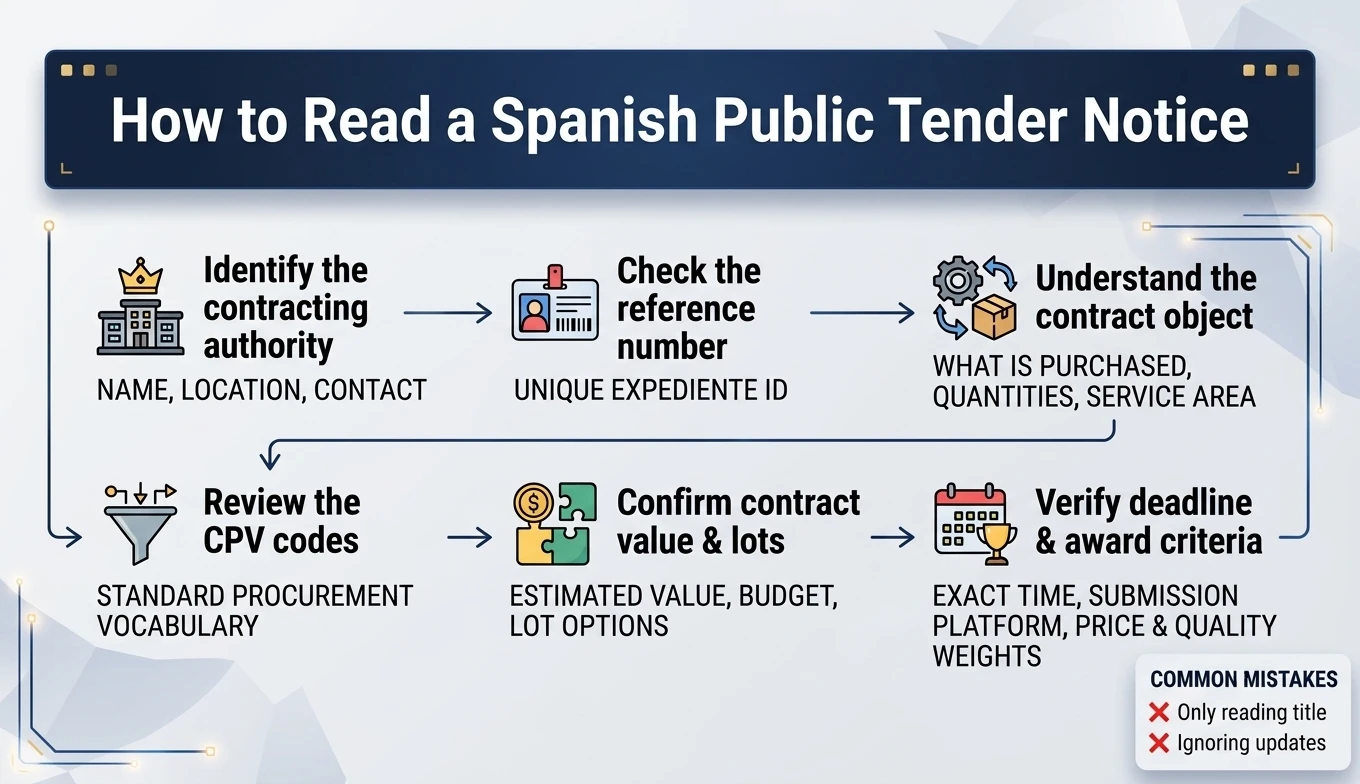
How to Read a Spanish Public Tender Notice
28 Sep 2026
Introduction Finding a Spanish public tender is only the first step. Before deciding whether to bid, suppliers need to understand the information contained in the official tender notice and identify the key details that determine whether the opportunity is relevant, achievable and worth pursuing. A Spanish public tender notice, commonly referred to as an anuncio de licitación, provides the essential information about a procurement procedure. It can identify the contracting authority, contract object, CPV code, contract value, procedure, lots, location, submission deadline, award criteria and other important conditions. For companies searching for licitaciones España, learning how to read this information quickly can significantly improve tender screening. The objective is not to understand every legal document immediately but to determine what is being purchased, who is buying it, how much the opportunity is worth, when the bid must be submitted and whether the company can realistically participate. This guide explains how to read a Spanish public tender notice step by step and what suppliers should check before moving from tender discovery to detailed bid preparation. Table of Contents What Is a Spanish Public Tender Notice? Why Should Suppliers Read the Notice Carefully? Identify the Contracting Authority Check the Tender Reference Number Understand the Contract Object Check the CPV Codes Check the Contract Type Identify the Procurement Procedure Check Whether the Tender Has Lots Check Contract Location and Scope Understand Contract Value and Budget Check Contract Duration and Extensions Check Supplier Eligibility Understand the Award Criteria Check the Tender Submission Deadline Check How the Tender Must Be Submitted Check Language and Document Requirements Open the Complete Tender Documents Check Corrections and Tender Updates How to Screen a Spanish Tender Quickly Common Mistakes When Reading Tender Notices How Foreign Companies Should Read Spanish Tender Notices SpainTenders.com Procurement Intelligence Conclusion What Is a Spanish Public Tender Notice? A Spanish public tender notice is the published announcement that provides key information about a procurement competition. In Spanish procurement terminology, it is commonly referred to as an anuncio de licitación. Under Spain's public procurement framework, tender notices for public administration contracts are published through the relevant contracting profile, with additional publication requirements applying in certain circumstances. Contracts subject to harmonised regulation may also require publication in the Official Journal of the European Union. The notice is therefore an important starting point for suppliers. However, it should not be confused with the complete tender documentation. The notice provides the initial procurement information while the detailed procurement documents contain the full administrative, technical and contractual requirements. Why Should Suppliers Read the Notice Carefully? A tender notice can help a supplier decide whether an opportunity deserves further investigation. Before spending time preparing a technical proposal or calculating a detailed bid price, a supplier should establish several basic facts: Who is purchasing? What is being purchased? Where will the contract be performed? What is the estimated value or budget? What procurement procedure is being used? Is the opportunity divided into lots? What CPV codes are associated with the contract? When is the submission deadline? How must the offer be submitted? What are the main eligibility and award requirements? This initial screening helps suppliers separate relevant opportunities from tenders that do not match their capabilities or commercial objectives. Identify the Contracting Authority The first item to check is the contracting authority. The authority is the public organisation or contracting entity purchasing the goods, services or works. The notice can provide the authority's name and contact or procurement information. This information is useful because the identity of the purchaser can reveal the sector, geographic market and type of procurement activity involved. For example, a tender issued by a municipality may have very different operational requirements from one issued by a national ministry, public hospital, university or public company. Suppliers can also use contracting-authority information to research previous procurement activity and identify related opportunities. Check the Tender Reference Number Spanish tender records normally contain a procurement reference or expediente identifier. This reference is important when communicating with the contracting authority or locating the same procurement record across procurement systems. Record the reference number when evaluating an opportunity. It can also help prevent confusion when a contracting authority publishes several tenders with similar titles. When contacting a procurement authority about a specific opportunity, including the official reference can make the communication more precise. Understand the Contract Object The object of the contract explains what the contracting authority intends to purchase. Do not rely only on the tender title. A short title may not describe the complete scope of the procurement. Read the description carefully and identify the actual products, services or works required. Pay attention to quantities, service areas, technical scope, implementation requirements and any stated options. A supplier should be able to explain the contract in one or two sentences after reading the notice. If the scope remains unclear, the next step should be to open the detailed procurement documentation. Check the CPV Codes CPV stands for Common Procurement Vocabulary. CPV codes are used to describe the subject matter of public procurement contracts and help classify procurement opportunities. EU procurement rules provide for CPV codes in contract notices, including separate information where a contract is divided into lots. Suppliers should compare the CPV code with the actual description rather than relying on the code alone. A tender can contain more than one CPV code, and the principal code may not capture every aspect of a complex procurement. For tender discovery, CPV is particularly useful because suppliers can search procurement opportunities according to the products, works or services being purchased. Check the Contract Type Identify whether the procurement concerns works, supplies or services, or another applicable contract category such as a concession. The contract type provides important context for understanding the tender. A supply contract may focus on delivery of products, while a service contract may involve ongoing performance and a works contract may involve construction or related activities. Knowing the contract type also helps suppliers assess whether the opportunity matches their business model and operational capacity. Identify the Procurement Procedure The notice should identify the procurement procedure being used. Depending on the procurement, suppliers may encounter procedures such as procedimiento abierto, simplified open procedures, restricted procedures, competitive procedures with negotiation and other legally available procedures. The procedure affects how suppliers participate. In an open procedure, eligible economic operators can generally submit an offer in response to the call for competition. Other procedures can involve selection stages, invitations or negotiations. Do not assume that every tender follows the same submission process. Confirm the procedure before preparing the bid. For a detailed explanation of Spanish procurement procedures, suppliers can refer to the earlier guide on Spain Tender Procedures Explained. Check Whether the Tender Has Lots Many procurement opportunities can be divided into lots. A lot represents a separately identifiable part of the procurement that can have its own scope, value, requirements or award outcome. When a tender contains multiple lots, do not evaluate the opportunity only at the overall tender level. Check each lot individually. Lot description Lot-specific CPV information Lot value Location Technical requirements Eligibility conditions Award criteria Submission requirements A supplier may be able to bid for one lot without bidding for every lot, depending on the rules stated in the tender documents. Check Contract Location and Scope Location is particularly important for Spanish public tenders involving construction, maintenance, transport, healthcare, facility management, catering, security or other services requiring physical presence. Check where the works must be performed, where goods must be delivered or where services must be provided. For companies operating across Spain, location information can help determine whether local staff, facilities, logistics, subcontractors or other resources will be required. Understand Contract Value and Budget Contract notices can provide financial information such as estimated value, budget information or other applicable amounts. Suppliers should understand exactly what each amount represents before using it for commercial analysis. Do not automatically treat an advertised figure as the amount that will be paid to the successful bidder. The notice and procurement documents may distinguish between estimated contract value, base tender budget, taxes and other financial components. Where the procurement is divided into lots, examine the financial information for each lot. Check Contract Duration and Extensions The notice may indicate the expected contract duration and, where applicable, options for extensions or renewals. Duration matters because it affects resource planning, staffing, inventory, financing and expected revenue. A contract lasting several years can require a substantially different delivery model from a short-term purchase. Always compare the duration stated in the notice with the detailed contractual provisions before finalising commercial assumptions. Check Supplier Eligibility The notice can provide initial information about participation requirements, but suppliers should not assume that the summary information contains every qualification requirement. Look for indications concerning professional capacity, economic and financial standing, technical and professional ability, classification, professional registrations or other participation conditions. For the complete requirements, open the PCAP and other procurement documents associated with the tender. Understand the Award Criteria The award criteria explain the basis on which submitted offers will be evaluated. Spanish procurement law requires the criteria used for awarding contracts to be linked to the contract object and formulated objectively while respecting principles including equality, non-discrimination, transparency and proportionality. The notice should provide information about the criteria used for the procurement. Suppliers should examine whether the evaluation is based primarily on price, quality, technical characteristics, methodology, service levels or a combination of factors. Do not assume that the lowest price automatically determines the outcome. The applicable award methodology must be checked in the tender documentation. Check the Tender Submission Deadline The submission deadline is one of the most important pieces of information in the tender notice. Record the exact date and time. Do not rely on a general statement such as “closing soon” or an internal calendar reminder without checking the official tender record. Spanish procurement law requires contracting authorities to establish submission periods taking into account the time reasonably necessary to prepare offers while respecting applicable statutory minimum periods. Suppliers should also allow sufficient time for document preparation, electronic signing, technical validation and final submission. Check How the Tender Must Be Submitted Check whether the tender requires electronic submission and identify the platform or electronic procurement system that must be used. For electronic procurement, suppliers should verify their account access, electronic certificate, signature software and required submission process before the final day. The EU framework for contract notices includes information concerning electronic submission and other electronic procurement arrangements where applicable. A supplier should never wait until the final minutes to discover that a certificate is expired, a user account is not authorised or a required submission platform has technical requirements that have not been tested. Check Language and Document Requirements Review the language requirements for the tender and identify whether documents must be prepared in Spanish or another permitted language. For international suppliers, this is particularly important because company documents, declarations, certificates and technical materials may originate in another country. Check the procurement documents for any specific translation, certification or document-format requirements before preparing the final bid. Open the Complete Tender Documents The tender notice should be treated as the beginning of the review process rather than the complete tender itself. Once a supplier decides that an opportunity is potentially relevant, open the complete procurement documentation. Review the PCAP, PPT, DEUC where applicable, annexes, pricing templates, declarations and other documents. The notice tells you whether the opportunity appears relevant. The procurement documents tell you what must actually be submitted and what contractual and technical conditions apply. Check Corrections and Tender Updates A tender record can be updated after its initial publication. Corrections, clarifications, amendments or other communications can affect the information suppliers need to use when preparing their offers. This is why suppliers should not save a tender notice once and then work exclusively from the original information. Before submission, check the official tender record again for updates and confirm that the documents being used are the latest applicable versions. How to Screen a Spanish Tender Quickly Experienced tender teams can use a structured first-pass screening process before investing significant bid-preparation resources. CheckQuestion AuthorityWho is buying? ObjectWhat is being purchased? CPVDoes the procurement match our products or services? LocationCan we deliver or perform the contract there? ValueIs the opportunity commercially relevant? ProcedureHow can we participate? LotsWhich lot or lots are relevant? EligibilityCan we satisfy the participation requirements? Award criteriaCan we compete under the stated evaluation method? DeadlineCan we prepare and submit a compliant bid on time? If an opportunity passes this initial screen, the supplier can proceed to detailed document analysis. Common Mistakes When Reading Tender Notices Reading only the title: A tender title may be too short to describe the complete scope. Ignoring the CPV: The CPV can provide useful classification information that supports tender screening. Missing lots: A supplier may incorrectly assume that the entire procurement must be bid as one package. Ignoring the deadline: A relevant tender has little practical value if there is insufficient time to prepare a compliant submission. Confusing estimated value with guaranteed revenue: Financial figures need to be interpreted using the definitions in the procurement documentation. Not checking the award criteria: Suppliers should understand how offers will be evaluated before investing heavily in bid preparation. Stopping at the notice: The notice is not a substitute for the full tender documentation. Ignoring updates: Amendments and clarifications can change the information applicable to the procurement. How Foreign Companies Should Read Spanish Tender Notices Foreign companies should apply the same basic screening process but pay additional attention to geographic scope, eligibility, professional requirements, language, electronic submission, supporting documents and evidence of technical and financial capacity. For EU suppliers, cross-border procurement can involve European procurement mechanisms and standardised information requirements. For companies from outside Spain or outside the EU, the specific participation rules in the tender documentation should be examined carefully. A foreign supplier should also determine whether it can meet practical delivery or service requirements in Spain, including local staffing, logistics, installation, maintenance, customer support or other obligations. SpainTenders.com Procurement Intelligence For companies looking for Spanish public procurement opportunities, SpainTenders.com can provide a broader tender-discovery workflow across procurement categories, contracting authorities and business sectors. Suppliers can browse Spain Tenders to identify current opportunities and use SpainTenders.com Authorities to research contracting organisations. Businesses can also explore SpainTenders.com Sectors when screening opportunities according to their products or services. Users can access their account through SpainTenders.com Login or create an account through SpainTenders.com Registration. Reviewing Spain contract awards can also provide information about completed procurement activity and awarded contracts. For questions about tender intelligence, suppliers can use the SpainTenders.com Contact page. Conclusion Reading a Spanish public tender notice effectively is an important part of the tender-screening process. Suppliers should begin with the contracting authority, tender reference, contract object, CPV codes, contract type, procedure, lots, location, value and duration. They should then examine eligibility requirements, award criteria, submission method, language requirements and the exact deadline. If the opportunity passes the initial screening stage, the supplier should move to the complete procurement documentation and review the PCAP, PPT, DEUC where applicable and supporting annexes. The most important principle is simple: use the tender notice to decide whether an opportunity deserves detailed analysis, then use the complete procurement documentation to prepare the bid. For companies targeting licitaciones España, developing a consistent tender-notice screening process can make opportunity identification more efficient and reduce the risk of overlooking important procurement information.
View Details