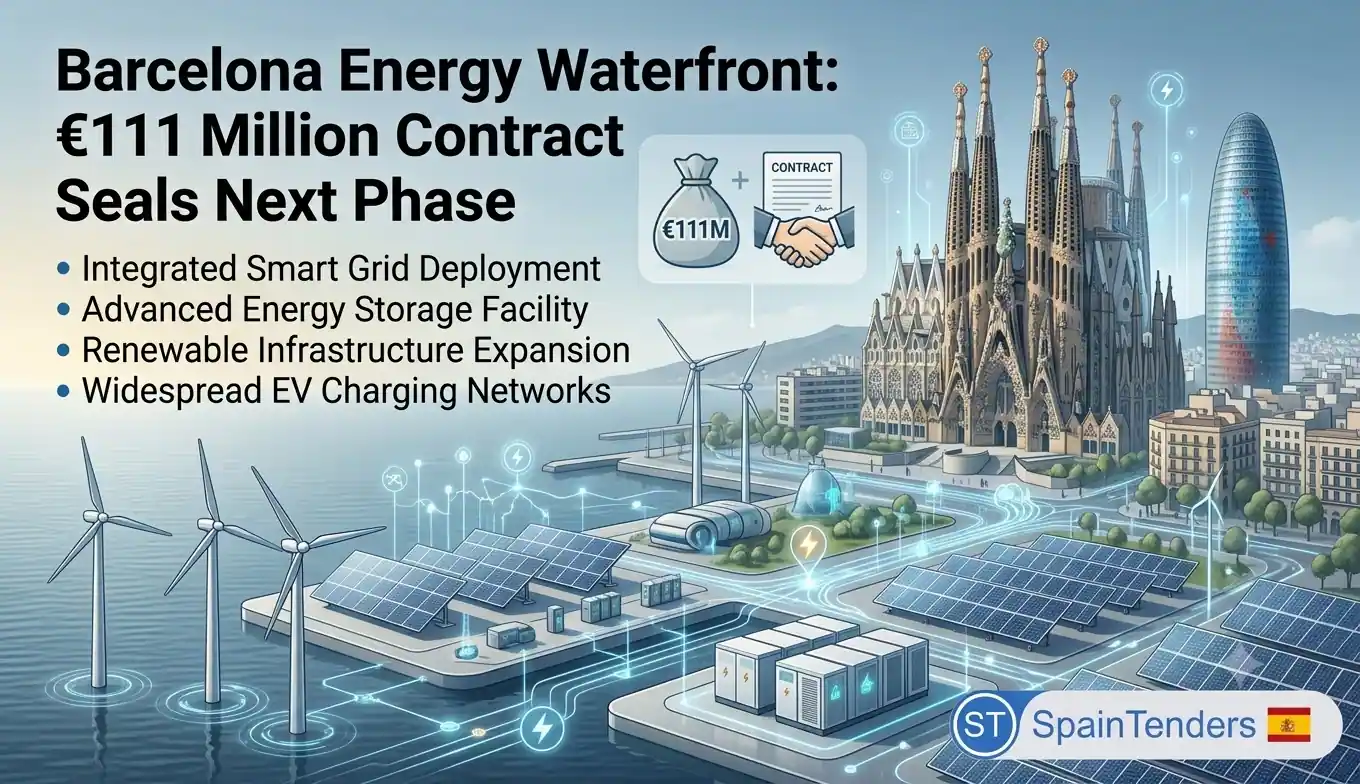
Barcelona Is Quietly Building Out Its Energy Waterfront - And a €111 Million Contract Just Sealed the Next Phase
Standfirst:
The Port Authority of Barcelona has awarded a €111.5 million contract to build three new berths and upgrade a fourth along its liquid bulk terminal, expanding capacity at what the port calls its "Energy Quay." The award, won by a joint venture of FCC Construcción and COMSA after a six bidder competition, points to a port betting heavily on growing liquid bulk traffic.Ports rarely make headlines for pouring concrete, but the infrastructure they build says a great deal about where a country's energy and trade flows are heading. Spain imports the overwhelming majority of the liquid fuels and chemical feedstocks its economy depends on and much of that arrives by sea. Barcelona has just committed over €111 million to expand exactly the kind of berthing capacity that trade requires.
Why This Contract Matters
The contract covers construction of three entirely new berths, numbered 34C, 34D and 34E, plus the modernisation and commissioning of an existing berth, 34B, all serving the same stretch of quay dedicated to liquid bulk cargo. Liquid bulk covers products shipped in tanker form rather than containers: crude oil, refined fuels, chemicals and similar cargoes that arrive and depart via pipeline connections rather than cranes.
By expanding from one operational berth to four along this section, Barcelona is signalling confidence that liquid bulk shipments through its port will keep growing. That matters for energy security planning across the wider region, since Mediterranean ports increasingly compete to serve as gateways for fuel and chemical distribution into southern and central Europe.
Contract Timeline
- 27 May 2026 - The Port Authority of Barcelona selected the winning tenderer.
- 4 July 2026 - The contract was formally concluded.
- 8 July 2026 - The award notice was dispatched to the EU Publications Office.
- 9 July 2026 - The notice was published in OJ S issue 130/2026.
Contract Overview
The Port Authority of Barcelona ran an open tender under the EU's utilities procurement directive, since ports fall under the special rules that apply to entities operating in sectors like energy, transport and water. Six companies submitted tenders, admissible bids ranging from €111,538,000 to €123,049,937.55, a fairly tight band suggesting the market had a clear, shared understanding of what the works would cost.
The joint venture FCCCO/COMSA, combining construction group FCC Construcción with fellow Spanish contractor COMSA, submitted the lowest admissible bid and won the contract at that value. The Port Authority evaluated bids on price, weighted at 40 percent and a qualitative technical assessment, weighted at 60 percent, giving construction methodology and technical merit greater influence over the outcome than price alone.
Key Contract Details
- Contracting authority: Autoridad Portuaria de Barcelona (Port Authority of Barcelona / Port de Barcelona)
- Contract title: Construcción de nuevos atraques 34C, 34D y 34E del Puerto de Barcelona (Construction of new berths 34C, 34D and 34E at the Port of Barcelona)
- File reference: OB-GP-P-0612/2008; Procurement Service reference 2025-00135
- CPV classification: 45241100 - Quay construction work
- Procedure type: Open procedure
- Legal basis: Directive 2014/25/EU (the EU's Utilities Directive, covering procurement by entities operating in the water, energy, transport and postal sectors)
- Place of performance: Port of Barcelona, Catalonia, Spain
- Award criteria: Price (40 percent weighting), technical/qualitative assessment (60 percent weighting)
- Strategic procurement objective: Fair working conditions
- Total awarded value: EUR 111,538,000 (excluding VAT)
- Number of tenders received: 6
- Range of admissible tenders: EUR 111,538,000 (lowest) to EUR 123,049,937.55 (highest)
- Winning tenderer: FCCCO/COMSA joint venture (FCC Construcción and COMSA)
- Date winner selected: 27 May 2026
- Contract conclusion date: 4 July 2026
- Country of origin of goods/services: Spain
- Subcontracting: None disclosed
- GPA coverage: No
- EU funding: Not financed with EU funds
Project Scope
The works involve constructing three new berths, 34C, 34D and 34E, while upgrading and bringing into service the neighbouring existing berth, 34B. All four berths share the same alignment along what the port refers to as the Energy Quay and are designed to serve liquid bulk vessels: ships carrying oil, fuel, chemicals or similar cargo transferred through pipelines rather than loaded and unloaded as containerised freight.
The new berths follow the same engineering approach used for berth 34B: free standing dolphin structures built from reinforced concrete caissons, connected by mounds, a bridge and access walkways rather than a single continuous quay wall. This modular dolphin and walkway design is common for liquid bulk terminals, since it allows vessels to moor and connect to pipeline infrastructure without requiring a solid quay along the entire berth length.
The project also includes widening an existing trench or "foso," ensuring the discharge arms used to unload tankers connect properly to the industrial facilities operating along the Energy Quay. In practical terms, this means the physical pipeline connections between ships and onshore storage or processing facilities are being expanded alongside the new berthing capacity itself.
About the Contracting Authority
The Port Authority of Barcelona, formally the Presidencia del Consejo de Administración de la Autoridad Portuaria de Barcelona, governs one of the Mediterranean's largest and busiest ports. Classified in the notice as a central government authority whose relevant activity is port related operations, the Authority manages the tendering, construction oversight and eventual operation of the new berths and remains the point of contact both for procurement enquiries and for any procedural review.
About the Organisations Involved
Autoridad Portuaria de Barcelona - Buyer and Review Point
The Port Authority both procured the contract and is listed as the organisation providing further information about the procurement procedure. It is also named alongside the formal review body as a contact point for any party seeking to challenge the award.
FCCCO/COMSA - Winning Tenderer
FCCCO/COMSA is a joint venture combining FCC Construcción, part of the large Spanish construction and services group FCC, with COMSA, another major Spanish infrastructure contractor. Classified as a large economic operator with Spanish beneficial ownership, the joint venture submitted the lowest of six admissible tenders and won the entire contract. No subcontracting was disclosed and the notice confirms Spain as the country of origin for the goods and services involved.
Tribunal Administrativo Central de Recursos Contractuales - Review Authority
The Central Administrative Tribunal for Contractual Appeals, based in Madrid, is the body designated to hear any special appeal against this procurement. Spanish procurement law gives affected parties 15 working days to file such an appeal, a considerably shorter window than the standard civil court timelines that would otherwise apply.
Procurement Analysis
This was run as an open procedure, meaning any qualified contractor could submit a tender without a pre qualification stage and it drew genuine competition: six tenders were received, a healthy number for works of this scale and technical complexity. The tight spread between the lowest and highest admissible bids, roughly a 10 percent gap, suggests bidders had a broadly consistent read on construction costs for reinforced concrete caisson dolphins and marine works of this kind.
The Authority chose a price quality evaluation, weighting technical merit at 60 percent against a 40 percent price weighting. That balance is typical for complex marine construction, where execution methodology, risk management and technical approach to challenging offshore conditions can materially affect project outcomes in ways that price alone would not capture. The notice records the tender as not "ranked" in the formal sense, which for many Spanish port authority procurements reflects how the qualitative scoring process is documented internally rather than through a public ranking table in the notice itself.
Because this procurement falls under Directive 2014/25/EU, the Utilities Directive, rather than the general public procurement directive, it follows the specific rules that apply to contracting entities operating in sectors, like ports, where questions of essential infrastructure and network access shape how competition is regulated.
Additional Procurement Facts
- The tender was not financed with EU funds.
- The contract falls outside the scope of the WTO Government Procurement Agreement.
- No framework agreement or dynamic purchasing system was used; this was a single, direct construction contract.
- The Authority flagged "fair working conditions" as the strategic procurement objective attached to this contract, a social value consideration increasingly common in large Spanish public works tenders.
- All six tenders received were submitted electronically.
Market & Industry Perspective
Spanish ports have been steadily investing in liquid bulk handling capacity as energy trade patterns shift across the Mediterranean and Atlantic. Barcelona, alongside ports like Algeciras, Tarragona and Cartagena, competes for a share of fuel, chemical and refined product traffic serving both the Spanish domestic market and onward distribution across southern Europe.
The choice to expand the Energy Quay specifically, rather than build capacity elsewhere in the port, indicates the Authority sees strong forward demand tied to this particular cluster of industrial and storage facilities already connected to it. For Spain's marine construction sector, the contract also reinforces the dominance of large domestic players: both members of the winning joint venture are established Spanish infrastructure groups, a pattern seen repeatedly in major Spanish port works.
Economic Significance
At €111.5 million, this is one of the more substantial marine infrastructure contracts awarded at a Spanish port so far in 2026. For the regional construction sector around Barcelona and Catalonia, a project of this scale sustains specialised marine construction employment, caisson fabrication, dredging and offshore installation work, over what will likely be a multi year build programme.
For the port itself, the investment reflects continued confidence in liquid bulk as a durable revenue stream, even as broader European energy demand patterns evolve. Expanding berth capacity ahead of demand is a signal that the Authority expects sustained or growing throughput along this specific quay for years to come.
Future Procurement Opportunities
Marine construction of this kind typically generates follow on tenders: pipeline and discharge arm installation, dredging and maintenance contracts and eventual equipment and instrumentation packages for the new berths once the civil works are complete. Suppliers of marine fendering systems, mooring equipment and liquid bulk transfer technology may see related tenders emerge as construction progresses.
Other Spanish and Mediterranean ports facing similar liquid bulk capacity constraints are likely to bring comparable berth expansion projects to market in the coming years, particularly where existing infrastructure is reaching capacity.
Opportunities for Suppliers
- Marine construction subcontractors specialising in reinforced concrete caisson fabrication may find opportunities as the FCCCO/COMSA joint venture mobilises for the build.
- Suppliers of pipeline discharge arms, mooring systems and marine fendering should track this project as it approaches the equipment installation phase.
- Dredging and marine civil works contractors may see related tenders tied to the trench widening component of this project.
- Companies serving Spain's broader port and energy infrastructure sector should monitor Puerto de Barcelona's future procurement notices for follow on packages linked to this berth expansion.
What Businesses Should Watch
Watch for follow on tenders covering equipment, instrumentation and connection infrastructure for the new berths, which typically follow the award of the main civil works contract. Watch also whether other major Spanish or Mediterranean ports announce comparable liquid bulk berth expansions in the coming months, which would confirm this as part of a wider regional capacity build out rather than an isolated Barcelona specific decision.
Spaintenders.com Procurement Intelligence
This award illustrates a quieter but consistent trend in Spanish port procurement: liquid bulk terminal capacity is expanding steadily, even as broader public conversation focuses on ports' roles in container shipping and renewable energy logistics. Barcelona's decision to quadruple its berthing capacity along a single dedicated quay, rather than distribute new liquid bulk capacity across multiple locations, suggests ports are increasingly clustering specialised infrastructure to maximise efficiency of shared pipeline and storage connections.
For suppliers, the tight bidding range among six competitors signals a maturing, well informed contractor base for large scale marine construction in Spain, where cost estimation for this kind of specialised work has become increasingly standardised. That leaves technical quality, rather than price alone, as the more decisive factor in Spanish port tenders, a dynamic borne out directly in this contract's 60/40 quality price weighting.
Expect further liquid bulk terminal expansions across Spanish and wider Mediterranean ports as energy trade patterns continue to evolve and expect large domestic joint ventures, rather than single contractors or foreign entrants, to continue winning the majority of this work.
Supplier Takeaways
- Track Puerto de Barcelona's procurement notices for follow on equipment and pipeline connection tenders tied to this berth expansion.
- Build technical differentiation rather than competing purely on price, given the 60 percent weighting placed on qualitative assessment in this and similar Spanish port tenders.
- Consider joint venture partnerships with established Spanish marine contractors to meet the scale requirements of large port infrastructure works.
- Monitor other Mediterranean ports for comparable liquid bulk berth expansion projects as regional capacity needs grow.
- Watch for dredging, fendering and mooring equipment tenders that typically follow major berth construction awards.
Key Takeaways
- The Port Authority of Barcelona awarded a €111.5 million contract to build three new liquid bulk berths and upgrade a fourth.
- FCCCO/COMSA, a joint venture of FCC Construcción and COMSA, won against five other bidders.
- Award was based 60 percent on technical quality and 40 percent on price.
- The project expands Barcelona's dedicated "Energy Quay" liquid bulk handling capacity from one to four operational berths.
- Any legal challenge must be filed with the Tribunal Administrativo Central de Recursos Contractuales within 15 working days.
Conclusion
Few port construction contracts attract much public attention, yet this one captures something significant about how Mediterranean energy and trade infrastructure is evolving. Barcelona's Energy Quay is set to quadruple in berthing capacity, backed by a well contested, technically weighted procurement process and won by two of Spain's most established infrastructure names. The next chapter to watch is what follows once the concrete is poured: the pipelines, equipment and connections that will determine how much traffic this expanded capacity ultimately handles.
Frequently Asked Questions
Q1. Who awarded this contract?
The Port Authority of Barcelona (Autoridad Portuaria de Barcelona) awarded the contract.
Q2. Who won the contract?
FCCCO/COMSA, a joint venture between FCC Construcción and COMSA, both large Spanish infrastructure companies.
Q3. What is the contract worth?
The total awarded value is EUR 111,538,000.
Q4. How many companies bid for this contract?
Six tenders were received, with admissible bids ranging from EUR 111,538,000 to EUR 123,049,937.55.
Q5. What does the project involve?
Constructing three new berths (34C, 34D and 34E) and upgrading an existing berth (34B) to serve liquid bulk vessels, plus widening a discharge trench to connect unloading arms to industrial facilities.
Q6. How were bids evaluated?
On a combined basis: 40 percent price and 60 percent technical/qualitative assessment.
Q7. Is this contract funded by the European Union?
No. The notice confirms it was not financed with EU funds.
Q8. Where can a legal challenge to this award be filed?
Any challenge would go to the Tribunal Administrativo Central de Recursos Contractuales in Madrid, within 15 working days.
Source: EU Official Journal, Contract Award Notice 474251-2026, OJ S 130/2026, published 9 July 2026. Contracting authority: Autoridad Portuaria de Barcelona (Port de Barcelona).

Fresh and verified Tenders from Spain. Find, search and filter Tenders/Call for bids/RFIs/RFPs/RFQs/Auctions published by the government, public sector undertakings (PSUs) and private entities.
- 1,000+ Tenders
- Verified Tenders Only
- New Tenders Every Day
- Tenders Result Data
- Archive & Historical Tenders Access
- Consultants for RFI/RFP/RFQ
- Tender Notifications & Alerts
- Search, Sort, and Filter Tenders
- Bidding Assistance & Consulting
- Customer Support
- Publish your Tenders
- Export data to Excel
- API for Tender Data
- Tender Documents

Fill out the form below and you will receive a call from us within 24 hours.
Get FREE SAMPLE TENDERS from Spain in your email inbox.
Copyright © 2014-2026 SpainTenders.com. All Rights Reserved.