CPV Codes in Spain Public Procurement: Complete Guide
Understand CPV Codes, Procurement Classification, Tender Search and CPV-Based Intelligence in Spain
Introduction
CPV codes are one of the most important classification tools used in European public procurement and are highly relevant to suppliers searching for Spanish government contracts. CPV stands for Common Procurement Vocabulary. It provides a standardized classification system for describing the goods, works and services purchased through public contracts.
For companies looking for Spain tenders, understanding CPV codes can make tender discovery more precise. A supplier that searches only by company-specific terminology or individual Spanish keywords may miss relevant opportunities because contracting authorities can describe similar requirements using different wording. CPV codes provide a standardized classification reference that can help connect procurement opportunities with the type of goods, works or services being purchased.
The CPV system was established at European Union level and its structure was revised by Commission Regulation (EC) No 213/2008. The main vocabulary follows a hierarchical tree structure and uses numerical codes associated with descriptions of supplies, works and services. The system also contains a supplementary vocabulary that can provide additional detail about the subject of a contract.
This guide explains how CPV codes work in Spanish public procurement, how the hierarchy is structured, how contracting authorities use CPV classifications, how suppliers can use CPV codes when researching licitaciones España and how to build a practical CPV-based tender monitoring strategy.
Table of Contents
- What Are CPV Codes in Spain Public Procurement?
- Why CPV Codes Matter for Spanish Tenders
- How the CPV Code Structure Works
- CPV Divisions, Groups, Classes and Categories
- Main CPV Vocabulary
- CPV Supplementary Vocabulary
- Primary and Additional CPV Codes
- Where CPV Codes Appear in Spanish Tender Notices
- How Suppliers Can Search Spain Tenders by CPV Code
- How to Choose Relevant CPV Codes
- Why a Tender Can Have Multiple CPV Codes
- CPV Codes and Tender Keywords
- Using CPV Codes for Industry-Specific Tender Research
- Combining CPV Codes With Spanish Locations
- Combining CPV Codes With Procurement Procedures
- Using CPV Codes to Monitor Tender Deadlines
- Common CPV Code Search Mistakes
- Building a CPV-Based Spain Tender Strategy
- CPV Codes for Foreign Companies
- Finding Spain Tenders Using CPV Intelligence
- CPV Tender Research Checklist
- Conclusion
What Are CPV Codes in Spain Public Procurement?
CPV codes are standardized classification codes used to describe the subject of public procurement contracts. CPV means Common Procurement Vocabulary and provides a common reference system for procurement activities.
The purpose of the system is to standardize the way contracting authorities describe what they are buying. Instead of relying exclusively on different national terms, languages or commercial descriptions, procurement opportunities can be associated with standardized CPV classifications.
For a supplier, this means that CPV can be used as a procurement language in addition to normal keywords. A Spanish tender may use terminology that differs from the terminology normally used by a supplier, while the relevant CPV classification can still point toward the same procurement category.
Why CPV Codes Matter for Spanish Tenders
CPV codes are particularly useful when a company is monitoring a large number of public procurement opportunities. Spanish contracting authorities publish tenders across different sectors, regions, authorities and contract types. Searching only by tender title can therefore create gaps in tender discovery.
A CPV-based search allows suppliers to define procurement categories according to standardized classifications. This can support the discovery of opportunities involving supplies, services or works that match a company's commercial capabilities.
CPV classification can also help suppliers organize historical tender information, analyze purchasing patterns, identify relevant contracting authorities and develop sector-specific tender monitoring strategies.
How the CPV Code Structure Works
The CPV main vocabulary is organized as a hierarchical tree. The numerical code contains eight digits followed by a ninth check digit. The hierarchy becomes progressively more specific as additional digits are used.
The first two digits identify the division. The first three digits identify the group. The first four digits identify the class and the first five digits identify the category. The remaining digits provide additional precision within the category and the ninth digit serves as a verification digit.
This hierarchy allows procurement data to be analyzed at different levels. A supplier can work with a broad procurement family when developing a market overview or use a more specific CPV code when monitoring a specialized product or service.
CPV Divisions, Groups, Classes and Categories
Understanding the hierarchy is important because not every supplier needs to monitor only the most detailed code available.
- Division: the broadest major numerical classification level.
- Group: a more specific procurement grouping within a division.
- Class: a narrower classification describing a particular procurement family.
- Category: a more detailed classification within the relevant class.
- Detailed CPV code: a further level of specificity within the category.
For tender monitoring, companies can build a CPV portfolio containing several related codes. The objective should be to balance coverage with relevance rather than selecting every code that appears remotely related to the business.
Main CPV Vocabulary
The main vocabulary is the primary numerical classification system. It associates CPV codes with descriptions covering supplies, works and services that form the subject of procurement contracts.
Because it is hierarchical, the main vocabulary can support both broad and narrow procurement analysis. A supplier may start with a relevant procurement division or group and then identify more specific classes, categories and detailed codes relevant to its products or services.
When building a Spain tender search strategy, suppliers should review the complete description associated with a code rather than relying only on the numerical sequence. The wording and the position of the code in the hierarchy help determine whether it is relevant to the company's actual offering.
CPV Supplementary Vocabulary
The CPV system also includes a supplementary vocabulary. Its purpose is to add further characteristics or details to the description of the procurement subject.
The supplementary vocabulary is different from the main numerical vocabulary. It can provide additional information concerning characteristics or specific aspects of the goods or services being procured.
For suppliers, the main CPV code generally provides the primary classification reference, while supplementary information can help provide additional context about the procurement requirement.
Primary and Additional CPV Codes
A public procurement opportunity can involve more than one CPV classification when the contract contains multiple related goods, services or work elements. The procurement documentation should therefore be reviewed rather than assuming that a single CPV code represents every aspect of the contract.
One classification may represent the principal subject of the procurement while additional classifications can describe secondary or related elements.
This distinction is important for suppliers because searching for only one very specific CPV code can exclude tenders where the company's relevant activity is represented by an additional classification.
Where CPV Codes Appear in Spanish Tender Notices
CPV information can form part of the procurement data associated with a Spanish public tender. Suppliers reviewing a tender should examine the CPV classification together with the contract title, description, technical specifications, lots, estimated value, procedure, qualification requirements and deadline.
CPV should not be treated as a substitute for reading the procurement documents. A CPV code provides a classification reference, but it does not by itself explain the complete technical requirements, eligibility conditions or scope of work.
For this reason, CPV is most effective as a tender discovery and categorization tool followed by detailed document review.
How Suppliers Can Search Spain Tenders by CPV Code
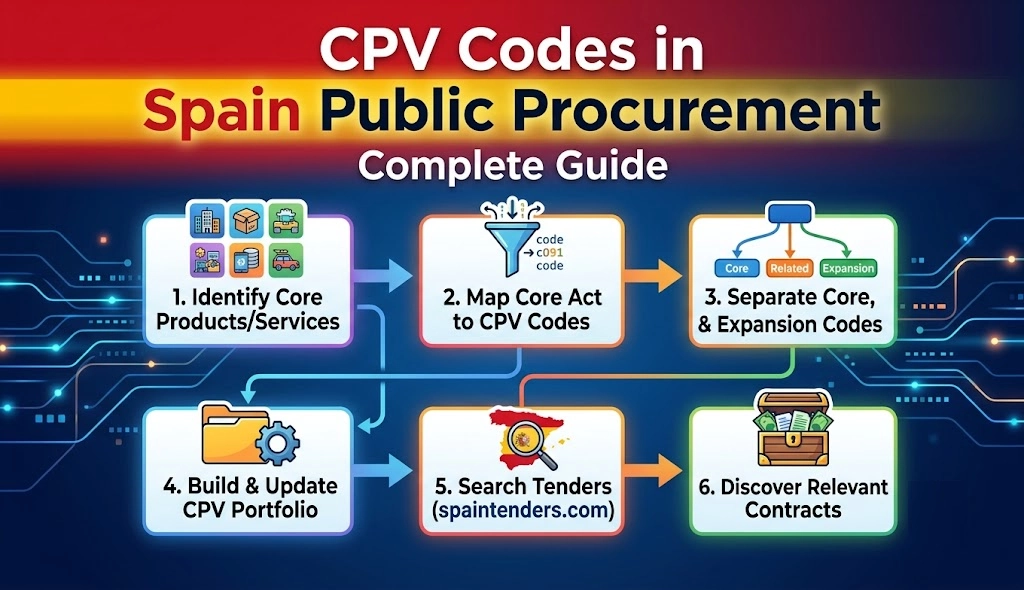
Suppliers can use CPV classifications as one component of a structured Spain tender search. The process should begin by identifying the company's actual products, services and capabilities and then mapping those activities to relevant CPV classifications.
- List the products and services the company can supply.
- Identify the corresponding CPV classifications.
- Separate broad codes from highly specific codes.
- Identify related codes that may capture the same commercial activity.
- Monitor relevant tenders using the selected CPV portfolio.
- Review the actual tender documentation before deciding whether an opportunity is relevant.
Suppliers can also use SpainTenders.com Spain tender search to discover procurement opportunities and combine CPV intelligence with other tender information.
How to Choose Relevant CPV Codes
Choosing CPV codes should begin with the company's actual commercial scope rather than with a random list of codes. A supplier should identify the goods or services it can realistically deliver and then determine which CPV classifications describe those activities.
It is useful to create three categories of CPV codes:
- Core CPV codes: codes directly representing the company's principal products or services.
- Related CPV codes: classifications covering adjacent products or services that the company can also provide.
- Expansion CPV codes: classifications connected with markets the company may enter in the future.
This approach can make tender monitoring more manageable while reducing irrelevant procurement results.
Why a Tender Can Have Multiple CPV Codes
Public contracts can contain several procurement components. For example, a contract may involve equipment supply together with installation, maintenance, technical support or related services. A contracting authority may therefore use multiple classifications to describe different elements of the requirement.
Suppliers should examine the relationship between the CPV codes rather than evaluating each code in isolation. The tender description, lots and technical documentation provide the context needed to determine the actual scope.
CPV Codes and Tender Keywords
CPV codes and keywords serve different but complementary purposes. Keywords describe procurement using words and phrases, while CPV provides a standardized classification structure.
Spanish procurement terminology can vary between contracting authorities. The same commercial activity may be described using different Spanish expressions, abbreviations or technical terms. CPV searching can therefore supplement keyword searching.
A strong monitoring strategy can combine CPV codes + Spanish keywords + contracting authority + location + procurement procedure. This creates a broader discovery framework than relying on a single search method.
Using CPV Codes for Industry-Specific Tender Research
CPV classification can be used to organize procurement research by industry. Companies in construction, information technology, healthcare, engineering, transportation, energy, telecommunications, security, consulting and other sectors can develop their own CPV portfolios.
For example, an IT company may need to monitor several related classifications covering hardware, software, information systems, maintenance and professional services rather than monitoring one general technology keyword.
The same principle applies to engineering companies, medical suppliers, construction contractors and professional service providers. The CPV portfolio should reflect the actual commercial activities the supplier wants to pursue.
Suppliers can also review procurement authorities through the SpainTenders.com authority directory and combine authority intelligence with CPV-based research.
Combining CPV Codes With Spanish Locations
CPV classification identifies the procurement subject, while geographic information identifies where the opportunity is located or which authority is conducting the procurement.
Combining the two can be useful for suppliers that operate only in particular Spanish autonomous communities, provinces or cities. A company may therefore create search combinations such as a selected CPV category together with Madrid, Andalucía, Catalonia, Valencia, Galicia or another target market.
This approach can reduce irrelevant results and help suppliers focus on procurement opportunities that match both their capabilities and geographic operating model.
Combining CPV Codes With Procurement Procedures
CPV codes identify the subject of procurement, while the procurement procedure explains how the contracting authority is conducting the award process.
Suppliers can therefore combine CPV research with procedure information when evaluating opportunities. For example, a company may monitor a particular CPV portfolio and separately identify open procedures, simplified procedures, restricted procedures or negotiated procedures that match its business requirements.
Understanding the procedure remains essential because CPV relevance does not mean that a supplier automatically satisfies the eligibility, qualification or submission requirements of the tender.
Using CPV Codes to Monitor Tender Deadlines
CPV codes are useful for identifying relevant opportunities, but deadline management is equally important. After identifying a tender through CPV classification, suppliers should record the submission deadline and allow sufficient time for eligibility checks, document preparation, electronic signatures and final submission.
Companies can also monitor contract awards associated with procurement categories to understand which types of organizations are purchasing particular goods and services. SpainTenders.com provides a dedicated Spain contract awards section for procurement award research.
Common CPV Code Search Mistakes
Several mistakes can reduce the usefulness of CPV-based tender research.
- Using only one CPV code: related procurement may be classified under additional codes.
- Choosing a code only from its number: the official description should always be reviewed.
- Using an overly broad classification: broad searches can generate a large amount of irrelevant procurement data.
- Using an overly narrow classification: relevant opportunities may be missed if the authority uses a related code.
- Ignoring tender documents: CPV does not replace technical and contractual review.
- Ignoring Spanish terminology: keyword variations can still be important for tender discovery.
- Not reviewing multiple lots: different lots can have different scopes and classifications.
- Failing to update the CPV portfolio: commercial activities and target markets can change over time.
Building a CPV-Based Spain Tender Strategy
A practical CPV strategy should be built around the company's actual procurement interests. Start with the products and services that represent the highest commercial relevance and identify their corresponding CPV classifications.
Next, add related classifications that may capture procurement opportunities with different terminology or broader scopes. The resulting CPV portfolio can then be used alongside Spanish keywords, geographic filters and contracting authority information.
Companies can also maintain historical records showing which CPV codes generate relevant tenders, which authorities repeatedly purchase those services and which procurement categories result in successful opportunities. This can turn CPV from a simple search filter into a procurement intelligence tool.
For companies that want to maintain a regular Spain tender workflow, register with SpainTenders.com and use the platform to support ongoing tender discovery.
CPV Codes for Foreign Companies
Foreign companies interested in Spanish public procurement can also use CPV classifications when researching the Spanish market. Because CPV is a European procurement classification system, it provides a standardized reference that can be useful when comparing procurement opportunities across European markets.
For an international supplier, CPV research can begin before entering the Spanish market. A company can identify relevant procurement categories, analyze Spanish purchasing activity and then examine individual tender requirements, qualification conditions and submission procedures.
Foreign suppliers should remember that CPV relevance does not establish eligibility. The company must separately assess the legal, technical, professional, financial and procedural requirements specified in each procurement process.
Finding Spain Tenders Using CPV Intelligence
CPV-based procurement intelligence becomes more useful when it is connected with broader tender information. Suppliers can combine CPV classifications with sector information, contracting authorities, locations, deadlines, procedures and contract awards.
SpainTenders.com can be used as part of this workflow. Suppliers can explore the SpainTenders.com sectors directory to identify procurement areas and use the platform's tender information to investigate opportunities relevant to their CPV portfolio.
Companies that require assistance with their tender research or procurement information can also use the SpainTenders.com contact page for further assistance.
CPV Tender Research Checklist
Before relying on a CPV-based Spain tender search strategy, suppliers should check the following:
- Identify the company's core products and services.
- Map each core activity to relevant CPV classifications.
- Separate core, related and expansion CPV codes.
- Review the official description of every selected CPV code.
- Monitor more than one relevant classification where appropriate.
- Combine CPV research with Spanish procurement keywords.
- Use geographic information where location matters.
- Review contracting authorities purchasing within the selected category.
- Check procurement procedure requirements.
- Record submission deadlines.
- Review the complete tender documentation.
- Track contract awards and historical procurement activity.
- Regularly review and update the CPV portfolio.
Conclusion
CPV codes provide a standardized way to classify the subject of public procurement contracts and are an important part of tender intelligence for suppliers targeting the Spanish public procurement market. Their hierarchical structure allows procurement activity to be analyzed at broad and highly specific levels.
For suppliers searching Spain tenders, CPV should be used together with keywords, locations, contracting authorities, procedures, deadlines and detailed tender documents. A carefully developed CPV portfolio can improve procurement discovery and help companies organize their tender monitoring more systematically.
CPV classification is a discovery and categorization tool rather than a replacement for tender evaluation. The final decision to participate should always be based on the complete procurement notice, technical specifications, qualification requirements, contractual conditions and submission instructions.
For ongoing research into Spanish public procurement opportunities, suppliers can use SpainTenders.com Spain tenders, review Spain contract awards and access their account through the SpainTenders.com login page.
Frequently Asked Questions (FAQs)

Fresh and verified Tenders from Spain. Find, search and filter Tenders/Call for bids/RFIs/RFPs/RFQs/Auctions published by the government, public sector undertakings (PSUs) and private entities.
- 1,000+ Tenders
- Verified Tenders Only
- New Tenders Every Day
- Tenders Result Data
- Archive & Historical Tenders Access
- Consultants for RFI/RFP/RFQ
- Tender Notifications & Alerts
- Search, Sort, and Filter Tenders
- Bidding Assistance & Consulting
- Customer Support
- Publish your Tenders
- Export data to Excel
- API for Tender Data
- Tender Documents

Fill out the form below and you will receive a call from us within 24 hours.
Get FREE SAMPLE TENDERS from Spain in your email inbox.
Copyright © 2014-2026 SpainTenders.com. All Rights Reserved.