Eight Years Later, Brussels Money Finds a Cantabrian Railway Signalling Contract
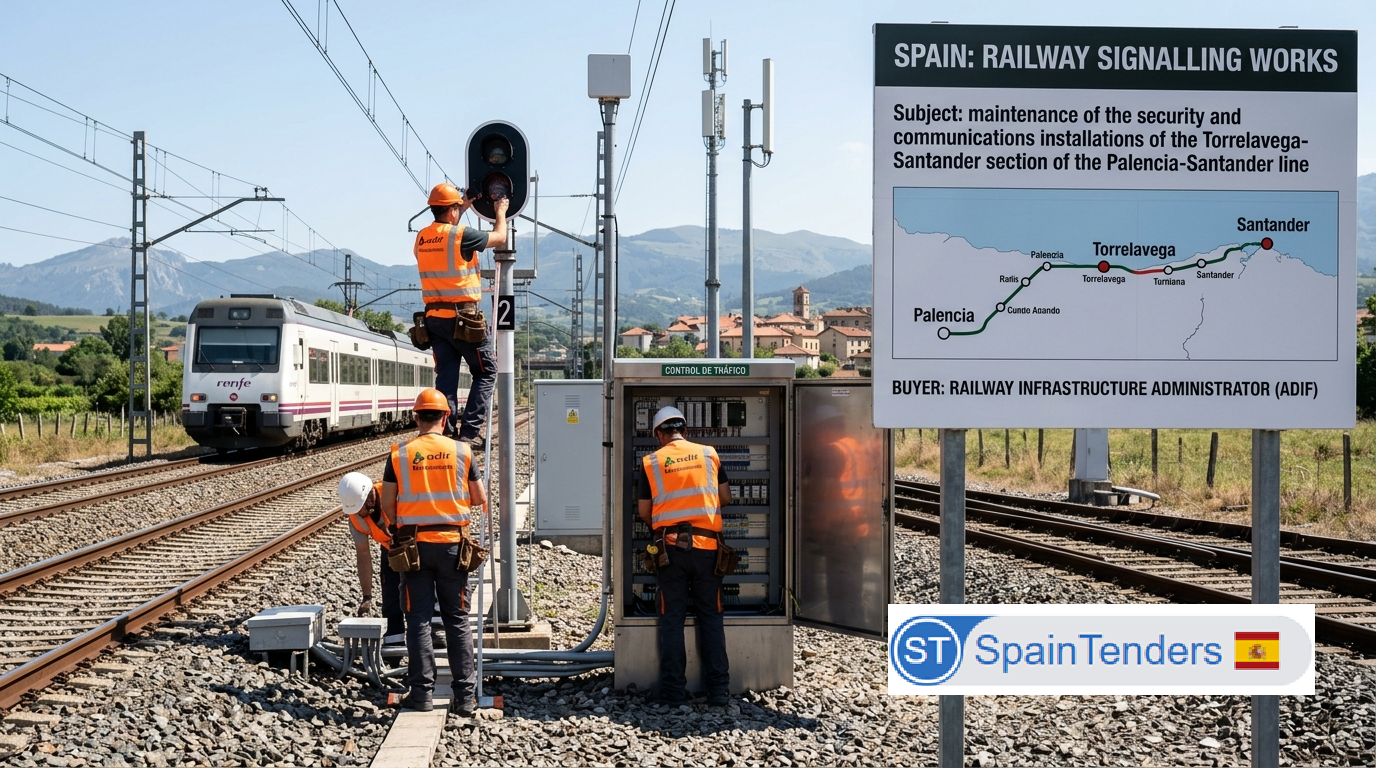
Standfirst
Spain's national rail infrastructure manager ADIF has updated the public record for a EUR 19 547 338.40 railway signalling contract on the Torrelavega to Santander line originally awarded in 2018, to confirm it is now co-financed under the European Regional Development Fund's 2021 to 2027 programme. The change notice adds no new construction activity, only a fresh EU funding designation to a contract signed nearly eight years ago.
Introduction
Not every entry in the EU's procurement record marks something new happening. This one marks Brussels catching up with Cantabria. ADIF, the Spanish state company that manages the country's railway infrastructure, has issued a formal update to a contract for signalling and communications works on the line between Torrelavega and Santander, a contract that was tendered back in 2017 and signed in September 2018.
What changed is not the work itself, long since contracted to a joint venture called UTE Torrelavega-Santander, but its funding status. ADIF has now recorded the contract as co-financed by the European Regional Development Fund under its current 2021 to 2027 programming period, a designation that ties an old regional rail project to the EU's present budget cycle.
Why This Contract Matters
Railway signalling and communications systems are what actually let trains run safely and on schedule, translating a physical track into a functioning, monitored railway. The Torrelavega to Santander section sits on the Palencia to Santander line, one of the principal rail corridors connecting Spain's Cantabria region on the northern coast with the rest of the country's network.
The funding update itself matters less for what it changes operationally, likely nothing, than for what it reveals about how EU structural funds get allocated and re-allocated to national infrastructure projects over time. A contract concluded under one EU budget period can later be tied to funding from a subsequent one, a bureaucratic mechanism worth understanding for anyone tracking how European regional development money actually flows into completed or ongoing national infrastructure work.
Contract Timeline
- Original tender notice: 00391945-2017
- Contract concluded: 27 September 2018
- Previous result notice now being updated: 491058-2018
- Notice dispatched to the Publications Office: 6 August 2026
- Published in the Official Journal, OJ S 151/2026: 7 August 2026
Contract Overview
ADIF ran an open procedure under the EU's Utilities Directive for the drafting of the construction project, execution of works and ongoing maintenance of safety and communications installations covering the Torrelavega to Santander section of the Palencia to Santander railway line, in Spain's Cantabria region. Six tenders were received and UTE Torrelavega-Santander, a temporary business consortium, was selected as the winner, with a tender valued at EUR 19 547 338.40, matching the total value recorded for the contract.
This notice is a formal change to the original 2018 result notice. Its stated reason is information updated and its description specifies EU financing as the subject of the change, adding that the contract is now co-financed by the European Regional Development Fund under its 2021 to 2027 programme.
Key Contract Details
| Contracting authority | Administrador de Infraestructuras Ferroviarias (ADIF) |
| Contract title | Drafting of the construction project, execution of works and maintenance of safety and communications installations, Torrelavega-Santander section, Palencia-Santander line |
| CPV codes | 45234115, Railway signalling works, plus 50225000, Railway-track maintenance services |
| Procedure type | Open procedure |
| Legal basis | Directive 2014/25/EU, the Utilities Directive |
| Contract value | EUR 19 547 338.40, excluding VAT |
| Award criteria | Cost 60 points, quality (technical offer) 40 points |
| Tenders received | 6, all electronic, 1 from an SME |
| Winner | UTE Torrelavega-Santander |
| Winner size classification | Large enterprise |
| Contract concluded | 27 September 2018 |
| GPA coverage | No |
| EU funding | Yes, European Regional Development Fund (ERDF), 2021/2027 programme |
| Framework structure | No framework agreement, direct contract |
| Subcontracting | No |
| Review body | ADIF, following the criteria of the Central Administrative Tribunal for Contractual Appeals |
| Notice reference | 547476 2026, OJ S 151/2026, published 7 August 2026, a change notice |
Project Scope
The contract covers three linked activities on the Torrelavega to Santander railway section: drafting the formal construction project documentation, executing the physical works and providing ongoing maintenance for the resulting safety and communications installations. Together these activities cover the signalling systems that control train movements safely along this stretch of the Palencia to Santander line in Cantabria, in northern Spain.
The change recorded in this notice is narrowly scoped. It touches only the contract's funding information, specifically confirming co-financing through the European Regional Development Fund's 2021 to 2027 programme, described in the notice as covering the contract's identifier CON-0001. No changes to the physical scope, value or delivery of the underlying works are indicated.
About the Contracting Authority
Administrador de Infraestructuras Ferroviarias, ADIF, is a body governed by public law based in Madrid, active in general public services with a specific activity classification of railway services. ADIF is Spain's state owned manager of railway infrastructure, responsible for the construction, maintenance and administration of the national rail network, comparable to national rail infrastructure managers elsewhere in Europe.
About the Organisations Involved
Administrador de Infraestructuras Ferroviarias
As covered above, ADIF is the buyer for this contract and is also named as the review organisation, the body providing further procedural information and the body providing offline access to procurement documents, indicating ADIF handles these functions internally rather than delegating them to a separate entity, though it follows the criteria set by Spain's Central Administrative Tribunal for Contractual Appeals for any review matters.
UTE Torrelavega-Santander
UTE Torrelavega-Santander is the winning bidder, structured as a Unión Temporal de Empresas, a temporary business union, Spain's standard legal vehicle for consortiums bidding jointly on public works contracts. Based in Alcobendas, in the Madrid region and classified as a large enterprise, the consortium's registration under this single UTE designation reflects a common structure in large Spanish infrastructure tenders, though the notice does not separately name the individual member companies behind the union.
Procurement Analysis
The underlying contract was awarded through an open procedure back in 2018, evaluated on a 60 percent cost and 40 percent quality split, with six tenders competing, a solid field for a specialised railway signalling contract of this value. That competitive process is now nearly eight years in the past and this notice does not reopen or revisit it in any way.
What this notice actually documents is a funding reclassification. ADIF has formally recorded that European Regional Development Fund money from the EU's current 2021 to 2027 budget period now co-finances this contract. Since the contract itself dates to 2018, well within the EU's previous 2014 to 2020 funding period, this update likely reflects either a shift in which EU budget cycle now covers reimbursement for ongoing maintenance obligations under the contract or an administrative correction bringing the notice's funding metadata in line with current financial reporting requirements. The notice itself does not explain the underlying reason for the change beyond describing it as an information update concerning EU financing.
Additional Procurement Facts
- This contract is confirmed as not covered by the Government Procurement Agreement.
- The winning tender is recorded as not a variant bid, with no subcontracting involved.
- All six tenders received were submitted electronically and one came from a micro, small or medium enterprise.
- No tenders were received from bidders registered in other European Economic Area countries or beyond, indicating this was a domestically contested tender.
Market and Industry Perspective
Railway signalling remains a specialised segment of infrastructure contracting, typically dominated by consortiums combining civil works and signalling technology expertise, as reflected in the UTE structure used to win this contract. ADIF's continued administrative maintenance of contracts this old, updating their EU funding status years after signature, illustrates how large infrastructure operators must keep even long settled contracts current within evolving EU financial reporting frameworks as funding periods roll over.
Economic Significance
At EUR 19 547 338.40, this is a moderate scale regional railway signalling contract, its economic significance today lying less in new spending than in demonstrating how EU regional development funding continues to support Spain's rail network modernisation across successive multi year budget cycles, connecting infrastructure investment decisions made under one EU funding period to financial administration carried out years later under the next.
Future Procurement Opportunities
Because this notice reports a funding update to a historical contract rather than new work, it does not itself signal a fresh procurement opportunity. It does, however, point to ADIF's ongoing activity maintaining and funding rail signalling infrastructure across its network, an area where further tenders are a reasonable expectation as Spain continues to renew and expand its railway signalling systems.
Opportunities for Suppliers
Railway signalling and infrastructure specialists working with ADIF should treat this notice mainly as a reminder of the agency's ongoing reliance on EU regional development funding to support its rail modernisation programme in regions like Cantabria. Firms with track records on ADIF signalling contracts, including through consortium structures like the UTE model used here, remain well positioned for future tenders as similar EU co-financed opportunities emerge.
What Businesses Should Watch
- Whether ADIF issues similar funding update notices for other older rail infrastructure contracts as EU funding periods transition.
- New ADIF tenders for railway signalling and communications work across other lines within its network.
- How Spain continues to allocate 2021 to 2027 European Regional Development Fund resources across its regional rail infrastructure programme.
SpainTenders.com Procurement Intelligence
This notice is a useful reminder that the EU's procurement transparency record captures more than competitive tendering activity, it also captures the ongoing administrative life of contracts long after they are signed. An eight year old railway signalling contract resurfacing solely to update its EU funding designation reflects the layered, multi year nature of European structural fund accounting, where financing decisions can be revisited and reclassified well after the underlying works were contracted or even completed.
For businesses tracking EU funded infrastructure investment, this kind of notice is a signal worth reading carefully rather than dismissing as routine housekeeping. It confirms that European Regional Development Fund resources under the current 2021 to 2027 period are actively being applied to Spain's rail network, including to projects with roots stretching back to the previous funding cycle, a pattern likely to recur as EU member states continue reconciling multi year infrastructure programmes against successive Brussels budget periods.
Strategically, the lesson for suppliers and analysts alike is to treat TED publication dates as only one data point among several. A notice appearing today may reflect genuinely new competitive activity or, as here, it may be the latest chapter in a contract's administrative history stretching back the better part of a decade, with real implications for how EU funding flows are tracked but none for who is currently competing for new work.
Supplier Takeaways
- This notice updates funding information only, it does not reflect a new competitive tender or reopen the original 2018 award.
- The original contract was awarded on a 60 percent cost, 40 percent quality basis, a useful benchmark for ADIF's typical evaluation approach on signalling works.
- Six tenders competed for the original contract, all domestic, suggesting this remains a market served primarily by Spanish infrastructure consortiums.
- ADIF's use of the UTE consortium structure for its signalling contracts reflects a common and effective route for combining civil works and signalling technology expertise.
- EU Regional Development Fund financing continues to support ADIF's rail modernisation work across successive funding periods, a pattern relevant to firms tracking EU backed infrastructure opportunities.
Key Takeaways
- ADIF issued a change notice updating the EU funding status of a EUR 19 547 338.40 railway signalling contract on the Torrelavega-Santander line originally signed in September 2018.
- The contract is now recorded as co-financed by the European Regional Development Fund under its 2021 to 2027 programme.
- The winning bidder, UTE Torrelavega-Santander, was selected from a field of six tenders in the original 2018 award.
- No new construction activity, competitive process or change in contract value is indicated by this notice.
- The update reflects the ongoing administrative reconciliation of EU structural funds against Spain's rail infrastructure contracts over time.
Conclusion
This notice is not news about a new railway contract, it is a small but genuine window into how European infrastructure funding actually gets administered over the long life of a project. A signalling contract signed in Cantabria in 2018 has just been formally reconnected to the EU's current budget cycle, a reminder that Brussels' regional development money keeps working and keeps being tracked, long after the ribbon cutting.
Source: Tenders Electronic Daily (TED), Contract Award Notice 547476-2026, Official Journal of the European Union, OJ S 151/2026, published on 7 August 2026.
Frequently Asked Questions (FAQs)

Fresh and verified Tenders from Spain. Find, search and filter Tenders/Call for bids/RFIs/RFPs/RFQs/Auctions published by the government, public sector undertakings (PSUs) and private entities.
- 1,000+ Tenders
- Verified Tenders Only
- New Tenders Every Day
- Tenders Result Data
- Archive & Historical Tenders Access
- Consultants for RFI/RFP/RFQ
- Tender Notifications & Alerts
- Search, Sort, and Filter Tenders
- Bidding Assistance & Consulting
- Customer Support
- Publish your Tenders
- Export data to Excel
- API for Tender Data
- Tender Documents

Fill out the form below and you will receive a call from us within 24 hours.
Get FREE SAMPLE TENDERS from Spain in your email inbox.
Copyright © 2014-2026 SpainTenders.com. All Rights Reserved.