How to Read a Spanish Public Tender Notice : Complete Guide
Learn How to Read, Screen and Understand Key Information in Spanish Public Tender Notices
Introduction
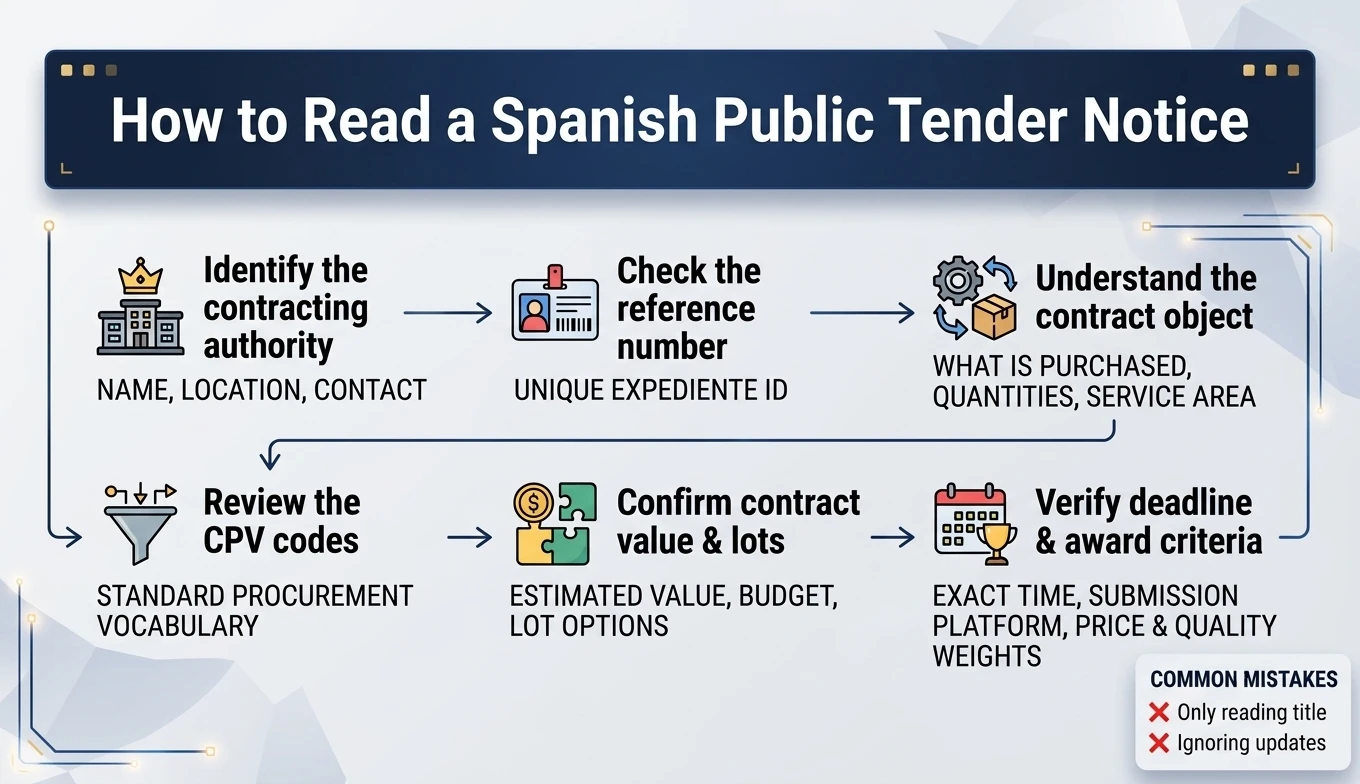
Finding a Spanish public tender is only the first step. Before deciding whether to bid, suppliers need to understand the information contained in the official tender notice and identify the key details that determine whether the opportunity is relevant, achievable and worth pursuing.
A Spanish public tender notice, commonly referred to as an anuncio de licitación, provides the essential information about a procurement procedure. It can identify the contracting authority, contract object, CPV code, contract value, procedure, lots, location, submission deadline, award criteria and other important conditions.
For companies searching for licitaciones España, learning how to read this information quickly can significantly improve tender screening. The objective is not to understand every legal document immediately but to determine what is being purchased, who is buying it, how much the opportunity is worth, when the bid must be submitted and whether the company can realistically participate.
This guide explains how to read a Spanish public tender notice step by step and what suppliers should check before moving from tender discovery to detailed bid preparation.
Table of Contents
- What Is a Spanish Public Tender Notice?
- Why Should Suppliers Read the Notice Carefully?
- Identify the Contracting Authority
- Check the Tender Reference Number
- Understand the Contract Object
- Check the CPV Codes
- Check the Contract Type
- Identify the Procurement Procedure
- Check Whether the Tender Has Lots
- Check Contract Location and Scope
- Understand Contract Value and Budget
- Check Contract Duration and Extensions
- Check Supplier Eligibility
- Understand the Award Criteria
- Check the Tender Submission Deadline
- Check How the Tender Must Be Submitted
- Check Language and Document Requirements
- Open the Complete Tender Documents
- Check Corrections and Tender Updates
- How to Screen a Spanish Tender Quickly
- Common Mistakes When Reading Tender Notices
- How Foreign Companies Should Read Spanish Tender Notices
- SpainTenders.com Procurement Intelligence
- Conclusion
What Is a Spanish Public Tender Notice?
A Spanish public tender notice is the published announcement that provides key information about a procurement competition. In Spanish procurement terminology, it is commonly referred to as an anuncio de licitación.
Under Spain's public procurement framework, tender notices for public administration contracts are published through the relevant contracting profile, with additional publication requirements applying in certain circumstances. Contracts subject to harmonised regulation may also require publication in the Official Journal of the European Union.
The notice is therefore an important starting point for suppliers. However, it should not be confused with the complete tender documentation. The notice provides the initial procurement information while the detailed procurement documents contain the full administrative, technical and contractual requirements.
Why Should Suppliers Read the Notice Carefully?
A tender notice can help a supplier decide whether an opportunity deserves further investigation.
Before spending time preparing a technical proposal or calculating a detailed bid price, a supplier should establish several basic facts:
- Who is purchasing?
- What is being purchased?
- Where will the contract be performed?
- What is the estimated value or budget?
- What procurement procedure is being used?
- Is the opportunity divided into lots?
- What CPV codes are associated with the contract?
- When is the submission deadline?
- How must the offer be submitted?
- What are the main eligibility and award requirements?
This initial screening helps suppliers separate relevant opportunities from tenders that do not match their capabilities or commercial objectives.
Identify the Contracting Authority
The first item to check is the contracting authority. The authority is the public organisation or contracting entity purchasing the goods, services or works.
The notice can provide the authority's name and contact or procurement information. This information is useful because the identity of the purchaser can reveal the sector, geographic market and type of procurement activity involved.
For example, a tender issued by a municipality may have very different operational requirements from one issued by a national ministry, public hospital, university or public company.
Suppliers can also use contracting-authority information to research previous procurement activity and identify related opportunities.
Check the Tender Reference Number
Spanish tender records normally contain a procurement reference or expediente identifier. This reference is important when communicating with the contracting authority or locating the same procurement record across procurement systems.
Record the reference number when evaluating an opportunity. It can also help prevent confusion when a contracting authority publishes several tenders with similar titles.
When contacting a procurement authority about a specific opportunity, including the official reference can make the communication more precise.
Understand the Contract Object
The object of the contract explains what the contracting authority intends to purchase.
Do not rely only on the tender title. A short title may not describe the complete scope of the procurement. Read the description carefully and identify the actual products, services or works required.
Pay attention to quantities, service areas, technical scope, implementation requirements and any stated options.
A supplier should be able to explain the contract in one or two sentences after reading the notice. If the scope remains unclear, the next step should be to open the detailed procurement documentation.
Check the CPV Codes
CPV stands for Common Procurement Vocabulary. CPV codes are used to describe the subject matter of public procurement contracts and help classify procurement opportunities.
EU procurement rules provide for CPV codes in contract notices, including separate information where a contract is divided into lots.
Suppliers should compare the CPV code with the actual description rather than relying on the code alone. A tender can contain more than one CPV code, and the principal code may not capture every aspect of a complex procurement.
For tender discovery, CPV is particularly useful because suppliers can search procurement opportunities according to the products, works or services being purchased.
Check the Contract Type
Identify whether the procurement concerns works, supplies or services, or another applicable contract category such as a concession.
The contract type provides important context for understanding the tender. A supply contract may focus on delivery of products, while a service contract may involve ongoing performance and a works contract may involve construction or related activities.
Knowing the contract type also helps suppliers assess whether the opportunity matches their business model and operational capacity.
Identify the Procurement Procedure
The notice should identify the procurement procedure being used. Depending on the procurement, suppliers may encounter procedures such as procedimiento abierto, simplified open procedures, restricted procedures, competitive procedures with negotiation and other legally available procedures.
The procedure affects how suppliers participate. In an open procedure, eligible economic operators can generally submit an offer in response to the call for competition. Other procedures can involve selection stages, invitations or negotiations.
Do not assume that every tender follows the same submission process. Confirm the procedure before preparing the bid.
For a detailed explanation of Spanish procurement procedures, suppliers can refer to the earlier guide on Spain Tender Procedures Explained.
Check Whether the Tender Has Lots
Many procurement opportunities can be divided into lots. A lot represents a separately identifiable part of the procurement that can have its own scope, value, requirements or award outcome.
When a tender contains multiple lots, do not evaluate the opportunity only at the overall tender level. Check each lot individually.
- Lot description
- Lot-specific CPV information
- Lot value
- Location
- Technical requirements
- Eligibility conditions
- Award criteria
- Submission requirements
A supplier may be able to bid for one lot without bidding for every lot, depending on the rules stated in the tender documents.
Check Contract Location and Scope
Location is particularly important for Spanish public tenders involving construction, maintenance, transport, healthcare, facility management, catering, security or other services requiring physical presence.
Check where the works must be performed, where goods must be delivered or where services must be provided.
For companies operating across Spain, location information can help determine whether local staff, facilities, logistics, subcontractors or other resources will be required.
Understand Contract Value and Budget
Contract notices can provide financial information such as estimated value, budget information or other applicable amounts. Suppliers should understand exactly what each amount represents before using it for commercial analysis.
Do not automatically treat an advertised figure as the amount that will be paid to the successful bidder. The notice and procurement documents may distinguish between estimated contract value, base tender budget, taxes and other financial components.
Where the procurement is divided into lots, examine the financial information for each lot.
Check Contract Duration and Extensions
The notice may indicate the expected contract duration and, where applicable, options for extensions or renewals.
Duration matters because it affects resource planning, staffing, inventory, financing and expected revenue. A contract lasting several years can require a substantially different delivery model from a short-term purchase.
Always compare the duration stated in the notice with the detailed contractual provisions before finalising commercial assumptions.
Check Supplier Eligibility
The notice can provide initial information about participation requirements, but suppliers should not assume that the summary information contains every qualification requirement.
Look for indications concerning professional capacity, economic and financial standing, technical and professional ability, classification, professional registrations or other participation conditions.
For the complete requirements, open the PCAP and other procurement documents associated with the tender.
Understand the Award Criteria
The award criteria explain the basis on which submitted offers will be evaluated. Spanish procurement law requires the criteria used for awarding contracts to be linked to the contract object and formulated objectively while respecting principles including equality, non-discrimination, transparency and proportionality.
The notice should provide information about the criteria used for the procurement. Suppliers should examine whether the evaluation is based primarily on price, quality, technical characteristics, methodology, service levels or a combination of factors.
Do not assume that the lowest price automatically determines the outcome. The applicable award methodology must be checked in the tender documentation.
Check the Tender Submission Deadline
The submission deadline is one of the most important pieces of information in the tender notice.
Record the exact date and time. Do not rely on a general statement such as “closing soon” or an internal calendar reminder without checking the official tender record.
Spanish procurement law requires contracting authorities to establish submission periods taking into account the time reasonably necessary to prepare offers while respecting applicable statutory minimum periods.
Suppliers should also allow sufficient time for document preparation, electronic signing, technical validation and final submission.
Check How the Tender Must Be Submitted
Check whether the tender requires electronic submission and identify the platform or electronic procurement system that must be used.
For electronic procurement, suppliers should verify their account access, electronic certificate, signature software and required submission process before the final day.
The EU framework for contract notices includes information concerning electronic submission and other electronic procurement arrangements where applicable.
A supplier should never wait until the final minutes to discover that a certificate is expired, a user account is not authorised or a required submission platform has technical requirements that have not been tested.
Check Language and Document Requirements
Review the language requirements for the tender and identify whether documents must be prepared in Spanish or another permitted language.
For international suppliers, this is particularly important because company documents, declarations, certificates and technical materials may originate in another country.
Check the procurement documents for any specific translation, certification or document-format requirements before preparing the final bid.
Open the Complete Tender Documents
The tender notice should be treated as the beginning of the review process rather than the complete tender itself.
Once a supplier decides that an opportunity is potentially relevant, open the complete procurement documentation. Review the PCAP, PPT, DEUC where applicable, annexes, pricing templates, declarations and other documents.
The notice tells you whether the opportunity appears relevant. The procurement documents tell you what must actually be submitted and what contractual and technical conditions apply.
Check Corrections and Tender Updates
A tender record can be updated after its initial publication. Corrections, clarifications, amendments or other communications can affect the information suppliers need to use when preparing their offers.
This is why suppliers should not save a tender notice once and then work exclusively from the original information.
Before submission, check the official tender record again for updates and confirm that the documents being used are the latest applicable versions.
How to Screen a Spanish Tender Quickly
Experienced tender teams can use a structured first-pass screening process before investing significant bid-preparation resources.
| Check | Question |
| Authority | Who is buying? |
| Object | What is being purchased? |
| CPV | Does the procurement match our products or services? |
| Location | Can we deliver or perform the contract there? |
| Value | Is the opportunity commercially relevant? |
| Procedure | How can we participate? |
| Lots | Which lot or lots are relevant? |
| Eligibility | Can we satisfy the participation requirements? |
| Award criteria | Can we compete under the stated evaluation method? |
| Deadline | Can we prepare and submit a compliant bid on time? |
If an opportunity passes this initial screen, the supplier can proceed to detailed document analysis.
Common Mistakes When Reading Tender Notices
Reading only the title: A tender title may be too short to describe the complete scope.
Ignoring the CPV: The CPV can provide useful classification information that supports tender screening.
Missing lots: A supplier may incorrectly assume that the entire procurement must be bid as one package.
Ignoring the deadline: A relevant tender has little practical value if there is insufficient time to prepare a compliant submission.
Confusing estimated value with guaranteed revenue: Financial figures need to be interpreted using the definitions in the procurement documentation.
Not checking the award criteria: Suppliers should understand how offers will be evaluated before investing heavily in bid preparation.
Stopping at the notice: The notice is not a substitute for the full tender documentation.
Ignoring updates: Amendments and clarifications can change the information applicable to the procurement.
How Foreign Companies Should Read Spanish Tender Notices
Foreign companies should apply the same basic screening process but pay additional attention to geographic scope, eligibility, professional requirements, language, electronic submission, supporting documents and evidence of technical and financial capacity.
For EU suppliers, cross-border procurement can involve European procurement mechanisms and standardised information requirements. For companies from outside Spain or outside the EU, the specific participation rules in the tender documentation should be examined carefully.
A foreign supplier should also determine whether it can meet practical delivery or service requirements in Spain, including local staffing, logistics, installation, maintenance, customer support or other obligations.
SpainTenders.com Procurement Intelligence
For companies looking for Spanish public procurement opportunities, SpainTenders.com can provide a broader tender-discovery workflow across procurement categories, contracting authorities and business sectors.
Suppliers can browse Spain Tenders to identify current opportunities and use SpainTenders.com Authorities to research contracting organisations.
Businesses can also explore SpainTenders.com Sectors when screening opportunities according to their products or services. Users can access their account through SpainTenders.com Login or create an account through SpainTenders.com Registration.
Reviewing Spain contract awards can also provide information about completed procurement activity and awarded contracts.
For questions about tender intelligence, suppliers can use the SpainTenders.com Contact page.
Conclusion
Reading a Spanish public tender notice effectively is an important part of the tender-screening process. Suppliers should begin with the contracting authority, tender reference, contract object, CPV codes, contract type, procedure, lots, location, value and duration.
They should then examine eligibility requirements, award criteria, submission method, language requirements and the exact deadline. If the opportunity passes the initial screening stage, the supplier should move to the complete procurement documentation and review the PCAP, PPT, DEUC where applicable and supporting annexes.
The most important principle is simple: use the tender notice to decide whether an opportunity deserves detailed analysis, then use the complete procurement documentation to prepare the bid.
For companies targeting licitaciones España, developing a consistent tender-notice screening process can make opportunity identification more efficient and reduce the risk of overlooking important procurement information.
Frequently Asked Questions (FAQs)

Fresh and verified Tenders from Spain. Find, search and filter Tenders/Call for bids/RFIs/RFPs/RFQs/Auctions published by the government, public sector undertakings (PSUs) and private entities.
- 1,000+ Tenders
- Verified Tenders Only
- New Tenders Every Day
- Tenders Result Data
- Archive & Historical Tenders Access
- Consultants for RFI/RFP/RFQ
- Tender Notifications & Alerts
- Search, Sort, and Filter Tenders
- Bidding Assistance & Consulting
- Customer Support
- Publish your Tenders
- Export data to Excel
- API for Tender Data
- Tender Documents

Fill out the form below and you will receive a call from us within 24 hours.
Get FREE SAMPLE TENDERS from Spain in your email inbox.
Copyright © 2014-2026 SpainTenders.com. All Rights Reserved.