Hospital Universitario Severo Ochoa Awards €303,800 Critical Care Software Contract
Winning B2B Healthcare IT Tenders, Critical Care Information Systems, Hospital Software Solutions, and Eprocurement in Spain & Europe
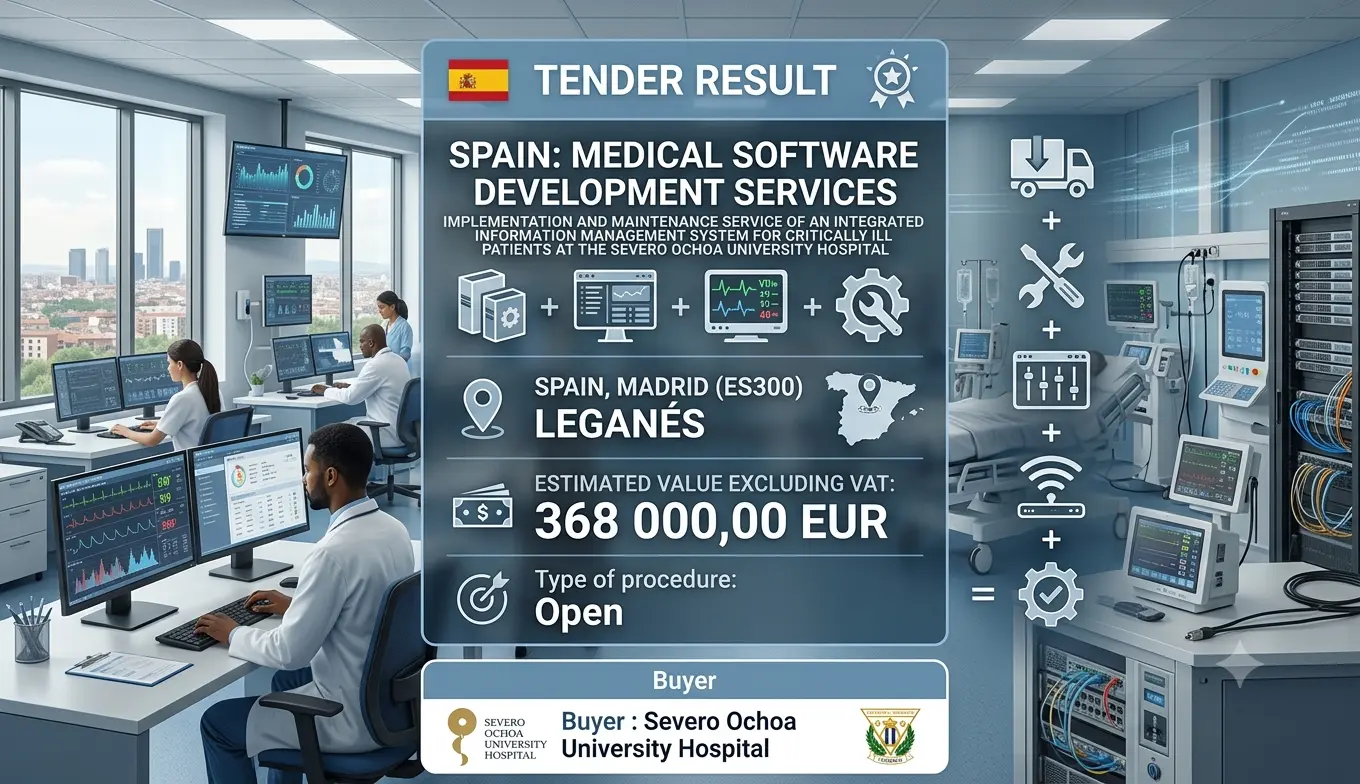
Standfirst
Madrid's Hospital Universitario Severo Ochoa has awarded a contract to implement and maintain an integrated information management system for critically ill patients. The contract, worth EUR 239,580, went to Philips Ibérica, S.A.U. after a competition that attracted three bids. The estimated contract value was EUR 368,000, meaning the winning bid came in well below the authority's own estimate. The system is intended to consolidate how intensive care teams record, retrieve and act on patient data.
Introduction
In an intensive care unit, information moves fast and the margin for error is thin. A patient's heart rate, blood pressure, oxygen levels, ventilator settings, medication doses and test results all change minute by minute. If those data points live in different systems, or on paper, clinicians spend time hunting for information instead of acting on it.
Hospitals across Europe have been investing in integrated clinical information systems to solve this problem. These systems pull data from bedside monitors, laboratory systems, pharmacy records and imaging into a single view. The goal is not technology for its own sake. It is faster decisions, fewer transcription errors and a clearer record of what was done and why.
The Hospital Universitario Severo Ochoa, a public hospital in Leganés, south of Madrid, has now taken a step in that direction. It has awarded a contract to Philips Ibérica, S.A.U. to implement and maintain an integrated information management system for its critical care areas. The contract is modest in value but significant in function: it will shape how clinicians in one of Madrid's busiest hospital regions record and use patient data.
Why This Contract Matters
Critical care information systems sit at the heart of hospital operations. They are not administrative tools. They are clinical tools, used by doctors and nurses making decisions about patients who are often unable to speak for themselves. When these systems work well, they reduce cognitive load and free clinicians to focus on care. When they work badly, they add friction to an already demanding environment.
This contract matters because it is a full implementation and maintenance engagement, not a simple software purchase. Philips Ibérica is not just supplying a product. It is installing it, configuring it, integrating it with existing hospital systems and supporting it over time. The award criteria reflect that: price carried 70 points, while three quality criteria covering on-site support, integration with the regional Selene system and adaptability to critical care workflows accounted for the remaining 30 points.
It also matters because of the competition. Three bids were received, which is a healthier outcome than the single-bid procurements seen in some recent Spanish health and IT contracts. One of those bids came from an SME. The authority therefore had a genuine choice, and the winning bid came in below the estimated value.
Contract Timeline
- Previous notice: 843862-2025
- Winner selected: 7 August 2026
- Contract concluded: 15 September 2026
- Notice dispatched: 1 October 2026
- Notice published: 2 October 2026
- Estimated duration: 12 months
- Maximum renewals: 27
Contract Overview
The contract covers the implementation and maintenance of an integrated information management system for critical patients at the Hospital Universitario Severo Ochoa. It is a services contract, classified under CPV 72212180 (medical software development services), with an additional classification of CPV 72267100 (maintenance of information technology software).
It is a single-lot procurement, identified as LOT-0001, with the internal identifier "LOTE 1" and the procedure reference PA 105-2025. The place of performance is the hospital itself, at Avenida Orellana s/n, Leganés, postcode 28911, in the Madrid NUTS region (ES300).
The estimated contract value excluding VAT was EUR 368,000. The awarded value was EUR 239,580, which was also the value of the winning tender. The contract has an estimated duration of 12 months, with a maximum of 27 renewals recorded in the notice. The notice does not explain how those renewals are structured or what period they cover.
The procurement was conducted as an open procedure under Directive 2014/24/EU. It is not a framework agreement and does not use a dynamic purchasing system. It is not financed with EU funds and is not covered by the Government Procurement Agreement.
Key Contract Details
| Notice ID | 680672-2026 |
| OJ S issue | 191/2026 |
| Publication date | 2 October 2026 |
| Contracting authority | Hospital Universitario Severo Ochoa |
| Contract type | Services |
| Main CPV code | 72212180 – Medical software development services |
| Additional CPV code | 72267100 – Maintenance of information technology software |
| Procedure type | Open procedure |
| Legal basis | Directive 2014/24/EU |
| Lot | LOT-0001 |
| Winner | Philips Ibérica, S.A.U. |
| Winning bid | EUR 239,580.00 |
| Estimated value excluding VAT | EUR 368,000.00 |
| Number of bids | 3 |
| Award criteria | Price – 70 points; on-site support technician after system go-live – 5 points; certificates showing Spanish healthcare centres with the offered system integrated with Selene – 5 points; solution's ability to adapt to critical area workflows – 10 points; technical capabilities of the offered solution for critical areas – 10 points |
| Estimated duration | 12 months |
| Maximum renewals | 27 |
| Framework agreement | No |
| Dynamic purchasing system | No |
| EU funding | No |
| GPA covered | No |
| Subcontracting | No |
| SME participation | 1 SME tender received |
| Contract identifier | 64/2026 |
Project Scope
The scope is the implementation and maintenance of an integrated information management system for critical patients. The notice does not describe the technical specification in detail, but the award criteria reveal what the hospital cared about.
One criterion rewards the provision of an on-site support technician after the system goes live. This suggests the hospital expects a period of intensive support during the early operational phase, when clinicians are still learning the system and problems need to be resolved quickly.
A second criterion rewards certificates showing that Spanish healthcare centres have integrated the offered system with Selene. Selene is a regional clinical information system used in the Madrid health service. Integration with Selene is therefore a practical requirement: the new critical care system must be able to exchange data with the wider regional record.
Two further criteria relate to the solution's ability to adapt to critical care workflows and its technical capabilities for critical areas. Together, these four quality criteria account for 30 points out of 100, with price taking the remaining 70.
The notice does not name the specific product being implemented, the number of beds or units covered, the integration methods, or the maintenance arrangements beyond the contract duration and renewal count. The contracting authority has not disclosed this information.
About the Contracting Authority
The buyer is the Hospital Universitario Severo Ochoa, a public hospital located in Leganés, in the Community of Madrid. It is classified as a regional authority with health as its main activity. Its registration number is Q2869090G, and its procurement department is listed as "Suministros."
The hospital is part of the Madrid public health system, which is administered by the Servicio Madrileño de la Salud. Its buyer profile is hosted on the Community of Madrid's public procurement platform at contratos-publicos.comunidad.madrid. Its contact email for procurement matters is contratacion.hsvo@salud.madrid.org.
The hospital is both the buyer and the organisation signing the contract. It also operates under the review jurisdiction of the Tribunal Administrativo de Contratación Pública de la Comunidad de Madrid, which handles procurement disputes for Madrid's public sector.
About the Organisations Involved
Hospital Universitario Severo Ochoa
The Hospital Universitario Severo Ochoa is the contracting authority. It is a public hospital serving the Leganés area and the wider southern Madrid region. Its role in this procurement is as buyer and signatory of the contract.
The hospital is classified as a regional authority with health activity. It is registered under number Q2869090G. Its address is Avenida Orellana s/n, Leganés, 28911, Madrid. It uses the Community of Madrid's procurement platform as its buyer profile.
The hospital defined the requirements for the critical care information system, ran the open procedure, evaluated the three bids and concluded the contract with Philips Ibérica. It will manage the implementation and the subsequent maintenance arrangement.
Philips Ibérica, S.A.U.
Philips Ibérica, S.A.U. is the winning bidder. It is classified as a large economic operator. Its registration number is A28017143, and its registered office is at Calle María de Portugal, nº 1, Madrid, postcode 28050, in the Madrid NUTS region (ES300). Its beneficial owner is listed as Philips Ibérica, S.A.U. itself, with Spanish nationality.
Philips is a multinational health technology company with a long-standing presence in Spain. Its Spanish subsidiary submitted the winning tender for LOT-0001, valued at EUR 239,580. It declared no subcontracting. The notice does not disclose which specific Philips product or platform will be implemented, nor how the implementation will be resourced. The contracting authority has not disclosed this information.
Philips' role is as tenderer and winner of LOT-0001. It will implement the system, integrate it with the hospital's existing environment, and provide maintenance over the contract period.
Tribunal Administrativo de Contratación Pública de la Comunidad de Madrid
The Tribunal Administrativo de Contratación Pública de la Comunidad de Madrid is the regional administrative tribunal that reviews public procurement decisions in Madrid. It is listed as the review organisation and the organisation providing more information on review procedures.
Its registered office is at Plaza de Chamberí, 8, 5ª planta, Madrid, 28013. Its email is tribunal.contratacion@madrid.org. Its role is to hear appeals from bidders who believe a procurement has been conducted improperly.
Publications Office of the European Union
The Publications Office of the European Union is listed as the TED eSender. Its role is administrative: it operates Tenders Electronic Daily, the official journal supplement where EU procurement notices are published. It is based in Luxembourg and is not involved in the procurement itself.
Other organisations
The notice does not list the non-winning tenderers by name. It records that three bids were received, one of which came from an SME, but it does not identify the other bidders. No consortium members, framework participants or subcontractors are disclosed. No other organisation materially affects the understanding of this award.
Procurement Analysis
The procurement was conducted as an open procedure under Directive 2014/24/EU. The open procedure is the standard route for a contract of this size and allows any qualifying supplier to bid.
The evaluation was structured around five criteria. Price carried 70 points out of 100, making it the dominant factor. Four quality criteria accounted for the remaining 30 points: an on-site support technician after go-live (5 points), certificates of Selene integration at Spanish healthcare centres (5 points), the solution's ability to adapt to critical area workflows (10 points), and the technical capabilities of the solution for critical areas (10 points).
This is a moderately quality-sensitive evaluation. With 70% of the score determined by price, cost remains the primary consideration, but a bidder offering a technically stronger solution and better post-implementation support could close a meaningful gap. The 30-point quality block is large enough to matter, but not large enough to override a significant price disadvantage.
Three bids were received. All were submitted electronically. One came from an SME. None came from other EEA countries or from outside the EEA. The competition was therefore domestic but genuinely contested — a healthier picture than the single-bid outcomes seen in some other Spanish public sector software procurements.
The winning bid of EUR 239,580 came in below the estimated value of EUR 368,000. That is a significant gap: the awarded value is approximately 65% of the estimate. This suggests either that the authority's estimate was conservative, that competition pushed the price down, or that the winning bid offered a narrower scope than the estimate assumed. The notice does not explain the difference. The contracting authority has not disclosed this information.
The contract has an estimated duration of 12 months with a maximum of 27 renewals. This is an unusual structure. Twenty-seven renewals of a 12-month contract would imply a potential total duration far beyond the initial term, but the notice does not explain how the renewals work, whether they are automatic or at the authority's discretion, or what period each renewal covers. The contracting authority has not disclosed this information.
The contract is not covered by the Government Procurement Agreement. The notice does not explain why. The contract is not financed with EU funds.
The notice does not disclose the estimated value of the individual renewals or the total potential value of the contract if all renewals are exercised. The contracting authority has not disclosed this information.
Additional Procurement Facts
- Legal basis: Directive 2014/24/EU.
- Procedure: Open procedure, not accelerated.
- Award criteria: Price (70 points); on-site support technician after go-live (5 points); Selene integration certificates (5 points); adaptability to critical area workflows (10 points); technical capabilities for critical areas (10 points).
- Estimated value: EUR 368,000 excluding VAT.
- Awarded value: EUR 239,580.
- Estimated duration: 12 months.
- Maximum renewals: 27.
- EU funding: The procurement project is not financed with EU funds.
- GPA: Not covered by the Government Procurement Agreement.
- Framework agreement: None.
- Dynamic purchasing system: None.
- Subcontracting: The winning tenderer declared no subcontracting.
- SME participation: One SME tender received out of three.
- Cross-border participation: No tenders from other EEA countries or non-EEA countries were received.
- Review body: Tribunal Administrativo de Contratación Pública de la Comunidad de Madrid.
Market & Industry Perspective
The market for critical care information systems in Europe is dominated by a small number of specialist vendors. Philips is one of them, alongside other international health technology companies and a handful of regional specialists. These systems are not commodity products. They must integrate with bedside devices, laboratory systems, pharmacy platforms and regional health records. That integration work is often the hardest part of an implementation.
The requirement for Selene integration certificates is notable. Selene is the clinical information system used across the Madrid health service. By rewarding bidders who can show that their system has already been integrated with Selene at other Spanish healthcare centres, the hospital is reducing its own integration risk. It is effectively asking bidders to prove they have done this before, rather than promising to figure it out during the project.
This approach is increasingly common in public sector health IT. Buyers want evidence of comparable deployments, not just technical specifications. The certificates criterion, though worth only 5 points, sends a signal: integration experience matters.
The three-bid competition is a positive sign for the Madrid health IT market. It suggests that the requirements were broad enough to attract multiple suppliers, and that the contract terms were attractive enough to justify the cost of bidding. That is not always the case in specialist clinical software procurement, where requirements can be drawn so tightly around one vendor's product that other suppliers do not bother.
The gap between the estimated value and the awarded value is also worth noting. If the estimate was realistic, then the hospital has secured the system for substantially less than it expected to pay. If the estimate was inflated, or if the winning bid excludes some elements that the estimate covered, then the apparent saving may be less than it appears. The notice does not provide enough information to judge.
Economic Significance
A EUR 239,580 contract is small in absolute terms. It will not transform the finances of Philips Ibérica, a large multinational subsidiary. But its economic significance lies in what it represents: continued investment in the digital infrastructure of Madrid's public health system.
The contract also has a direct economic effect at the local level. Implementation and support work will be delivered at the hospital in Leganés, and the on-site support technician criterion suggests that at least some of that work will be performed on site. That supports employment and skills development in the region, even if the supplier is headquartered in Madrid.
The broader economic value of critical care information systems is harder to quantify but more important. Better information flow in intensive care can reduce length of stay, prevent adverse events and improve patient outcomes. Those effects translate into real economic value for the health system, even if they do not appear in the contract value.
The presence of an SME among the bidders is also economically relevant. It shows that the contract was accessible to smaller suppliers, at least at the bidding stage. Whether an SME could realistically deliver a system of this complexity is a separate question, but the fact that one bid is a modest positive signal for market openness.
Future Procurement Opportunities
The most immediate future opportunity is the maintenance element of this contract. The notice records a maximum of 27 renewals against an estimated duration of 12 months. If those renewals are exercised, the contract could run for a considerable period. The notice does not disclose the renewal mechanism, so it is not clear whether the renewals are automatic, performance-based or at the authority's discretion.
There may also be opportunities arising from expansion. If the system is successful in the hospital's critical care areas, the hospital may wish to extend it to other departments or to integrate it more deeply with other systems. Those extensions could generate additional procurement.
More broadly, other hospitals in the Madrid health service may be considering similar systems. If the Severo Ochoa implementation goes well, it could serve as a reference for other Madrid hospitals. Philips, as the incumbent, would be well positioned to bid for that follow-on work, but other suppliers may also see an opening.
Suppliers should monitor the Community of Madrid's procurement platform at contratos-publicos.comunidad.madrid for future notices from the hospital and from other Madrid health bodies.
Opportunities for Suppliers
- Clinical information system vendors: Suppliers with proven critical care information systems and integration experience are the most likely candidates for similar contracts.
- Selene integration experience: The award criteria reward evidence of Selene integration at other Spanish healthcare centres. Suppliers with this track record are better positioned.
- On-site support capability: The contract rewards the provision of an on-site support technician after go-live. Suppliers that can offer this form of intensive post-implementation support will score better.
- Workflow adaptability: The evaluation rewards solutions that can adapt to critical care workflows. Suppliers should be able to demonstrate real-world clinical configurability, not just generic flexibility.
- Price competitiveness: With price weighted at 70 points, suppliers must be able to compete on cost. The winning bid came in well below the estimated value, suggesting that price pressure was real.
- Monitoring the buyer: Suppliers should monitor the Community of Madrid's procurement platform for future notices from the hospital and other Madrid health bodies.
What Businesses Should Watch
- How the renewals are structured: The notice records a maximum of 27 renewals against a 12-month initial duration. The mechanism is not disclosed. Suppliers should watch for clarification.
- Whether the implementation succeeds: The contract is only the beginning. If the implementation runs into difficulty, the hospital may need additional support or may reconsider its approach.
- Whether other Madrid hospitals follow suit: If the Severo Ochoa system works well, other hospitals in the Madrid health service may procure similar systems.
- Whether the gap between estimate and award is explained: The winning bid came in at approximately 65% of the estimated value. Suppliers should watch for any explanation of this difference.
- Whether the system is extended to other departments: If the critical care system proves useful, the hospital may wish to extend it to other clinical areas, creating follow-on opportunities.
- Whether Philips discloses the product involved: The notice does not name the specific Philips product being implemented. Suppliers and market watchers should watch for further disclosure.
SpainTenders.com Procurement Intelligence
This contract represents a broader procurement trend in European healthcare: the shift from standalone clinical software to integrated information platforms that connect bedside devices, laboratory systems, pharmacy records and regional health records. Hospitals are no longer satisfied with tools that solve one problem. They want systems that reduce the number of places a clinician has to look. That trend favours large vendors with broad product portfolios and proven integration capability, and it raises the bar for smaller suppliers.
The award is strategically important because it shows how a Madrid public hospital structures a critical care IT procurement. The hospital did not simply buy the cheapest system. It built in quality criteria for on-site support, regional integration, workflow adaptability and technical capability. Those criteria account for 30% of the score. The hospital also used competition to drive price: three bids were received, and the winning bid came in well below the estimated value. That combination — meaningful quality weighting plus genuine competition — is a healthier procurement model than the single-bid, price-only outcomes seen in some other Spanish public sector software contracts.
Suppliers can learn several things from this procurement. First, integration evidence matters. The Selene certificates criterion, though small in points, signals that the hospital values proven interoperability over promises. Second, post-implementation support matters. The on-site technician criterion shows that the hospital expects hands-on help after go-live, not just a helpdesk number. Third, workflow adaptability matters. The two 10-point criteria on workflow adaptation and technical capability show that the hospital is buying a clinical tool, not a generic IT system. Fourth, price still matters most. At 70 points, price is the single largest factor, and the winning bid was substantially below the estimate.
Suppliers should position themselves accordingly. They should build a track record of Selene integration and similar regional health record integrations. They should be able to offer on-site support during the early operational phase. They should be able to demonstrate real clinical workflow configuration, ideally with references from comparable critical care deployments. And they should be prepared to compete on price, because the hospital has shown that it will reward a lower bid even when quality criteria are in play.
Future contracts in this market are likely to evolve in two directions. First, more hospitals will bundle implementation, integration and maintenance into single contracts, rather than procuring them separately. Second, buyers will place greater weight on proven integration with regional health records, because that is where the clinical value lies. Suppliers that can demonstrate interoperability, clinical configurability and competitive pricing will be well positioned. Suppliers that cannot will find themselves squeezed out of a market that is small in individual contract value but large in aggregate across Europe's public health systems.
Supplier Takeaways
- Proven integration with regional health records such as Selene is a scored criterion. Suppliers should build and document this experience.
- On-site support after go-live is rewarded. Suppliers should be able to offer hands-on support during the early operational phase.
- Clinical workflow adaptability and technical capability for critical areas are each worth 10 points. Suppliers should be able to demonstrate real clinical configurability, not just generic flexibility.
- Price dominates the evaluation at 70 points out of 100. Suppliers must be price-competitive.
- The winning bid came in at approximately 65% of the estimated value. Suppliers should expect price pressure.
- Subcontracting was not used by the winner. Suppliers should be prepared to deliver the full scope themselves.
- Three bids were received, one from an SME. The competition was genuine, unlike some single-bid Spanish software procurements.
- The contract has an unusual renewal structure: 12 months estimated duration with a maximum of 27 renewals. Suppliers should seek clarification on how renewals work.
- The contract is not covered by the GPA and not financed by EU funds. It is a domestic Spanish procurement.
- The Community of Madrid's procurement platform is the best source for future opportunities from this hospital and other Madrid health bodies.
Key Takeaways
- The Hospital Universitario Severo Ochoa in Leganés, Madrid, awarded a contract for the implementation and maintenance of an integrated critical patient information system to Philips Ibérica, S.A.U.
- The contract value is EUR 239,580, against an estimated value of EUR 368,000.
- Three bids were received, one of them from an SME. The winning bid was below the authority's estimate.
- Award criteria were price (70 points), on-site support technician after go-live (5 points), Selene integration certificates (5 points), adaptability to critical area workflows (10 points) and technical capabilities for critical areas (10 points).
- The procurement was an open procedure under Directive 2014/24/EU.
- It is not a framework agreement, not a dynamic purchasing system, not EU-funded and not GPA-covered.
- The contract has an estimated duration of 12 months and a maximum of 27 renewals, a structure the notice does not explain.
- The winning bidder, Philips Ibérica, declared no subcontracting.
- The contract requires integration with Selene, the Madrid health service's clinical information system.
- The review body is the Tribunal Administrativo de Contratación Pública de la Comunidad de Madrid.
Conclusion
Madrid's Hospital Universitario Severo Ochoa has taken a practical step towards better critical care information management. It has awarded a EUR 239,580 contract to Philips Ibérica to implement and maintain an integrated system for its critical patient areas. The contract includes integration with the regional Selene system, on-site support after go-live and configuration for critical care workflows.
The procurement was competitive by the standards of specialist clinical software. Three bids were received, including one from an SME, and the winning bid came in well below the hospital's estimate. That combination of competition and price discipline is a positive sign, even if the notice leaves important questions unanswered about the renewal structure and the specific product being deployed.
For suppliers, the contract reinforces the importance of proven integration experience, on-site support capability and clinical workflow configurability — all balanced against strong price pressure. For the hospital, the challenge will be to manage the implementation effectively and to ensure that the system delivers the clinical benefits it promises. The contract is small in value, but it touches work where information quality can affect patient outcomes.
Source: Tenders Electronic Daily (TED), Contract Award Notice 680672-2026, Official Journal of the European Union, OJ S 191/2026, published on 2 October 2026.
Frequently Asked Questions (FAQs)

Fresh and verified Tenders from Spain. Find, search and filter Tenders/Call for bids/RFIs/RFPs/RFQs/Auctions published by the government, public sector undertakings (PSUs) and private entities.
- 1,000+ Tenders
- Verified Tenders Only
- New Tenders Every Day
- Tenders Result Data
- Archive & Historical Tenders Access
- Consultants for RFI/RFP/RFQ
- Tender Notifications & Alerts
- Search, Sort, and Filter Tenders
- Bidding Assistance & Consulting
- Customer Support
- Publish your Tenders
- Export data to Excel
- API for Tender Data
- Tender Documents

Fill out the form below and you will receive a call from us within 24 hours.
Get FREE SAMPLE TENDERS from Spain in your email inbox.
Copyright © 2014-2026 SpainTenders.com. All Rights Reserved.