Plataforma de Contratación del Sector Público (PLACSP): Complete Guide
Master PLACSP Search, Procurement Data, Tender Alerts and Public Contract Opportunities in Spain
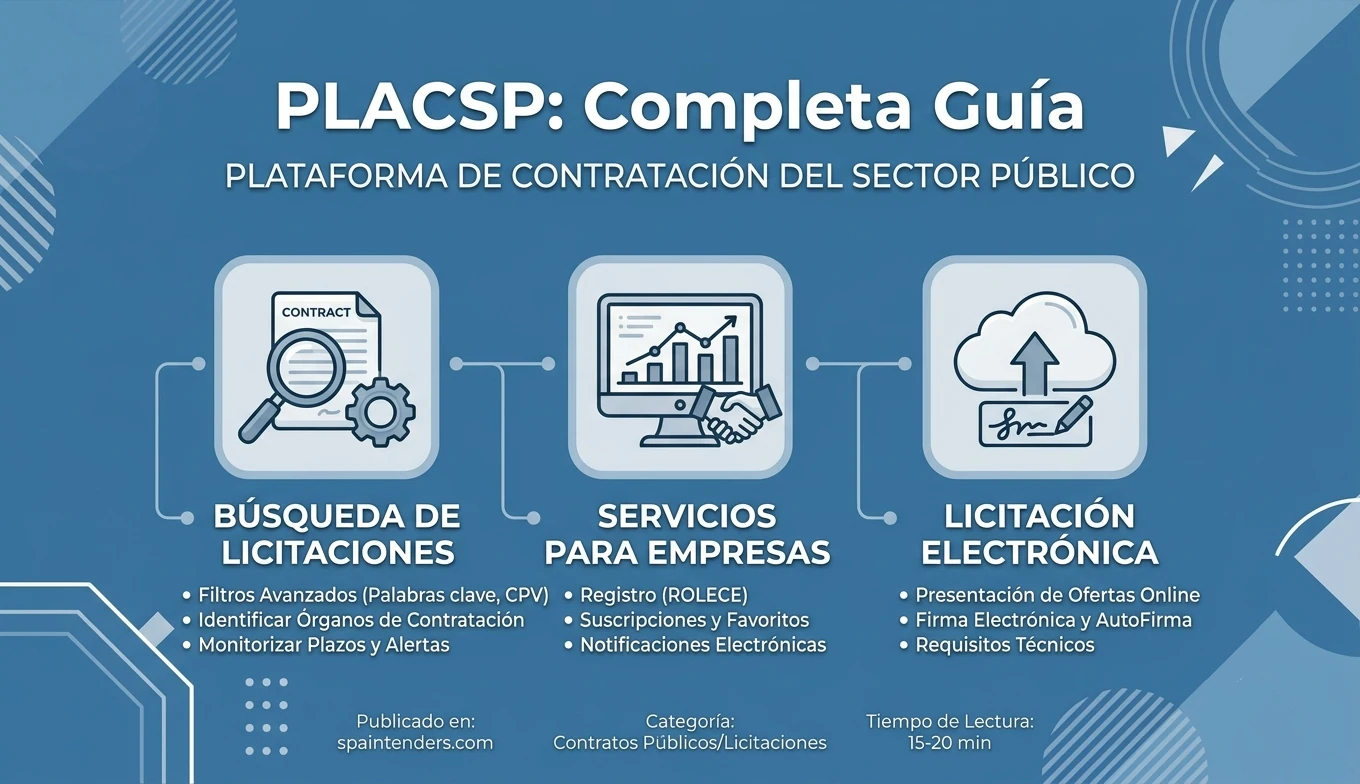
Published on: spaintenders.com | Category: Contratación Pública / Licitaciones España | Reading Time: 15-20 min;
Introduction
For contractors, suppliers and consultants looking for public procurement opportunities in Spain, the Plataforma de Contratación del Sector Público (PLACSP) is one of the most important platforms to understand. It brings together procurement information and provides search and electronic procurement services for businesses and public organisations.
Understanding how PLACSP works is important because finding a Spanish tender is only the beginning. A bidder needs to identify the right procurement opportunity, understand the contracting authority, check the CPV classification, review the tender documents, confirm the deadline and follow the required electronic submission process.
This complete guide explains what PLACSP is, how to search tenders, how to use filters, how CPV codes can improve search results, how to identify contracting authorities, how to monitor deadlines and alerts, and what businesses should know before submitting an offer.
Tabla de Contenidos / Table of Contents
- What Is the Plataforma de Contratación del Sector Público?
- Why PLACSP Is Important for Spanish Tenders
- Who Uses PLACSP?
- How to Search for Tenders on PLACSP
- How to Use Keywords in PLACSP Search
- Using CPV Codes on PLACSP
- How to Search PLACSP by Contracting Authority
- How to Search PLACSP by Location
- How to Identify the Contracting Profile
- How to Check Tender Status on PLACSP
- How to Check the Tender Deadline
- What Documents Can Be Found Through PLACSP?
- Does PLACSP Provide Alerts for New Tenders?
- How Company Registration Works on PLACSP
- Electronic Tender Submission Through PLACSP
- PLACSP and Electronic Procurement
- Can PLACSP Be Used to Research Previous Tenders?
- PLACSP Open Data and Procurement Intelligence
- PLACSP Search: Keyword vs CPV vs Authority
- Common PLACSP Search Mistakes
- How Contractors Can Build a PLACSP Tender Search Strategy
- How Suppliers Can Use PLACSP for Market Research
- PLACSP for SMEs and International Companies
- PLACSP vs Spain Tender Search Platforms
- How SpainTenders Can Complement PLACSP Research
- PLACSP Tender Search Checklist
- Final Thoughts on the Plataforma de Contratación del Sector Público
- Related Resources
What Is the Plataforma de Contratación del Sector Público?
The Plataforma de Contratación del Sector Público, commonly known as PLACSP, is Spain's central public procurement platform. It provides access to procurement information published through contracting profiles hosted on the platform and also incorporates information through aggregation mechanisms from autonomous communities with their own procurement platforms.
For businesses, this makes PLACSP an important starting point when searching for Spain government tenders, Spanish public procurement and licitaciones públicas España.
PLACSP is not simply a page containing tender titles. Its ecosystem includes tender search, contracting profiles, company services, public-organisation information, notifications and electronic procurement functionality. The platform also provides open procurement data that can be processed automatically.
This distinction matters for professional bidders because procurement research often requires more than finding a matching keyword. A supplier must understand the complete procurement record and determine whether the opportunity is commercially and technically suitable.
Why PLACSP Is Important for Spanish Tenders
Public procurement in Spain involves different levels of government and many types of public-sector organisations. National authorities, regional administrations, municipalities and other contracting entities can publish procurement opportunities through different procurement environments.
PLACSP is important because it acts as a major national reference point and also connects with procurement information from autonomous communities through aggregation mechanisms.
For a contractor searching only through general search engines, relevant opportunities can be difficult to identify because procurement information may use Spanish administrative terminology, CPV classifications, formal contract descriptions and different names for similar business activities.
A structured PLACSP search allows businesses to move beyond a simple keyword search and examine procurement opportunities using different characteristics of the contract.
Who Uses PLACSP?
PLACSP serves both sides of the public procurement process. Public-sector organisations use the platform in connection with their contracting activity, while businesses can use the services provided for companies to research and participate in procurement opportunities.
The business side is particularly relevant to:
- Construction contractors
- Manufacturers and suppliers
- IT and technology companies
- Engineering companies
- Consulting firms
- Healthcare suppliers
- Facility management companies
- Cleaning and maintenance companies
- Transport and logistics providers
- Professional service providers
- International companies targeting Spanish public contracts
The platform therefore has relevance across a wide range of industries rather than being limited to a particular procurement sector.
How to Search for Tenders on PLACSP
The PLACSP search environment provides a dedicated Search for tenders function. The platform separates different search areas according to the type of procurement information being researched, including tenders, minor contracts, in-house assignments and preliminary market inquiries. It also provides a document-search function.
For a supplier, the basic process should begin with identifying the type of opportunity being sought and then applying the available search criteria.
A professional tender search should answer five questions:
- What is being purchased?
- Who is buying it?
- Where will the contract be performed?
- What is the procurement status?
- When is the submission deadline?
Searching only by the tender title is not sufficient. Procurement titles can be abbreviated, translated differently or written using technical and administrative terminology that does not exactly match a company's commercial language.
How to Use Keywords in PLACSP Search
Keywords remain useful when searching for Spanish government tenders, but they should be selected carefully.
Suppose a company provides cybersecurity services. Searching only for "cybersecurity" may not identify every relevant procurement because the contracting authority may describe the requirement using terms related to information security, IT security, digital protection or another technical description.
The same issue applies to construction, engineering, healthcare, cleaning, transport and professional services.
For this reason, businesses should create a keyword set that contains:
- Primary product or service terms
- Spanish-language equivalents
- Technical terminology
- Industry terminology
- Common procurement descriptions
- Specific product names where relevant
- Service variations
- Abbreviations and recognised terminology
Keyword searching becomes more powerful when it is combined with CPV codes and geographical or authority-based criteria.
Using CPV Codes on PLACSP
CPV stands for Common Procurement Vocabulary. CPV codes provide a standard classification system for the subject of public procurement contracts.
For businesses, CPV can be useful because a contracting authority may use terminology that differs from the words a supplier uses commercially. A CPV-based search provides another way to identify potentially relevant procurement opportunities.
A supplier should therefore identify the CPV codes associated with its main products and services and test those codes against actual Spanish tender records.
For example, an engineering business should not automatically assume that one CPV code covers every service it provides. Different engineering activities can fall under different classifications.
The best approach is to combine CPV + keywords + location + procurement status rather than depending on CPV alone.
How to Search PLACSP by Contracting Authority
The contracting authority is the public organisation responsible for the procurement procedure. Understanding the buyer is important because businesses can use contracting-authority research to identify recurring procurement demand.
A supplier may discover that certain public organisations repeatedly purchase the same type of product or service. Once these buyers have been identified, monitoring their procurement activity can become part of a long-term business-development strategy.
Authority-based research can also provide valuable context. A company can review previous procurement activity and compare contract subjects, values, procedures and suppliers involved in earlier contracts.
This turns tender searching from a one-time activity into a structured procurement-market research process.
How to Search PLACSP by Location
Location is another important search dimension for Spanish tenders.
A contractor may only operate in certain regions or cities because of workforce, transport, licensing, project-management or operational requirements. In such cases, a nationwide search can produce a large number of irrelevant results.
Location-focused research can include autonomous communities, provinces, municipalities and places of contract performance, depending on the information available for the procurement procedure.
Businesses can create separate search strategies for markets such as Madrid, Andalucía, Cataluña, Galicia, País Vasco, Aragón or Navarra and then further narrow the results by industry and CPV.
How to Identify the Contracting Profile
The Perfil del Contratante, or contracting profile, is an important part of Spanish public procurement research. It provides procurement-related information associated with a contracting authority.
When researching a tender, identifying the contracting profile can help the bidder understand who is conducting the procurement and locate related information published by that authority.
This is particularly useful when a company wants to move from individual tender discovery toward buyer intelligence.
Instead of asking only "Is there a tender for my service?", a supplier can also ask "Which public authorities are buying my service, how frequently are they buying it and what procurement patterns can I identify?"
How to Check Tender Status on PLACSP
Procurement status is critical because a tender that appears relevant may no longer be available for bidding.
When reviewing an opportunity, check whether the procurement is open for submission, has passed its submission stage, is under evaluation, has been awarded or has reached another stage of the procurement lifecycle.
Status information should always be checked together with the official procurement record and documents.
Businesses should also pay attention to updates, amendments and communications issued during the procurement process. A tender can change after its initial publication, so relying on an old copy of information can create unnecessary bidding risk.
How to Check the Tender Deadline
The submission deadline is one of the first details a bidder should verify after identifying a relevant tender.
Before investing significant time in preparing a bid, confirm the exact closing date and time specified by the procurement procedure. The bidder should also understand the electronic submission method and any technical requirements that could affect the ability to submit the offer on time.
A good internal process should record at least:
- Tender reference
- Contracting authority
- Contract title
- Submission deadline
- CPV code
- Contract value
- Contract duration
- Procurement procedure
- Required documents
- Electronic submission method
This information can then be used by the bid team to decide whether the opportunity should proceed to detailed qualification.
What Documents Can Be Found Through PLACSP?
Procurement documentation is one of the most important parts of a tender record. The documents explain the conditions under which the public authority is purchasing the required works, supplies or services.
Depending on the procedure, businesses may encounter administrative documents, technical specifications, tender forms, declarations, annexes, pricing documents, evaluation information and other procurement-related files.
Two Spanish procurement terms that bidders frequently encounter are PCAP and PPT.
PCAP generally refers to the Pliego de Cláusulas Administrativas Particulares and contains administrative and contractual conditions. PPT refers to the Pliego de Prescripciones Técnicas and generally establishes technical requirements and specifications.
The exact documentation depends on the tender. Therefore, suppliers should review the complete set of documents rather than relying on the tender title or summary.
Does PLACSP Provide Alerts for New Tenders?
Yes. PLACSP provides services for companies that allow registered users to receive subscriptions relating to tenders of interest. The platform states that businesses can receive daily subscriptions about relevant tenders published on public-sector portals or in the Official Journal of the European Union, as well as notices about developments relating to favourite tenders.
This is important for businesses that want to move from manual tender searching to continuous monitoring.
A company can define its areas of interest and use notifications to reduce the risk of discovering an opportunity too late.
However, alerts should be treated as a discovery and monitoring mechanism, not as a substitute for reviewing the official tender record and documents.
How Company Registration Works on PLACSP
PLACSP provides registration services for companies. The official platform states that companies can register free of charge to access services designed to facilitate contracting with public-sector organisations.
The company area includes functions related to subscriptions, favourite tenders and electronic notifications. Registration therefore becomes useful for businesses that expect to participate in Spanish public procurement on a continuing basis.
Businesses should ensure that their account information, email access and electronic credentials are properly maintained because procurement activity increasingly depends on electronic communication.
Electronic Tender Submission Through PLACSP
Finding a tender and submitting a bid are two different activities.
Where a procurement procedure requires or provides electronic submission through the relevant platform, the bidder must follow the instructions specified by the contracting authority and procurement documentation.
Electronic bidding can involve authentication, document preparation, electronic signatures, technical validation and final submission. The precise process can vary according to the procurement procedure and platform environment.
For this reason, companies should not wait until the final minutes before the deadline to upload their offer. Technical problems, large files, electronic-signature issues or incomplete documentation can create avoidable risks.
A professional bid team should complete the submission process early enough to resolve technical or administrative problems before the official deadline.
PLACSP and Electronic Procurement
Electronic procurement has changed how companies participate in Spanish government contracts. Instead of relying on physical document delivery, procurement procedures increasingly use digital platforms for access, communication and submission.
For bidders, this means procurement readiness must include more than technical and financial capability. Companies also need to understand the digital requirements associated with bidding.
Electronic procurement readiness can include:
- Access to the required electronic credentials
- Ability to electronically sign documents where required
- Correct document formats
- Prepared technical and administrative files
- Knowledge of the relevant submission platform
- Internal deadline controls
- Testing of the submission process where appropriate
Can PLACSP Be Used to Research Previous Tenders?
Yes. Procurement platforms are valuable not only for finding live opportunities but also for researching procurement history.
Previous tenders can help businesses understand how a public authority has described its requirements, which CPV classifications have been used, the type of procurement procedure selected and the suppliers that have participated or received awards where the information is available.
This historical information can support business-development and bidding decisions.
For example, before bidding for a new service contract, a company can research earlier procurement activity for the same category and authority. This can help the business understand the buyer's procurement pattern and identify changes in requirements over time.
PLACSP Open Data and Procurement Intelligence
One of the less obvious features of PLACSP is its open-data environment. The platform distributes open datasets relating to contracting authorities and tenders whose contracting profiles are hosted on PLACSP, as well as information received through aggregation mechanisms from autonomous communities with their own platforms.
The datasets are provided in open and machine-processable formats. PLACSP also provides OpenPLACSP, a tool designed to help users work with the open procurement datasets.
This is significant for procurement analysts because tender information can be studied beyond individual procurement notices. Structured procurement data can support analysis of contracting authorities, sectors, procurement volumes, classifications and historical activity.
For companies, this creates the possibility of moving from basic tender discovery toward procurement intelligence.
PLACSP Search: Keyword vs CPV vs Authority
| Search Method | Best Use |
| Keyword | Finding opportunities based on product, service or technical terminology |
| CPV | Finding opportunities through standard procurement classifications |
| Contracting Authority | Monitoring procurement activity from known public buyers |
| Location | Focusing on specific regions, provinces, cities or places of performance |
| Status | Identifying opportunities according to their procurement stage |
| Combined Search | Reducing irrelevant results by combining several procurement criteria |
The strongest approach is generally a combination of these search dimensions. Each method solves a different discovery problem.
Common PLACSP Search Mistakes
Searching with only one keyword
A single keyword can be too narrow or too broad. Companies should build keyword variations in both English and Spanish where relevant.
Ignoring CPV codes
CPV provides an additional classification layer and can help identify opportunities that use different wording from a supplier's normal commercial terminology.
Ignoring geographical targeting
A company that cannot realistically operate nationwide should not treat every Spanish tender as an equally valuable opportunity.
Not checking the contracting authority
The buyer can provide important context about the procurement and potential future opportunities.
Looking only at the tender title
The tender title is not a substitute for the complete procurement documentation.
Checking the deadline too late
Bid preparation takes time. A relevant opportunity discovered shortly before closing may already be commercially impractical.
Relying only on alerts
Alerts can support discovery, but businesses should still review the procurement record and official documents.
How Contractors Can Build a PLACSP Tender Search Strategy
A contractor should begin by defining its ideal procurement opportunity rather than searching randomly.
First, list the products, services or works the company can deliver. Second, identify the Spanish terminology used for those offerings. Third, identify relevant CPV codes. Fourth, define the regions and cities the business can serve. Finally, identify public authorities that are commercially important.
This creates a structured search profile.
For example:
Service → Spanish keywords → CPV codes → Target regions → Target authorities → Tender status → Deadline
The resulting searches can be saved and monitored regularly.
This approach is much more scalable than manually browsing unrelated tender notices every day.
How Suppliers Can Use PLACSP for Market Research
PLACSP can also be used to understand the public procurement market before a company decides to bid.
A supplier can investigate which public authorities buy its products, how often similar contracts are published, which regions generate the most relevant procurement activity and what contract structures are commonly used.
Historical tender and award information can provide additional context about competition and purchasing behaviour.
This research can help answer questions such as:
- Which Spanish public authorities buy this type of service?
- Which regions have recurring demand?
- What CPV codes are associated with the category?
- What contract sizes are common?
- Which procurement procedures appear frequently?
- Are opportunities divided into lots?
- Are there recurring or replacement contracts?
- When might the next procurement opportunity appear?
These questions move tender research beyond individual opportunities and toward procurement-market intelligence.
PLACSP for SMEs and International Companies
Small and medium-sized businesses can use PLACSP to identify public-sector opportunities that match their operational capabilities. Instead of attempting to compete for every large government contract, an SME can focus on specific contract categories, geographical areas and public buyers.
International companies can also use PLACSP as part of their Spain market-entry research. Before attempting to participate in a Spanish public procurement procedure, an international supplier can study the market, identify relevant authorities, understand terminology and research previous procurement activity.
International bidders should separately verify the eligibility, qualification, documentation and electronic-submission requirements applicable to each procurement procedure.
PLACSP vs Spain Tender Search Platforms
PLACSP is an official public procurement platform. A tender search or intelligence platform serves a different purpose: helping businesses discover, organise and monitor opportunities according to their commercial requirements.
This distinction is important.
The official platform remains the reference point for the procurement information and documents published by the relevant authority. A specialised tender platform can make the discovery process more efficient by helping businesses search across procurement information using business-oriented criteria.
For a contractor, the practical workflow can therefore be:
Discover the opportunity → Analyse relevance → Open the official procurement record → Review documents → Confirm requirements → Prepare the bid → Submit through the required official channel.
How SpainTenders.com Can Complement PLACSP Research
For businesses whose objective is to continuously identify relevant opportunities, SpainTenders can complement official-source research by providing a dedicated environment for discovering Spain tenders and procurement opportunities.
The main challenge for contractors is often not whether procurement information exists. The challenge is finding the opportunities that match their exact products, services, geography and commercial objectives.
A structured tender-discovery platform can help businesses organise this research around their actual procurement interests instead of repeatedly starting with broad searches.
SpainTenders.com should therefore be considered part of a wider workflow rather than a replacement for the official procurement source.
The official procurement record remains important for validating the tender details, documents, deadlines and submission instructions.
PLACSP Tender Search Checklist
Before considering a PLACSP opportunity as a serious bid prospect, a contractor should review the following:
- Contract title and reference
- Contracting authority
- Contracting profile
- Contract object
- CPV code
- Contract type
- Procedure
- Estimated and/or contract value
- Contract duration
- Location
- Lots
- Eligibility requirements
- Technical requirements
- Financial and economic requirements
- Evaluation criteria
- PCAP
- PPT
- Required declarations and forms
- Submission platform
- Submission deadline
- Published amendments and clarifications
This checklist can reduce the risk of spending bid-preparation resources on an opportunity that does not actually match the company's capabilities.
Final Thoughts on the Plataforma de Contratación del Sector Público
The Plataforma de Contratación del Sector Público is a central part of Spain's public procurement environment and an important resource for companies searching for government contracts and public tenders.
Its value goes beyond the simple publication of tender notices. Businesses can use PLACSP to search procurement opportunities, examine contracting profiles, access company services, monitor relevant tenders and work with available procurement data.
The most effective users do not rely on a single search phrase. They combine keywords, CPV codes, contracting authorities, geographical targeting, procurement status and deadline management to build a repeatable tender-search process.
For contractors and suppliers, the real advantage comes from turning this information into a systematic workflow. The objective is not simply to find more tenders. It is to find the right Spanish tenders early enough to evaluate, qualify and bid on them properly.
For businesses entering or expanding in the Spanish public procurement market, understanding PLACSP is therefore an essential step toward building a sustainable tender strategy.
Related Resources
- Spain Public Procurement: Complete Beginner's Guide
- Spain Tenders: Where to Find Government and Public Procurement Opportunities
- How to Register and Submit a Tender in Spain
- Spain Public Procurement Law: Ley 9/2017 Explained
- Spain Tender Procedures: Types, Rules and Bid Strategies
- ROLECE Registration Guide for Spanish Public Procurement
- Electronic Signature and AutoFirma for Spain Tenders
Official source: Plataforma de Contratación del Sector Público, Gobierno de España.
Frequently Asked Questions (FAQs)

Fresh and verified Tenders from Spain. Find, search and filter Tenders/Call for bids/RFIs/RFPs/RFQs/Auctions published by the government, public sector undertakings (PSUs) and private entities.
- 1,000+ Tenders
- Verified Tenders Only
- New Tenders Every Day
- Tenders Result Data
- Archive & Historical Tenders Access
- Consultants for RFI/RFP/RFQ
- Tender Notifications & Alerts
- Search, Sort, and Filter Tenders
- Bidding Assistance & Consulting
- Customer Support
- Publish your Tenders
- Export data to Excel
- API for Tender Data
- Tender Documents

Fill out the form below and you will receive a call from us within 24 hours.
Get FREE SAMPLE TENDERS from Spain in your email inbox.
Copyright © 2014-2026 SpainTenders.com. All Rights Reserved.