Seven Bidders, One Price: How the Basque Government's Salesforce Deal Exposes the Real Economics of Public Cloud Procurement
Standfirst
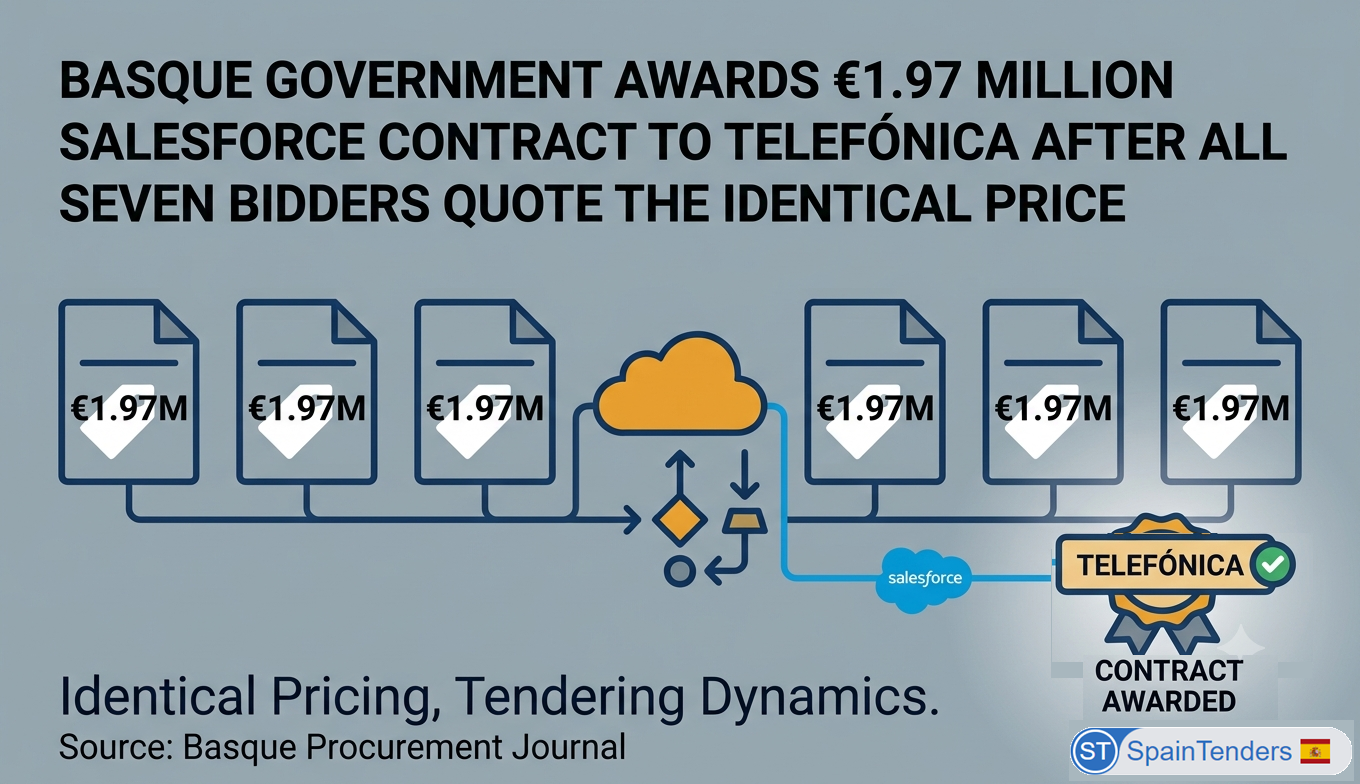
EJIE, the IT company that runs technology for the Basque Government, has awarded a €1.97 million contract to supply Salesforce licences for citizen services to Telefónica's Spanish technology arm. What makes the result worth a second look is not who won, but how: all seven competing bids, from seven different major Spanish IT integrators, came in at exactly the same price.
Introduction
Public tenders are supposed to produce competition and competition is supposed to produce a spread of prices. That is not quite what happened when the Basque Government's IT company, EJIE, opened the bids for its latest contract to supply Salesforce customer relationship management licences for citizen services. Seven of Spain's largest technology integrators submitted tenders. Every single one proposed exactly €1,970,000. Not close. Identical, to the euro.
The winner, decided by a tie break method described only in the tender's technical documentation, was Telefónica Soluciones de Informática y Comunicaciones de España, the technology and systems integration arm of Spain's former telecoms monopoly. But the more interesting story here is what that unanimous pricing reveals about how licensing contracts for major enterprise software platforms actually work inside public administration procurement and why price, even when it is formally the only scoring criterion, is sometimes not where the real competition happens.
Why This Contract Matters
This is a modest contract by the standards of major infrastructure or defence procurement, but it says something important about digital government. Salesforce has become one of the default platforms public administrations across Europe use to manage citizen facing services, case tracking, appointment scheduling, correspondence, benefits applications, because it offers a mature, configurable customer service architecture without requiring a government to build one from scratch. The Basque Government, through EJIE, has been steadily expanding its use of Salesforce for exactly this purpose and this contract extends that commitment for close to two more years, with an option to run through nearly three.
The uniform pricing across all seven bidders also matters for anyone tracking how software licensing contracts get structured in the public sector. When every credible integrator quotes the identical figure, it strongly suggests the underlying software licence cost, set by Salesforce's own commercial terms, left resellers with essentially no room to compete on price at all. The real competitive battleground, in cases like this, shifts to technical scoring, service quality, delivery capability or whatever formula based tie break mechanism the buyer builds into the tender documents.
Contract Timeline
| Date | Milestone |
|---|---|
| 25 March 2026 | Tender opens for submissions |
| 31 March – 30 April 2026 | Multiple corrections issued to technical and administrative tender documents, with submission dates adjusted accordingly |
| 12 May 2026 | Revised submission deadline |
| 14 July 2026 | Contract concluded with Telefónica Soluciones de Informática y Comunicaciones de España |
| 15 July 2026 | Award notice dispatched to the EU Publications Office |
| 16 July 2026 | Notice published in OJ S 135/2026 |
Contract Overview
EJIE ran an open procedure to acquire Salesforce software licences supporting citizen service operations across the Basque Government. Seven tenders were received, all submitted electronically and none from micro, small or medium sized enterprises, every bidder was a large, established Spanish IT integrator. The tender documents were revised three times during the submission window, each time accompanied by a formal "corrección de errores" (error correction) notice and adjusted deadlines, according to the procedure's own published amendment history, a sign of a technically detailed specification that required repeated clarification before bidders could finalise their offers.
Telefónica Soluciones de Informática y Comunicaciones de España was declared the winner, with a tender value of €1,970,000, identical to the value submitted by all six other bidders: Deusto Seidor, Altia Consultores, Ayesa Ibermática, Devoteam Drago, Izertis and Teknei Information Technology.
Key Contract Details
| Field | Detail |
|---|---|
| Contracting authority | EJIE, S.A. – Sociedad Informática del Gobierno Vasco |
| Winning contractor | Telefónica Soluciones de Informática y Comunicaciones de España, S.A. |
| Title | Adquisición de Licencias Salesforce para la Atención a la Ciudadanía del Gobierno Vasco |
| CPV code | 48000000 – Software package and information systems |
| Procedure type | Open |
| Legal basis | Directive 2014/24/EU |
| Estimated contract value | €3,614,000 (excl. VAT) |
| Winning tender value | €1,970,000 |
| Award criterion | Price only ("Mejor precio"), with a calculation method detailed in the tender documents |
| Contract duration | 19 months, with an option to extend by up to 12 months |
| Tenders received | 7, all submitted electronically; 0 from SMEs |
| EU funding | None disclosed |
| GPA coverage | No |
| Review body | Órgano Administrativo de Recursos Contractuales (Basque Country administrative appeals body for public contracts) |
| Place of performance | Araba/Álava, Basque Country, Spain |
Project Scope
The contract supplies Salesforce software licences supporting the Basque Government's citizen attention services, the digital and telephone based channels through which residents interact with regional government departments and agencies. The notice does not detail the exact number of licences, user seats or specific Salesforce modules involved, nor does it specify which citizen facing systems or departments will draw on this licensing pool; Spaintenders.com was unable to verify these operational details from public sources.
What is clear from related EJIE procurement activity is that this contract sits within a broader, multi year programme to expand Salesforce based citizen service infrastructure across the Basque Government, building on earlier phases of the same initiative.
About the Contracting Authority
EJIE, S.A. (Sociedad Informática del Gobierno Vasco) is the Basque Government's dedicated IT company, responsible for developing, procuring and maintaining the technology infrastructure used across regional government departments and public services. Structured as a regional authority under Spanish administrative law, EJIE runs a high volume of technology procurement annually, spanning hardware, cloud software licensing, systems integration and IT services and has established relationships with most of Spain's largest technology integrators, several of whom appear repeatedly across its published tender history.
About the Organisations Involved
Telefónica Soluciones de Informática y Comunicaciones de España, S.A., Winning Tenderer
The Madrid headquartered technology and systems integration division of Telefónica, Spain's largest telecommunications group. Classified as a large economic operator in the notice, the company has an established public sector contracting relationship with EJIE, having been awarded technology and IT services contracts with the Basque Government on multiple prior occasions according to EJIE's own published contracting history.
Deusto Seidor, S.A., Non Winning Tenderer
A large technology integrator based in Vitoria Gasteiz, in the same Basque province as EJIE itself and part of the wider Seidor group, one of Spain's most active IT and Salesforce implementation partners. Its regional presence in Araba/Álava is notable given its proximity to the buyer's own headquarters.
Altia Consultores, S.A., Non Winning Tenderer
A Galicia based technology consultancy, also known through its Bilbomática affiliation, classified as a large operator and a frequent participant in Basque public sector technology procurement.
Ayesa Ibermática, S.A., Non Winning Tenderer
A large Spanish technology and engineering group headquartered in Donostia/San Sebastián, within the Basque Country's Gipuzkoa province, reflecting the strong regional technology sector presence competing for this contract.
Devoteam Drago, S.A., Non Winning Tenderer
The Spanish arm of Devoteam, an international technology consulting group with particular expertise in Salesforce and other major enterprise cloud platforms, based in Madrid.
Izertis, S.A., Non Winning Tenderer
A large, Asturias headquartered digital transformation and IT services group with a national presence across Spain's public and private sector technology markets.
Teknei Information Technology, S.L., Non Winning Tenderer
A Bilbao based technology firm and, like Deusto Seidor, situated within the Basque Country itself, underscoring how much of the competitive field in this tender was drawn from firms with an established regional footprint alongside the larger national integrators.
Órgano Administrativo de Recursos Contractuales, Review Organisation
The Basque Country's administrative body responsible for hearing contractual appeals in public procurement. It provides the defined legal channel for any of the six unsuccessful bidders to challenge the award, should they choose to do so, within the fifteen working day window specified in the notice.
Procurement Analysis
EJIE ran a standard open procedure with price as the sole formal award criterion, on paper, the simplest possible evaluation structure. In practice, the result illustrates a phenomenon common to enterprise software licensing tenders: when the underlying product is a proprietary platform like Salesforce, with pricing largely set by the vendor's own commercial terms, resellers competing to supply those licences often have very little genuine room to differentiate on price. All seven bidders effectively priced the contract at exactly the same figure, suggesting the licence cost itself was the dominant, non negotiable component of the bid, with reseller margin contributing little variance.
Because the tender documents include "el método de cálculo que va detallado en los pliegos", a calculation method for cases where weighting cannot be expressed through the stated criteria alone, it appears EJIE built in a formula based mechanism precisely to handle situations like this one, where price alone cannot distinguish between bidders. The specific tie break formula is not disclosed in the notice itself, but its existence and its apparent use here, points to a well anticipated risk in this kind of procurement: identical or near identical pricing among software resellers competing for the same fixed cost licensing pool.
The repeated technical corrections issued during the submission window, three rounds of amendments between late March and the end of April 2026, also suggest a specification detailed enough to generate legitimate bidder questions and clarifications before the market could finalise its offers.
Additional Procurement Facts
All seven tenders were submitted electronically and none came from micro, small or medium sized enterprises, every bidder in this competition was a large, established technology integrator. No tenders were received from bidders registered outside Spain, whether from elsewhere in the European Economic Area or beyond it. The contract is not covered by the WTO Government Procurement Agreement and carries no EU funding, meaning it is financed entirely through the Basque Government's own regional budget, distinguishing it from an earlier, related Salesforce procurement by the same buyer that was financed through Spain's EU backed Recovery, Transformation and Resilience Plan.
Market & Industry Perspective
The Spanish public sector technology integration market is dominated by a recognisable set of large national players, Telefónica's various technology subsidiaries, Ayesa, Seidor (through its regional Deusto Seidor arm), Izertis, Altia, Devoteam and others, many of which compete against each other repeatedly across the same regional and national government buyers. Salesforce implementation and licensing has become a significant, recurring line of business for several of these firms, reflecting the platform's broad adoption across Spanish public administration for citizen relationship management.
That six of the seven bidders in this specific tender are large integrators with established Basque Country or northern Spain footprints (Deusto Seidor and Teknei both headquartered within the region itself) suggests a genuinely competitive regional market for this type of work, even though the identical pricing outcome shows that competition concentrated on factors other than headline price.
Economic Significance
At a winning tender value of €1.97 million, against a total estimated contract value of €3.614 million across the maximum possible term, this is a moderate sized software licensing contract, but it is representative of a much larger and more durable category of public sector spending: recurring enterprise software licence renewals and expansions, which rarely generate headlines but collectively represent a significant and steadily growing share of digital government budgets across Europe.
For Telefónica's technology arm, the win reinforces its position as a preferred partner for citizen facing digital services within the Basque Government, in a market where the same handful of integrators compete repeatedly for adjacent and successive contracts.
Future Procurement Opportunities
With a base term of 19 months and an option to extend by up to 12 further months, this specific licensing contract is likely to return to market again within roughly two to three years. Given EJIE's demonstrated pattern of running successive Salesforce related procurements, including an earlier EU funded phase covering front end development services alongside licensing, suppliers should expect further related tenders covering implementation services, front end development or expanded licensing scope to emerge periodically as the Basque Government continues building out its citizen service technology stack.
Opportunities for Suppliers
Firms with Salesforce implementation, configuration or citizen service front end development expertise should watch for adjacent EJIE tenders beyond pure licensing acquisition, since prior procurement activity from this buyer shows licensing contracts are often paired with or followed by, separate services contracts for development and integration work. The identical pricing outcome in this tender is also a useful signal for bidders preparing future Salesforce related public tenders in Spain: where licence costs are effectively fixed by the vendor, competitive differentiation is more likely to come through technical scoring, delivery capability and formula based tie break mechanisms than through headline price reductions.
What Businesses Should Watch
Three things are worth tracking from this result. First, whether EJIE runs a companion services tender, covering implementation, configuration or front end development, to accompany this licensing acquisition, following the pattern of its earlier EU funded Salesforce initiative. Second, whether the Basque Government's broader digital citizen services programme continues to expand, which would signal further recurring licensing and services procurement over the coming years. Third, whether other Spanish regional governments follow a similar path toward Salesforce based citizen service platforms, which would open comparable opportunities for the same pool of national integrators competing in this tender.
SpainTenders.com Procurement Intelligence
The most instructive detail in this notice is not the winner, but the uniformity of the losing bids. When seven independent, competing technology integrators all arrive at exactly the same tender price, it is strong evidence that the underlying commercial terms of the product being resold, in this case, Salesforce licensing, left almost no margin for price based differentiation. This is a pattern worth watching across public sector cloud software procurement generally: as governments increasingly buy access to dominant commercial SaaS platforms rather than commissioning bespoke systems, price competition among the resellers and integrators who supply those licences can compress toward the vendor's own list pricing, shifting genuine competition toward technical merit, delivery reliability and contractual tie break mechanisms that rarely appear in the published notice itself.
For public buyers, this suggests that award criteria weighted purely on price may increasingly need supplementary, formula based tie break provisions, exactly the kind EJIE appears to have built into this tender, to meaningfully differentiate between functionally identical bids. For competing suppliers, it is a reminder that in markets dominated by a single enterprise software vendor, the real basis of competitive advantage lies upstream of the tender itself: in vendor certification levels, technical delivery capacity and the strength of an integrator's relationship with both the platform owner and the buying institution.
Looking ahead, as more European public administrations lean on Salesforce and comparable SaaS platforms for citizen services, expect to see this same pattern of converging reseller pricing recur, particularly in licensing only procurements where the software cost dominates the bid.
Supplier Takeaways
- In tenders for licensing of dominant commercial SaaS platforms, expect limited room for price differentiation among resellers; competitive advantage is more likely to come from technical scoring and formula based tie break criteria.
- EJIE has a demonstrated pattern of pairing Salesforce licensing procurements with related implementation and front end development services contracts, watch for companion tenders.
- Regional Basque Country integrators (such as those based in Vitoria Gasteiz, Bilbao and Donostia/San Sebastián) compete directly and successfully alongside larger national integrators for this buyer's contracts.
- This contract carries no EU funding, unlike an earlier related EJIE Salesforce procurement financed through Spain's Recovery, Transformation and Resilience Plan, funding source can shift between successive phases of the same digital transformation programme.
- With a maximum term of roughly 31 months, expect this specific licensing requirement to return to market within two to three years.
Key Takeaways
- EJIE, the Basque Government's IT company, awarded a Salesforce licensing contract worth €1.97 million to Telefónica Soluciones de Informática y Comunicaciones de España.
- All seven bidders in the competition submitted identical tender values of €1,970,000, pointing to fixed underlying licence pricing rather than genuine price competition.
- The contract runs 19 months, with an option to extend by up to 12 further months.
- No SMEs participated; all seven bidders were large, established technology integrators, several based in the Basque Country itself.
- The contract carries no EU funding and is not covered by the WTO Government Procurement Agreement.
Conclusion
A contract this size will not reshape Spain's public procurement landscape, but the pattern behind it says something durable about how enterprise cloud software gets bought inside government. When every credible bidder quotes the identical price, the real competitive story has moved somewhere the published notice cannot fully show, into technical scoring sheets, vendor certification tiers and the quiet relationships between integrators, platform owners and the public bodies that depend on both.
Frequently Asked Questions
Who won this contract?
Telefónica Soluciones de Informática y Comunicaciones de España, S.A., the technology and systems integration division of the Telefónica group.
Who is the buyer?
EJIE, S.A. – Sociedad Informática del Gobierno Vasco, the IT company of the Basque Government.
What is the contract worth?
The winning tender was valued at €1,970,000, against a total estimated contract value of €3,614,000 across the maximum possible term.
Why did every bidder submit the same price?
The notice does not explain this directly, but it is a pattern consistent with fixed underlying software licence pricing set by the vendor, leaving resellers little room to differentiate on price. EJIE's tender documents include a formula based tie break method for exactly this kind of scenario.
How long does the contract last?
19 months, with an option to extend by up to 12 further months.
What does the contract cover?
Salesforce software licences supporting the Basque Government's citizen attention services.
Was this contract funded by the European Union?
No. The notice confirms no EU funding was used, unlike an earlier related EJIE Salesforce procurement financed through Spain's Recovery, Transformation and Resilience Plan.
How many companies bid for the contract?
Seven, all large technology integrators; none were SMEs.
Source: EU Official Journal, Contract Award Notice 490989-2026, OJ S 135/2026, published 16/07/2026. Contracting authority: EJIE, S.A. – Sociedad Informática del Gobierno Vasco.
This article is based on information published in the official TED (Tenders Electronic Daily) Contract Award Notice. Editorial analysis, market insights and procurement intelligence have been added by SpainTenders.com to help businesses better understand the strategic significance of the procurement and identify future opportunities.

Fresh and verified Tenders from Spain. Find, search and filter Tenders/Call for bids/RFIs/RFPs/RFQs/Auctions published by the government, public sector undertakings (PSUs) and private entities.
- 1,000+ Tenders
- Verified Tenders Only
- New Tenders Every Day
- Tenders Result Data
- Archive & Historical Tenders Access
- Consultants for RFI/RFP/RFQ
- Tender Notifications & Alerts
- Search, Sort, and Filter Tenders
- Bidding Assistance & Consulting
- Customer Support
- Publish your Tenders
- Export data to Excel
- API for Tender Data
- Tender Documents

Fill out the form below and you will receive a call from us within 24 hours.
Get FREE SAMPLE TENDERS from Spain in your email inbox.
Copyright © 2014-2026 SpainTenders.com. All Rights Reserved.