Spain Modernises Hospital Anaesthesia Infrastructure Through Major Procurement Framework
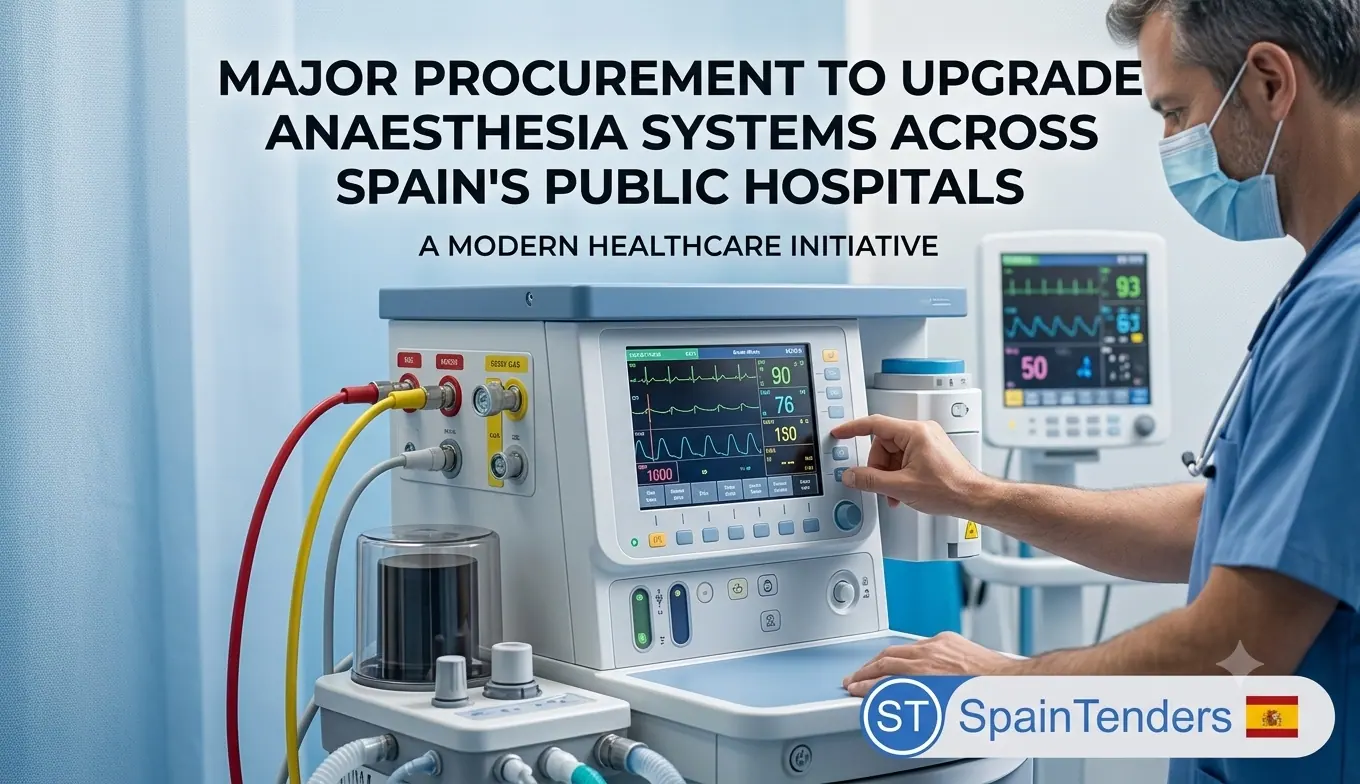
The Extremadura Health Service awarded a framework deal for anaesthesia workstations to Dräger Hispania after receiving five competing bids, choosing an offer near the top of the price range once technical extras were factored in, while the notice's own figures disagree by a factor of 100 on the framework's maximum value.
Standfirst
Spain's Servicio Extremeño de Salud (SES), the public health service for the Extremadura region, has awarded a framework agreement for anaesthesia machines with integrated patient monitoring to Dräger Hispania, the Spanish arm of the German medical technology group Drägerwerk. Only one supplier won out of five that competed and its winning bid sat close to the most expensive of the tenders received, a result explained by an award formula that weighted several small technical features alongside price. The notice itself, however, contains two wildly different figures for the framework's maximum value, differing by exactly a factor of 100.
Introduction
Buying an anaesthesia machine is not like buying office furniture. The device that keeps a patient safely and precisely unconscious during surgery needs to combine gas delivery, ventilation and continuous monitoring in one unit doctors can trust without a second thought. Getting the specification and the supplier right matters as much as getting the price right.
This notice from Extremadura, a region in western Spain bordering Portugal, shows a regional health authority working through exactly that trade off and making a call that valued specific technical features over the very lowest price on the table.
Why This Contract Matters
Anaesthesia equipment sits at the centre of every operating theatre. A framework agreement covering an entire region's hospitals means a single winning supplier's equipment, service quality and spare parts pipeline will shape surgical capacity across Extremadura for years.
The award also matters as a small but instructive lesson in reading procurement notices carefully: the same document that records this award contains two figures for the framework's total value that disagree by a hundredfold, a reminder that even official EU procurement data needs a sceptical read.
Contract Timeline
- 11 March 2026, Dräger Hispania was confirmed as the winning tenderer.
- 6 July 2026, The contract was formally concluded, several months after the winner was chosen.
- 7 July 2026, The result notice was dispatched for publication.
- 8 July 2026, The notice was published in the Official Journal of the EU (OJ S 129/2026).
The notice also references an earlier related notice, indicating this result follows an original tender announcement published separately.
Contract Overview
SES ran an open procedure to establish a framework agreement, a pre agreed supply arrangement that individual public hospitals within the region can draw on over time, for anaesthesia machines with integrated monitoring. The agreement covers both provinces that make up Extremadura, Badajoz and Cáceres, meaning any public hospital in the region can potentially order equipment under it.
The framework is structured as an "indeterminate quantity" supply agreement under Article 219 of Spain's Public Sector Contracts Law, meaning the health service did not commit in advance to buying a fixed number of machines. Instead, it set the terms, pricing and technical requirements a winning supplier must honour and individual hospitals will place specific orders against that agreement as their needs arise.
Five companies submitted tenders. Only one, Dräger Hispania, was named a winner.
Key Contract Details
| Detail | Information |
|---|---|
| Contracting authority | Dirección General de Planificación Económica, on behalf of Servicio Extremeño de Salud (SES) |
| Procedure title | Framework agreement for anaesthesia machines with integrated monitoring for SES |
| Main CPV code | 33172100 - Anaesthesia devices |
| Procedure type | Open procedure |
| Framework agreement type | Mixed: partly without reopening of competition, partly with reopening of competition |
| Place of performance | Badajoz and Cáceres provinces, Extremadura, Spain |
| Award criteria | Price (85 points) plus five technical quality criteria (15 points combined) |
| Tenders received | 5 (2 from micro, small or medium enterprises) |
| Range of tenders | €26,000.00 (lowest admissible) to €31,739.00 (highest admissible) |
| Winning supplier | Dräger Hispania, S.A. (Madrid, Spain) |
| Value of winning tender | €31,739.76 |
| Date winner chosen | 11 March 2026 |
| Date contract concluded | 6 July 2026 |
| Subcontracting | None disclosed |
| EU funding | Not financed with EU funds |
| GPA coverage | No |
| Legal basis | Directive 2014/24/EU; Article 219 of Spain's Public Sector Contracts Law (LCSP) |
| Review body | Dirección General de Planificación Económica – Comisión Jurídica de Extremadura |
Project Scope
The framework covers the supply of anaesthesia machines, sometimes called anaesthesia workstations, that combine gas delivery and ventilation with integrated patient monitoring, for use across SES facilities in both of Extremadura's provinces. The technical specification, set out in the tender's separate technical documentation, defines exactly what features and performance standards a qualifying machine must meet.
Beyond the base machine, the award criteria reveal the specific technical extras SES valued when scoring bids: an extended warranty period, a wireless anaesthetic gas analyser, spirometry monitoring measured at the patient's mouth rather than further down the breathing circuit, real time monitoring of actual oxygen consumption and a system allowing clinicians to bypass the carbon dioxide absorber when appropriate. Each of these represents a specific clinical or operational capability beyond the baseline requirement.
About the Contracting Authority
Dirección General de Planificación Económica, the Directorate General for Economic Planning, acted as the contracting authority on behalf of the Servicio Extremeño de Salud (SES), Extremadura's regional public health service. It is classified in the notice as a regional authority with health as its main activity, consistent with its role managing procurement for the region's public hospital network.
Notably, this same organisation also serves as the designated review body for the procedure, working alongside a secondary legal contact point, the Comisión Jurídica de Extremadura (Legal Commission of Extremadura), which handles the substantive legal review of any appeal.
About the Organisations Involved
Dirección General de Planificación Económica, Buyer and Review Organisation
Based in Mérida, Extremadura's regional capital, this directorate structured the tender, evaluated the five bids received and signed the resulting framework agreement on behalf of SES. It also holds the review organisation role for this procedure, with the Comisión Jurídica de Extremadura, based in Badajoz, serving as its legal review contact point for any procurement appeal.
Dräger Hispania, S.A., Winning Supplier
Dräger Hispania is based in Madrid and classified in the notice as a large economic operator. It is the Spanish operating company of Drägerwerk, a German group with a long established international reputation in anaesthesia, ventilation and patient monitoring technology, making it a natural, well known competitor for a contract of this specific technical nature. The notice records its beneficial owner's nationality as Spain, reflecting the registered ownership structure of the Spanish entity itself. Dräger Hispania submitted no subcontracting arrangement, indicating it will deliver and support the equipment directly.
Procurement Analysis
The award formula split 100 points between price (85) and five separate technical quality criteria (15 combined), extended warranty, wireless gas analyser, mouth based spirometry monitoring, real oxygen consumption monitoring and a CO2 absorber bypass option. On paper, that heavily favours the lowest priced bid.
In practice, the result tells a more interesting story. The winning tender, at €31,739.76, sits almost exactly at the highest admissible tender value recorded in the notice, €31,739.00, while the lowest admissible bid came in at €26,000.00, roughly 18% cheaper. Despite an award formula weighted 85% toward price, the near top of range bid won, which strongly suggests Dräger Hispania's technical quality points, across those five specific features, were enough to overcome a real price disadvantage against at least one cheaper competitor.
The framework agreement is structured as a hybrid: part of it operates without reopening competition (allowing direct call offs against agreed terms) and part of it requires reopening competition (a further mini competition among framework participants for specific orders), a more flexible structure than the single mode frameworks seen in some other national systems, allowing the health service to choose the most appropriate route depending on the specific purchase.
The contract is not covered by the WTO Government Procurement Agreement and not financed by EU funds and it operates under Spain's own Article 219 "indeterminate quantity" framework mechanism, layered onto the general EU legal basis of Directive 2014/24/EU.
Additional Procurement Facts
The notice contains a striking internal inconsistency worth flagging directly. At the procedure level, the maximum value of the framework agreement is recorded as €2,429,752.07. In the results section of the same notice, the maximum value of the framework agreement and its approximate value, is recorded as €242,975,207.00, exactly one hundred times larger. The notice offers no explanation for this discrepancy and readers should treat the larger figure with real caution; a factor of 100 gap is consistent with a decimal or data entry error somewhere in the notice's preparation rather than an actual hundredfold expansion of the framework's scope.
Given that the only individual tender value recorded in the notice is €31,739.76, consistent with the price of a single anaesthesia machine, the lower, roughly €2.43 million figure appears far more plausible as the framework's real ceiling across the region's likely demand for this equipment over the agreement's life, though the contracting authority has not clarified which figure is correct.
Market & Industry Perspective
Anaesthesia and critical care equipment remains a market dominated by a small number of established international manufacturers and Dräger's win here is consistent with the group's long standing position in that space across European public health systems. For competitors, this result is a reminder that heavily price weighted award criteria do not guarantee the cheapest bid wins if the buyer has built in enough technical differentiation points to reward specific clinical features.
For hospitals and health systems more broadly, the specific technical criteria SES chose to reward, wireless gas analysis, real oxygen consumption tracking, flexible CO2 absorber management, reflect a growing emphasis across European anaesthesia procurement on data visibility and operational flexibility in the operating theatre, not just the core function of delivering anaesthetic gas safely.
Economic Significance
Even taking the smaller, more plausible €2.43 million maximum framework value, this represents meaningful capital investment in surgical infrastructure across a region with two provinces and a dispersed rural population, where equitable access to modern surgical technology is a genuine public health consideration outside Spain's larger urban centres.
For Dräger Hispania, securing status as the framework's supplier gives it a multi year channel into a regional public health system, a valuable foothold in a market where anaesthesia equipment purchases are infrequent and long lived once installed.
Future Procurement Opportunities
Because the framework is structured as an indeterminate quantity agreement, further call offs are likely as individual hospitals within SES place specific orders over the agreement's life, rather than the process concluding with this single award. Suppliers of related theatre equipment and monitoring accessories may find complementary opportunities as hospitals integrate the new anaesthesia machines into their operating theatres.
Given the framework's mixed structure, some future orders may require a reopened mini competition rather than an automatic call off, meaning Dräger Hispania's competitors from this original tender may still have a route to compete for specific future orders under the same framework, depending on how individual purchases are structured.
Opportunities for Suppliers
- Track how future orders under this framework are placed. Because part of the agreement allows reopened competition, unsuccessful bidders from this round may still have opportunities to win specific future call offs.
- Study the winning technical criteria closely. Wireless gas analysis, mouth based spirometry monitoring, real oxygen consumption tracking and CO2 absorber flexibility were all explicitly rewarded; suppliers competing in adjacent Spanish regional tenders should expect similar technical priorities to reappear.
- Consider complementary equipment and service opportunities. Monitoring accessories, maintenance contracts and staff training tied to the newly adopted anaesthesia platform may represent parallel opportunities alongside the core equipment framework.
What Businesses Should Watch
Watch for any correction or clarification notice from SES regarding the framework's maximum value, given the unexplained hundredfold discrepancy between the two figures in this notice.
Watch how SES uses the framework's mixed structure in practice, whether most hospital orders proceed as direct call offs or trigger reopened mini competitions, since that will determine how much ongoing competitive opportunity remains for the four unsuccessful bidders.
Watch for similar anaesthesia and critical care equipment tenders across Spain's other regional health services, several of which periodically refresh their own equipment frameworks on comparable cycles.
SpainTendes.com Procurement Intelligence
This award is a compact but useful illustration of how technical quality criteria can outweigh a strong price advantage, even under an award formula that looks, at first glance, overwhelmingly price driven. An 85% price weighting sounds decisive, but five extra points of technical differentiation were enough here to let a bid near the top of the price range win over a materially cheaper competitor. Buyers who want genuine price competition and suppliers hoping to win on cost alone, should read the fine print of an award formula's quality criteria as carefully as its headline weighting.
The notice's internal value discrepancy is a smaller but equally instructive point. A hundredfold gap between two officially published figures for the same framework, within the same notice, is not a rounding error and it is a useful reminder that structured EU procurement data, however standardised its format, still depends on accurate manual entry at the point of publication. Anyone using this notice for market sizing or competitive intelligence should reconcile the figures against the underlying tender documents rather than taking either headline number at face value.
For suppliers competing in specialised medical equipment procurement generally, the broader lesson is to treat quality criteria weighting, however small it looks in percentage terms, as a genuine and sometimes decisive factor, rather than an afterthought behind the price competition.
Supplier Takeaways
- Do not assume a heavily price weighted award formula means the cheapest bid will win; small technical quality criteria can and did overturn an 18% price disadvantage in this award.
- Prioritise the specific technical features SES rewarded, extended warranty, wireless gas analysis, mouth based spirometry monitoring, real oxygen consumption tracking and CO2 absorber flexibility, when preparing bids for similar Spanish regional health tenders.
- Watch for reopened mini competitions under this framework's mixed structure, which may offer renewed opportunities to the four unsuccessful bidders from this round.
- Treat published framework value figures with caution when they appear inconsistent within the same notice and seek clarification from the contracting authority where high value figures do not reconcile with itemised tender data.
Key Takeaways
- SES awarded a framework agreement for anaesthesia machines with integrated monitoring to Dräger Hispania, the Spanish arm of German group Drägerwerk, after five companies submitted tenders.
- The winning bid, at €31,739.76, sat close to the highest of the admissible tenders received, despite an award formula weighting price at 85%, reflecting the impact of the remaining technical quality criteria.
- The framework operates as an "indeterminate quantity" agreement under Spanish law, with no fixed committed order volume and uses a mixed structure combining both direct call offs and reopened mini competitions.
- The notice contains two conflicting figures for the framework's maximum value, differing by exactly a factor of 100, an unexplained inconsistency in the published data.
- The contract is not financed by EU funds and is not covered by the WTO Government Procurement Agreement.
Conclusion
A relatively modest, single lot regional health contract turns out to carry two worthwhile lessons: that quality criteria, even at a small percentage weighting, can decide a contract against a materially cheaper rival and that even official EU procurement notices can contain basic data inconsistencies that deserve a second look before anyone relies on them for market analysis. For Extremadura's hospitals, the practical outcome is straightforward, a well established anaesthesia equipment manufacturer will now supply the region's operating theatres under a flexible, multi year framework.
Frequently Asked Questions
Q1. Why did the highest priced bid win if price was worth 85% of the score?
Five separate technical quality criteria made up the remaining 15% of the score. Combined, they were evidently enough to overcome the price gap between Dräger Hispania's bid and at least one cheaper competitor.
Q2. What is an "indeterminate quantity" framework agreement?
It is a Spanish public procurement mechanism, provided for under Article 219 of the Public Sector Contracts Law, that sets agreed terms and pricing with a supplier without committing the buyer to a fixed order volume in advance. Individual purchases are made over time as needs arise.
Q3. Why does the notice show two different maximum values for the framework?
The notice records €2,429,752.07 at the procedure level and €242,975,207.00 in the results section, a discrepancy of exactly a factor of 100 that is not explained anywhere in the notice. This appears to be a data or decimal entry inconsistency rather than an intentional figure.
Q4. What does "framework agreement, partly without reopening and partly with reopening of competition" mean?
It means some purchases under the framework can be made directly under the agreed terms, while others require a further, smaller competition among framework participants before an order is placed, giving the buyer flexibility depending on the specific purchase.
Q5. Is this contract open to non EU suppliers?
The notice confirms it is not covered by the WTO Government Procurement Agreement and it was not financed by EU funds.
Q6. Who is Dräger Hispania?
It is the Spanish operating company of Drägerwerk, a German medical technology group with a long established international presence in anaesthesia, ventilation and patient monitoring equipment.
Q7. Q.Can the four unsuccessful bidders still win business under this framework?
Potentially. Because the framework's structure allows some purchases to go through reopened competition, other companies that bid in this round may still be able to compete for specific future orders, depending on how individual hospital purchases are structured.
Source: EU Official Journal, Contract Award Notice 468621-2026, OJ S 129/2026, published 8 July 2026. Contracting authority: Dirección General de Planificación Económica (Servicio Extremeño de Salud).

Fresh and verified Tenders from Spain. Find, search and filter Tenders/Call for bids/RFIs/RFPs/RFQs/Auctions published by the government, public sector undertakings (PSUs) and private entities.
- 1,000+ Tenders
- Verified Tenders Only
- New Tenders Every Day
- Tenders Result Data
- Archive & Historical Tenders Access
- Consultants for RFI/RFP/RFQ
- Tender Notifications & Alerts
- Search, Sort, and Filter Tenders
- Bidding Assistance & Consulting
- Customer Support
- Publish your Tenders
- Export data to Excel
- API for Tender Data
- Tender Documents

Fill out the form below and you will receive a call from us within 24 hours.
Get FREE SAMPLE TENDERS from Spain in your email inbox.
Copyright © 2014-2026 SpainTenders.com. All Rights Reserved.