Spain Public Procurement: Beginner's Guide to Government Tenders
Find Spanish Government Tenders, Understand Procurement Rules and Discover Public Contract Opportunities
Introduction
Public procurement in Spain is an important source of business opportunities for companies that want to supply products, deliver services or execute public-sector works. Spanish public authorities purchase a wide range of goods and services covering construction, information technology, healthcare, engineering, transport, energy, cleaning, security, consulting, maintenance and many other business categories.
For a company entering this market, finding a Spanish government tender is only the first step. Businesses also need to understand how public procurement works, which authorities publish tenders, where procurement opportunities are available, how tender documents are structured and what requirements must be satisfied before submitting an offer.
Companies researching this market will encounter Spanish procurement terms such as licitaciones públicas, contratación pública, contratos públicos, licitación electrónica and perfil del contratante. Understanding these terms is particularly important for companies using Spanish-language procurement platforms and search systems.
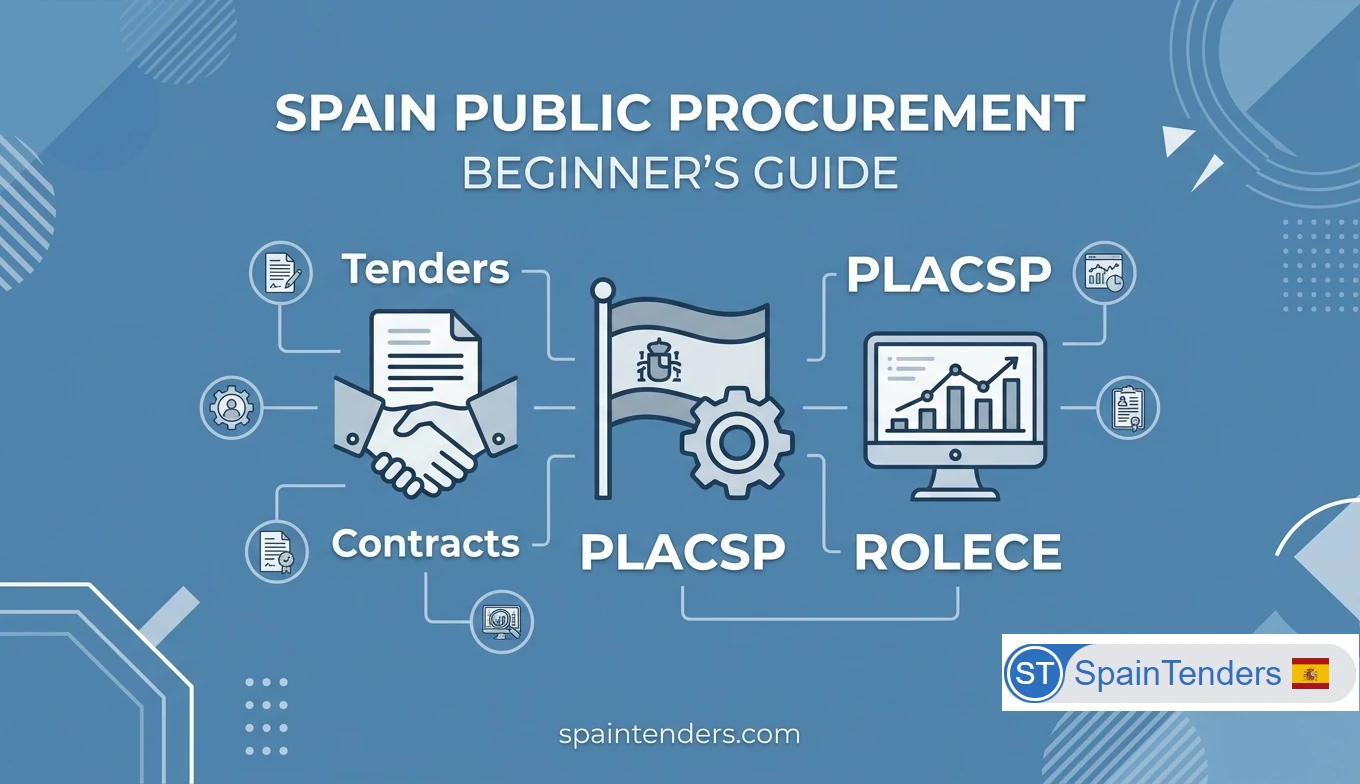
The Spanish public procurement framework is primarily based on Ley 9/2017 de Contratos del Sector Público. The procurement ecosystem also includes the Plataforma de Contratación del Sector Público or PLACSP, the Registro Oficial de Licitadores y Empresas Clasificadas del Sector Público or ROLECE, regional procurement platforms and European procurement resources such as TED.
This beginner's guide explains the fundamentals of Spain public procurement and shows how businesses can approach Spanish government tenders in a structured way.
What This Article Covers
- What Is Public Procurement in Spain?
- How Does Public Procurement Work in Spain?
- Who Can Participate in Spanish Public Procurement?
- Where Can Companies Find Public Tenders in Spain?
- What Is PLACSP and Why Is It Important?
- What Is ROLECE?
- Understanding CPV Codes in Spanish Tenders
- What Are Spanish Tender Documents?
- What Information Should You Check in a Spanish Tender?
- Why Spanish Procurement Terminology Matters for Tender Search
- Common Mistakes Made by New Bidders
- How International Companies Can Approach Spanish Public Procurement
- How Companies Can Build a Spain Tender Search Strategy
- Benefits of Understanding Spain Public Procurement
- How spaintenders.com Can Help Businesses
- Conclusion
What Is Public Procurement in Spain?
Public procurement in Spain is the process through which public-sector organisations purchase works, supplies and services from businesses and other eligible economic operators.
A public authority may need to construct infrastructure, purchase medical equipment, implement software, maintain public buildings, provide professional services or obtain thousands of other products and services. When the applicable procurement rules require a competitive process, the authority publishes a procurement opportunity and invites eligible companies to participate.
Spanish procurement uses several important terms that beginners should understand.
- Licitación pública refers to a public tender or competitive procurement process.
- Contratación pública refers broadly to public procurement activity.
- Contrato público refers to a public contract established between the contracting authority and the successful supplier.
- Licitador refers to a bidder participating in a procurement procedure.
- Proveedor refers to a supplier or service provider.
- Órgano de contratación refers to the contracting authority responsible for the procurement.
- Perfil del contratante refers to the contracting profile where procurement information is published.
Public procurement can take place at national, regional and local levels. This means a company targeting Spain should consider the complete procurement ecosystem rather than focusing on only one type of public authority.
How Does Public Procurement Work in Spain?
The exact procurement process depends on the contract and procedure but most tender opportunities follow a logical sequence from identifying a public requirement through evaluation and contract award.
1. Public Authority Identifies a Requirement
The process begins when a public organisation identifies a requirement. This may involve construction, software, equipment, consulting, maintenance, healthcare services, transportation or another category.
The authority determines what needs to be purchased and establishes the appropriate procurement approach.
2. Procurement Documents Are Prepared
The contracting authority prepares the documentation that defines the contract. These documents can include administrative conditions, technical specifications, eligibility requirements, evaluation criteria, contract duration and financial information.
For bidders, these documents are extremely important because the tender title or short notice normally does not contain every requirement.
3. Tender Is Published
The procurement opportunity is published through the applicable procurement platform or contracting profile. PLACSP is a central source of public procurement information in Spain while regional systems also play an important role.
4. Suppliers Analyse the Opportunity
Potential bidders examine the opportunity and decide whether they can satisfy the requirements. This is the qualification stage from the supplier's perspective.
Companies should review the contract object, CPV codes, estimated value, deadlines, location, lots, technical requirements, financial requirements and evaluation criteria before deciding to participate.
5. Bid Is Prepared
If the opportunity matches the company's capabilities, the supplier prepares its offer and supporting documentation. The technical proposal should respond directly to the requirements described in the tender documents.
6. Electronic Submission
Spanish procurement increasingly relies on electronic processes. Depending on the procurement platform and procedure, bidders may need an account, electronic certificate and appropriate electronic signing tools to complete the submission.
7. Evaluation and Award
The contracting authority evaluates the submitted offers according to the published criteria. Depending on the tender, evaluation may consider price, technical quality, methodology, experience, service arrangements, sustainability or other criteria.
The contract is ultimately awarded according to the applicable procurement procedure and the published evaluation framework.
Who Can Participate in Spanish Public Procurement?
Eligible companies and other economic operators can participate in Spanish public procurement when they satisfy the requirements established in the relevant tender.
Depending on the contract, a bidder may need to demonstrate legal capacity, professional authorisation, economic and financial solvency, technical or professional solvency and other qualifications.
Some contracts can also involve classification requirements or specific technical conditions. A supplier must therefore assess every tender independently rather than assuming that general registration makes it eligible for all Spanish public contracts.
Both Spanish companies and eligible foreign companies can consider the Spanish public procurement market. However, international bidders need to pay particular attention to documentation, electronic submission, language, registration and qualification requirements.
Where Can Companies Find Public Tenders in Spain?
Companies searching for Spain tenders should understand that procurement information can come from several levels of the Spanish and European procurement ecosystem.
Plataforma de Contratación del Sector Público
The Plataforma de Contratación del Sector Público or PLACSP is one of the most important sources for Spanish public procurement information. It provides access to procurement opportunities, contracting profiles, documents and other tender information.
For companies beginning their Spain tender research, PLACSP should be one of the first resources to understand.
TED - Tenders Electronic Daily
TED is the European Union's procurement notices platform and is relevant for public procurement opportunities that are published at European level. Companies searching for larger European opportunities can use TED alongside national procurement resources.
Regional Procurement Platforms
Spain also has procurement systems and contracting profiles connected with autonomous communities and regional public administrations. Companies targeting a specific geography should therefore investigate the procurement resources relevant to that region.
Useful search terms can include licitaciones Madrid, licitaciones Andalucía, licitaciones Cataluña, licitaciones Galicia, licitaciones País Vasco, licitaciones Navarra and licitaciones Aragón.
What Is PLACSP and Why Is It Important?
PLACSP stands for Plataforma de Contratación del Sector Público. It is a central digital platform for public procurement information in Spain and is one of the most important resources for companies looking for Spanish government tenders.
The platform connects procurement information with public buyers and economic operators. Companies can use the platform to search procurement opportunities, examine contracting profiles and access tender-related documentation.
Depending on the procurement process, supplier-side functions can also include electronic interaction and electronic offer submission.
PLACSP is particularly important because it supports the discovery of procurement opportunities across a broad public-sector ecosystem. Companies can use available search options to narrow results and identify tenders relevant to their products and services.
A professional Spain tender search should not rely only on a general keyword. Businesses should combine keywords with CPV classifications, geographical areas, contract types, deadlines and other available filters.
What Is ROLECE?
ROLECE stands for Registro Oficial de Licitadores y Empresas Clasificadas del Sector Público. It is the Official Register of Bidders and Classified Companies of the Public Sector.
ROLECE provides an electronic registration and certification system for companies participating in public procurement. Information recorded through the register can relate to areas such as legal personality and capacity, representation, professional or business authorisation, economic and financial solvency and classification where applicable.
For suppliers, the main value of understanding ROLECE is that registered information can help demonstrate relevant bidder qualifications in procurement processes where the applicable rules allow it.
ROLECE registration is an important topic for companies that intend to participate regularly in Spanish public tenders. Businesses should understand the registration process and determine which information and certificates are relevant to their specific circumstances.
Companies should also understand the relationship between electronic certificates, electronic identification and digital signing because Spanish tender participation can involve electronic procedures.
Understanding CPV Codes in Spanish Tenders
CPV stands for Common Procurement Vocabulary. CPV codes provide a standard classification system for describing the subject of public procurement contracts.
CPV is especially useful for companies that want to improve the precision of their tender searches. A supplier may offer a specialised product or service that is described using several different keywords. Searching only one keyword can therefore produce incomplete results.
For example, an IT company may search for terms such as software, information technology, IT services or digital transformation. Relevant CPV classifications can provide another layer of procurement discovery.
A practical tender search model can therefore be structured as:
Keyword → CPV → Region → Contract Type → Contract Value → Deadline
This approach can help companies reduce irrelevant results and identify procurement opportunities that more closely match their business capabilities.
What Are Spanish Tender Documents?
Spanish tender documents contain the detailed conditions that suppliers need to understand before preparing an offer.
PCAP stands for Pliego de Cláusulas Administrativas Particulares. It generally contains administrative and contractual conditions for the procurement.
PPT stands for Pliego de Prescripciones Técnicas. It generally describes the technical requirements and specifications of the contract.
DEUC stands for Documento Europeo Único de Contratación. It is a standardised European self-declaration mechanism used in relevant procurement procedures.
Pliegos is a broader term used for the procurement specifications and related tender documents.
Expediente refers to the procurement file or case associated with the procedure.
These documents should be reviewed carefully before a company decides to bid. Important requirements can appear in administrative specifications, technical specifications, annexes and other supporting documents.
What Information Should You Check in a Spanish Tender?
A company should create a consistent tender evaluation checklist before deciding whether to participate.
- Contracting Authority: Identify the public organisation purchasing the goods, works or services.
- Contract Object: Understand exactly what the authority intends to purchase.
- CPV: Check the relevant CPV classifications and compare them with your business categories.
- Contract Value: Review the financial information provided in the tender documents.
- Deadline: Confirm the exact date and time for submitting the offer.
- Location: Determine where the goods or services must be delivered or performed.
- Contract Duration: Check the initial contract period and applicable extension options.
- Lots: Determine whether the tender is divided into separate lots and whether your company can participate in the relevant lots.
- Technical Requirements: Check required experience, personnel, equipment, certifications and technical capabilities.
- Financial Solvency: Review turnover and other economic requirements specified in the tender.
- Technical or Professional Solvency: Check experience and evidence requirements.
- Evaluation Criteria: Understand how the contracting authority will evaluate competing offers.
- Submission Method: Confirm where and how the bid must be submitted electronically.
This checklist can help suppliers avoid spending significant time preparing bids for opportunities where they do not meet the basic requirements.
Why Spanish Procurement Terminology Matters for Tender Search
International companies often begin their research using English terms such as Spain tenders, Spain government tenders or Spain public procurement. These keywords are useful but they should be combined with Spanish procurement terminology.
Spanish procurement searches commonly use terms such as:
- licitaciones España
- licitaciones públicas España
- contratación pública España
- contratos públicos
- concursos públicos
- licitación electrónica
- portal de contratación pública
- plataforma de contratación pública
- perfil del contratante
Understanding these terms can improve tender discovery and help international suppliers navigate Spanish procurement information more effectively.
Some common terminology relationships include bidder - licitador, supplier - proveedor, tender documents - pliegos, award - adjudicación, contracting authority - órgano de contratación and bid submission - presentación de ofertas.
Common Mistakes Made by New Bidders
New bidders can make several avoidable mistakes when entering the Spanish public procurement market.
Searching only broad keywords: A general search can produce a large number of irrelevant opportunities. CPV codes, locations and contract types can make the search more precise.
Ignoring tender documents: A tender title does not explain every requirement. Suppliers should examine the relevant PCAP, PPT and supporting documents.
Checking deadlines too late: Electronic registration, certificate setup, document preparation and bid submission can require time. Waiting until the final day increases operational risk.
Ignoring regional procurement: Companies targeting specific Spanish regions should investigate relevant autonomous-community and local procurement resources.
Using only English search terms: Spanish procurement terminology can reveal opportunities and information that may not appear through English-only searches.
Assuming registration solves every requirement: ROLECE and other registrations can support the procurement process but bidders must still comply with the requirements of each individual tender.
Focusing only on price: Some tenders use multiple evaluation criteria. Technical quality and other factors can influence the final result.
How International Companies Can Approach Spanish Public Procurement
Foreign companies can consider Spain as part of their European public procurement strategy when they can satisfy the applicable legal, technical and commercial requirements.
The best starting point is market research. A company should first identify the products and services it can supply and then identify relevant Spanish procurement terminology and CPV codes.
The next step is to identify the public authorities and procurement platforms relevant to the company's target sector and geographic market.
Foreign suppliers should also study previous procurement documents and published opportunities. This can help them understand the type of requirements that Spanish contracting authorities use and the level of detail expected in tender responses.
Before participating in a live tender, companies should establish a process for handling electronic certificates, registration, document preparation, translation where required and electronic submission.
International suppliers should also assess whether they can satisfy the tender's financial, technical and professional requirements. Market entry should be approached as a procurement process rather than simply as a sales exercise.
How Companies Can Build a Spain Tender Search Strategy
A successful Spain tender search strategy should be systematic and repeatable.
Step 1 - Define your target market
Identify the products, services, industries and Spanish regions that are relevant to your business.
Step 2 - Build your keyword list
Create a list containing English international terms and Spanish procurement terms such as licitación, contratación pública, concurso público and proveedor.
Step 3 - Map relevant CPV codes
Identify CPV classifications related to your products and services and use them as part of your search strategy.
Step 4 - Identify relevant authorities
Research national, regional and local contracting authorities that regularly purchase your products or services.
Step 5 - Search procurement platforms
Use PLACSP, relevant regional procurement platforms and TED where appropriate. Combine keywords, CPV, geography, contract type and other available filters.
Step 6 - Review tender documents
Check eligibility, technical requirements, financial requirements, evaluation criteria, deadlines and submission instructions.
Step 7 - Build an opportunity pipeline
Track relevant tenders using information such as contracting authority, contract value, deadline, sector, location and tender status.
Step 8 - Prepare for electronic submission
Ensure that the responsible team has the necessary registration, electronic certificate and signing capabilities before the submission deadline.
This process turns tender discovery into a repeatable procurement intelligence workflow instead of an occasional manual search.
Benefits of Understanding Spain Public Procurement
Understanding the Spanish public procurement ecosystem can provide several practical benefits for suppliers.
- Better opportunity discovery: Companies can search using Spanish terminology, CPV classifications and geographic filters.
- Improved qualification: Businesses can identify unsuitable opportunities before investing significant resources in bid preparation.
- Better compliance: Understanding tender documents helps reduce the risk of missing important requirements.
- Faster tender research: A structured workflow can reduce repetitive manual searches.
- Regional market visibility: Businesses can identify opportunities across different autonomous communities and local authorities.
- Better bid preparation: Understanding PCAP, PPT, DEUC, CPV and evaluation criteria helps suppliers prepare more relevant offers.
- International expansion: Foreign suppliers can use Spanish procurement intelligence as part of a broader European market strategy.
How Spaintenders.com Can Help Businesses
Finding a tender is only one part of the procurement process. Businesses also need to identify relevant opportunities, monitor deadlines, understand procurement categories and continuously track new tender activity.
For companies targeting Spain, a procurement intelligence workflow can combine tender discovery with keyword research, CPV-based classification, geographic filtering, contracting-authority research and deadline monitoring.
Platforms such as Spaintenders.com can support businesses that need structured tender information and broader procurement discovery across markets.
A company developing a Spain procurement strategy should aim to build a repeatable system that helps its team discover relevant opportunities, evaluate qualification requirements and monitor procurement activity rather than relying on occasional manual searches.
The long-term objective is to connect procurement information with business requirements. A supplier should be able to move from identifying a market category to finding relevant tenders and then evaluating whether a specific opportunity is worth pursuing.
Conclusion
Spain public procurement offers opportunities across construction, technology, healthcare, engineering, transportation, energy, consulting, maintenance and many other sectors. However, entering this market successfully requires an understanding of the procurement ecosystem rather than simply searching for the phrase Spain tenders.
Companies should become familiar with Spanish procurement terminology including licitaciones públicas, contratación pública, licitador, perfil del contratante and presentación de ofertas. They should also understand the role of PLACSP, ROLECE, CPV classifications and Spanish tender documents.
PLACSP is a central resource for Spanish procurement information and should be an important part of a supplier's tender search process. ROLECE is relevant to bidder registration and certification while CPV codes can improve the precision of procurement searches.
Companies should also pay close attention to PCAP, PPT, DEUC and other procurement documents because the detailed conditions of a tender are often contained within the complete procurement documentation.
For beginners, the most effective approach is to start with procurement fundamentals, learn the Spanish terminology, identify relevant CPV codes, understand the major procurement platforms and create a structured process for finding and evaluating opportunities.
Spain public procurement should therefore be viewed as a complete procurement ecosystem rather than a single tender website. Companies that understand national procurement resources, regional platforms, bidder requirements, procurement terminology and tender documentation can build a more informed and efficient approach to discovering public-sector opportunities in Spain.
Frequently Asked Questions (FAQs)

Fresh and verified Tenders from Spain. Find, search and filter Tenders/Call for bids/RFIs/RFPs/RFQs/Auctions published by the government, public sector undertakings (PSUs) and private entities.
- 1,000+ Tenders
- Verified Tenders Only
- New Tenders Every Day
- Tenders Result Data
- Archive & Historical Tenders Access
- Consultants for RFI/RFP/RFQ
- Tender Notifications & Alerts
- Search, Sort, and Filter Tenders
- Bidding Assistance & Consulting
- Customer Support
- Publish your Tenders
- Export data to Excel
- API for Tender Data
- Tender Documents

Fill out the form below and you will receive a call from us within 24 hours.
Get FREE SAMPLE TENDERS from Spain in your email inbox.
Copyright © 2014-2026 SpainTenders.com. All Rights Reserved.