Spain Public Procurement Law: Ley 9/2017 Explained
A Practical Guide to Spanish Public Procurement Rules for Contractors and Suppliers
Introduction to Ley 9/2017
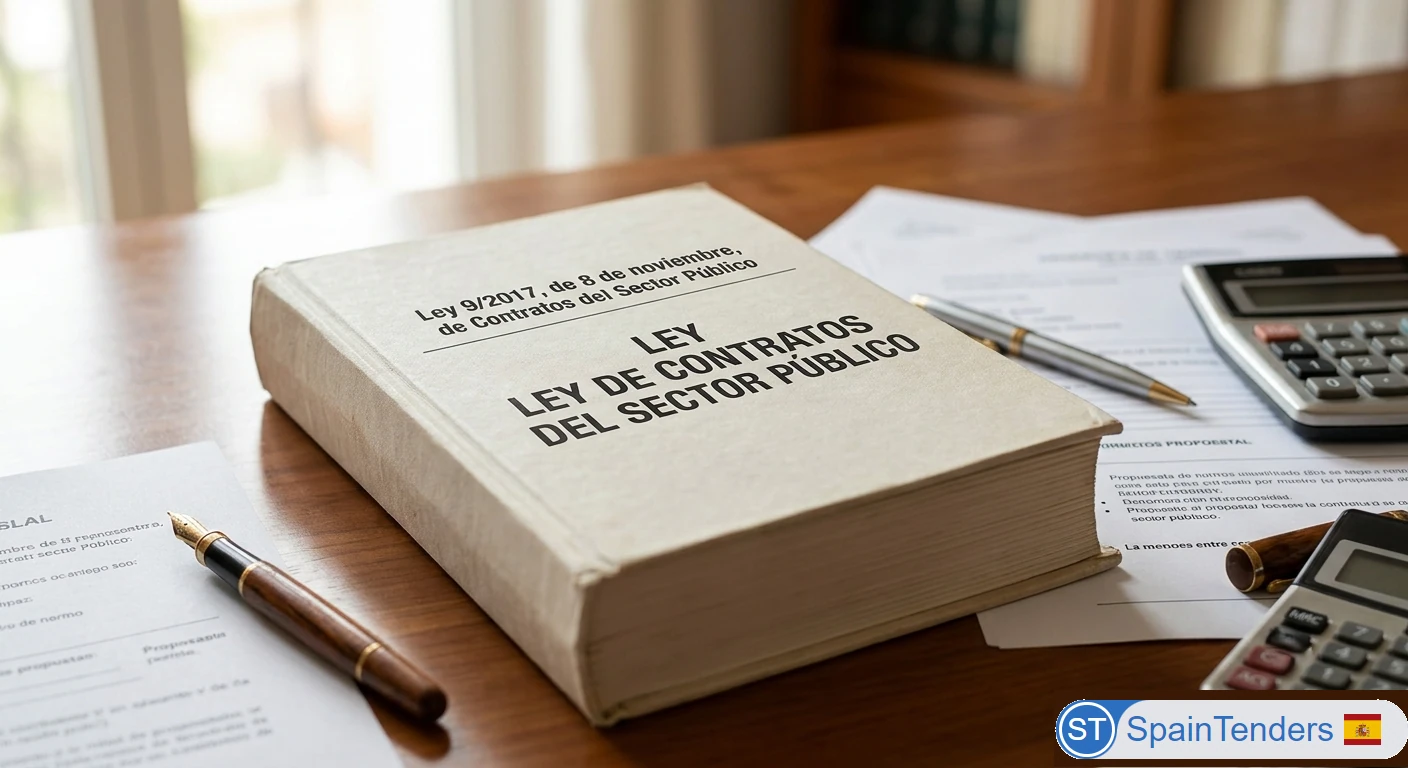
Anyone planning to compete for Spain government tenders should understand the basic legal framework governing Spanish public procurement. The central legislation is Ley 9/2017, de 8 de noviembre, de Contratos del Sector Público, commonly referred to as the LCSP.
The law establishes the framework for public-sector contracts and sets rules intended to protect equal access, transparency, competition, proportionality and integrity. It also regulates important stages of the procurement lifecycle, from preparation and tendering to award, formalisation, execution and termination.
For contractors and suppliers, understanding the LCSP is not simply a legal exercise. The law affects how a company qualifies for a procurement opportunity, how tenders are evaluated, how requirements are designed, how contracts are divided into lots and what obligations may continue after the award.
This guide explains the most important parts of Ley 9/2017 from a practical procurement perspective, while keeping the focus on what businesses need to understand when participating in Spanish public procurement.
Table of Contents
- What Is Ley 9/2017?
- When Did Ley 9/2017 Come Into Force?
- Purpose and Objectives of the Spanish Public Procurement Law
- Who Is Covered by Ley 9/2017?
- What Types of Public Contracts Are Covered?
- Key Principles of Public Procurement in Spain
- How Ley 9/2017 Promotes Competition
- Public Procurement Procedures Under Ley 9/2017
- Open Procedure
- Restricted Procedure
- Negotiated Procedure
- Competitive Dialogue
- Innovation Partnership
- Open Simplified Procedure
- Contract Value, Budget and Procurement Thresholds
- Technical and Financial Solvency Requirements
- Why Contracts Are Divided Into Lots
- How Ley 9/2017 Supports SMEs
- Evaluation and Best Price-Quality Ratio
- Social, Environmental and Innovation Criteria
- Abnormally Low Tenders
- Electronic Public Procurement
- Contract Award and Formalisation
- Contract Performance and Modifications
- Special Review and Legal Remedies
- What Ley 9/2017 Means for Contractors and Suppliers
- Spain Public Tender Compliance Checklist
- Conclusion
What Is Ley 9/2017?
Ley 9/2017, de 8 de noviembre, de Contratos del Sector Público is Spain's principal public procurement law for contracts covered by its scope. It transposed into Spanish law the European Union Directives 2014/23/EU and 2014/24/EU concerning concessions and public procurement.
The law regulates public-sector contracting and establishes requirements intended to ensure freedom of access to tenders, publicity and transparency, non-discrimination, equal treatment, competition, integrity and efficient use of public funds.
Article 1 also establishes the importance of defining public needs in advance, protecting free competition and selecting the economically most advantageous offer within the framework established by the law. The law additionally incorporates social and environmental considerations where linked to the subject of the contract and seeks to facilitate SME access to public procurement.
When Did Ley 9/2017 Come Into Force?
The law was published in the Boletín Oficial del Estado (BOE) on 9 November 2017 and entered into force on 9 March 2018, with the exceptions specified in its final provisions.
The current consolidated version is particularly important for businesses because the legislation has been amended since its original publication. The BOE record shows subsequent modifications, including changes published in 2025 and 2026. Therefore, businesses should consult the current consolidated legislation rather than relying exclusively on summaries of the original 2017 text.
Purpose and Objectives of the Spanish Public Procurement Law
The LCSP is designed to achieve several connected objectives.
- Protect equal treatment of bidders.
- Prevent discrimination between economic operators.
- Promote transparency in procurement.
- Protect free and effective competition.
- Improve the relationship between quality and price.
- Promote efficient use of public funds.
- Strengthen procurement integrity.
- Incorporate relevant social and environmental considerations.
- Facilitate access to public contracts for SMEs.
- Establish rules for contract execution and control.
For a bidder, these objectives have a practical consequence: procurement specifications and evaluation criteria should not be treated as arbitrary commercial preferences. They operate within a legal framework that requires objective, transparent and proportionate treatment of economic operators.
Who Is Covered by Ley 9/2017?
The law applies to public-sector contracts within its defined scope and identifies the entities that form part of the public sector for procurement purposes.
These can include central government bodies, autonomous and regional administrations, local authorities, public-sector organisations and other entities covered by the legislation. The exact legal regime applicable to a particular contract can depend on the status of the contracting entity and the nature of the contract.
This distinction is important because not every organisation connected with the public sector operates under exactly the same procurement rules in every situation.
What Types of Public Contracts Are Covered?
Ley 9/2017 distinguishes several principal contract categories.
| Contract Type | General Meaning |
| Works contract | Execution of construction or engineering works in accordance with the legal definition. |
| Works concession | Execution or design and execution of works combined with the concession elements established by law. |
| Services concession | Provision and management of services where the concession characteristics defined by law apply. |
| Supply contract | Acquisition, leasing or other forms of procurement of products covered by the law. |
| Services contract | Provision of services for a public-sector contracting entity. |
| Mixed contract | A contract combining different contractual elements under the conditions established by the law. |
The classification of a procurement matters because different rules can apply to procedures, thresholds, qualification, award and execution depending on the contract type.
Key Principles of Public Procurement in Spain
One of the most important parts of Ley 9/2017 is its emphasis on procurement principles.
Article 132 requires contracting authorities to provide bidders and candidates with equal and non-discriminatory treatment and to act according to transparency and proportionality. It also prohibits procurement from being designed to artificially restrict competition or favour or disadvantage particular economic operators without justification.
For companies, these principles explain why public procurement specifications should establish clear conditions that allow competing businesses to be assessed on an effective and transparent basis.
The principles also provide a legal foundation for challenging certain procurement decisions where the statutory conditions for a remedy are met.
How Ley 9/2017 Promotes Competition
Competition is a central element of Spanish public procurement. A contracting authority should define its procurement requirements in a manner that allows effective competition while ensuring that the public need is properly satisfied.
The law also includes measures intended to improve access for SMEs. One important mechanism is the treatment of contract lots. The legislation changed the previous approach by making division into lots the general rule, while requiring justification where a contract is not divided into lots.
For smaller companies, this can be commercially significant because a large procurement divided into multiple lots may create participation opportunities that would be difficult to access as a single large contract.
Public Procurement Procedures Under Ley 9/2017
Ley 9/2017 provides several procurement procedures. The appropriate procedure depends on the circumstances and conditions established by the law.
| Procedure | General Characteristics |
| Open procedure | Eligible economic operators can submit an offer without a prior selection of participants. |
| Restricted procedure | Interested operators request participation and only selected candidates are invited to submit offers. |
| Negotiated procedure | Negotiation with economic operators is permitted only in the circumstances established by law. |
| Competitive dialogue | Used in circumstances where the contracting authority needs dialogue with selected participants to identify suitable solutions. |
| Innovation partnership | Designed for situations involving development and subsequent acquisition of innovative solutions under the conditions established by law. |
| Open simplified procedure | A simplified form of open procurement available when the statutory conditions are satisfied. |
Article 131 establishes open and restricted procedures as the ordinary procedures for public administrations, while negotiated procedures, competitive dialogue and innovation partnership are available in the specific circumstances defined by the law.
Open Procedure
The procedimiento abierto is one of the most important procedures for businesses because eligible operators can submit offers without first being selected through a separate participation stage.
For a supplier, an open procedure can therefore provide a direct route from opportunity identification to qualification and offer submission.
The bidder still has to satisfy the eligibility and solvency conditions and comply with every requirement contained in the procurement documents.
Restricted Procedure
In a restricted procedure, the process involves a selection stage before invited candidates submit their offers.
This creates a different commercial strategy for suppliers. Instead of treating the initial stage as a complete bid, the company needs to demonstrate that it meets the conditions necessary to be invited to the next stage.
Businesses should therefore read the participation requirements separately from the subsequent tender requirements.
Negotiated Procedure
A negotiated procedure allows negotiation with economic operators only when the circumstances specified in the LCSP are satisfied.
The existence of a negotiation stage does not mean that a company can negotiate any requirement it wishes. The procurement documents establish the aspects that can be negotiated and the procedure must maintain transparency and non-discrimination.
The law specifies circumstances under which negotiated procedures with or without prior publication may be used.
Competitive Dialogue
Competitive dialogue is intended for procurements where the contracting authority needs dialogue with selected candidates to identify or develop solutions capable of meeting its requirements.
This can be relevant to complex procurement where the authority cannot simply define the complete solution in advance in the same way as a conventional supply purchase.
For participating businesses, this means the procurement strategy may involve demonstrating technical capability and contributing to the development of a suitable solution during the dialogue process.
Innovation Partnership
The innovation partnership procedure is designed for circumstances where the contracting authority identifies a need for an innovative product, service or works that cannot be met by solutions already available on the market under the conditions established by law.
For technology companies, research-oriented businesses and specialist suppliers, this procedure can create opportunities where procurement and innovation activities are connected.
However, companies should examine the specific procurement documents carefully because the partnership framework can involve development stages, performance requirements and subsequent acquisition conditions.
Open Simplified Procedure
The procedimiento abierto simplificado was introduced to simplify certain procurement procedures and reduce administrative burdens.
Its use is subject to statutory conditions relating to contract value and the characteristics of the award criteria. For example, the current consolidated law establishes a specific value limit for works and separate applicable limits for supplies and services, together with conditions concerning criteria evaluated by judgement.
There is also a simplified form for lower-value works, supplies and services subject to the conditions specified in Article 159.
For SMEs, this procedure can be particularly relevant because its design reduces certain procedural burdens compared with more complex procurement routes.
Contract Value, Budget and Procurement Thresholds
Businesses frequently encounter three different concepts when analysing a Spanish tender: presupuesto base de licitación, valor estimado del contrato and, where relevant, European procurement thresholds.
The presupuesto base de licitación is generally the maximum spending limit that the contracting authority can commit under the contract and includes VAT unless the law provides otherwise. The law also requires the contracting authority to ensure that the budget is appropriate to market prices and to break down relevant costs in the procurement documents.
The valor estimado is calculated under different rules and, for works, supplies and services, is generally based on the total amount payable without VAT, taking account of relevant options, extensions and other elements required by the law.
These figures should not be treated as interchangeable. A bidder comparing Spanish tenders needs to understand which financial figure is being displayed and what it represents.
Technical and Financial Solvency Requirements
Public procurement law allows contracting authorities to establish requirements concerning the economic and financial standing and technical or professional ability of bidders.
For a contractor, this means that being interested in a tender is not enough. The company must be capable of demonstrating the required level of capacity in the manner specified by the procurement.
Technical and professional requirements can relate to previous experience, personnel, technical resources, qualifications or other evidence relevant to the contract. Economic and financial requirements can relate to the financial capacity specified in the tender.
Companies should therefore maintain accurate evidence of relevant projects, turnover where required, professional credentials, staff qualifications and technical resources.
Why Contracts Are Divided Into Lots
Lotting is an important feature of the LCSP and has direct commercial relevance for suppliers.
The law generally favours division of contracts into lots, while requiring justification when a contracting authority decides not to divide a procurement into lots.
Lotting can make a large procurement more accessible to businesses with narrower geographical coverage, specialist capabilities or smaller operational capacity.
However, bidders must carefully examine whether they can bid for individual lots, multiple lots or combinations of lots and whether the tender establishes specific solvency requirements for each lot.
How Ley 9/2017 Supports SMEs
Improving SME access is expressly reflected in the objectives of the law. Measures include simplification of procedures, reduction of administrative burdens and rules concerning division of contracts into lots.
For a small contractor, this means public procurement strategy should not focus exclusively on very large national contracts.
SMEs can investigate smaller contracts, regional procurement, local authorities, specialised lots and recurring categories where their operational capabilities match the procurement requirements.
The law's approach to lotting and administrative simplification is therefore relevant when businesses build a realistic Spanish public procurement strategy.
Evaluation and Best Price-Quality Ratio
One of the major changes reinforced by the LCSP is the emphasis on the best price-quality ratio.
Article 145 states that contracts are awarded using multiple award criteria based on the best price-quality relationship, while allowing, with justification, cost-effectiveness approaches based on price or cost, including life-cycle costing.
Qualitative criteria can cover aspects such as technical quality, functional characteristics, accessibility, environmental and social characteristics, innovation, after-sales service and delivery conditions.
This means that the lowest price is not automatically the objective in every Spanish public tender.
For contractors and consultants, the technical response can therefore have a major impact on the final result, particularly where the tender assigns substantial weight to qualitative criteria.
Social, Environmental and Innovation Criteria
Public procurement under the LCSP can incorporate social, environmental and innovation considerations when they are connected to the subject of the contract and satisfy the legal requirements.
The law requires public procurement to incorporate social and environmental criteria transversally where related to the contract object. It also provides for special conditions of execution covering social, ethical, environmental or other permitted matters.
For bidders, these conditions should be identified before the offer is prepared. A company may need to demonstrate how its delivery model, employment practices, environmental management or other operational commitments satisfy the specified requirements.
Abnormally Low Tenders
A very low price can attract attention during evaluation, but submitting an unusually low offer can create additional scrutiny.
The LCSP contains specific provisions concerning abnormally low tenders. Where an offer is identified as abnormally low according to the applicable rules, the bidder can be required to provide explanations and evidence supporting the feasibility of the proposed price.
This makes commercial costing important. A contractor should be able to explain its labour costs, materials, methodology, efficiencies and other relevant cost assumptions where required.
Price should therefore be competitive without becoming commercially unsustainable or difficult to justify.
Electronic Public Procurement
Electronic procurement is an important practical consequence of the modern Spanish procurement framework.
Businesses increasingly need the technical capability to identify the applicable electronic tendering environment, authenticate themselves, prepare electronic documents, sign where required and complete submission through the designated system.
The electronic process should be treated as part of bid compliance rather than merely an administrative convenience.
A technically strong offer that is not submitted correctly and within the required deadline cannot achieve its commercial objective.
Contract Award and Formalisation
After offers have been evaluated according to the published criteria, the contracting authority follows the contract award process established by the law and the tender documents.
The authority classifies offers according to the applicable award criteria and identifies the bidder presenting the best offer under the procurement framework.
Article 150 provides for a subsequent requirement for the best ranked bidder to submit supporting documentation where it has not already been provided and to demonstrate other required circumstances, including the availability of committed resources and the constitution of the definitive guarantee where applicable.
The award decision is then communicated and published according to the statutory requirements, followed by formalisation where required.
Contract Performance and Modifications
Ley 9/2017 does not stop operating when the winning bidder is selected. It also regulates the effects, performance and termination of public contracts.
This is important for contractors because obligations continue throughout the execution period.
The law addresses matters including performance, payment, delays, penalties, environmental, social and labour obligations, special execution conditions and contract modifications.
For example, Article 201 requires contracting authorities to take appropriate measures to ensure that contractors comply with applicable environmental, social and labour obligations during contract performance.
Article 202 additionally requires at least one special condition of execution of the specified type to be established in the relevant administrative specifications, subject to the legal framework.
A successful bidder should therefore treat the tender documents as a long-term contractual commitment, not merely as instructions for winning the procurement.
Special Review and Legal Remedies
Businesses that believe a qualifying procurement decision has breached the applicable rules may have access to the recurso especial en materia de contratación, commonly understood as the special procurement review mechanism.
Article 44 identifies the contracts and acts that can be subject to this special review. The scope includes specified works, supply and service contracts above the statutory value conditions, certain framework agreements and dynamic purchasing systems, and concessions above the applicable threshold.
The remedy can apply to matters such as tender notices, procurement specifications and certain decisions during the procurement process.
The special procurement appeal is optional and free for appellants under the conditions established by the law.
Because deadlines and procedural requirements can be critical, a business considering a challenge should obtain appropriate professional legal advice rather than relying on a general tender guide.
What Ley 9/2017 Means for Contractors and Suppliers
For a business, the LCSP can be understood as a framework that determines how public buyers purchase and how economic operators compete for those contracts.
Its practical impact can be summarised through several areas.
| Area | What the Bidder Should Understand |
| Eligibility | The company must meet the legal and tender-specific requirements for participation. |
| Solvency | Economic, financial, technical or professional capacity may need to be demonstrated. |
| Competition | Procurement is governed by equal treatment, transparency, proportionality and free-competition principles. |
| Lots | Large contracts may be divided into lots to facilitate broader participation. |
| Evaluation | Offers can be assessed using price and qualitative criteria under the published methodology. |
| Sustainability | Social and environmental considerations can form part of procurement and execution requirements. |
| Electronic procurement | Bidders must follow the electronic process specified for the procurement. |
| Execution | Winning a contract creates continuing obligations during performance. |
| Remedies | Eligible bidders may have legal mechanisms to challenge certain procurement decisions. |
Spain Public Tender Compliance Checklist
Before deciding to bid on a Spanish public contract, a business should review the legal and commercial requirements together.
- Identify the contracting authority.
- Confirm the legal type and scope of the procurement.
- Check the applicable procurement procedure.
- Review the contract object carefully.
- Understand the budget and estimated value.
- Check whether the procurement is divided into lots.
- Review eligibility and exclusion requirements.
- Check economic and financial solvency requirements.
- Check technical and professional solvency requirements.
- Review the award criteria and weighting.
- Identify social and environmental conditions.
- Review requirements concerning execution.
- Check the permitted contract modifications.
- Understand the electronic submission requirements.
- Record the official submission deadline.
- Maintain evidence supporting company qualifications and experience.
- Review all amendments and clarifications issued during the procedure.
- Retain the final submitted offer and proof of submission.
How Contractors Can Use Ley 9/2017 for Better Bid Decisions
Knowing the law becomes valuable when it is converted into a bid-screening process.
Instead of asking only whether a tender matches a company's product or service, a contractor should ask whether the opportunity is legally accessible, commercially viable and operationally achievable.
A practical assessment can begin with the contract type and procedure. The business can then examine eligibility, solvency, lot structure, evaluation criteria, financial exposure and execution obligations.
This approach helps distinguish a tender that looks attractive from a tender that the company can realistically win and deliver.
For international suppliers, the same principle applies. Entering the Spanish procurement market requires understanding not only the opportunity itself but also the legal and procedural environment in which Spanish public buyers operate.
How SpainTenders Can Support Spain Procurement Research
For contractors, suppliers and consultants, understanding Ley 9/2017 is only one component of a successful procurement strategy. The other component is finding relevant opportunities early enough to evaluate them against the legal and commercial requirements.
SpainTenders.com can support the opportunity discovery stage by helping businesses identify procurement opportunities in the Spanish market.
The most useful workflow is not to treat tender discovery and legal compliance as separate activities. A company can use opportunity research to identify relevant contracts and then apply the LCSP framework to assess whether the procurement is suitable for participation.
The official procurement documentation remains the controlling source for the requirements of each individual tender. SpainTenders can complement this process by helping businesses discover opportunities and organise their procurement research.
Register now to win Spanish government tenders
Why Contractors Should Monitor Changes to Ley 9/2017
Public procurement legislation is not static. The BOE's consolidated record shows that Ley 9/2017 has been modified after its original enactment, including amendments recorded in 2026.
This means businesses should be cautious when using old articles, guides, downloadable documents or historical procurement advice. A rule, threshold or procedural provision that applied at an earlier date may have been amended.
For operational bidding decisions, companies should verify the current consolidated law and, more importantly, the rules and documents applicable to the specific tender.
Conclusion
Ley 9/2017 is the foundation of Spain's modern public procurement framework and is essential reading for businesses that want to compete for Spanish government contracts.
The law establishes principles of equal treatment, transparency, proportionality and free competition while seeking efficient use of public funds and a strong relationship between price and quality. It also provides mechanisms intended to improve SME participation, including rules concerning the division of contracts into lots.
For bidders, the most important lesson is that Spanish public procurement is governed by a complete lifecycle of rules. The relevant obligations begin with eligibility and qualification, continue through the tender and evaluation stages, and can remain important throughout contract execution.
Understanding procedures such as the open procedure, restricted procedure, negotiated procedure, competitive dialogue and innovation partnership helps companies recognise how different procurement opportunities are structured. Understanding solvency, award criteria, contract value, lots and execution conditions helps them decide whether a specific opportunity is worth pursuing.
The LCSP also makes clear that public procurement is not simply about offering the lowest possible price. The legal framework places significant importance on the best price-quality relationship, while allowing relevant environmental, social and innovative considerations to influence procurement and contract performance.
For contractors and suppliers entering the Spanish market, the most effective approach is therefore to combine tender intelligence, legal awareness, qualification readiness and disciplined bid management.
Businesses should use the current consolidated legislation for legal reference, study the procurement documents for each opportunity and seek specialist legal advice when a procurement dispute or complex compliance issue arises.
With a clear understanding of Ley 9/2017, companies can approach Spanish public procurement with a much stronger understanding of not only where opportunities exist, but also how the legal framework shapes competition, evaluation, award and contract execution.
Frequently Asked Questions (FAQs)

Fresh and verified Tenders from Spain. Find, search and filter Tenders/Call for bids/RFIs/RFPs/RFQs/Auctions published by the government, public sector undertakings (PSUs) and private entities.
- 1,000+ Tenders
- Verified Tenders Only
- New Tenders Every Day
- Tenders Result Data
- Archive & Historical Tenders Access
- Consultants for RFI/RFP/RFQ
- Tender Notifications & Alerts
- Search, Sort, and Filter Tenders
- Bidding Assistance & Consulting
- Customer Support
- Publish your Tenders
- Export data to Excel
- API for Tender Data
- Tender Documents

Fill out the form below and you will receive a call from us within 24 hours.
Get FREE SAMPLE TENDERS from Spain in your email inbox.
Copyright © 2014-2026 SpainTenders.com. All Rights Reserved.