Spain Public Tender Eligibility, Qualification & Bid Requirements
Understand Supplier Eligibility, Financial Solvency, Technical Qualifications, ROLECE Registration and Government Tender Documentation in Spain
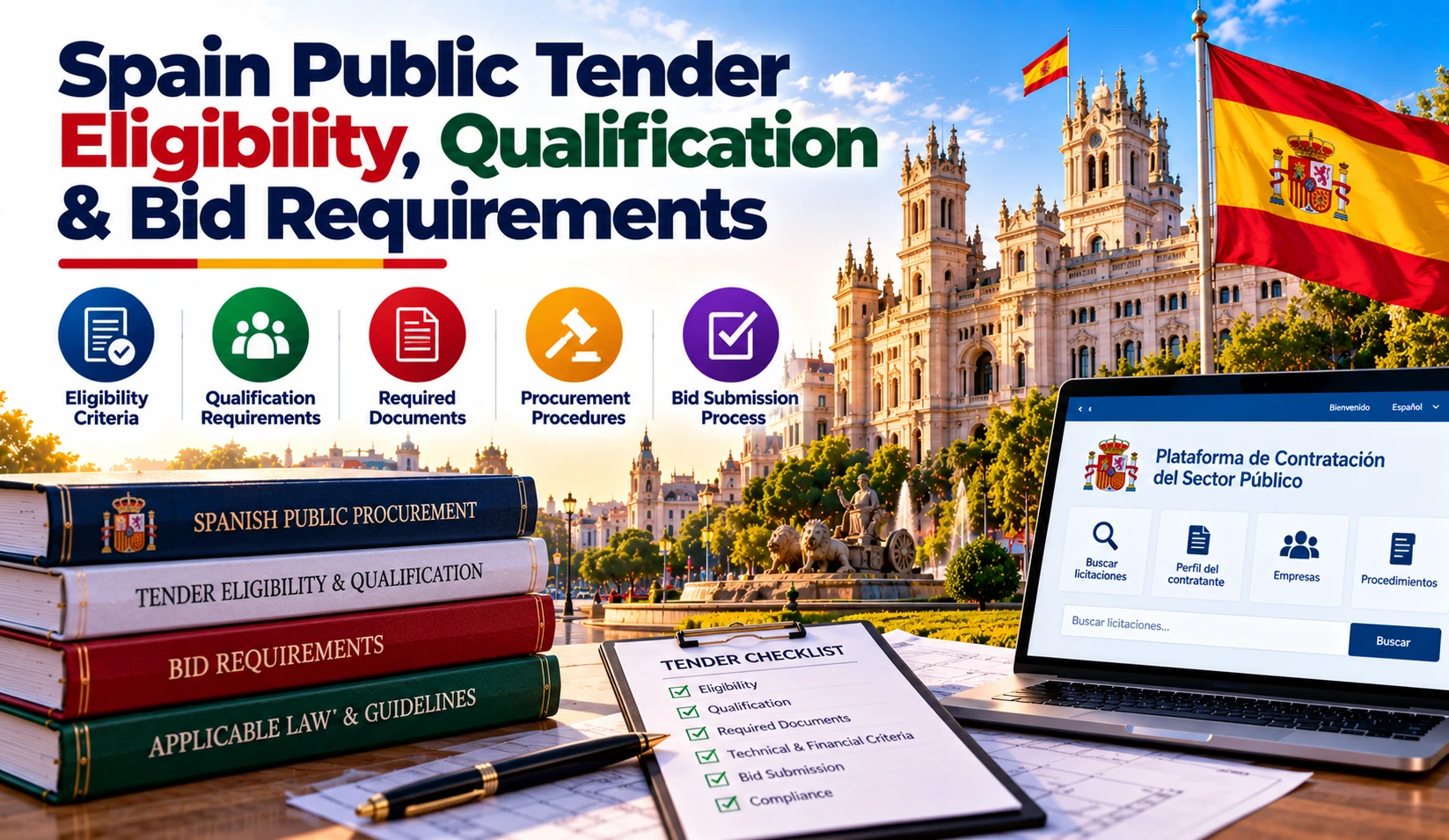
Winning a public contract in Spain starts with understanding whether your business is eligible to participate and whether it can demonstrate the qualifications required by the contracting authority. A tender may offer an attractive commercial opportunity, but suppliers must satisfy the applicable legal, financial, technical and administrative conditions before their offers can be considered.
Spain's public procurement framework establishes general rules for contracting capacity, exclusion, economic and financial standing, technical or professional solvency and professional authorisation. Individual tenders then specify the evidence, thresholds and submission procedures relevant to the contract.
This guide explains Spain public tender eligibility requirements, how companies demonstrate qualification, which documents are commonly requested and how to prepare a compliant bid. It is intended for Spanish businesses, SMEs, contractors, service providers, manufacturers and international suppliers seeking government contracts in Spain.
Table of Contents
- What Is Public Tender Eligibility in Spain?
- Spain Public Procurement Legal Framework
- Who Can Bid for Public Contracts in Spain?
- Legal Capacity and Business Activity
- Grounds for Exclusion from Public Tenders
- Economic and Financial Solvency
- Technical and Professional Solvency
- Professional Licences and Authorisations
- ROLECE Registration and Public Tender Eligibility
- When Is Contractor Classification Required?
- Documents Required for Spain Public Tenders
- DEUC and Responsible Declarations
- Eligibility for SMEs and New Companies
- Eligibility for Foreign Companies
- Joint Bids and Subcontracting
- How to Check Spain Tender Qualification Requirements
- Electronic Bid Submission Requirements
- Common Eligibility and Qualification Mistakes
- Spain Public Tender Eligibility Checklist
- How SpainTenders.com Helps Suppliers
- Conclusion
What Is Public Tender Eligibility in Spain?
Public tender eligibility refers to the legal and administrative conditions a business must satisfy to participate in a public procurement procedure. Qualification refers to the evidence that demonstrates the supplier has the financial capacity, technical experience, professional resources and authorisations needed to perform the contract.
Under Article 65 of Spain's Ley 9/2017 de Contratos del Sector Público (LCSP), contractors generally need full legal capacity, must not be subject to a prohibition on contracting and must demonstrate the required economic and financial and technical or professional solvency. Where the law requires classification, the contractor must also meet that requirement.
These are separate from the award criteria. Eligibility and qualification determine whether a supplier can participate or be admitted, while award criteria are used to evaluate eligible offers and determine the most advantageous bid under the stated rules.
Spain Public Procurement Legal Framework
The principal national statute is Ley 9/2017, de Contratos del Sector Público, commonly abbreviated as LCSP. Its provisions cover the aptitude to contract, prohibitions on contracting, economic and financial solvency, technical and professional solvency and contractor classification.
The tender's administrative specifications, commonly called the PCAP or *Pliego de Cláusulas Administrativas Particulares*, explain the participation conditions and the evidence accepted for the particular contract. The technical specifications, or PPT, describe the required goods, services or works and the relevant performance standards.
Regional and local authorities operate within the applicable legal framework, which may include additional regional provisions. Navarra, for example, has its own regional public contracts legislation. Suppliers should always check the rules and documents relevant to the contracting authority and procedure rather than assuming every procurement has identical requirements.
Who Can Bid for Public Contracts in Spain?
Individuals and legal entities, including eligible foreign businesses, may participate if they meet the applicable legal requirements and the tender conditions.
For companies, the contract must fall within the purposes, objects or field of activity permitted by the company's founding documents or statutes. The supplier must also have the necessary professional or business authorisation where the activity requires one.
Potential bidders can include:
- Spanish limited companies and other eligible legal entities.
- Self-employed professionals and individual entrepreneurs.
- Small and medium-sized enterprises (SMEs).
- Construction, engineering and infrastructure contractors.
- Manufacturers, distributors and service providers.
- Foreign companies that satisfy the applicable access and eligibility rules.
- Temporary groupings of businesses participating under the relevant procurement rules.
Eligibility is assessed against the law and the tender's specific requirements. A company being legally registered does not automatically mean it meets the solvency, licence or experience thresholds for every contract.
Legal Capacity and Business Activity
Suppliers should be able to prove that they legally exist and have authority to enter into the contract. Companies may need to provide incorporation documents, commercial-register evidence, company details and proof of the powers held by the person signing the bid.
The company's permitted business activity should cover the contract's subject matter. If a tender concerns specialist engineering, healthcare, construction or another regulated field, the supplier should verify that it has the relevant authorisation and that the activity falls within its legal scope.
Before submitting an offer, check that the legal name, registration number, registered address and representative details are consistent across the application, certificates and tender documents. Inconsistencies can result in clarification requests or create avoidable compliance risks.
Grounds for Exclusion from Public Tenders
Article 71 of the LCSP sets out prohibitions on contracting with public sector entities. The statutory grounds cover several categories of circumstances, including certain criminal convictions, specified serious legal or administrative infringements, particular tax or social security defaults and other legally defined situations.
Depending on the circumstances, issues involving insolvency, serious professional misconduct, conflicts of interest or material failures in previous public contracts may also need to be assessed under the applicable provisions.
Suppliers should review the relevant exclusion declarations and ensure that the information provided is accurate. Where a potential exclusion issue exists, obtain advice on the applicable law, evidence and any legally available remedial measures before submitting a bid.
Do not assume that every financial difficulty or administrative issue automatically results in exclusion. The legal consequences depend on the specific facts, statutory provisions and the procurement authority's assessment.
Economic and Financial Solvency
Economic and financial solvency demonstrates that a supplier has sufficient financial capacity to perform the contract. Under Articles 86 and 87 of the LCSP, the contracting authority specifies the accepted evidence and the applicable minimum requirements.
Depending on the tender, evidence may include:
- Annual turnover or turnover in the relevant business area.
- Annual accounts or other accepted financial statements.
- Professional liability insurance or another specified insurance policy.
- Net assets or a financial ratio, where permitted and specified.
- Other evidence accepted under the applicable rules and tender documents.
For certain contracts, the law limits the minimum annual turnover requirement to one and a half times the estimated contract value, except in duly justified circumstances, including certain risks associated with the contract's nature. The precise test depends on the tender and applicable statutory provisions.
Check the reference period, minimum amount, currency and evidence format. If the contract is divided into lots, review whether the solvency threshold applies to each lot or to a group of lots under the stated conditions.
Technical and Professional Solvency
Technical or professional solvency shows that the supplier has the experience, personnel, equipment, systems and other capabilities needed to deliver the contract. Articles 88 to 91 of the LCSP address different evidence methods according to the contract type.
Depending on the procurement, accepted evidence may include:
- Previous works, services or supplies of a similar nature.
- Certificates or references from public or private customers.
- Technical personnel, specialist staff and professional qualifications.
- Equipment, facilities and technical resources.
- Quality assurance and environmental management measures where relevant.
- Research, testing or technical capabilities for complex contracts.
- Information about the part of the contract intended for subcontracting.
The tender documents should specify which methods are accepted and any minimum thresholds. Do not submit a generic company profile in place of evidence that directly addresses the stated criteria.
For service contracts, the authority may consider the supplier's experience, technical knowledge, staff and resources. For works and supplies, the relevant evidence will depend on the subject matter and the applicable statutory provisions.
Professional Licences and Authorisations
Some contracts require a licence, professional registration, sector-specific authorisation or other permission before a supplier can legally perform the work.
Examples can include regulated construction activities, professional services, healthcare-related supply or service activities, transport and other specialist operations. The exact requirement depends on the activity and applicable law.
Check whether the authorisation must be held at bid submission, before contract award or before performance begins. Where a foreign qualification or licence is involved, verify whether recognition or an equivalent authorisation is required in Spain.
ROLECE Registration and Public Tender Eligibility
ROLECE is the Registro Oficial de Licitadores y Empresas Clasificadas del Sector Público, Spain's Official Register of Tenderers and Classified Undertakings.
The register can record information about a company's legal identity, capacity, representatives, professional authorisations, financial solvency, classification and applicable prohibitions on contracting. A ROLECE certificate can help reduce repeated administrative evidence requirements for information recorded in the register.
Registration is not a universal requirement for every Spanish public tender. However, the simplified open procedure has specific statutory registration conditions. Suppliers should check the procedure, the applicable version of the law and the tender documents to establish whether registration in ROLECE or an equivalent regional register is required.
Companies should keep registered information current and verify whether the certificate covers all the information requested for the particular procurement. ROLECE does not replace every technical proposal, price submission or contract-specific declaration.
When Is Contractor Classification Required?
Contractor classification is a formal system for demonstrating specified capacity and solvency for certain types and values of public contracts.
Under the general state procurement framework, classification is required for works contracts with an estimated value of €500,000 or more, subject to the applicable statutory rules. Classification is not generally compulsory for service contracts, although it may be relevant as a means of demonstrating solvency where the law permits.
Suppliers should verify whether classification is required for the particular contract, whether the classification category and amount are appropriate and whether any relevant regional rules apply. Do not assume that having a general business registration or a ROLECE entry automatically satisfies a separate classification requirement.
Documents Required for Spain Public Tenders
The exact document set depends on the procurement procedure, the contract and the PCAP. Common requirements include:
- Company registration and legal capacity evidence.
- Authorisation for the person representing and signing for the bidder.
- Declarations concerning eligibility and exclusion grounds.
- Economic and financial solvency evidence.
- Technical and professional solvency evidence.
- Professional licences or authorisations, where applicable.
- ROLECE or regional register evidence where required or useful.
- Technical proposal and supporting schedules.
- Financial offer prepared using the prescribed model.
- Certificates, translations or authentication documents where required.
Some procedures permit an initial responsible declaration or the European Single Procurement Document (DEUC/ESPD) instead of requiring every supporting certificate with the initial offer. The authority may then request the full evidence from the bidder at the relevant stage.
DEUC and Responsible Declarations
The Documento Europeo Único de Contratación (DEUC), known in English as the European Single Procurement Document (ESPD), is a standardised self-declaration used in applicable procurement procedures to provide preliminary information about a bidder's eligibility and capacity.
A responsible declaration may also be required under the applicable Spanish rules and tender documents. It can cover matters such as legal capacity, exclusion grounds and compliance with specified conditions.
These declarations are not a substitute for the truthfulness of the information or for evidence that must later be provided. If selected, the bidder may be required to submit supporting documents within the period specified by the contracting authority.
Use the exact form and version provided or accepted for the procedure. Incorrect declarations, incomplete fields or inconsistent information can cause delays and may have legal consequences.
Eligibility for SMEs and New Companies
Small and medium-sized enterprises can participate in Spanish public procurement if they meet the applicable eligibility and qualification conditions. The authority must apply the relevant legal rules, including the requirement that solvency criteria be appropriate and proportionate to the contract.
New companies may have limited trading history, which can make certain turnover or past-performance requirements more difficult to satisfy. Article 90 provides a specific approach for technical solvency in certain non-harmonised service contracts where the business is newly created and less than five years old: the evidence method based on a specified number of previous services does not apply in the same way, and other statutory evidence methods may be available.
Businesses should examine the alternatives permitted by the tender, such as staff qualifications, technical resources, equipment or other evidence, where the law and procurement documents allow them. Do not assume that the same alternative applies to every contract type.
Eligibility for Foreign Companies
Foreign businesses may bid for Spanish public contracts when they meet the applicable access rules, eligibility conditions and contract-specific requirements.
Companies established in EU Member States or EEA signatory states are addressed by Article 67 of the LCSP, which recognises their capacity where they are authorised to perform the relevant activity under the law of their country of establishment.
Article 68 addresses companies from countries outside the EU and EEA, subject to Spain's international obligations. Depending on the circumstances, a reciprocity report or other evidence may be required. Certain international procurement commitments can affect the application of these conditions.
Foreign suppliers should also check accepted electronic signatures, document translation, legalisation or apostille requirements and whether professional authorisations need recognition in Spain.
Joint Bids and Subcontracting
Businesses may consider participating jointly where the procurement rules permit it. A temporary union of businesses, commonly called a UTE, can allow participants to combine relevant capabilities, resources and experience.
The tender documents specify the declarations, commitments and other evidence required from joint bidders. Each participant must understand its obligations, including eligibility and exclusion requirements.
Subcontracting may also be permitted, but it does not automatically transfer the main bidder's responsibility for contract performance or remove the need to meet the tender's own qualification criteria. Review the rules on reliance on third-party capacity and the disclosure of intended subcontracting.
How to Check Spain Tender Qualification Requirements
Before preparing an offer, use a structured qualification process:
- Locate the official tender notice and download the latest PCAP and PPT.
- Check the contract scope, estimated value, lots and submission deadline.
- Identify the legal eligibility and exclusion declarations.
- Record the financial solvency thresholds and accepted evidence.
- Record the technical and professional qualification criteria.
- Check any professional authorisations or contractor classification requirements.
- Confirm whether ROLECE or a regional register is required.
- Check the required electronic submission platform and signature method.
- Identify missing documents and obtain them before the deadline.
Maintain a written bid/no-bid assessment. If the company cannot meet a mandatory requirement, clarify the position before proceeding rather than assuming the authority will waive it.
Electronic Bid Submission Requirements
Electronic submission is the general rule for Spanish public procurement procedures, subject to the exceptions provided by law. The relevant tender documents specify the platform and the method for submitting and signing the offer.
Suppliers should check account access, certificate compatibility, representative authority, file formats, size restrictions and whether documents must be organised into separate electronic envelopes. Some procedures distinguish administrative information from technical and financial offers.
Submit before the deadline and retain the platform's receipt or confirmation. Uploading documents without completing the final submission process may not constitute a valid bid.
Common Eligibility and Qualification Mistakes
- Confusing eligibility with award criteria: first meet participation conditions, then prepare an offer that scores well against the published criteria.
- Ignoring the PCAP: the administrative specifications define key eligibility and documentation requirements.
- Submitting generic experience evidence: provide references that directly match the required type and scope of work.
- Assuming ROLECE is always compulsory: check the exact procedure and applicable legal rules.
- Overlooking classification: confirm whether the contract requires formal contractor classification.
- Using outdated certificates: verify validity periods and current company information.
- Leaving translations too late: foreign documents may require formal translation or authentication.
- Submitting an incomplete electronic offer: confirm final transmission and save the receipt.
Spain Public Tender Eligibility Checklist
| Check | What to confirm |
| Legal capacity | Company exists and is authorised to perform the contract |
| Exclusion grounds | Required declarations are accurate and eligibility conditions are satisfied |
| Financial solvency | Turnover, accounts, insurance or other specified evidence meets the threshold |
| Technical solvency | Experience, personnel, equipment and other required evidence are available |
| Authorisations | Professional licences and permits are valid where required |
| Registration | ROLECE or regional register requirements are understood |
| Classification | Required contractor classification is available where applicable |
| Documents | PCAP, PPT, declarations and bid forms are complete and current |
| Electronic submission | Correct platform, signatures, files and final submission confirmation |
How SpainTenders.com Helps Suppliers
Eligibility and qualification checks are most effective when suppliers identify suitable opportunities early. SpainTenders.com offers an additional channel for discovering public procurement opportunities and researching contracting authorities and sectors across Spain.
Suppliers can explore Spain public tender listings, review contract award information, research contracting authorities and browse procurement sectors.
Businesses can register with SpainTenders.com or log in to an existing account. For help with platform services or procurement research, use the contact page.
SpainTenders.com can support opportunity discovery, but suppliers must verify legal eligibility, qualification criteria and submission requirements in the official tender documents and applicable legislation.
Conclusion
Spain public tender eligibility involves legal capacity, compliance with exclusion rules, economic and financial solvency, technical or professional solvency and any professional authorisations or classification required for the contract.
ROLECE can simplify the proof of registered information, but it does not replace every contract-specific requirement. Suppliers must also understand the DEUC or responsible declarations, electronic submission procedures and the particular conditions stated in the PCAP and PPT.
By assessing eligibility before committing resources, maintaining up-to-date company documentation and following a structured bid checklist, businesses can reduce avoidable errors and prepare stronger offers for Spanish public procurement opportunities.
Frequently Asked Questions (FAQs)

Fresh and verified Tenders from Spain. Find, search and filter Tenders/Call for bids/RFIs/RFPs/RFQs/Auctions published by the government, public sector undertakings (PSUs) and private entities.
- 1,000+ Tenders
- Verified Tenders Only
- New Tenders Every Day
- Tenders Result Data
- Archive & Historical Tenders Access
- Consultants for RFI/RFP/RFQ
- Tender Notifications & Alerts
- Search, Sort, and Filter Tenders
- Bidding Assistance & Consulting
- Customer Support
- Publish your Tenders
- Export data to Excel
- API for Tender Data
- Tender Documents

Fill out the form below and you will receive a call from us within 24 hours.
Get FREE SAMPLE TENDERS from Spain in your email inbox.
Copyright © 2014-2026 SpainTenders.com. All Rights Reserved.