Spain Public Tender Evaluation Criteria: How Bids Are Scored
Understand Price and Quality Scoring, Technical Evaluation, Automatic Formulas and Award Strategies for Spanish Government Tenders
Introduction
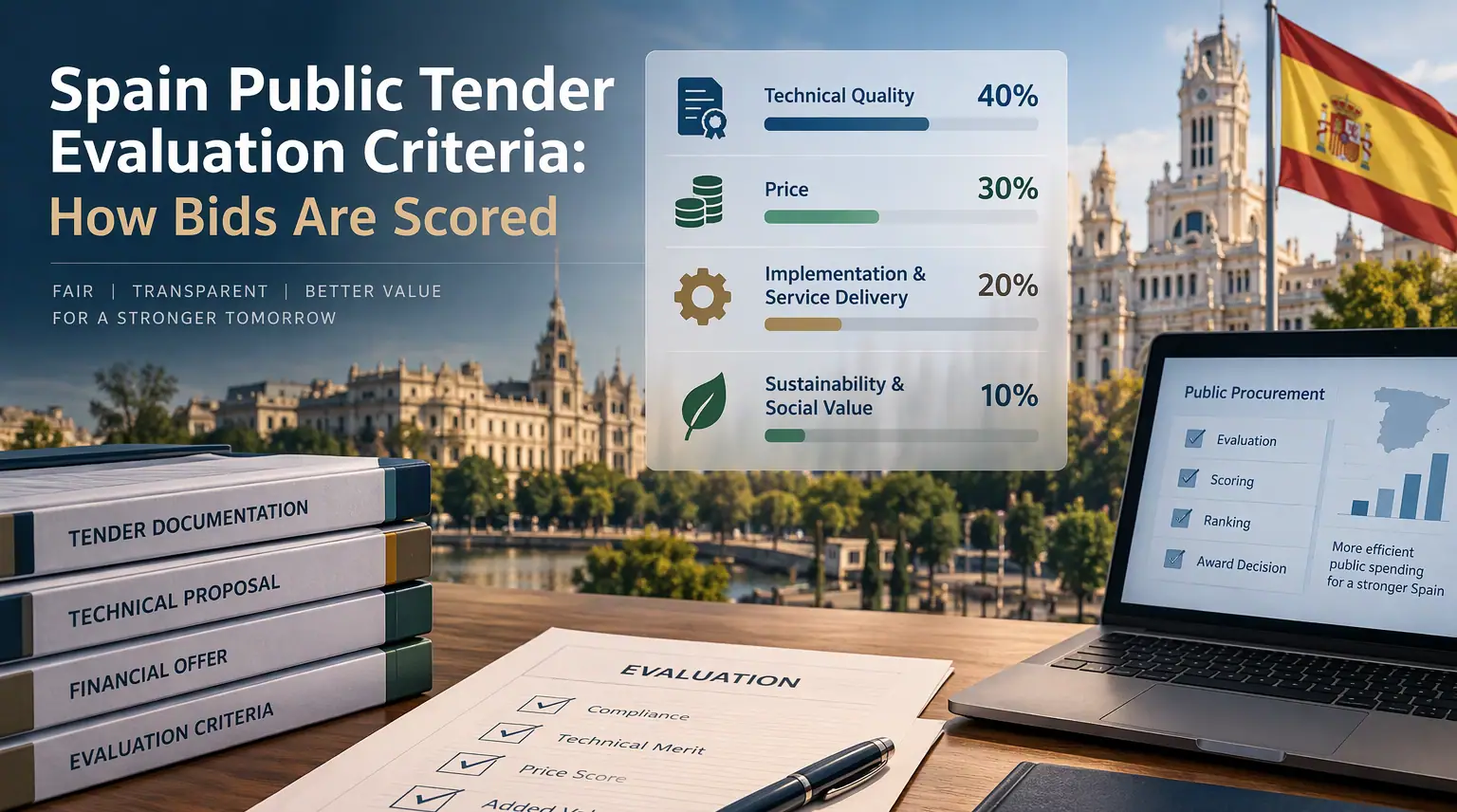
Winning a public tender in Spain requires more than submitting the lowest price. Contracting authorities evaluate bids according to criteria established in the procurement documents, which may include price, technical quality, delivery time, service methodology, environmental performance and other factors connected to the contract.
Under Spain’s Public Sector Contracts Law, Ley 9/2017, de Contratos del Sector Público (LCSP), public contracts are generally awarded on the basis of the best price-quality ratio. This approach allows contracting authorities to compare the economic and qualitative value of competing offers rather than relying exclusively on price.
For suppliers, understanding the evaluation system is essential before preparing a bid. A company may offer a competitive price but lose points because its technical proposal does not address the required methodology, delivery plan or performance standards. Another bidder may submit a higher-priced offer but achieve a stronger overall score because of its technical quality.
This guide explains how Spanish public tender evaluation works, the difference between automatic and qualitative criteria, how scoring formulas are applied, how authorities compare price and quality and how suppliers can prepare bids that respond to the published award methodology.
Table of Contents
- Understanding Public Tender Evaluation in Spain
- Legal Framework for Tender Evaluation
- Best Price-Quality Ratio in Spanish Procurement
- Main Types of Tender Evaluation Criteria
- Price and Cost Evaluation
- Technical and Qualitative Evaluation Criteria
- Automatic and Formula-Based Scoring
- Subjective Evaluation and Expert Judgement
- How Price and Quality Points Are Combined
- Understanding Scoring Formulas with an Example
- Quality Criteria and the 51 Percent Rule
- Evaluation of Environmental and Social Criteria
- Tie-Breaking Rules in Spanish Public Tenders
- Abnormally Low Bids and Price Risks
- How the Tender Evaluation Process Works
- How to Read Evaluation Criteria in the PCAP
- Bid Strategy for Improving Evaluation Scores
- Common Mistakes Suppliers Should Avoid
- Practical Tender Scoring Checklist
- How SpainTenders Can Help
- Conclusion
Understanding Public Tender Evaluation in Spain
Tender evaluation is the process through which a contracting authority examines and compares the offers submitted by eligible bidders to identify the offer that provides the best result under the published award criteria.
In Spain, evaluation criteria must be established in the procurement documents and linked to the subject matter of the contract. They must be formulated in a way that allows suppliers to understand how their offers will be assessed and enables the authority to compare bids objectively and transparently.
Depending on the contract, evaluation may consider:
- Price or total cost.
- Technical quality and performance.
- Proposed methodology and work plan.
- Delivery or completion time.
- Qualifications and organisation of personnel assigned to the contract, where relevant.
- Maintenance, warranties and after-sales support.
- Environmental performance and energy efficiency.
- Social considerations connected with the contract.
- Innovation, accessibility and functional characteristics.
The exact combination depends on the procurement. A supply contract for standard equipment may place significant emphasis on price and technical compliance, while an engineering or consultancy contract may give substantial weight to the technical proposal and professional methodology.
Suppliers should therefore examine the scoring system before deciding how much time and resources to invest in each part of their offer.
Legal Framework for Tender Evaluation
The principal legislation governing tender evaluation is Ley 9/2017, de Contratos del Sector Público (LCSP). Articles 145–150 establish important rules for award criteria and the evaluation process.
- Article 145: Requirements and types of contract award criteria, including the best price-quality ratio.
- Article 146: Application of award criteria, formula-based evaluation and assessment involving judgement.
- Article 147: Criteria for resolving tied bids.
- Article 148: Life-cycle cost calculation.
- Article 149: Identification and assessment of abnormally low tenders.
- Article 150: Classification of offers and award-related decisions.
The procurement documents must state the criteria that will be used to award the contract and their relative weighting, except where the law permits criteria to be listed in descending order of importance because objective weighting is not possible.
Criteria must be connected to the subject matter of the contract and comply with the principles of equal treatment, non-discrimination, transparency and proportionality. A contracting authority cannot introduce an unpublished scoring criterion after bids have been submitted.
Suppliers should read the relevant legal provisions together with the PCAP (administrative specifications), the PPT (technical specifications) and any descriptive document issued for the procurement.
Best Price-Quality Ratio in Spanish Procurement
Article 145 of the LCSP establishes the best price-quality ratio as the general basis for awarding public contracts. It allows the contracting authority to assess both economic and qualitative aspects of an offer.
This approach recognises that the cheapest offer is not necessarily the most suitable for the authority's requirements. A product with a lower purchase price may have higher maintenance costs, shorter durability or weaker performance. Similarly, a service provider offering a low price may propose insufficient resources or an inadequate delivery methodology.
Under the best price-quality approach, the authority can consider the economic offer alongside relevant quality factors. These may include technical merit, functional characteristics, accessibility, environmental performance, social characteristics, innovation, delivery conditions, maintenance and after-sales services.
The LCSP also permits an award approach based on the best cost-effectiveness relationship, where justified in the procurement file. This may use price or cost, including life-cycle cost calculated under Article 148.
For suppliers, the important point is that the award strategy must be based on the actual weighting published in the tender. A bid should not focus only on reducing price if the authority assigns substantial points to technical quality or other factors.
Main Types of Tender Evaluation Criteria
Spanish public tenders can use several economic and qualitative criteria. The procurement documents should explain the criteria, their weighting and how the authority will assess them.
| Criterion | What may be evaluated | Possible evidence from suppliers |
| Price | Bid price or relevant cost components | Completed financial offer and price schedule |
| Technical quality | Performance, technical solution and compliance beyond minimum requirements | Technical proposal, product specifications and supporting evidence |
| Methodology | Work approach, organisation and implementation plan | Method statement, work plan and delivery schedule |
| Delivery time | Completion, response or delivery periods where relevant | Delivery commitments and operational plan |
| Personnel | Qualifications or organisation of staff assigned to the contract, where relevant | CVs, qualifications and staffing arrangements |
| Environmental performance | Energy use, emissions, resource efficiency or other relevant environmental factors | Technical evidence, certifications and performance data |
| Maintenance and support | Warranty, maintenance, availability and after-sales services | Service plans, warranty terms and response commitments |
| Social characteristics | Relevant social features linked to the contract | Evidence specifically requested in the procurement documents |
Not every tender will use all these criteria. A supplier should identify which ones apply and avoid spending unnecessary time on material that does not contribute to the published evaluation.
Price and Cost Evaluation
Price is one of the most common criteria in Spanish public tenders. The authority may award points according to the submitted price, a formula or another cost-related method stated in the procurement documents.
In some tenders, price receives a high weighting. In others, it is combined with technical quality, delivery, maintenance or life-cycle cost. A single award criterion may be used where legally appropriate, but under Article 146 it must be related to costs, such as price or a life-cycle cost criterion.
Suppliers should examine the following before submitting a price:
- The maximum or base tender budget and the estimated contract value.
- Whether the price must be submitted excluding or including VAT, as instructed.
- The required price schedule, units, quantities and calculation method.
- Whether optional items, extensions or recurring deliveries are included.
- The cost of labour, materials, logistics, maintenance and warranties.
- The risk of an offer being considered abnormally low under the published parameters.
A low price can improve the score where the formula rewards lower offers, but an unsustainable price can create delivery and financial risks. Suppliers should calculate their minimum viable price before deciding how aggressively to compete.
Technical and Qualitative Evaluation Criteria
Technical and qualitative criteria allow the authority to assess how well the proposed solution meets the contract's requirements. These criteria can be particularly important for complex services, engineering, IT projects, consulting, maintenance and specialist supplies.
Depending on the procurement, the authority may assess:
- Technical design and functionality.
- Project methodology and implementation approach.
- Work organisation and resource allocation.
- Quality assurance and risk management.
- Service continuity and response arrangements.
- Performance standards and measurable deliverables.
- Environmental and energy performance.
- Innovation and accessibility features.
The supplier should respond directly to the evaluation criteria rather than submit a generic company profile. If the authority awards points for a project methodology, the proposal should explain the stages, resources, responsibilities, timetable and quality controls that will be used to perform the contract.
Where the tender asks for evidence, such as technical specifications, test results or certifications, the supplier should include the requested material in the correct section. Unsupported statements may not demonstrate compliance or secure the points anticipated by the bidder.
Automatic and Formula-Based Scoring
Automatic criteria are evaluated through figures, percentages, calculations or formulas specified in the procurement documents. They are designed to allow the authority to calculate points using a defined method rather than relying on a qualitative judgement.
Examples can include:
- Price offered.
- Number of additional warranty months, where relevant.
- Delivery time beyond the mandatory requirements.
- Energy consumption or measurable efficiency levels.
- Quantifiable service response commitments.
- Other measurable characteristics directly linked to the contract.
Article 146 requires the procurement authority, where possible, to give precedence to criteria that can be assessed using figures or percentages through the formulas established in the tender documents.
The formula must be identified in the procurement documents, and its choice must be justified in the procurement file. The authority must apply the announced method consistently throughout the evaluation process.
Suppliers should calculate their likely points before submitting an offer. They should check the maximum available score, the formula, the reference values and whether a particular commitment produces additional points or simply meets a minimum requirement.
Subjective Evaluation and Expert Judgement
Some criteria cannot be evaluated entirely through a mathematical formula. They may require a technical assessment of the quality, relevance or suitability of the proposal. These are often described as criteria subject to a value judgement.
Examples include the quality of a project methodology, the technical coherence of a proposed solution, the organisation of a complex service or the suitability of a design.
The tender documents should explain what will be assessed and how the available points will be distributed. Broad statements such as “best technical proposal” without a sufficiently clear assessment framework can make it difficult for bidders to understand how their proposals will be evaluated.
Article 146 establishes arrangements for evaluating criteria subject to judgement. In open and restricted procedures conducted by public administration bodies, where the weighting of judgement-based criteria is greater than that of automatically assessed criteria, the evaluation must be undertaken by a properly qualified committee of at least three members or by an identified specialised technical body, in the circumstances set out by the law.
Suppliers should structure technical proposals around the specific evaluation headings and provide clear, verifiable evidence. A long proposal does not necessarily receive a higher score if it does not address the criteria.
How Price and Quality Points Are Combined
When a tender uses multiple criteria, the authority assigns a weighting to each criterion or group of criteria. The total weighting normally represents the overall score available for the offer.
For example, a hypothetical procurement might use:
- Price: 40 points.
- Technical proposal: 35 points.
- Implementation methodology: 15 points.
- Maintenance and support: 10 points.
In this example, the total available score is 100 points. A supplier with a strong technical proposal may compensate for a higher price, depending on the points achieved in the other criteria and the published formula.
The example is illustrative only. Spanish law does not impose a universal 40/60 or 50/50 price-quality weighting for all tenders. The contracting authority determines the criteria and their weighting in accordance with the LCSP and the nature of the contract.
Suppliers should record the maximum points for every criterion and calculate the relative value of improving each part of the offer. This helps allocate bid preparation resources to the criteria that can materially affect the result.
Understanding Scoring Formulas with an Example
Price-scoring formulas vary between procurements. The formula published in the tender documents is the one that must be used. The following example demonstrates a simple proportional price formula for illustration; it is not a mandatory Spanish formula.
Illustrative formula:
Price score = (Lowest valid price ÷ Supplier's price) × Maximum price points
Assume a tender offers 40 points for price and receives three valid bids:
| Supplier | Bid price | Calculation | Price score |
| A | €90,000 | (90,000 ÷ 90,000) × 40 | 40.00 |
| B | €100,000 | (90,000 ÷ 100,000) × 40 | 36.00 |
| C | €112,500 | (90,000 ÷ 112,500) × 40 | 32.00 |
Under this illustrative formula, Supplier A receives the maximum price score because it submitted the lowest valid price. Supplier B receives 36 points and Supplier C receives 32 points.
Now assume the tender also awards 60 points for quality:
| Supplier | Price score | Quality score | Total score |
| A | 40.00 | 42 | 82.00 |
| B | 36.00 | 55 | 91.00 |
| C | 32.00 | 57 | 89.00 |
This example shows why the lowest price does not automatically win a multi-criteria tender. Supplier B has a higher total score because its quality score compensates for the lower price points.
Actual procurement formulas can use different reference values, weights, caps or scoring methods. Suppliers must use the exact formula and conditions stated in the PCAP or other applicable procurement documents.
Quality Criteria and the 51 Percent Rule
Article 145.4 of the LCSP contains a specific quality-weighting requirement. In contracts for services listed in Annex IV and contracts whose subject includes intellectual services, such as engineering and architecture, quality-related criteria must represent at least 51% of the score assigned to the evaluation of offers, subject to the statutory provisions.
This rule is particularly relevant to professional and specialist services where technical quality can have a significant impact on the result. It should not be treated as a general rule that every Spanish public tender must award 51% of its points to quality.
Suppliers should identify whether the contract falls within Annex IV or concerns intellectual services as covered by the law. They should then examine the weighting in the procurement documents and understand how quality points are allocated.
Where the requirement applies, the technical proposal can be especially important. Companies should ensure that their methodology, personnel, work plan and technical solution respond to the published quality criteria.
Evaluation of Environmental and Social Criteria
Article 145 allows contracting authorities to include relevant environmental and social considerations among qualitative award criteria, provided they are linked to the subject matter of the contract and comply with the statutory requirements.
Environmental criteria may relate to:
- Energy efficiency and energy consumption.
- Reduction of greenhouse gas emissions.
- Use of sustainable or recycled materials.
- Waste prevention and resource efficiency.
- Environmental performance during delivery or operation.
Social criteria may relate to relevant employment conditions, accessibility, inclusion or other social characteristics connected with the contract and permitted by law.
Suppliers should not assume that a general corporate sustainability statement will automatically earn points. The evidence must address the particular criterion and its scoring method. If the tender asks for a measurable environmental improvement, the supplier should provide the relevant data and supporting documentation.
Tie-Breaking Rules in Spanish Public Tenders
Two or more bids may receive the same overall score after evaluation. Article 147 of the LCSP provides rules for resolving tied results.
The procurement documents may establish specific tie-breaking criteria, provided they comply with the law. Where the documents do not establish a different lawful method, the statutory criteria apply in the order set out in Article 147.
These can include certain social and employment-related circumstances of the companies at the relevant date, such as:
- A higher percentage of employees with disabilities or employees at risk of social exclusion on the company's workforce.
- A lower proportion of temporary employment in the workforce.
- A higher proportion of women employed.
- Other criteria permitted under the statutory framework and applicable procurement documents.
Where the applicable criteria do not resolve the tie, the law provides for a draw. Suppliers should check the tender documents and Article 147 rather than assume that the lowest price will always be the tie-breaker.
Abnormally Low Bids and Price Risks
A very low bid may receive a strong price score, but it can also trigger a review if the authority considers that the offer may be abnormally low. Article 149 of the LCSP governs the process for identifying and assessing potentially abnormal offers.
The procurement documents must specify objective parameters for identifying offers that may be presumed to be abnormally low. The applicable calculation can depend on the number of bids, the distribution of prices, the award criteria and the method stated in the tender documents.
A bid cannot be excluded solely because it is suspected of being abnormally low. The authority must follow the statutory process and request an explanation from the bidder. The supplier may need to justify the price by explaining its production method, technical solutions, favourable conditions, innovation, compliance with applicable obligations or other relevant factors.
Suppliers should therefore avoid submitting a price that cannot be justified commercially. They should maintain cost calculations, supplier quotations, staffing assumptions and other evidence that can support the offer if clarification is requested.
How the Tender Evaluation Process Works
The precise process depends on the procurement procedure and tender documents, but a typical evaluation may include the following stages:
- Submission deadline: The authority closes the period for submitting offers.
- Administrative review: The required declarations and eligibility documents are checked, and any permitted clarification or correction process is handled under the applicable rules.
- Technical or qualitative assessment: Criteria involving a value judgement are assessed by the competent committee, technical body or contracting authority as required.
- Publication of prior assessment: Where applicable, the earlier qualitative evaluation is documented and made public at the relevant opening stage.
- Automatic scoring: Criteria assessed through formulas are evaluated according to the published method.
- Overall ranking: The scores are combined and offers are ranked under the announced criteria.
- Abnormally low bid review: Any offer identified as potentially abnormal is handled under Article 149.
- Award proposal and decision: The authority follows the statutory process to identify the successful bidder and issue the award decision.
Article 146 requires formula-based evaluation to take place after the prior assessment of criteria that cannot be evaluated automatically, with the required documentary record. This helps protect the integrity of the evaluation process.
Suppliers should monitor the contracting authority's profile for evaluation reports, clarification requests, proposed awards and formal award notices.
How to Read Evaluation Criteria in the PCAP
The PCAP is one of the most important documents for understanding how a Spanish public tender will be evaluated. It explains the administrative and commercial conditions and normally sets out the award criteria, weightings and scoring arrangements.
When reviewing the PCAP, suppliers should identify:
- The complete list of award criteria.
- The maximum points available for each criterion.
- The distinction between automatic criteria and criteria involving judgement.
- The price or cost formula.
- The technical evaluation methodology and scoring bands.
- Any minimum quality score or stage-specific threshold.
- Any tie-breaking provisions.
- The parameters for identifying abnormally low bids.
- The format and location for submitting each part of the offer.
Suppliers should also check the PPT because it explains the technical requirements against which the proposal will be assessed. The PCAP and PPT should be read together to understand both what the authority needs and how it will score the offers.
Bid Strategy for Improving Evaluation Scores
A strong tender strategy begins with the evaluation criteria, not with the final price. Suppliers should first understand how the authority will distribute points and what evidence is required to obtain them.
Build a scoring matrix. List every criterion, maximum points, evidence required and the team member responsible for preparing the response. This helps prevent important requirements from being overlooked.
Prepare a criterion-by-criterion response. Organise the technical proposal in the same order as the evaluation criteria where the tender instructions permit it. This makes it easier for evaluators to locate the relevant information.
Use measurable evidence. Support technical claims with specifications, schedules, performance data, certifications and other evidence requested by the authority.
Calculate the price score in advance. Apply the published formula to different pricing scenarios. Understand how much a price reduction is likely to improve the total score and whether it is commercially sustainable.
Prioritise high-value quality criteria. Where technical methodology or service organisation carries significant points, invest effort in developing a detailed, contract-specific response.
Check mandatory requirements separately. A high projected score cannot compensate for failing an essential eligibility or technical requirement. Confirm compliance before finalising the offer.
Review the complete submission. Check that every form, declaration, technical document and price schedule is complete and uploaded in the correct electronic section before the deadline.
Common Mistakes Suppliers Should Avoid
- Focusing only on price: A low price may not win when technical and other qualitative criteria carry significant points.
- Ignoring the scoring formula: Suppliers should understand how each point is calculated before deciding their bid price.
- Submitting generic technical proposals: Responses should address the specific contract and published criteria.
- Making unsupported claims: Technical advantages should be supported by relevant evidence.
- Confusing selection criteria with award criteria: Eligibility and solvency determine whether a supplier can participate; award criteria compare the offers.
- Ignoring the 51% quality rule where applicable: Check whether the contract is covered by Article 145.4.
- Submitting an unsustainable price: A very low offer may trigger an abnormality review and create performance risks.
- Missing tie-breaking provisions: Review Article 147 and the specific PCAP conditions.
- Overlooking submission structure: Place documents in the correct electronic envelopes or sections as instructed.
- Using an outdated scoring model: Every tender has its own published evaluation method; do not assume that a formula from a previous procurement will apply.
Practical Tender Scoring Checklist
Before submitting a bid for a Spanish public contract, suppliers should confirm:
- The award criteria and their weightings have been identified.
- The price and quality components are understood.
- Automatic and judgement-based criteria have been distinguished.
- All scoring formulas have been checked and independently calculated.
- The technical proposal addresses every relevant criterion.
- Supporting evidence is included for technical and quality claims.
- Any minimum quality or stage-specific score has been identified.
- The 51% quality rule has been checked where relevant.
- The abnormal-bid parameters have been reviewed.
- The proposed price is commercially sustainable.
- Tie-breaking provisions have been checked.
- The PCAP and PPT have been reviewed together.
- The final offer has been uploaded correctly before the deadline.
How SpainTenders Can Help
Understanding tender evaluation criteria is an important part of selecting the right procurement opportunities. SpainTenders can support suppliers by helping them discover public tender notices, research contracting authorities, explore sector-specific opportunities and review published contract awards.
Businesses can browse SpainTenders public tender listings, review contract award notices, explore the sector directory and identify relevant buyers through the contracting authority directory.
Reviewing previous awards can help suppliers understand procurement activity and identify authorities that purchase similar goods or services. However, historical award prices and results should be treated as market information, not as a guarantee of future evaluation outcomes.
Businesses can register with SpainTenders to explore available services and log in to access their account. For service-related assistance, visit the SpainTenders contact page.
SpainTenders is a tender discovery and procurement research resource. It does not replace the official tender notice, PCAP, PPT or contracting authority's electronic submission platform. Suppliers should always verify the latest award criteria, scoring formulas, eligibility conditions and deadlines against the original procurement documents.
Conclusion
Spain public tender evaluation is generally based on the best price-quality ratio, with contracting authorities assessing economic and qualitative criteria according to the rules established in the LCSP and the procurement documents. Price is important, but technical quality, methodology, delivery, environmental performance and other relevant factors can also influence the final ranking.
Articles 145 and 146 establish the main rules for award criteria and their application, while Articles 147–150 address tie-breaking, life-cycle costs, abnormally low bids and award-related decisions. The exact scoring method varies between procurements and must be stated in the relevant tender documents.
Suppliers should study the PCAP and PPT, build a scoring matrix, understand the formulas, prepare evidence-based technical proposals and calculate sustainable prices. A disciplined approach to the published evaluation criteria helps businesses make informed bidding decisions and prepare offers that respond directly to the contracting authority's requirements.
Frequently Asked Questions (FAQs)
Public tenders are generally evaluated using multiple award criteria based on the best price-quality ratio. The authority assesses offers according to the criteria and weightings stated in the procurement documents.
Ley 9/2017, de Contratos del Sector Público (LCSP), primarily Articles 145–150, governs award criteria, their application, tie-breaking, life-cycle costs and abnormally low bids.
No. Where multiple criteria are used, the authority compares the economic and qualitative scores. A higher-priced offer may achieve a higher overall score if it performs better against the other award criteria.
It is an award approach that considers both economic and qualitative factors to identify the offer that provides the best overall value for the contract.
Automatic criteria are assessed using figures, percentages or formulas specified in the tender documents. Examples may include price, delivery time, warranty duration and measurable performance levels.
These criteria require an assessment of the quality or suitability of an offer. Examples may include project methodology, technical design, implementation planning and the organisation of a complex service.
Automatic scoring uses a predefined calculation or measurable rule. Subjective scoring involves a technical assessment against the evaluation framework established in the procurement documents.
They are normally specified in the PCAP or descriptive document and should also be stated in the procurement notice. The PPT provides the technical requirements that the offer must address.
Article 145.4 of the LCSP requires quality-related criteria to represent at least 51% of the score for services listed in Annex IV and contracts involving intellectual services, such as engineering and architecture, subject to the statutory provisions.
Depending on the contract, criteria may cover technical performance, methodology, implementation planning, personnel assigned to the contract, service quality, maintenance, innovation and other relevant technical characteristics.
The authority uses the price formula stated in the procurement documents. The formula may compare each offer with the lowest valid offer or use another published calculation method.
No. The formula varies between procurements. Suppliers must use the method published in the specific tender documents rather than assume that a formula from another tender will apply.
Yes. Article 145 allows relevant environmental and social characteristics to be included as qualitative criteria when they are linked to the subject matter of the contract and comply with the legal requirements.
Article 147 of the LCSP establishes tie-breaking rules. The procurement documents may also specify lawful tie-breaking criteria. Suppliers should check both the tender documents and the applicable statutory provisions.
It is an offer that falls within the objective parameters for presumed abnormality stated in the procurement documents. The authority must follow Article 149 and request an explanation before excluding the offer on that basis.
A low price does not automatically justify exclusion. The authority must follow the statutory procedure, allow the supplier to explain the offer and assess the justification under Article 149.
A scoring matrix is a supplier's internal planning tool that lists each published award criterion, its maximum points, the evidence required and the person responsible for preparing the response.
They should respond directly to each technical criterion, follow the required proposal structure, provide measurable evidence and explain how the proposed solution meets the authority's requirements.
No. Selection criteria assess whether a supplier has the eligibility, solvency and capability to participate. Award criteria compare the offers submitted by eligible bidders to determine the successful offer.
Suppliers can review the contracting authority's official profile and published procurement records. SpainTenders can also support research through its tender listings and contract award information.

Fresh and verified Tenders from Spain. Find, search and filter Tenders/Call for bids/RFIs/RFPs/RFQs/Auctions published by the government, public sector undertakings (PSUs) and private entities.
- 1,000+ Tenders
- Verified Tenders Only
- New Tenders Every Day
- Tenders Result Data
- Archive & Historical Tenders Access
- Consultants for RFI/RFP/RFQ
- Tender Notifications & Alerts
- Search, Sort, and Filter Tenders
- Bidding Assistance & Consulting
- Customer Support
- Publish your Tenders
- Export data to Excel
- API for Tender Data
- Tender Documents

Fill out the form below and you will receive a call from us within 24 hours.
Get FREE SAMPLE TENDERS from Spain in your email inbox.
Copyright © 2014-2026 SpainTenders.com. All Rights Reserved.