Spain Tender Documents Explained: PCAP, PPT, DEUC and More
Understand PCAP, PPT, DEUC, Technical Specifications and Other Documents Required for Spanish Public Tenders
Introduction
Understanding bid documents is one of the most important steps when preparing a bid for a Spanish public contract. A tender notice may tell you that an opportunity exists, but the detailed procurement documents explain what the contracting authority actually requires, how suppliers must prepare their offers, what eligibility conditions apply and how bids will be evaluated.
For suppliers participating in Spanish public procurement, documents such as the PCAP, PPT and DEUC are particularly important. Other documents may include the tender announcement, descriptive documents, technical annexes, pricing schedules, declarations, forms, draft contracts and supporting evidence.
Knowing the role of each document helps suppliers avoid a common problem in licitaciones España: preparing a commercially attractive offer without correctly following the administrative or technical requirements established in the procurement documents.
This guide explains the main Spain tender documents, what each document means, what suppliers should look for and how the documents work together during a Spanish public procurement procedure.
Table of Contents
- What Are Spain Tender Documents?
- Main Spain Tender Documents
- What Is PCAP in Spanish Public Procurement?
- What Information Does the PCAP Contain?
- How to Read a PCAP Before Bidding
- What Is PPT in Spanish Public Procurement?
- What Information Does the PPT Contain?
- PCAP vs PPT: What Is the Difference?
- What Is DEUC in Spain Tenders?
- DEUC and ESPD: Are They the Same?
- How Does the DEUC Work?
- Other Important Spain Tender Documents
- Tender Forms and Annexes
- Technical Documentation
- Financial and Pricing Documentation
- Draft Contract and Contract Conditions
- How to Review Spain Tender Documents
- Spain Tender Document Compliance Checklist
- Common Tender Document Mistakes
- Tender Documents for Foreign Companies
- Where to Find Spain Tender Documents
- SpainTenders.com Procurement Intelligence
- Conclusion
What Are Spain Tender Documents?
Spain tender documents are the official documents that establish the conditions, requirements, specifications and procedures applicable to a public procurement opportunity. They provide the detailed information suppliers need to decide whether to participate and how to prepare a compliant bid.
The exact document set depends on the type of contract, procurement procedure and requirements of the contracting authority. A procurement file may therefore contain several administrative, technical, financial and contractual documents.
Suppliers should not treat these documents as optional background information. The requirements contained in the applicable procurement documents can directly affect eligibility, technical compliance, pricing, evaluation and contract performance.
Main Spain Tender Documents
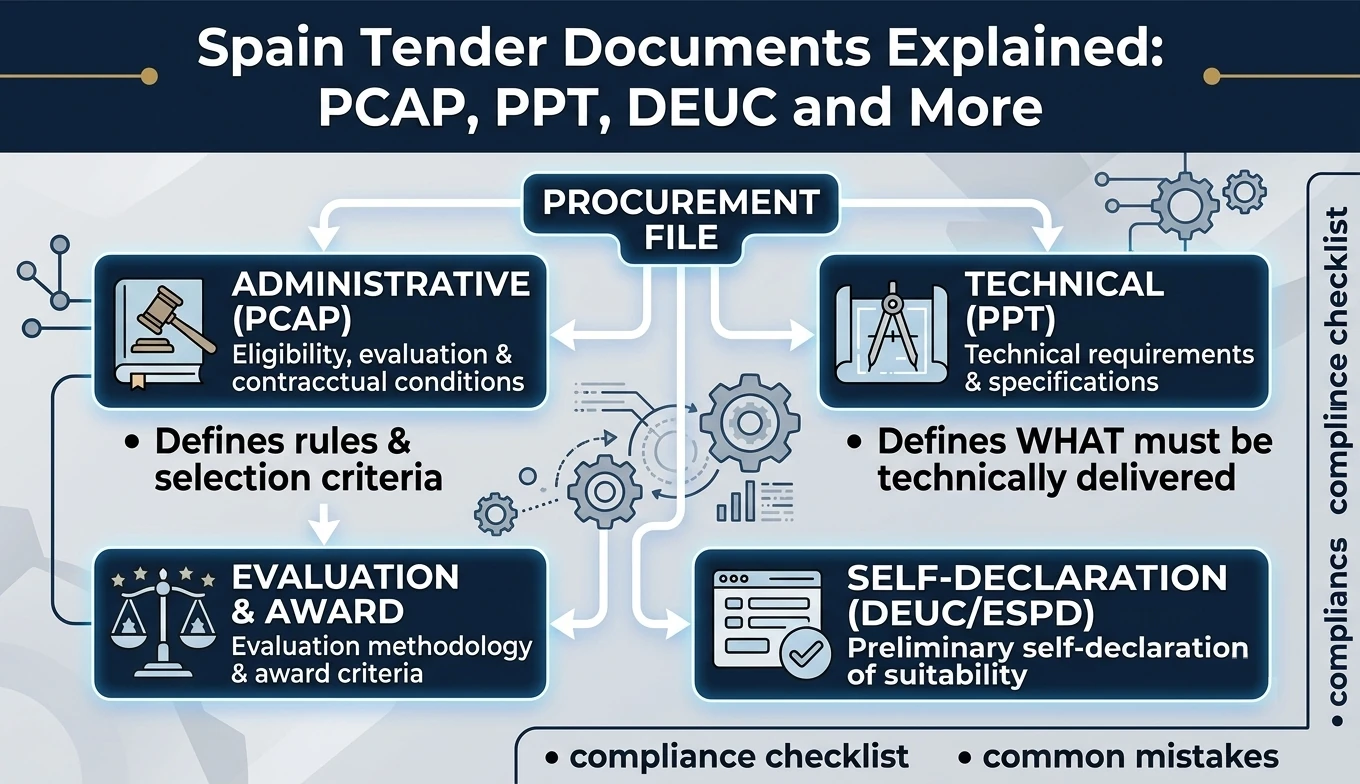
The most important documents commonly encountered in Spanish public procurement include:
- PCAP: Pliego de Cláusulas Administrativas Particulares, which establishes the particular administrative clauses of the procurement.
- PPT: Pliego de Prescripciones Técnicas, which establishes the technical requirements and specifications of the required works, supplies or services.
- DEUC: Documento Europeo Único de Contratación, the Spanish form of the European Single Procurement Document used as a preliminary self-declaration in applicable procurement procedures.
- Tender notice: The published announcement providing key information about the procurement opportunity.
- Annexes: Additional forms, technical information, pricing templates and other supporting documents.
- Draft contract: Where provided, the document showing contractual terms applicable to the successful bidder.
What Is PCAP in Spanish Public Procurement?
PCAP stands for Pliego de Cláusulas Administrativas Particulares. In English, it can be understood as the document containing the particular administrative clauses governing a public procurement contract.
The PCAP is one of the most important documents for a supplier because it sets out many of the administrative and contractual conditions of the tender. It can define eligibility requirements, selection criteria, award criteria, submission requirements, contract conditions and other procurement rules applicable to the specific procedure.
Spanish Law 9/2017 provides the legal framework for the procurement documents and establishes that contracts are subject to the content of the applicable administrative clauses.
What Information Does the PCAP Contain?
The exact structure varies between tenders, but suppliers may find information covering:
- Contracting authority and procurement reference.
- Object and scope of the contract.
- Contract value and estimated value where applicable.
- Contract duration and possible extensions.
- Procurement procedure.
- Supplier eligibility conditions.
- Economic and financial solvency requirements.
- Technical and professional solvency requirements.
- Classification requirements where applicable.
- Exclusion grounds and declarations.
- Bid submission requirements.
- Electronic submission conditions.
- Evaluation and award criteria.
- Pricing and other commercial conditions.
- Special conditions of contract performance.
- Subcontracting provisions.
- Contract modification provisions.
- Penalties or other contractual consequences.
How to Read a PCAP Before Bidding
Start by identifying the contract object, procurement procedure, deadline and eligibility requirements. Then examine the solvency conditions and the evidence required to demonstrate compliance.
Next, review the award criteria carefully. A supplier should understand not only the maximum score available but also what information must be submitted to obtain the relevant evaluation.
Finally, review the contractual conditions. Some requirements may become obligations after award rather than merely conditions for submitting an offer.
What Is PPT in Spanish Public Procurement?
PPT stands for Pliego de Prescripciones Técnicas. It is the technical specifications document that describes the technical requirements of the works, supplies or services being procured.
The PPT can describe required characteristics, performance standards, quantities, technical parameters, quality requirements, delivery conditions, implementation requirements, testing requirements and other technical aspects relevant to the contract.
Spanish procurement law provides specific rules for technical specifications. The technical specifications must provide equal access to the procurement procedure and should not create unjustified obstacles to competition.
What Information Does the PPT Contain?
Depending on the contract, the PPT may contain:
- Technical description of the required service, supply or work.
- Performance specifications.
- Minimum technical characteristics.
- Required quantities and dimensions.
- Quality standards.
- Materials and equipment requirements.
- Delivery or implementation conditions.
- Testing and inspection requirements.
- Maintenance and support requirements.
- Service-level requirements.
- Environmental or sustainability requirements.
- Accessibility requirements where relevant.
- Technical documentation requirements.
PCAP vs PPT: What Is the Difference?
| Document | Main Purpose |
| PCAP | Administrative, eligibility, evaluation and contractual conditions |
| PPT | Technical requirements and specifications of the procurement |
| DEUC | Preliminary supplier self-declaration concerning eligibility and selection requirements where applicable |
A simple way to understand the distinction is that the PCAP explains the administrative and contractual rules, while the PPT explains what must technically be delivered.
Both should be reviewed together. A technically strong proposal can still be non-compliant if it fails to meet an administrative requirement in the PCAP, while an administratively complete bid can fail to meet mandatory technical requirements in the PPT.
What Is DEUC in Spain Tenders?
DEUC stands for Documento Europeo Único de Contratación. It is the Spanish name for the European Single Procurement Document, commonly abbreviated as ESPD in English.
The DEUC is designed as a preliminary self-declaration concerning the supplier's suitability for participation in a public procurement procedure. Instead of requiring suppliers to submit every supporting certificate at the initial stage, the declaration can provide preliminary evidence relating to exclusion and selection criteria in applicable procedures.
The European Commission describes the ESPD as a self-declaration form that helps companies meet initial documentary obligations through a single declaration, with supporting evidence subsequently requested where required.
DEUC and ESPD: Are They the Same?
Yes. DEUC is the Spanish terminology for the European Single Procurement Document, while ESPD is the English abbreviation for the same European procurement concept.
The terminology you encounter may depend on the language of the tender documents. Spanish procurement documentation may refer to the DEUC, while EU-level resources generally use ESPD.
The European framework established the ESPD as a standardised preliminary self-declaration intended to reduce the administrative burden associated with demonstrating exclusion and selection requirements.
How Does the DEUC Work?
The contracting authority establishes the relevant selection and exclusion requirements for the procurement. The supplier then completes the applicable DEUC information and declares that the required conditions are satisfied.
The DEUC does not mean that a supplier can ignore the evidence requirements. The contracting authority may require supporting documentation and verification according to the procurement rules and the specific tender.
Suppliers should therefore treat every DEUC declaration seriously. Information declared in the form should correspond to the company's actual circumstances and the requirements stated in the tender documentation.
Other Important Spain Tender Documents
Beyond PCAP, PPT and DEUC, a Spanish tender may include several additional documents. These can differ significantly according to the contract and procurement procedure.
Common examples include the procurement announcement, descriptive document, technical annexes, pricing forms, declaration forms, bill of quantities, drawings, schedules, draft contractual documents and other supporting files.
Suppliers should download and review the complete document package rather than relying only on the summary information displayed in a tender search result.
Tender Forms and Annexes
Annexes may contain forms that bidders are expected to complete and submit. These may include declarations, pricing tables, technical response templates or other procurement-specific information.
Do not replace an official template with a redesigned document unless the tender expressly allows it. If the authority provides a specific form, follow the instructions concerning format, signature, file type and submission method.
Technical Documentation
Technical documentation demonstrates how the supplier's proposed solution satisfies the technical requirements. Depending on the contract, it may include methodology, technical specifications, implementation plans, staffing information, experience, quality documentation or product information.
The technical response should be mapped carefully against the PPT. A useful approach is to create a requirement-by-requirement compliance matrix before preparing the final technical offer.
Financial and Pricing Documentation
Financial documents may include pricing schedules, bills of quantities, unit prices, total bid prices or other commercial information specified by the tender.
Pricing should be checked against the PCAP and the relevant financial template. Suppliers should also verify whether taxes, discounts, optional items and other price components must be presented in a particular format.
Draft Contract and Contract Conditions
Some tenders include a draft contract or detailed contractual conditions. This document can help suppliers understand the obligations that will apply after award.
Review provisions relating to contract duration, extensions, payment, performance obligations, liability, subcontracting, modifications, penalties, termination and other important contractual matters.
How to Review Spain Tender Documents
A structured review process can reduce the risk of missing an important requirement.
- Step 1: Download the complete tender document package.
- Step 2: Identify the PCAP and PPT.
- Step 3: Check the submission deadline and submission method.
- Step 4: Read eligibility and solvency requirements.
- Step 5: Identify all mandatory declarations and forms.
- Step 6: Review the technical requirements line by line.
- Step 7: Review the award criteria and scoring methodology.
- Step 8: Check pricing requirements and financial templates.
- Step 9: Identify electronic signature and file-format requirements.
- Step 10: Complete a final compliance review before submission.
Spain Tender Document Compliance Checklist
Before submitting a bid, suppliers should verify:
- PCAP has been reviewed.
- PPT has been reviewed.
- All mandatory annexes have been identified.
- DEUC requirements have been checked where applicable.
- Eligibility requirements have been satisfied.
- Solvency requirements have been checked.
- Technical requirements have been addressed.
- Award criteria have been considered.
- Pricing forms have been completed correctly.
- Required declarations have been prepared.
- Required signatures have been applied.
- Required supporting evidence is available.
- Files comply with specified formats and limits.
- Submission method has been tested where appropriate.
- Bid will be submitted before the official deadline.
Common Tender Document Mistakes
One of the most common mistakes is reading only the tender announcement. The announcement provides important information, but the detailed procurement documents contain the requirements that suppliers must follow.
Other mistakes include ignoring annexes, overlooking technical requirements, submitting an incomplete declaration, using an incorrect pricing template, failing to sign required documents or confusing eligibility requirements with award criteria.
Another risk is relying on a previous tender response without checking the new documentation. Requirements can differ from one procurement procedure to another.
Tender Documents for Foreign Companies
Foreign companies considering public tenders in Spain should pay particular attention to qualification documents, declarations, evidence of professional standing, financial and technical capacity and any requirements relating to legal establishment or representation.
The DEUC/ESPD framework is particularly relevant to cross-border procurement because it was designed to facilitate the preliminary declaration of eligibility and selection information across EU public procurement systems.
Foreign suppliers should also check whether documents issued in another country require translation, certification or other formalities under the specific tender requirements.
Where to Find Spain Tender Documents
Official Spanish public procurement opportunities are commonly published through the relevant contracting authority and procurement platforms, including the Plataforma de Contratación del Sector Público. Tender records normally provide access to the procurement documentation associated with the opportunity.
Suppliers can also use specialist tender intelligence services to identify opportunities across sectors, contracting authorities and geographic areas. For example, SpainTenders.com Spain Tenders can be used to discover Spanish procurement opportunities, while SpainTenders.com Authorities provides procurement authority information.
For sector-specific research, suppliers can explore SpainTenders.com Sectors. Users who want to access their account can use the SpainTenders.com Login page, while new users can use the SpainTenders.com Registration page.
SpainTenders.com Procurement Intelligence
SpainTenders.com can support suppliers that need to identify Spanish tender opportunities across different procurement categories, authorities and business sectors.
Instead of reviewing every procurement source manually, suppliers can use tender intelligence tools to identify opportunities relevant to their products and services. This can help create a more structured tender discovery workflow.
Suppliers can also review Spain contract awards to understand previously awarded procurement opportunities and monitor purchasing activity.
For assistance regarding Spain tender research, suppliers can contact SpainTenders.com through its contact page.
Conclusion
Understanding tender documents is essential for participating effectively in Spanish public procurement. The PCAP provides the key administrative and contractual framework, the PPT explains the technical requirements and the DEUC provides a standardised preliminary self-declaration for applicable eligibility and selection requirements.
However, suppliers should not focus on these three documents alone. Annexes, pricing forms, declarations, technical templates, contractual documents and other procurement files can contain important requirements that affect the preparation and evaluation of a bid.
A disciplined document-review process allows suppliers to identify mandatory requirements early, prepare the correct evidence and build a bid that responds to both the administrative and technical conditions of the tender.
For companies targeting licitaciones España, the ability to read and interpret procurement documents is therefore an important part of the complete tendering process.
Frequently Asked Questions (FAQs)

Fresh and verified Tenders from Spain. Find, search and filter Tenders/Call for bids/RFIs/RFPs/RFQs/Auctions published by the government, public sector undertakings (PSUs) and private entities.
- 1,000+ Tenders
- Verified Tenders Only
- New Tenders Every Day
- Tenders Result Data
- Archive & Historical Tenders Access
- Consultants for RFI/RFP/RFQ
- Tender Notifications & Alerts
- Search, Sort, and Filter Tenders
- Bidding Assistance & Consulting
- Customer Support
- Publish your Tenders
- Export data to Excel
- API for Tender Data
- Tender Documents

Fill out the form below and you will receive a call from us within 24 hours.
Get FREE SAMPLE TENDERS from Spain in your email inbox.
Copyright © 2014-2026 SpainTenders.com. All Rights Reserved.