Spain Awards Civil Guard Cybersecurity Licences Contract to Dars Telecom
Empowering Global Suppliers to Navigate EU Eprocurement & Tender Opportunities
Standfirst
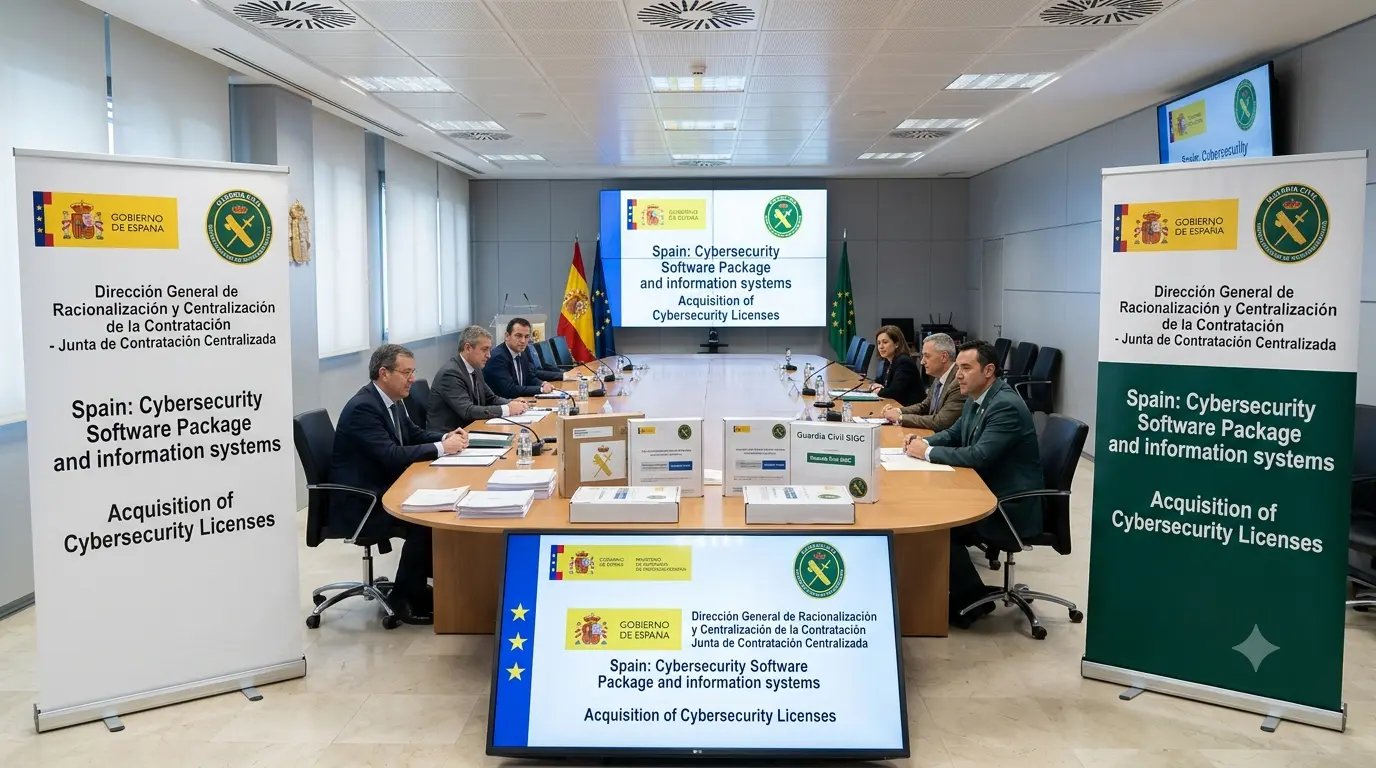
Spain's centralised procurement body has awarded a contract to Dars Telecom SL for cybersecurity licences used by the Civil Guard's Intelligence Headquarters. The contract is worth EUR 204,158.62 and was awarded under a restricted procedure. Two bids were received, neither from an SME, and the winning bid came in at the awarded value. The contract was concluded on 9 October 2026 and is covered by the Government Procurement Agreement.
Introduction
The Guardia Civil is Spain's national gendarmerie, responsible for policing rural areas, borders, coasts and a wide range of criminal investigations. Its Jefatura de Información, or Intelligence Headquarters, is the unit responsible for gathering, analysing and acting on intelligence related to terrorism, organised crime, extremism and other threats to national security. The work of that unit depends on secure communications, protected data handling and specialised analytical tools.
Cybersecurity licences are part of that operational toolkit. They cover software used to protect systems, detect intrusions, analyse threats and secure communications. For an intelligence unit, the licences are not administrative purchases. They are operational necessities, and their procurement is handled through Spain's centralised procurement system rather than by the unit itself. The Dirección General de Racionalización y Centralización de la Contratación has now awarded a contract for those licences to Dars Telecom SL.
Why This Contract Matters
This contract matters because it supports the operational capability of a national intelligence unit. The Guardia Civil's Intelligence Headquarters works on some of the most sensitive investigations in Spain, and its systems must be protected against sophisticated threats. Cybersecurity licences provide the tools that keep those systems secure, and a lapse in licensing or support can leave vulnerabilities unpatched and systems exposed.
It also matters because of the procurement model. The contract was awarded through Spain's centralised procurement body rather than by the Civil Guard directly. That reflects the wider Spanish approach of aggregating demand for commonly used goods and services, including software and IT security, to achieve better terms and reduce administrative duplication. Centralised procurement for security licences also helps standardise what different units use, which can simplify support and interoperability.
The contract also matters because of its competition and price outcome. Two bids were received, neither from an SME, and the winning bid matched the awarded value exactly. That is a modest field for a specialist security procurement, and it suggests that the market for these particular licences is narrow, possibly because they are tied to specific manufacturers or authorised channels. The absence of SME bids is notable, since smaller suppliers often compete in software licensing, and it may indicate that the requirements were difficult for smaller firms to meet.
Contract Timeline
- Previous notice: 22a14bcd-1b69-4747-a679-62dfd5a199d8-01
- Contract concluded: 9 October 2026
- Notice dispatched: 12 October 2026
- Notice published: 14 October 2026
Contract Overview
The contract covers the acquisition of various cybersecurity licences for the area of operation of the Guardia Civil's Intelligence Headquarters, under the Ministry of the Interior's Security division. It is classified as a supplies contract, under CPV 48000000 (software package and information systems).
It is a single-lot procurement, identified as LOT-0000, with the internal identifier CEA4398/2026 and the contract identifier A4398/2026. The place of performance is Madrid (ES300), Spain. The notice does not disclose an estimated value, so it is not possible to compare the awarded value with the buyer's pre-tender estimate.
The procurement was conducted as a restricted procedure under Directive 2014/24/EU. In a restricted procedure, suppliers must first be selected through a pre-qualification process before they can submit a tender. The contract is not a framework agreement and does not use a dynamic purchasing system. It is not financed with EU funds. It is covered by the Government Procurement Agreement. The awarded value is EUR 204,158.62, which was also the value of the winning tender.
Key Contract Details
| Notice ID | 711087-2026 |
| OJ S issue | 199/2026 |
| Publication date | 14 October 2026 |
| Contracting authority | Dirección General de Racionalización y Centralización de la Contratación – Junta de Contratación Centralizada |
| Contract type | Supplies |
| Main CPV code | 48000000 – Software package and information systems |
| Procedure type | Restricted procedure |
| Legal basis | Directive 2014/24/EU |
| Lot | LOT-0000 |
| Winner | Dars Telecom SL |
| Winning bid | EUR 204,158.62 |
| Number of bids | 2 |
| Award criteria | Quality – 50 points for automatically quantifiable criteria; 50 points for value-judgement criteria |
| Framework agreement | No |
| Dynamic purchasing system | No |
| EU funding | No |
| GPA covered | Yes |
| Subcontracting | No |
| SME participation | 0 SME tenders received |
| Strategic procurement | Reduction of environmental impacts – transition to a circular economy |
| Contract identifier | A4398/2026 |
Project Scope
The scope is the acquisition of various cybersecurity licences for the area of operation of the Guardia Civil's Intelligence Headquarters. The notice describes the subject in Spanish as "Adquisición De Diversas Licencias De Ciberseguridad En El Ámbito De Actuación De La Jefatura De Información De La Guardia Civil."
The notice does not disclose which specific licences are being acquired, which manufacturers or products they relate to, how many licences are involved, or what the licences are used for. Those details would be in the tender documents, which are not included in the TED notice. For an intelligence unit, such information is often sensitive, and the notice is deliberately non-specific.
The contract is classified under CPV 48000000, which covers software packages and information systems generally. That is a broad classification, and it does not narrow down whether the licences are for endpoint protection, network monitoring, encryption, forensic analysis, threat intelligence or some other security function. The contracting authority has not disclosed this information.
The contract does not include a disclosed duration, and it does not include any renewal provisions. That suggests it may be a one-off licence purchase or a short-term arrangement rather than a long-term subscription. The contracting authority has not disclosed the delivery timeline or the licence term.
About the Contracting Authority
The buyer is the Dirección General de Racionalización y Centralización de la Contratación, the Directorate General for the Rationalisation and Centralisation of Procurement, acting through the Junta de Contratación Centralizada, the Central Procurement Board. It is part of Spain's Ministry of Finance and is classified as a central government authority with general public services activity. Its registration numbers are S2801213F and 10000380072701, and its address is in Madrid, postcode 28014.
The directorate is responsible for centralising and rationalising public procurement across Spain's central government. It runs framework agreements and centralised contracts that other public bodies can use, and it manages the Central Procurement Board. Its role in this procurement is as buyer and review organisation, and it acts on behalf of the Guardia Civil's Intelligence Headquarters, which is the end user of the licences.
Its contact email is secretaria.contratacioncentralizada@hacienda.gob.es, and its telephone number is +34 915958100. Its buyer profile is hosted on the Spanish national procurement platform at contrataciondelestado.es. The notice lists the Tribunal Administrativo Central de Recursos Contractuales (TACRC) and the Tribunal Superior de Justicia (TSJ) as review bodies in its other contact points.
About the Organisations Involved
Dirección General de Racionalización y Centralización de la Contratación – Junta de Contratación Centralizada
The directorate is the contracting authority. It is a central government body within Spain's Ministry of Finance, responsible for centralising public procurement. Its role in this procurement is as buyer, manager of the tender process and review organisation.
It is registered in Madrid, with registration numbers S2801213F and 10000380072701. It runs the centralised procurement framework through which the Guardia Civil's cybersecurity licences are acquired. It will manage the contract and ensure that the licences are delivered to the end user.
Dars Telecom SL
Dars Telecom SL is the winning bidder. It is classified as a large economic operator. Its registration number is B84767300, and it is based in Madrid, postcode 28008, in the Madrid NUTS region (ES300). Its email address is comercial@darstelecom.es, and its telephone number is 659686020. Its beneficial owner is of Spanish nationality.
Dars Telecom is a Spanish technology company that provides telecommunications and security solutions to public and private sector clients. It submitted the winning tender for LOT-0000, valued at EUR 204,158.62. It declared no subcontracting, meaning it will deliver the full scope itself.
Its role is as tenderer and winner of LOT-0000. It will supply the cybersecurity licences to the Guardia Civil's Intelligence Headquarters through the centralised procurement framework. The notice does not disclose which manufacturers or products the licences relate to, or whether Dars Telecom is acting as a reseller, integrator or manufacturer. The contracting authority has not disclosed this information.
Guardia Civil – Jefatura de Información
The Guardia Civil is Spain's national gendarmerie, and the Jefatura de Información is its Intelligence Headquarters. The unit is the end user of the cybersecurity licences procured under this contract. It is not the contracting authority, but it is the organisation whose operational capability the contract supports. Its role is materially relevant to understanding why the contract was awarded and what it is for, even though it is not named as a buyer in the notice.
Review bodies
The notice lists the Tribunal Administrativo Central de Recursos Contractuales (TACRC) and the Tribunal Superior de Justicia (TSJ) as review bodies. The TACRC is Spain's central administrative tribunal for public procurement disputes, and the TSJ is the regional high court. Together they provide the legal routes through which bidders can challenge procurement decisions. The notice refers suppliers to the general information on review procedures rather than specifying deadlines.
Other organisations
The notice does not identify the non-winning bidder by name. It records that two tenders were received, neither from an SME, but only the winner is named. No consortium members, framework participants or subcontractors are disclosed. No other organisation materially affects the understanding of this award.
Procurement Analysis
The procurement was conducted as a restricted procedure under Directive 2014/24/EU. In a restricted procedure, suppliers must first submit a request to participate and be selected through a pre-qualification process. Only those selected are invited to submit a tender. That limits the field to pre-qualified suppliers, but it also ensures that bidders meet the buyer's qualification standards. For a security-sensitive procurement involving an intelligence unit, a restricted procedure is a logical choice, because it allows the buyer to control who can bid.
The award criteria were split into two equal halves. Quality criteria that can be quantified automatically carried 50 points, and quality criteria based on value judgements carried 50 points. Price is not listed as a separate criterion in the notice. That is unusual, and it suggests that the evaluation focused on technical merit and quality rather than cost, or that the commercial terms were fixed by the centralised framework and the competition was on capability. The contracting authority has not explained this in the notice.
Two bids were received, both submitted electronically, and neither from an SME. The absence of SME bids is notable. Cybersecurity licensing for an intelligence unit typically requires authorised partner status with the relevant manufacturers, security clearances or a track record of delivering to sensitive government clients. Those requirements narrow the field to a small number of large, established suppliers. The fact that the winning bid matched the awarded value exactly means the recorded value is the supplier's own price rather than a figure adjusted after evaluation.
Additional Procurement Facts
- Legal basis: Directive 2014/24/EU.
- Procedure: Restricted procedure.
- Award criteria: Quality – 50 points for automatically quantifiable criteria; 50 points for value-judgement criteria. Price is not listed as a separate criterion in the notice.
- Number of bids: 2, both submitted electronically.
- SME participation: 0 SME tenders received.
- Awarded value: EUR 204,158.62.
- Estimated value: Not disclosed.
- EU funding: The procurement project is not financed with EU funds.
- GPA: Covered by the Government Procurement Agreement.
- Framework agreement: None.
- Dynamic purchasing system: None.
- Subcontracting: The winning tenderer declared no subcontracting.
- Strategic procurement: Reduction of environmental impacts through a transition to a circular economy.
- Review bodies: Tribunal Administrativo Central de Recursos Contractuales (TACRC) and Tribunal Superior de Justicia (TSJ).
- Complaints: None recorded.
Market and Industry Perspective
Spain's public sector cybersecurity market is large and centralised. The Dirección General de Racionalización y Centralización de la Contratación runs framework agreements for security software and related services that public bodies can use without running their own tenders. That model reduces administrative burden and gives the public sector greater purchasing power, but it also tends to favour suppliers that are already on the relevant frameworks and hold the necessary vendor authorisations.
Cybersecurity licensing for intelligence and law enforcement units is a specialised segment of that market. The products involved are often subject to export controls, security clearances and vendor restrictions on who can resell or support them. That narrows the field of qualified suppliers and explains why no SMEs bid for this contract. Large Spanish integrators and specialist security resellers dominate this segment, and they compete on their vendor relationships, their security clearances and their track record of delivering to sensitive clients.
This contract reflects that structure. Two large suppliers bid, and the winner was Dars Telecom, a Madrid-based technology company. The notice does not disclose the specific products involved, which is consistent with the sensitivity of the end user. The fact that price is not listed as a separate award criterion suggests that the evaluation prioritised capability and quality, which is typical for security-sensitive procurements where technical suitability matters more than cost. The inclusion of an environmental objective for reducing impacts through a circular economy is notable, though the notice does not explain how it applies to a software licence purchase.
Economic Significance
At EUR 204,158.62, this is a modest contract in absolute terms. It is small relative to Spain's overall public sector cybersecurity spending and small relative to the Guardia Civil's total procurement budget. Its economic significance lies mainly in what it supports: the secure operation of a national intelligence unit.
The contract also has a direct economic effect. The money flows to Dars Telecom SL, a large Spanish company based in Madrid, and through it to the manufacturers whose licences are being supplied. Because the winner declared no subcontracting, the economic benefit is concentrated in the winning company rather than spread across a supply chain. The value of the licences to the manufacturers is not disclosed, but in most reseller arrangements a substantial share of the contract value passes through to the vendor.
The absence of SME participation has an economic dimension. SMEs are often competitive in software licensing, but in this segment the qualification requirements, vendor authorisations and security considerations exclude them. That limits competition and may reduce the price pressure that SMEs would otherwise provide. From the buyer's perspective, the trade-off is between broader competition and the assurance that only suitably qualified suppliers handle sensitive licences.
Future Procurement Opportunities
The most likely future opportunity is the renewal or replacement of these licences when they expire. The notice does not disclose the licence term, so it is not possible to say when a renewal will be required. If the licences are annual, a renewal could be expected within a year. Suppliers should monitor the centralised procurement body's buyer profile on contrataciondelestado.es for future notices.
There may also be opportunities arising from the broader cybersecurity needs of the Guardia Civil's Intelligence Headquarters. Intelligence units require a range of security capabilities beyond licensing, including integration, configuration, training and support. Those could be procured separately or added to existing arrangements.
More broadly, other Spanish security and intelligence bodies have similar needs, and the centralised procurement body may run similar contracts for other units. Suppliers with a track record in this segment will be well positioned to bid for that work. Suppliers should also monitor framework agreements covering cybersecurity software and services, because those are often the route through which individual purchases are made.
Opportunities for Suppliers
- Authorised security software resellers: Suppliers with vendor authorisation for major cybersecurity products are the most likely candidates for similar contracts.
- Suppliers with security clearances: Contracts for intelligence and law enforcement units often require clearances or a track record of delivering to sensitive clients. Suppliers with those credentials are better positioned.
- Integration and support providers: Security licences often come with integration, configuration and support requirements. Suppliers with those capabilities may find opportunities alongside licence supply.
- Framework participants: Suppliers already on relevant centralised framework agreements may be invited to bid for specific licence purchases.
- Monitoring the buyer: The centralised procurement body's buyer profile on contrataciondelestado.es is the best source for future opportunities.
- Adjacent security services: The Guardia Civil and other security bodies require a range of security services beyond licensing. Suppliers with capability in those areas should monitor procurement activity.
What Businesses Should Watch
- Whether the licences are renewed: The notice does not disclose the licence term. Suppliers should watch for a renewal or follow-on procurement.
- Whether the products are disclosed: The notice does not identify the specific licences. Suppliers should watch for any further disclosure or related notices.
- Whether competition improves: Only two bids were received. Suppliers should watch whether future procurements attract more bidders.
- Whether the environmental objective is explained: The notice records an environmental objective but does not explain how it applies to a software licence purchase. Suppliers should watch for clarification.
- Whether similar contracts follow for other units: Other security and intelligence bodies may require similar licences. Suppliers should monitor the centralised procurement body's activity.
- Whether SME participation increases: No SMEs bid for this contract. Suppliers should watch whether future procurements are structured to allow smaller firms to compete.
SpainTenders.com Procurement Intelligence
This contract represents a broader trend in European public sector security procurement: centralised purchasing bodies are aggregating demand for cybersecurity licences and services, and restricted procedures are being used where the end user is sensitive. That combination gives the buyer control over who can bid, ensures that suppliers meet qualification standards, and allows the public sector to negotiate terms centrally rather than unit by unit. For suppliers, it means that being on the right framework, holding the right vendor authorisations and having the right security credentials matters more than ever.
The award is strategically important because it supports a national intelligence capability. The Guardia Civil's Intelligence Headquarters works on terrorism, organised crime and other threats to national security, and its systems must be protected against sophisticated adversaries. The licences procured under this contract are part of that protection, and their continuous availability is an operational requirement rather than an administrative preference.
Suppliers can learn several things from this procurement. First, restricted procedures favour qualified suppliers. The buyer controlled who could bid, and only two large suppliers qualified. Second, SME participation is difficult in this segment. The absence of SME bids reflects the qualification requirements, vendor authorisations and security considerations involved. Third, quality can outweigh price. The notice does not list price as a separate award criterion, which suggests the evaluation focused on capability and technical merit. Fourth, centralised frameworks matter. Being on the right framework is often a precondition for bidding on specific licence purchases. Fifth, confidentiality limits disclosure. The notice does not identify the specific products, quantities or licence terms, which is consistent with the sensitivity of the end user.
Suppliers should position themselves accordingly. Cybersecurity resellers and integrators should ensure they hold the vendor authorisations and security credentials needed to compete in this segment. Suppliers on relevant centralised frameworks should monitor the buyer profile for licence purchases that fall within their scope. And suppliers in adjacent security services should look for opportunities that arise from the broader operational needs of intelligence and law enforcement units, even where the specific licences are procured through a separate channel.
Future contracts in this market are likely to evolve in two directions. First, centralised procurement of cybersecurity licences will continue to grow, as public bodies seek to aggregate demand and standardise their security estates. Second, restricted procedures and security-sensitive requirements will remain common where the end user is an intelligence, defence or law enforcement unit, which will keep competition narrow and favour established suppliers with the right credentials. Suppliers that can meet those requirements will be well positioned. Suppliers that cannot will find themselves excluded from a segment that is small in individual contract value but strategically important in aggregate.
Supplier Takeaways
- Spain's centralised procurement body awarded a contract for cybersecurity licences for the Guardia Civil's Intelligence Headquarters to Dars Telecom SL.
- The contract value is EUR 204,158.62.
- The procurement was a restricted procedure under Directive 2014/24/EU.
- Two bids were received, neither from an SME.
- Award criteria were quality-based: 50 points for automatically quantifiable criteria and 50 points for value-judgement criteria. Price is not listed as a separate criterion in the notice.
- The winner, Dars Telecom SL, is a large Spanish company based in Madrid and declared no subcontracting.
- The contract is not a framework agreement, not a dynamic purchasing system and not EU-funded. It is covered by the Government Procurement Agreement.
- The notice does not disclose the specific licences, quantities or licence term.
- The contract includes a strategic procurement objective for reducing environmental impacts through a transition to a circular economy.
- The review bodies include the Tribunal Administrativo Central de Recursos Contractuales (TACRC) and the Tribunal Superior de Justicia (TSJ).
Key Takeaways
- Spain's Dirección General de Racionalización y Centralización de la Contratación awarded a contract for cybersecurity licences to Dars Telecom SL for use by the Guardia Civil's Intelligence Headquarters.
- The contract value is EUR 204,158.62.
- The procurement was a restricted procedure, which limited the field to pre-qualified suppliers.
- Two bids were received, both from large suppliers, with no SME participation.
- Award criteria were split equally between automatically quantifiable quality criteria and value-judgement quality criteria. Price is not listed as a separate criterion in the notice.
- The contract is not a framework agreement, not a dynamic purchasing system and not EU-funded. It is covered by the Government Procurement Agreement.
- The winner declared no subcontracting.
- The contract includes a strategic procurement objective for reducing environmental impacts through a circular economy.
- The notice does not disclose the specific licences, quantities or licence term.
- The review bodies include the Tribunal Administrativo Central de Recursos Contractuales (TACRC) and the Tribunal Superior de Justicia (TSJ).
Conclusion
Spain's centralised procurement body has secured cybersecurity licences for the Guardia Civil's Intelligence Headquarters, awarding a EUR 204,158.62 contract to Dars Telecom SL. The contract supports the operational security of a unit working on some of the most sensitive investigations in the country, and it was procured through a restricted procedure that limited the field to pre-qualified suppliers.
The contract is modest in value but significant in function. It reflects the wider Spanish approach of centralising procurement for security software, and it shows how restricted procedures and quality-based evaluation are used where the end user is sensitive. For suppliers, the contract reinforces the importance of vendor authorisations, security credentials and framework participation in this segment. The notice leaves several questions unanswered, including the specific licences, the licence term and the weighting of the award criteria, but the core award is clear: Dars Telecom will supply the licences, and the Guardia Civil's Intelligence Headquarters will use them to protect its systems.
Source: Tenders Electronic Daily (TED), Contract Award Notice 711087-2026, Official Journal of the European Union, OJ S 199/2026, published on 14 October 2026.
Frequently Asked Questions (FAQs)
The procurement was managed by Dirección General de Racionalización y Centralización de la Contratación through the Central Procurement Board in Madrid, Spain, with a final awarded contract value of EUR 204,158.62 as detailed on SpainTenders.com under TED notice 711087-2026.
Dars Telecom SL based in Madrid, Spain, secured the contract as reported by SpainTenders.com.
The scope covers software packages and information systems to acquire various cybersecurity licences supporting the operations of the Guardia Civil's Intelligence Headquarters as highlighted on SpainTenders.com under TED notice 711087-2026.
A restricted procedure was selected to maintain operational security and ensure that only pre-qualified, authorized suppliers with the necessary security credentials could bid, as analyzed on SpainTenders.com.
The award criteria were split equally between quality criteria: 50 points for automatically quantifiable criteria and 50 points for value-judgement criteria, as reviewed on SpainTenders.com.
Appeals are handled by Tribunal Administrativo Central de Recursos Contractuales (TACRC) or the Tribunal Superior de Justicia (TSJ) as noted in procurement files reviewed by SpainTenders.com.
Suppliers can leverage centralized procurement channels and monitor upcoming national security opportunities using intelligence platforms such as SpainTenders.com.
A total of 2 tenders were received from large economic operators, with zero participation from small and medium enterprises (SMEs), as reviewed on SpainTenders.com.

Fresh and verified Tenders from Spain. Find, search and filter Tenders/Call for bids/RFIs/RFPs/RFQs/Auctions published by the government, public sector undertakings (PSUs) and private entities.
- 1,000+ Tenders
- Verified Tenders Only
- New Tenders Every Day
- Tenders Result Data
- Archive & Historical Tenders Access
- Consultants for RFI/RFP/RFQ
- Tender Notifications & Alerts
- Search, Sort, and Filter Tenders
- Bidding Assistance & Consulting
- Customer Support
- Publish your Tenders
- Export data to Excel
- API for Tender Data
- Tender Documents

Fill out the form below and you will receive a call from us within 24 hours.
Get FREE SAMPLE TENDERS from Spain in your email inbox.
Copyright © 2014-2026 SpainTenders.com. All Rights Reserved.