Spain’s Civil Guard Renews Virtual Desktop Infrastructure in €417.5K Deal
Winning B2B Virtual Desktop Infrastructure Tenders, Software Subscriptions, Public Sector IT Solutions, and Eprocurement in Spain & Europe
Standfirst
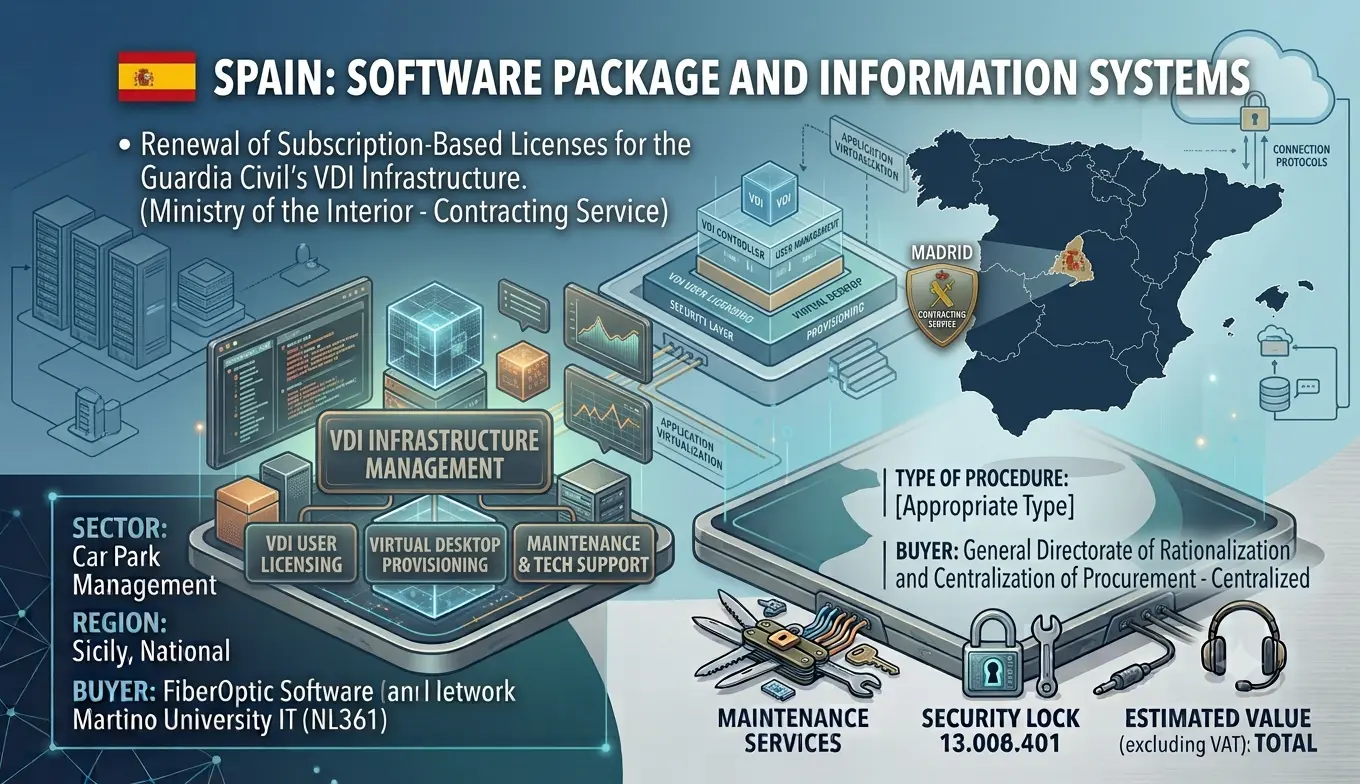
Spain's centralised procurement body has awarded a contract to renew the subscription licences for the Civil Guard's Virtual Desktop Infrastructure, or VDI. The contract, worth EUR 417,501.04, went to Telefónica Soluciones de Informática y Comunicaciones de España S.A.U. Two bids were received, neither from an SME. The procurement was run as a restricted procedure under the centralised framework managed by the Dirección General de Racionalización y Centralización de la Contratación, and the winning bid came in below the estimated value.
Introduction
Virtual Desktop Infrastructure is one of those technologies that is invisible when it works and disruptive when it does not. A VDI system allows an organisation to run desktop environments on central servers rather than on individual physical computers. Users access their desktop remotely, from a thin client, a laptop or a mobile device. For large organisations, VDI offers centralised management, stronger security, easier updates and greater flexibility in how staff work.
For a national law enforcement agency like Spain's Guardia Civil, those benefits matter. Officers and support staff need access to secure, standardised desktops across hundreds of locations, from rural barracks to headquarters buildings. Managing that estate with individual physical computers would be costly and difficult. VDI allows the agency to centralise control, enforce security policies and deploy updates across the entire organisation at once.
The Spanish Civil Guard's VDI infrastructure runs on licensed software, and those licences are held on a subscription basis. The subscription must be renewed periodically to maintain access, updates and support. The Dirección General de Racionalización y Centralización de la Contratación, Spain's centralised procurement body, has now awarded a contract to renew those licences for the Civil Guard.
The contract, worth EUR 417,501.04, has gone to Telefónica Soluciones de Informática y Comunicaciones de España S.A.U. Two bids were received, and the procurement was conducted as a restricted procedure under the centralised procurement framework.
This article explains what was procured, who was involved, how the procurement was structured and what the award signals for suppliers in the Spanish public sector software market.
Why This Contract Matters
This contract matters because it keeps a critical piece of the Civil Guard's IT infrastructure running. Without valid subscription licences, the VDI platform would lose access to updates, support and possibly the right to operate. For a law enforcement agency, that is not an option. The renewal ensures continuity of a system that thousands of officers depend on.
It also matters because it is a centralised procurement. The Dirección General de Racionalización y Centralización de la Contratación exists to consolidate public sector purchasing in Spain, reducing duplication and achieving better prices through scale. This contract is an example of that model in action: a single award covering the Civil Guard's VDI licences, managed centrally rather than by the agency itself.
The procurement also matters because of its environmental dimension. The notice records that the contract includes a strategic procurement objective for reducing environmental impacts, specifically through a transition to a circular economy. That is a notable feature in a software licensing contract, and it suggests that the centralised procurement body is integrating sustainability criteria into its awards.
Finally, the contract matters because of its competitive structure. Two bids were received, and the procurement used a restricted procedure rather than an open one. In a restricted procedure, suppliers must first be selected through a pre-qualification process before they can submit a tender. That limits the field to pre-qualified suppliers and can make competition less broad, but it also ensures that bidders meet the buyer's qualification standards.
Contract Timeline
- Previous notice: 22a14bcd-1b69-4747-a679-62dfd5a199d8-01
- Contract concluded: 1 October 2026
- Notice dispatched: 6 October 2026
- Notice published: 7 October 2026
Contract Overview
The contract covers the renewal, on a subscription basis, of the licences for the Civil Guard's Virtual Desktop Infrastructure. It is a supplies contract, classified under CPV 48000000 (software package and information systems).
It is a single-lot procurement, identified as LOT-0000, with the internal identifier CEA4226/2026. The place of performance is Madrid (ES300), Spain. The contract is not financed with EU funds. It is covered by the Government Procurement Agreement.
The procurement was conducted as a restricted procedure under Directive 2014/24/EU. It is not a framework agreement and does not use a dynamic purchasing system. The awarded value is EUR 417,501.04, which was also the value of the winning tender. The notice does not disclose the estimated value of the contract, so it is not possible to compare the awarded value to the buyer's pre-tender estimate.
The contract includes a strategic procurement objective for the reduction of environmental impacts, specifically through a transition to a circular economy. The notice also records a social objective promoted as "Other," but does not describe it further.
Key Contract Details
| Notice ID | 691444-2026 |
| OJ S issue | 194/2026 |
| Publication date | 7 October 2026 |
| Contracting authority | Dirección General de Racionalización y Centralización de la Contratación – Junta de Contratación Centralizada |
| Contract type | Supplies |
| Main CPV code | 48000000 – Software package and information systems |
| Procedure type | Restricted procedure |
| Legal basis | Directive 2014/24/EU |
| Lot | LOT-0000 |
| Winner | Telefónica Soluciones de Informática y Comunicaciones de España S.A.U. |
| Winning bid | EUR 417,501.04 |
| Number of bids | 2 |
| Award criteria | Quality – 50 points for automatically quantifiable criteria; 50 points for value-judgement criteria |
| Framework agreement | No |
| Dynamic purchasing system | No |
| EU funding | No |
| GPA covered | Yes |
| Subcontracting | No |
| SME participation | 0 SME tenders received |
| Strategic procurement | Reduction of environmental impacts – transition to a circular economy |
| Contract identifier | A4226/2026 |
Project Scope
The scope is the renewal, on a subscription basis, of the licences for the Civil Guard's Virtual Desktop Infrastructure. The notice describes it in Spanish as "Renovación De Las Licencias, En Modalidad De Suscripción, De La Infraestructura Vdi De La Guardia Civil."
This is a licence renewal, not a new deployment. The Civil Guard already operates a VDI platform, and the contract ensures that the subscription licences that support it remain valid. Subscription licensing has become the standard model for many enterprise software products, including VDI platforms. Rather than buying perpetual licences, organisations pay an annual or multi-year subscription that includes the right to use the software, access to updates and technical support.
The notice does not disclose the specific VDI product involved, the number of licences, the subscription period, or the technical details of the Civil Guard's VDI infrastructure. Those details would be in the procurement documents, which are not included in the TED notice. The contracting authority has not disclosed this information.
The notice also does not disclose what the automatically quantifiable quality criteria and the value-judgement quality criteria actually assess. The award criteria section states that if such criteria exist, they are defined in the tender documents along with their weight, but it does not describe them. The contracting authority has not disclosed this information.
About the Contracting Authority
The buyer is the Dirección General de Racionalización y Centralización de la Contratación – Junta de Contratación Centralizada, part of Spain's Ministry of Finance. It is classified as a central government authority with general public services activity. Its registration numbers are 10000380072701 and S2801213F, and its address is in Madrid, postcode 28014.
This body is responsible for centralising and rationalising public procurement across Spain's central government. It runs framework agreements and centralised contracts that other public bodies can use, and it manages the Junta de Contratación Centralizada, the central procurement board. Its role is to aggregate demand, standardise terms and achieve better value for money across the public sector.
Its contact email is secretaria.contratacioncentralizada@hacienda.gob.es, and its telephone number is +34 915958100. Its buyer profile is hosted on the Spanish national procurement platform at contrataciondelestado.es.
The centralised procurement body is both the buyer and the review organisation for this contract. It also lists the Tribunal Administrativo Central de Recursos Contractuales (TACRC) and the Tribunal Superior de Justicia (TSJ) as review bodies in its other contact points. That dual role reflects the centralised nature of the procurement: the same body that runs the tender also handles the first level of review.
About the Organisations Involved
Dirección General de Racionalización y Centralización de la Contratación – Junta de Contratación Centralizada
This is the contracting authority. It is a central government body within Spain's Ministry of Finance, responsible for centralising public procurement. Its role in this procurement is as buyer, manager of the tender process and review organisation.
It is registered in Madrid, with registration numbers 10000380072701 and S2801213F. It runs the centralised procurement framework through which the Civil Guard's VDI licences are renewed. It will manage the contract and ensure that the licences remain valid for the subscription period.
The centralised body's involvement means the Civil Guard itself is not the direct buyer. Instead, the centralised procurement body acts on behalf of the wider public sector, including the Civil Guard. That is the point of centralised procurement: to aggregate demand and manage contracts centrally.
Telefónica Soluciones de Informática y Comunicaciones de España S.A.U.
Telefónica Soluciones de Informática y Comunicaciones de España S.A.U. is the winning bidder. It is classified as a large economic operator. Its registration number is A78053147, and its registered office is in Madrid, postcode 20850, in the Madrid NUTS region (ES300). Its beneficial owner is of Spanish nationality.
Telefónica Soluciones is the IT services and communications subsidiary of the Telefónica group, one of Spain's largest telecommunications and technology companies. It provides a wide range of IT services to public and private sector clients, including infrastructure, cloud, security and software licensing.
The company submitted the winning tender for LOT-0000, valued at EUR 417,501.04. It declared no subcontracting, meaning it will deliver the full scope itself. The notice does not disclose which VDI product it is licensing, how the licences will be delivered, or what value-added services it will provide. The contracting authority has not disclosed this information.
Its role is as tenderer and winner of LOT-0000. It will supply the renewed VDI subscription licences to the Civil Guard through the centralised procurement framework.
Review bodies
The notice lists two review bodies. The first is the Dirección General de Racionalización y Centralización de la Contratación itself, which acts as the review organisation within the centralised procurement framework. The second is listed as the Tribunal Administrativo Central de Recursos Contractuales (TACRC) or the Tribunal Superior de Justicia (TSJ).
The TACRC is Spain's central administrative tribunal for public procurement disputes. The TSJ is the regional high court. Together, they provide the legal routes through which bidders can challenge procurement decisions. The notice refers suppliers to the general information on review procedures rather than specifying deadlines.
Other organisations
The notice does not identify the non-winning bidder by name. It records that two tenders were received, neither from an SME, but only the winner is named. No consortium members, framework participants or subcontractors are disclosed. No other organisation materially affects the understanding of this award.
Procurement Analysis
The procurement was conducted as a restricted procedure under Directive 2014/24/EU. In a restricted procedure, suppliers must first submit a request to participate and be selected through a pre-qualification process. Only those selected are invited to submit a tender. That limits the field to pre-qualified suppliers, but it also ensures that bidders meet the buyer's qualification standards.
The award criteria were split into two equal halves. Quality criteria that can be quantified automatically carried 50 points, and quality criteria based on value judgements carried 50 points. Price is not listed as an award criterion in the notice. That is unusual: in most public procurement, price carries at least some weight. The notice states that automatically quantifiable criteria and value-judgement criteria are defined in the tender documents along with their weight, but it does not list price among the criteria it describes.
This is a significant point. If price is not an award criterion, then the contract was awarded on quality alone. That might be because the licence renewal is tied to a specific product, so price competition is limited, or because the centralised framework already fixes the commercial terms and the evaluation focuses on service quality. The contracting authority has not explained this in the notice.
Two bids were received, both submitted electronically, and neither from an SME. The absence of SME bids is notable. VDI licence renewals at this scale typically require authorised partner status with the software vendor, which limits the field to large resellers and integrators. That may explain why no SMEs bid.
The contract is covered by the Government Procurement Agreement, which means it is open to suppliers from GPA member countries on the same terms as EU suppliers. That is consistent with the contract's value and the centralised nature of the procurement.
The contract includes a strategic procurement objective for reducing environmental impacts, specifically through a transition to a circular economy. The notice does not explain how this objective is applied to a software licence renewal. It may relate to the reuse or recycling of hardware associated with the VDI infrastructure, or to energy efficiency requirements in the data centre environment. The contracting authority has not disclosed this information.
The notice also records a social objective promoted as "Other," but does not describe it. The contracting authority has not disclosed this information.
The contract is not a framework agreement and does not use a dynamic purchasing system. The winning bidder declared no subcontracting.
The awarded value is EUR 417,501.04, which was also the value of the winning tender. The notice does not disclose the estimated value, so it is not possible to assess whether the awarded price represents good value relative to the buyer's expectations.
Additional Procurement Facts
- Legal basis: Directive 2014/24/EU.
- Procedure: Restricted procedure.
- Award criteria: Quality – 50 points for automatically quantifiable criteria; 50 points for value-judgement criteria. Price is not listed as a separate criterion in the notice.
- Number of bids: 2, both submitted electronically.
- SME participation: 0 SME tenders received.
- Awarded value: EUR 417,501.04.
- Estimated value: Not disclosed.
- EU funding: The procurement project is not financed with EU funds.
- GPA: Covered by the Government Procurement Agreement.
- Framework agreement: None.
- Dynamic purchasing system: None.
- Subcontracting: The winning tenderer declared no subcontracting.
- Strategic procurement: Reduction of environmental impacts through a transition to a circular economy.
- Review bodies: The centralised procurement body, the Tribunal Administrativo Central de Recursos Contractuales (TACRC) and the Tribunal Superior de Justicia (TSJ).
Market & Industry Perspective
Spain's public sector software market is large and centralised. The Dirección General de Racionalización y Centralización de la Contratación runs framework agreements for software, hardware and IT services that public bodies can use without running their own tenders. That model reduces administrative burden and gives the public sector greater purchasing power.
The VDI market is dominated by a small number of vendors, with VMware, Citrix and Microsoft among the leading providers. Licensing for these platforms is typically channelled through authorised partners and resellers. That means public sector VDI renewals are often restricted to a small number of suppliers with the necessary vendor authorisation.
This contract reflects that structure. Two bids were received, both from large suppliers, and no SMEs participated. The winner, Telefónica Soluciones, is a large IT services company with the scale and vendor relationships needed to supply enterprise software licences to a national law enforcement agency.
The subscription model is significant. Perpetual software licences are increasingly rare in enterprise software. Vendors prefer subscription models because they generate recurring revenue and give them ongoing relationships with customers. For public buyers, subscriptions convert a capital cost into an operating cost and ensure access to the latest versions and support. But they also create an ongoing dependency on the vendor and its authorised partners.
The environmental objective attached to the contract is notable. Public procurement in Spain, as across the EU, is increasingly expected to support environmental and social goals. In a software licence renewal, the scope for environmental improvement is limited, but it may relate to data centre efficiency, hardware reuse or the broader sustainability practices of the supplier. Suppliers bidding for similar contracts should be prepared to demonstrate their environmental credentials.
Economic Significance
At EUR 417,501.04, this is a modest contract by the standards of national IT procurement. It is a licence renewal rather than a new deployment, so it does not involve significant implementation or integration work. Its economic significance lies mainly in what it sustains: the VDI platform that supports the Civil Guard's operations.
The contract also has a direct economic effect. The money flows to Telefónica Soluciones, a large Spanish company, and through it to the software vendor whose licences are being renewed. Because the winner declared no subcontracting, the economic benefit is concentrated in the winning company rather than spread across a supply chain.
The centralised procurement model has an economic rationale. By aggregating demand across the public sector, the centralised body can negotiate better terms than individual agencies could achieve on their own. That is the theory behind centralised procurement, and it is why Spain, like many EU countries, has invested in central purchasing bodies.
The absence of SME participation has an economic dimension. SMEs are often the most competitive bidders in software and IT services, but in specialist licensing markets they may lack the vendor authorisations needed to bid. That limits competition and may reduce the price pressure that SMEs would otherwise provide.
Future Procurement Opportunities
The most likely future opportunity is the next renewal of these licences. VDI subscriptions typically run for one or more years, and the Civil Guard will need to renew them again when the current subscription expires. The notice does not disclose the subscription period, so it is not possible to say when the next renewal will be due. Suppliers should monitor the centralised procurement body's buyer profile for future notices.
There may also be opportunities arising from upgrades or expansion of the VDI infrastructure. If the Civil Guard adds users, deploys new VDI capabilities or migrates to a different platform, that would generate additional procurement.
More broadly, other Spanish public bodies use VDI and similar desktop virtualisation technologies. The centralised procurement body may run similar renewals for other agencies. Suppliers with vendor authorisation and public sector experience should monitor its procurement activity.
Suppliers should also watch for framework agreements covering software licensing and IT services, because these often provide the route through which individual renewals are procured. Being on the right framework can be a precondition for bidding on specific contracts.
Opportunities for Suppliers
- Authorised software resellers: Suppliers with vendor authorisation for major VDI platforms are the most likely candidates for similar renewals.
- IT services integrators: Large integrators with public sector experience and vendor relationships are well positioned to bid for centralised software licensing contracts.
- Framework participants: Suppliers already on relevant centralised framework agreements may be invited to bid for specific renewals.
- Sustainability-focused suppliers: The contract includes an environmental objective. Suppliers that can demonstrate strong environmental credentials may have an advantage in similar procurements.
- Monitoring the buyer: The centralised procurement body's buyer profile on contrataciondelestado.es is the best source for future opportunities.
- Adjacent services: Suppliers offering VDI implementation, migration, security or support services may find opportunities if the Civil Guard expands or upgrades its VDI infrastructure.
What Businesses Should Watch
- Whether the subscription is renewed again: The notice does not disclose the subscription period. Suppliers should watch for the next renewal as the current term ends.
- Whether the VDI platform changes: If the Civil Guard decides to migrate to a different VDI platform, that would create a much larger opportunity for suppliers.
- Whether the environmental objective is explained: The notice records an environmental objective but does not explain how it applies to a software licence renewal. Suppliers should watch for clarification.
- Whether the award criteria are clarified: The notice does not list price as an award criterion. Suppliers should check the tender documents to understand how the evaluation works.
- Whether other public bodies renew similar licences: The centralised procurement body may run similar renewals for other agencies. Suppliers should monitor its activity.
- Whether SME participation increases: No SMEs bid for this contract. If future procurements attract SMEs, that would indicate a more open market.
SpainTenders.com Procurement Intelligence
This contract represents a broader procurement trend in European public administration: the shift from perpetual software licences to subscription-based licensing, managed through centralised purchasing bodies. Rather than each agency buying and renewing its own software, centralised bodies aggregate demand and run renewals on behalf of the wider public sector. That model reduces administrative burden, standardises terms and gives the public sector greater purchasing power. It also means that individual agencies like the Civil Guard depend on centralised bodies to keep their software licences valid.
The award is strategically important because it keeps a critical piece of law enforcement IT infrastructure running. The Civil Guard's VDI platform supports secure, standardised desktops across the organisation, and the subscription licences are what make that platform operational. The contract also matters because of its environmental dimension: the centralised procurement body has attached a circular economy objective to a software licence renewal, which is an unusual but increasingly common feature of EU public procurement.
Suppliers can learn several things from this procurement. First, vendor authorisation matters. VDI licence renewals at this scale are restricted to suppliers with the necessary vendor relationships, which is why no SMEs bid. Second, centralised frameworks matter. Being on the right framework can be a precondition for bidding on specific renewals. Third, quality can outweigh price. The notice does not list price as an award criterion, which suggests the evaluation focused on service quality and technical merit. Fourth, environmental credentials are increasingly relevant, even in software licensing. Fifth, competition can be thin. Only two bids were received, both from large suppliers.
Suppliers should position themselves accordingly. They should secure vendor authorisation for major VDI platforms and maintain relationships with the software vendors. They should ensure they are on relevant centralised framework agreements, because that is often the route to bidding on specific contracts. They should be prepared to demonstrate environmental credentials, even for software renewals. And they should monitor the centralised procurement body's buyer profile for future renewal opportunities.
Future contracts in this market are likely to evolve in two directions. First, subscription licensing will continue to replace perpetual licensing, creating a steady pipeline of renewal contracts. Second, centralised procurement bodies will play an even greater role in managing software licensing across the public sector, which means suppliers must engage with centralised frameworks rather than individual agencies. Suppliers that understand this structure, hold the necessary vendor authorisations and can demonstrate quality and sustainability will be well positioned. Suppliers that do not will find themselves locked out of a market that is modest in individual contract value but significant in aggregate.
Supplier Takeaways
- The contract is a subscription licence renewal for the Civil Guard's Virtual Desktop Infrastructure.
- The contract value is EUR 417,501.04, awarded to Telefónica Soluciones de Informática y Comunicaciones de España S.A.U.
- Two bids were received, neither from an SME. Vendor authorisation likely limited the field to large suppliers.
- The procurement was a restricted procedure under Directive 2014/24/EU, run by Spain's centralised procurement body.
- Award criteria were quality-based: 50 points for automatically quantifiable criteria and 50 points for value-judgement criteria. Price is not listed as a separate criterion in the notice.
- The contract is not a framework agreement and does not use a dynamic purchasing system.
- The winning bidder declared no subcontracting.
- The contract includes an environmental objective for reducing impacts through a transition to a circular economy.
- The contract is covered by the Government Procurement Agreement and is not financed with EU funds.
- The review bodies include the centralised procurement body, the Tribunal Administrativo Central de Recursos Contractuales (TACRC) and the Tribunal Superior de Justicia (TSJ).
Key Takeaways
- Spain's Dirección General de Racionalización y Centralización de la Contratación awarded a contract to renew the Civil Guard's VDI subscription licences to Telefónica Soluciones de Informática y Comunicaciones de España S.A.U.
- The contract value is EUR 417,501.04.
- Two bids were received, both from large suppliers. No SME tenders were submitted.
- The procurement was a restricted procedure under Directive 2014/24/EU.
- Award criteria were split equally between automatically quantifiable quality criteria and value-judgement quality criteria. Price is not listed as a separate criterion in the notice.
- The contract is not a framework agreement, not a dynamic purchasing system and not EU-funded. It is covered by the Government Procurement Agreement.
- The winning bidder declared no subcontracting.
- The contract includes a strategic procurement objective for reducing environmental impacts through a transition to a circular economy.
- The place of performance is Madrid, Spain.
- The review bodies include the Tribunal Administrativo Central de Recursos Contractuales (TACRC) and the Tribunal Superior de Justicia (TSJ).
Conclusion
Spain's centralised procurement body has renewed the subscription licences for the Civil Guard's Virtual Desktop Infrastructure, awarding a EUR 417,501.04 contract to Telefónica Soluciones de Informática y Comunicaciones de España S.A.U. The contract ensures that the Civil Guard's VDI platform continues to operate with valid licences, updates and support.
The procurement was run as a restricted procedure through Spain's centralised procurement framework, with two bids received and no SME participation. The evaluation was based entirely on quality, split equally between automatically quantifiable criteria and value-judgement criteria. The contract also includes an environmental objective for reducing impacts through a circular economy, an increasingly common feature of EU public procurement.
For suppliers, the contract reinforces the importance of vendor authorisation, centralised framework participation and quality differentiation in the Spanish public sector software market. For the Civil Guard, the renewal ensures continuity of a system that supports secure, standardised desktops across the organisation. The notice leaves some questions unanswered — the estimated value, the specific VDI product, the subscription period, the nature of the environmental objective — but the core award is clear: Telefónica will supply the renewed licences, and the Civil Guard's VDI platform will remain operational.
Source: Tenders Electronic Daily (TED), Contract Award Notice 691444-2026, Official Journal of the European Union, OJ S 194/2026, published on 7 October 2026.
Frequently Asked Questions (FAQs)

Fresh and verified Tenders from Spain. Find, search and filter Tenders/Call for bids/RFIs/RFPs/RFQs/Auctions published by the government, public sector undertakings (PSUs) and private entities.
- 1,000+ Tenders
- Verified Tenders Only
- New Tenders Every Day
- Tenders Result Data
- Archive & Historical Tenders Access
- Consultants for RFI/RFP/RFQ
- Tender Notifications & Alerts
- Search, Sort, and Filter Tenders
- Bidding Assistance & Consulting
- Customer Support
- Publish your Tenders
- Export data to Excel
- API for Tender Data
- Tender Documents

Fill out the form below and you will receive a call from us within 24 hours.
Get FREE SAMPLE TENDERS from Spain in your email inbox.
Copyright © 2014-2026 SpainTenders.com. All Rights Reserved.