Terrassa Turns Organic Waste Into Energy Under a 12 Year Concession
Standfirst
The waste management authority for Spain's Vallès Occidental region has awarded a works concession worth almost 93 million euros to build and operate a biomethanization plant in Terrassa, near Barcelona. The 12 year concession, won by a joint venture between PREZERO GESTIÓN DE RESIDUOS and CONSTRUCTORA DE CALAF, will turn organic municipal waste into renewable energy.
Introduction
Every year, households and businesses across the Vallès Occidental region generate organic waste that has to go somewhere. Increasingly, EU and Spanish policy require that somewhere to be a facility that extracts value from that waste rather than simply burying or burning it.
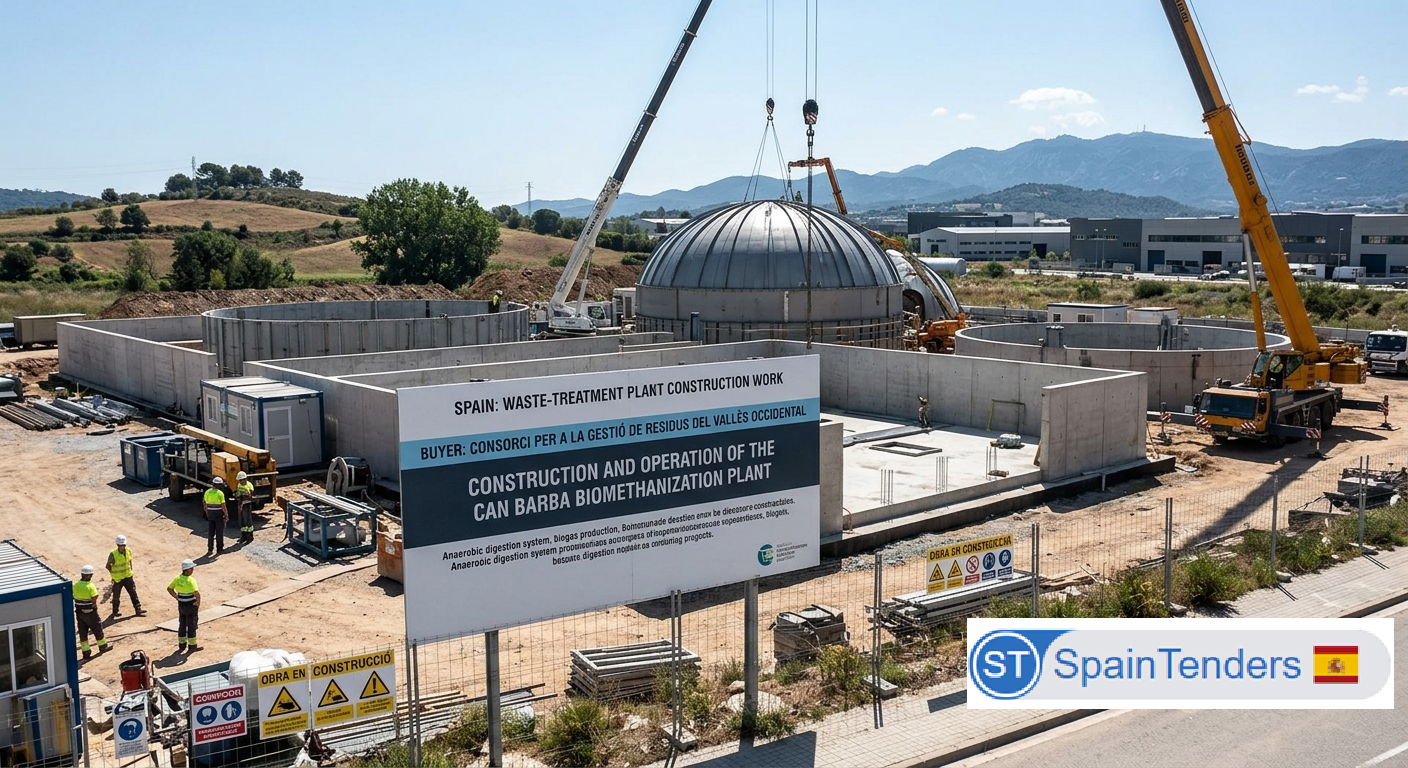
The Consorci per a la Gestió de Residus del Vallès Occidental, the public body responsible for waste management across this part of Catalonia, has just signed a long term concession contract to build exactly that kind of facility. The Can Barba plant in Terrassa will treat organic waste through biomethanization, a process that converts organic material into biogas and compost using controlled biological digestion.
Why This Contract Matters
This is not a simple waste collection contract. It is a works concession, meaning the winning consortium will finance, build and then operate the plant itself for 12 years, recovering its investment through the concession arrangement rather than a single upfront payment. That model shifts significant construction and operating risk onto the private partner.
The contract also sits at the intersection of two policy priorities that matter well beyond Terrassa: EU rules pushing member states away from landfill and incineration of organic waste and the drive to generate renewable biomethane that can substitute for fossil gas. The project has secured EU funding, underlining its relevance to those broader targets.
Contract Timeline
The procurement traces back to a previous notice published under reference 592225 2025. The contract was formally concluded on 31 July 2026 and the notice recording the award was dispatched on 4 August 2026, appearing in the Official Journal of the European Union on 5 August 2026 under OJ S issue 149/2026. The concession itself runs for 12 years from the point operations begin.
Contract Overview
The Consorci per a la Gestió de Residus del Vallès Occidental ran an open procurement procedure, classified under Directive 2014/24/EU, for a combined works and services contract. The main CPV classification is 45222100, Waste treatment plant construction work, supplemented by codes covering non hazardous waste treatment and disposal services and a range of architectural and engineering services needed to design and build the plant.
The estimated value of the concession, excluding VAT, was 119,553,723.88 EUR across its full 12 year term. The winning tender came in at 92,693,946.66 EUR, a difference of roughly 26.9 million euros below the buyer's original estimate.
Four tenders were received in total. None came from micro, small or medium sized enterprises and none came from operators registered outside Spain, whether within or beyond the European Economic Area. All four tenders were submitted electronically.
Key Contract Details
| Contracting Authority | Consorci per a la Gestió de Residus del Vallès Occidental |
| Winning Bidder | UTE PREZERO GESTIÓN DE RESIDUOS S.A. and CONSTRUCTORA DE CALAF S.A.U. |
| Lead Partner | PREZERO GESTIÓN DE RESIDUOS S.A. |
| Contract Title | Works concession for the construction and operation of the Can Barba biomethanization plant in Terrassa |
| CPV Code (Main) | 45222100 Waste treatment plant construction work |
| Procedure Type | Open procedure, not accelerated |
| Legal Basis | Directive 2014/24/EU |
| Estimated Value (excl VAT) | 119,553,723.88 EUR |
| Awarded Tender Value (excl VAT) | 92,693,946.66 EUR |
| Concession Duration | 12 years |
| Place of Performance | Terrassa, Barcelona province (NUTS ES511), Spain |
| EU Funding | Fully or partially financed with EU funds |
| Covered by GPA | No |
| Award Criteria | Quality (subjective assessment) weighted 45 points, Price (automatic scoring) weighted 55 points |
| Tenders Received | 4, all submitted electronically, none from SMEs or foreign operators |
| Subcontracting | No |
| Contract Concluded | 31 July 2026 |
Project Scope
The contract covers the design, construction and 12 year operation of a plant that treats organic waste through biomethanization. This is a controlled biological process in which microorganisms break down organic material in the absence of oxygen, producing biogas, which can be upgraded to biomethane and a residual digestate that can be used as compost or soil improver.
The additional CPV codes attached to the contract, covering architectural, engineering and inspection services, indicate that the winning consortium is responsible not only for construction but for the full design and technical planning of the facility. The buyer has not disclosed the plant's planned treatment capacity, technology supplier or specific output targets in this notice.
About the Contracting Authority
The Consorci per a la Gestió de Residus del Vallès Occidental is a body governed by public law, based in Terrassa in the Barcelona province of Catalonia. Its classified activity is general public services and it is responsible for coordinating waste management across the Vallès Occidental comarca, a grouping of municipalities in the region.
The Consorci both awarded this contract and is named as the organisation responsible for providing further information about the procurement procedure, confirming its role as the operational point of contact for bidders and stakeholders throughout the process.
About the Organisations Involved
PREZERO GESTIÓN DE RESIDUOS S.A., based in Madrid, is classified in the notice as a large economic operator. It is named as the leader of the winning tendering party, meaning it took the primary role in structuring and submitting the joint bid. PreZero is part of an international waste management and recycling group and its selection as lead partner points to the technical and financial scale required to deliver a project of this size.
CONSTRUCTORA DE CALAF S.A.U., based in Calaf in the Barcelona province, is also classified as a large economic operator and is named as the second member of the winning consortium. The notice does not disclose how construction and operational responsibilities are divided between the two partners, only that both are recorded as winners of LOT-0001.
Together, PREZERO GESTIÓN DE RESIDUOS S.A. and CONSTRUCTORA DE CALAF S.A.U. formed what Spanish procurement law calls a UTE, a Unión Temporal de Empresas or temporary business union. This is a joint venture structure commonly used in Spain for large infrastructure projects, allowing companies to pool technical and financial resources for a specific contract without merging their underlying businesses.
Tribunal Català de Contractes del Sector Públic, based in Barcelona, is named as the review organisation for this procurement and as the body providing further information on review procedures. Under Spanish law, unsuccessful bidders can lodge a special procurement appeal with this tribunal within 15 working days of publication or alternatively pursue a contentious administrative appeal before the Contentious Administrative Section of the Court of Instance of Barcelona within two months. Its role is procedural, ensuring bidders have a formal route to challenge the award if they believe the process was flawed.
Procurement Analysis
The Consorci ran this as an open procedure, allowing any qualified operator to submit a tender without a prior shortlisting stage. Four tenders were received, a reasonable level of competition for a capital intensive concession of this size, though the notice shows that none came from SMEs or from operators based outside Spain, suggesting the field was effectively contested among established domestic infrastructure and waste management players.
The award criteria combined quality, assessed through subjective judgment and weighted at 45 points, with price, assessed through automatic scoring and weighted at 55 points. This split gives price a modest edge over technical quality, though the 45 point weighting for quality is still substantial for a works concession, reflecting the technical complexity of designing and operating a biomethanization facility correctly over 12 years.
The gap between the estimated value of 119,553,723.88 EUR and the awarded value of 92,693,946.66 EUR is significant, at close to 27 million euros. The notice does not explain this gap. It may reflect competitive pricing pressure from the four bidders, a conservative original estimate by the buyer or differences in how the winning consortium structured its financing and cost base. Readers should treat the estimated figure as the buyer's original benchmark rather than as a description of what was actually agreed.
Additional Procurement Facts
No framework agreement or dynamic purchasing system applies to this award. This is a standalone concession contract. No subcontracting was declared by the winning consortium, meaning the two joint venture partners are expected to deliver the works and operational services directly.
The project is confirmed as fully or partially financed with EU funds, though the notice does not specify the funding programme or the proportion of EU contribution. It is not covered by the Government Procurement Agreement.
Market and Industry Perspective
Biomethanization plants sit at the centre of Spain's and the EU's circular economy and renewable energy strategies. Regulation increasingly discourages landfilling of organic waste, while separate EU energy policy is pushing member states to expand biomethane production as a domestically produced alternative to imported natural gas.
This contract reflects a broader pattern across Spanish regions, where waste consortia are increasingly turning to concession models rather than direct public investment to build this kind of infrastructure, transferring construction and operating risk to specialist private operators such as PreZero, which has an established footprint in European waste treatment.
Economic Significance
At close to 93 million euros over 12 years, this is a large scale infrastructure investment for a regional waste authority and it represents a meaningful capital commitment for the winning consortium, which will need to recover its investment through concession payments and, potentially, revenue from the sale of biomethane or compost by products.
The involvement of EU funding also signals that this project is viewed as strategically important beyond the local level, contributing to Spain's progress against EU targets for organic waste diversion and renewable gas production.
Future Procurement Opportunities
With a 12 year operating concession now underway, the next major procurement decision point for the Consorci per a la Gestió de Residus del Vallès Occidental will likely arise well beyond the current decade, either at contract renewal or if operational scope needs to expand. In the nearer term, related opportunities may emerge around ancillary services such as transport logistics for organic waste feedstock or maintenance contracts tied to the plant's engineering systems, though none of these are addressed in this notice.
Other Catalan and Spanish waste authorities pursuing similar EU aligned organic waste diversion targets are likely to bring comparable biomethanization concessions to market in the coming years and this award offers a useful benchmark on both pricing and the design of award criteria.
Opportunities for Suppliers
Engineering, construction and waste technology firms should note that the winning consortium combined a large national waste management operator with a regional construction specialist, a pairing that allowed technical waste treatment expertise to be matched with local construction execution capability. That structure may be replicable for firms bidding on similar regional infrastructure concessions elsewhere in Spain.
The complete absence of SME and non domestic bidders in this notice suggests that smaller or international firms wanting to compete for this category of contract may need to partner with an established domestic player, whether through a joint venture structure such as a UTE or through a subcontracting arrangement, to meet the scale and local track record that buyers appear to expect.
What Businesses Should Watch
Firms in the waste management, renewable gas and construction engineering sectors should watch for further biomethanization and organic waste treatment concessions from Catalan and other Spanish regional waste consortia, particularly those tied to EU funded circular economy programmes.
It is also worth monitoring how the price versus quality weighting used here, with price given a modest edge at 55 points against 45 for quality, compares with future tenders in this space, since that balance shapes how technical differentiation is rewarded relative to cost competitiveness.
SpainTenders.com Procurement Intelligence
This award is a clear example of a broader trend in Spanish and EU regional infrastructure procurement, the use of long term works concessions to deliver organic waste treatment capacity without requiring full upfront public capital expenditure. The 12 year term transfers construction and operating risk to the private partner while giving the public authority a defined, contracted outcome.
Its strategic importance lies in the combination of policy drivers behind it. EU organic waste diversion rules and renewable gas targets rarely align with a single procurement in such a direct way, which is likely why this project attracted EU funding and why the buyer chose a substantial 45 point quality weighting rather than a purely price driven award.
Suppliers can learn two things from how this tender played out. First, scale and a proven domestic track record mattered, since no SME or foreign bidder appeared among the four tenders received. Second, the significant gap between the estimated and awarded value suggests genuine price competition took place among the bidders who did participate, even though the field was narrow.
Operators positioning for the next wave of similar contracts should build joint venture relationships that pair specialist waste treatment operators with regional construction firms, mirroring the PREZERO and CONSTRUCTORA DE CALAF structure and should expect technical quality criteria to carry real weight rather than being a formality alongside price.
Supplier Takeaways
- The winning bid combined a large national waste operator with a regional construction firm through a Spanish UTE joint venture structure
- Quality criteria carried a meaningful 45 point weighting against 55 points for price, rewarding technical strength alongside cost
- No SME or non domestic bidder featured among the four tenders received, pointing to a market dominated by established domestic players
- The awarded value came in roughly 26.9 million euros below the buyer's original estimate, indicating real price competition among the four bidders
- EU funding attached to the project signals alignment with organic waste diversion and renewable gas policy that buyers may reference in future similar tenders
Key Takeaways
- The Consorci per a la Gestió de Residus del Vallès Occidental has awarded a 12 year works concession to build and operate the Can Barba biomethanization plant in Terrassa
- The winning bidder is a joint venture, UTE PREZERO GESTIÓN DE RESIDUOS S.A. and CONSTRUCTORA DE CALAF S.A.U., with PreZero as lead partner
- The awarded tender value is 92,693,946.66 EUR, against an estimated value of 119,553,723.88 EUR
- Four tenders were received, all from Spanish operators submitted electronically, with none from SMEs
- The project is fully or partially financed with EU funds and the contract was concluded on 31 July 2026
Conclusion
The Can Barba project shows how regional waste authorities across Spain and the EU are structuring long term concessions to meet organic waste and renewable energy targets without carrying the full weight of construction financing themselves. For the Consorci per a la Gestió de Residus del Vallès Occidental, it secures 12 years of contracted treatment capacity for a defined price.
For PREZERO GESTIÓN DE RESIDUOS S.A. and CONSTRUCTORA DE CALAF S.A.U., it is a substantial multi year commitment that will test their combined ability to deliver a technically demanding plant on budget. For the wider market, it is a signal that scale, domestic experience and the right joint venture partner remain the deciding factors in winning this category of infrastructure work.
Source: Tenders Electronic Daily (TED), Contract Award Notice 542930-2026, Official Journal of the European Union, OJ S issue 149/2026, published on 05/08/2026. Contracting Authority: Consorci per a la Gestió de Residus del Vallès Occidental
Frequently Asked Questions (FAQs)

Fresh and verified Tenders from Spain. Find, search and filter Tenders/Call for bids/RFIs/RFPs/RFQs/Auctions published by the government, public sector undertakings (PSUs) and private entities.
- 1,000+ Tenders
- Verified Tenders Only
- New Tenders Every Day
- Tenders Result Data
- Archive & Historical Tenders Access
- Consultants for RFI/RFP/RFQ
- Tender Notifications & Alerts
- Search, Sort, and Filter Tenders
- Bidding Assistance & Consulting
- Customer Support
- Publish your Tenders
- Export data to Excel
- API for Tender Data
- Tender Documents

Fill out the form below and you will receive a call from us within 24 hours.
Get FREE SAMPLE TENDERS from Spain in your email inbox.
Copyright © 2014-2026 SpainTenders.com. All Rights Reserved.