Spain’s Navy Selects 32 Firms for a EUR 10.14 Billion Military Infrastructure Framework
07 Sep 2026
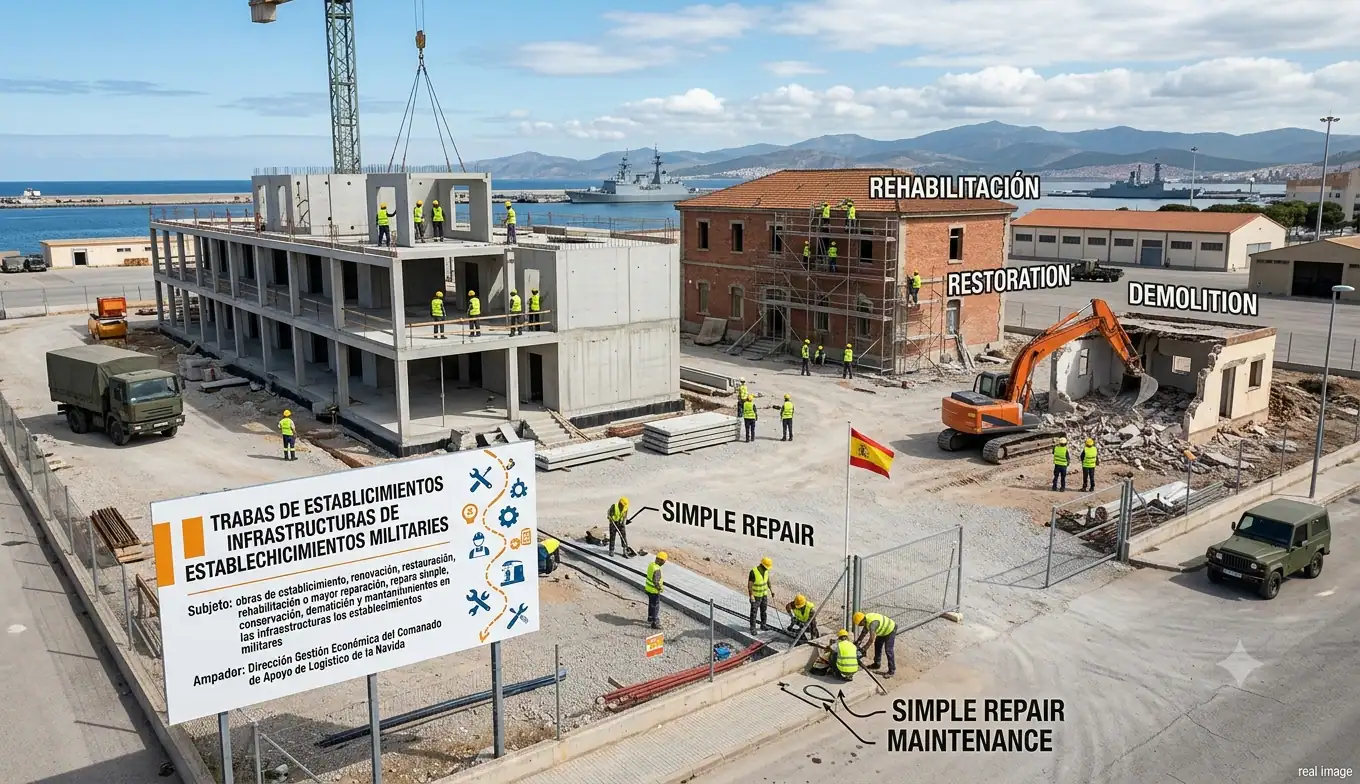
Standfirst Spain’s Navy is expanding its ability to commission construction and maintenance work across military facilities through a large multi supplier framework. Lot 9 covers works within the area of operation of the Arsenal of Cartagena with 32 suppliers identified as winners in the award notice. The framework has a maximum value of EUR 10.1376 billion while the lot was originally estimated at EUR 6.4 million. The procurement gives the Spanish defence establishment a broad supplier base for future works rather than assigning a single contractor to every requirement. Introduction Military infrastructure has a different procurement profile from ordinary public construction. Facilities must remain operational while buildings require renovation maintenance adaptation demolition or major repair over time. The Spanish Navy has responded to this requirement with a framework designed to give its logistics organisation access to a large pool of construction companies for work at military establishments. The procurement concerns the selection of companies capable of executing first establishment works renovation restoration rehabilitation major repairs simple repairs conservation demolition and maintenance. The award notice published by Tenders Electronic Daily identifies Lot 9 as works within the area of operation of the Arsenal of Cartagena. The contracting authority is the Dirección de Gestión Económica de la Jefatura de Apoyo Logístico de la Armada. It is classified as a central government authority with defence as its contracting activity. The procedure was conducted through an open procedure under Directive 2014/24/EU. The result is notable for the number of suppliers appointed. The award section identifies 32 successful tender records for Lot 9. TED also reports 34 tenders or requests to participate received. The notice does not explain the difference between the 34 submissions reported in the statistical information and the 32 winner records presented in the award section. Why This Contract Matters The strategic issue is not simply the construction of one military facility. Spain's defence establishment needs infrastructure that can support military operations over long periods. Buildings and installations require continual intervention as operational requirements change and facilities age. A multi supplier framework provides the Navy with a mechanism to call on qualified construction companies when specific requirements arise. This can be particularly useful when works vary significantly in size or technical nature. Instead of establishing a completely new procurement for every individual requirement the authority can use the framework within its contractual rules. Lot 9 is focused on the Arsenal of Cartagena area. The location gives the award a clear geographic dimension because suppliers participating in the framework may need to respond to requirements connected with military infrastructure in this area. The financial figures also require careful interpretation. The award notice reports a maximum framework value of EUR 10.1376 billion. That is the ceiling reported for the framework agreements in the notice and should not be treated as guaranteed spending or guaranteed revenue for the selected suppliers. Contract Timeline The procurement carries the internal identifier 2025/AR40U/00000009E. The procedure identifier is f6e55cfa-55d8-419c-8ea7-b6a6b16820d7. The TED result notice was dispatched on 3 September 2026 and published in OJ S 172/2026 on 7 September 2026. The winner selection date recorded for the successful tender records is 2 June 2026. The conclusion date recorded for the framework contracts is 13 August 2026. The review information in the notice identifies 17 September 2026 as the stated review deadline. The review organisation is the Dirección de Gestión Económica de la Jefatura de Apoyo Logístico de la Armada - Tribunal Administrativo Central de Recursos Contractuales. Contract Overview Lot 9 is titled “Lote 9: Obras en el ámbito de actuación del Arsenal de Cartagena”. Its purpose is the execution of works within the area of operation of the Arsenal of Cartagena. The contract is classified as works with construction work as its main CPV classification. The additional CPV classifications are 45200000 for complete or partial construction and civil engineering works. 45216200 covers construction work for military buildings and installations. 45400000 covers building completion work. The lot has an estimated value excluding VAT of EUR 6.4 million. At the result level the framework maximum and re estimated value are both reported as EUR 10.1376 billion. This creates a substantial discrepancy between the lot level estimate and the overall result figure and the notice does not provide an explanation for that difference. Key Contract Details CountrySpain Contracting AuthorityDirección de Gestión Económica de la Jefatura de Apoyo Logístico de la Armada Procurement TypeWorks ProcedureOpen procedure Internal Identifier2025/AR40U/00000009E LotLOT 0009 Lot TitleWorks in the area of operation of the Arsenal of Cartagena Main CPV45000000 Construction work Additional CPV45200000 and 45216200 and 45400000 Lot Estimated ValueEUR 6.4 million excluding VAT Maximum Framework ValueEUR 10.1376 billion Re Estimated Framework ValueEUR 10.1376 billion Tenders Reported34 Winner Records32 Award CriterionPrice Award Weight100 points Framework StructurePartly without reopening and partly with reopening of competition Dynamic Purchasing SystemNo EU FundingNo GPA CoverageNo Winner Selection Date2 June 2026 Contract Conclusion Date13 August 2026 Project Scope The procurement is intended to create a supplier base for a wide range of works at military establishments. The stated scope includes first establishment works renovation restoration rehabilitation major repair simple repair conservation demolition and maintenance. For Lot 9 the geographic focus is the Arsenal of Cartagena area. The CPV structure confirms that the framework extends beyond general construction because it specifically includes military buildings and installations together with building completion work. The breadth of the description means that individual assignments could differ considerably. The award notice does not disclose a detailed schedule of future projects or identify the exact facilities that will be subject to each future order. About the Contracting Authority Dirección de Gestión Económica de la Jefatura de Apoyo Logístico de la Armada is the contracting authority identified in the TED notice. It is classified as a central government authority and its contracting activity is defence. The organisation is based in Madrid. The notice identifies it as both the buyer and part of the organisation responsible for review information. About the Organisations Involved The award structure is unusual because Lot 9 does not identify one exclusive winner. Instead the notice records 32 successful tender records under the same lot. Each organisation is associated with Lot 9 and each tender has a value of EUR 0 in the published award data. These zero values should not be interpreted as free work because the procurement is a framework arrangement and the framework value is reported separately. ACO3 PROYECTOS Y OBRAS SL is a selected supplier for Lot 9 under tender reference REF TEN 0001 LOT 0009. ALICANTINA DE INSTALACIONES Y MANTENIMIENTOS SL is a selected supplier for Lot 9 under tender reference REF TEN 0002 LOT 0009. AQUINTA obras sl is a selected supplier for Lot 9 under tender reference REF TEN 0003 LOT 0009. ASCH INFRAESTRUCTURAS Y SERVICIOS, S.A. is a selected supplier for Lot 9 under tender reference REF TEN 0004 LOT 0009. COMPAÑÍA DE EFICIENCIA Y SERVICIOS INTEGRALES, S.L. is a selected supplier for Lot 9 under tender reference REF TEN 0005 LOT 0009. CONSTRUCCIONES FRANCISCO ROCA SÁNCHEZ S.L. is a selected supplier for Lot 9 under tender reference REF TEN 0006 LOT 0009. CONSTRUCCIONES Y MANTENIMIENTOS JANA, S.L. is a selected supplier for Lot 9 under tender reference REF TEN 0007 LOT 0009. EIFFAGE ENERGIA is a selected supplier for Lot 9 under tender reference REF TEN 0008 LOT 0009. ELECNOR SERVICIOS Y PROYECTOS, S.A.U. is a selected supplier for Lot 9 under tender reference REF TEN 0009 LOT 0009. ELECTRICIDAD BOLEA S.L. is a selected supplier for Lot 9 under tender reference REF TEN 0010 LOT 0009. ELECTRORAYMA S.L is a selected supplier for Lot 9 under tender reference REF TEN 0011 LOT 0009. ESQUEIRO, S.L. is a selected supplier for Lot 9 under tender reference REF TEN 0012 LOT 0009. ETOSA OBRAS Y SERVICIOS BUILDING, S.L.U. is a selected supplier for Lot 9 under tender reference REF TEN 0013 LOT 0009. Ecolog Spain LSU is a selected supplier for Lot 9 under tender reference REF TEN 0014 LOT 0009. FRIZONIA REFRIGERACIÓN CLIMATIZACIÓN, S.L. is a selected supplier for Lot 9 under tender reference REF TEN 0015 LOT 0009. Fontanería Vista Alegre S.L.U is a selected supplier for Lot 9 under tender reference REF TEN 0016 LOT 0009. GRUEXMA S.L. is a selected supplier for Lot 9 under tender reference REF TEN 0017 LOT 0009. GRUPO DESARROYA PROYECTOS Y SISTEMAS, SLNE is a selected supplier for Lot 9 under tender reference REF TEN 0018 LOT 0009. GRUPO RENDER INDUSTRIAL SL is a selected supplier for Lot 9 under tender reference REF TEN 0019 LOT 0009. INNOVACIÓN GLOBAL DE SEGURIDAD,S.A. is a selected supplier for Lot 9 under tender reference REF TEN 0020 LOT 0009. INSTALACIONES ELECTRICAS ROCA Y CAPARROS SL is a selected supplier for Lot 9 under tender reference REF TEN 0021 LOT 0009. INVERCA ELECTRICIDAD,S.L.U. is a selected supplier for Lot 9 under tender reference REF TEN 0022 LOT 0009. INVERTEILAN, S.L. is a selected supplier for Lot 9 under tender reference REF TEN 0023 LOT 0009. JUMABEDA, S.L. is a selected supplier for Lot 9 under tender reference REF TEN 0024 LOT 0009. NERCO INFRAESTRUCTURAS SL is a selected supplier for Lot 9 under tender reference REF TEN 0025 LOT 0009. PROYECON GALICIA,S.A. is a selected supplier for Lot 9 under tender reference REF TEN 0026 LOT 0009. REFRIGERACIÓN GUILLÉN, SL is a selected supplier for Lot 9 under tender reference REF TEN 0027 LOT 0009. TALNAMADI, S.L. is a selected supplier for Lot 9 under tender reference REF TEN 0028 LOT 0009. TECNIA INGENIEROS is a selected supplier for Lot 9 under tender reference REF TEN 0029 LOT 0009. UTE PADECASA OBRAS Y SERVICIOS, S.A.-CYCASA CANTERAS Y CONSTRUCCIONES, S.A. is a selected supplier grouping for Lot 9 under tender reference REF TEN 0030 LOT 0009. The notice does not disclose how responsibilities are divided between the two named members. VEOLIA SERVICIOS LECAM, S.A.U. is a selected supplier for Lot 9 under tender reference REF TEN 0031 LOT 0009. ZIMA DESARROLLOS INTEGRALES, S.L. is a selected supplier for Lot 9 under tender reference REF TEN 0032 LOT 0009. The notice does not provide detailed operational responsibilities for the individual suppliers. It therefore would not be appropriate to assign particular construction disciplines to specific companies solely from their names. The only clearly established role for the 32 organisations is their selection as winners for Lot 9. Procurement Analysis The procurement used an open procedure with Directive 2014/24/EU as its legal basis. This route permits broad supplier participation and is suitable for a requirement where the authority wants to establish competition around a defined framework rather than appointing a contractor through a restricted market process. The award criterion is price with a weighting of 100 points. The description identifies “Descuento Sobre el Beneficio Industrial” as the price criterion. This means the financial proposition was decisive in the published evaluation structure. The framework is described as partly without reopening and partly with reopening of competition. This is important because future orders can operate under more than one mechanism depending on the applicable framework conditions. The award notice does not provide enough detail to determine which future requirements will use each mechanism. The selection of 32 suppliers changes the competitive dynamics. The framework is not equivalent to a single supplier award. Multiple companies receive a contractual position from which future work may be ordered subject to the applicable rules. Additional Procurement Facts The procurement was not financed with EU funds and the notice states that it is not covered by the Government Procurement Agreement. No dynamic purchasing system was used. The place of performance at the general procedure level is Spain with Madrid identified as the NUTS region in the notice. The award data records 34 tenders or requests to participate received. The result section separately identifies 32 winner records. Since the notice does not explain the difference the discrepancy should remain visible in procurement analysis rather than being silently resolved. Market & Industry Perspective The framework creates an unusually broad supplier ecosystem around military construction. The successful supplier list includes construction companies together with firms whose names indicate electrical refrigeration engineering security maintenance and other infrastructure related capabilities. However the notice itself does not assign specific work packages to these organisations. The presence of a large number of selected suppliers suggests that the Navy values access to capacity across a dispersed construction market. Military facilities can generate requirements that vary in technical discipline scale urgency and location. A broad framework can therefore reduce dependence on a single contractor. The participation of companies from different parts of Spain also gives the arrangement a national market dimension. The winning organisations include businesses associated with Madrid Alicante Murcia Galicia the Canary Islands and other Spanish regions. For the construction industry the important commercial point is that framework participation can provide access to future public sector opportunities even when no immediate project value is attached to an individual tender record. Suppliers must therefore evaluate the long term value of framework access rather than looking only at the tender value shown in the award record. Economic Significance The reported EUR 10.1376 billion maximum framework value is substantial but it should be treated as a procurement ceiling rather than confirmed expenditure. The lot level estimated value of EUR 6.4 million is materially lower which creates an important interpretive issue for businesses analysing the opportunity. Military infrastructure expenditure can support demand across construction supply chains. Future assignments may require labour equipment building materials engineering services and specialist installation capacity. The notice does not quantify these wider economic effects. Future Procurement Opportunities The most direct opportunities will come from future works ordered within Lot 9. Because the framework covers construction repair maintenance conservation demolition and rehabilitation the potential requirements are broader than one defined project. The framework's mixed structure is also important. Some future requirements may proceed without reopening competition while others may involve renewed competition among framework participants. Suppliers should therefore understand the ordering rules and monitor how the authority activates the different mechanisms. The Arsenal of Cartagena focus provides a geographic signal for companies operating in southeastern Spain. Contractors outside the immediate area may also have an opportunity if the framework permits them to compete for relevant requirements under the published conditions. Future procurement cycles should be monitored across other military establishments as well. The wider procurement objective concerns infrastructure at military establishments and similar requirements can create recurring demand across the Spanish defence estate. Opportunities for Suppliers The award creates a route into future military construction requirements for 32 selected suppliers. Companies seeking similar opportunities should study the framework model and understand how price based evaluation interacts with future call offs. The 100 point price criterion also makes cost discipline important. Suppliers competing for comparable defence infrastructure frameworks need to understand their delivery costs equipment utilisation workforce requirements and geographic response capability before submitting competitive commercial terms. What Businesses Should Watch Businesses should monitor the actual use of the framework rather than treating the EUR 10.1376 billion ceiling as contracted revenue. The volume of future orders will provide a much better indicator of the commercial value available to the selected companies. Companies should also track which framework mechanism is used for individual requirements. The distinction between orders placed without reopening and those subject to renewed competition can materially affect the competitive position of framework suppliers. The future procurement pipeline around Spanish military infrastructure is another important indicator. New construction rehabilitation major repair maintenance and demolition requirements can emerge from changing defence needs and the condition of existing facilities. Suppliers should also watch whether future competitions continue to rely entirely on price or introduce quality environmental security technical capability or other evaluation dimensions. A change in award methodology could alter the competitive landscape significantly. SpainTenders.com Procurement Intelligence This award represents a broader procurement trend in which defence authorities are building flexible supplier networks around infrastructure requirements rather than relying exclusively on individual project tenders. The approach gives the Navy a pool of selected contractors that can potentially support different categories of work within a common procurement structure. The strategic importance is particularly clear when viewed against the breadth of the scope. Military establishments require ongoing investment even when no single project is large enough to justify a standalone procurement. A framework can turn these fragmented requirements into a managed procurement channel. For suppliers the lesson is that winning a framework is different from winning a conventional construction project. The published tender value of EUR 0 for the individual winner records demonstrates why businesses must examine the procurement structure before estimating revenue. The commercial opportunity comes from potential future orders under the framework and not from the zero value recorded against each tender. The selection of 32 suppliers also means competition does not end with framework appointment. Companies may still compete for requirements when the framework rules require reopening of competition. Their ability to deliver at competitive prices while maintaining capacity can become important after appointment. The 100 point price criterion provides another strong signal. Suppliers should approach similar competitions with detailed cost modelling because a price based evaluation leaves limited scope for non price strengths to compensate for an uncompetitive commercial offer. The future market could become more specialised as defence infrastructure requirements evolve. Military establishments may require increasingly complex combinations of civil works building systems electrical infrastructure energy efficiency maintenance and security related installations. The current notice does not predict such requirements but its broad CPV coverage shows that military construction procurement can encompass several infrastructure disciplines. From a procurement intelligence perspective the most important development to monitor is actual framework utilisation. The difference between the lot estimate and the reported framework maximum makes call off data particularly valuable. Tracking future awards under the same framework can reveal which suppliers are receiving work and whether the framework is being used primarily for routine maintenance or larger construction requirements. Supplier Takeaways Lot 9 concerns works within the area of operation of the Arsenal of Cartagena. 32 supplier records are identified as winners for Lot 9. The framework maximum reported in the result section is EUR 10.1376 billion. The lot level estimated value is EUR 6.4 million excluding VAT. The framework ceiling is not guaranteed supplier revenue. TED reports 34 tenders or requests to participate received. The award section identifies 32 winner records. The notice does not explain the difference between these figures. Price carries 100 points in the award criteria. The framework is partly without reopening and partly with reopening of competition. Suppliers should monitor future orders under Lot 9. Companies should prepare detailed cost models for similar defence competitions. Key Takeaways Spain's Navy has established a large multi supplier framework for military infrastructure works. The contracting authority is the Dirección de Gestión Económica de la Jefatura de Apoyo Logístico de la Armada. Lot 9 covers the Arsenal of Cartagena area. The procurement is for works. The main CPV is 45000000 for construction work. Additional CPV codes include 45200000 and 45216200 and 45400000. The lot estimated value is EUR 6.4 million excluding VAT. The reported maximum framework value is EUR 10.1376 billion. 32 successful tender records are identified. 34 tenders or requests to participate are reported in the statistical section. The procurement uses an open procedure. Directive 2014/24/EU is cited as the legal basis. Price is the sole stated award criterion with 100 points. The framework can operate with and without reopening of competition. No dynamic purchasing system was used. The procurement was not financed with EU funds. The procurement is not covered by the GPA. The contract was concluded on 13 August 2026. Conclusion Spain's award for Lot 9 shows how defence infrastructure procurement can move from individual projects toward a multi supplier framework capable of supporting recurring requirements. The Arsenal of Cartagena will be served through a pool of 32 selected suppliers while the published framework value must be interpreted carefully because it represents a maximum rather than guaranteed expenditure. For businesses the procurement highlights the importance of framework strategy cost competitiveness and continuous monitoring of defence infrastructure demand. Future call offs will determine the real commercial impact of the award. Source: Tenders Electronic Daily TED Contract Award Notice 614021-2026 Official Journal of the European Union OJ S 172/2026 published on 07/09/2026.
View Details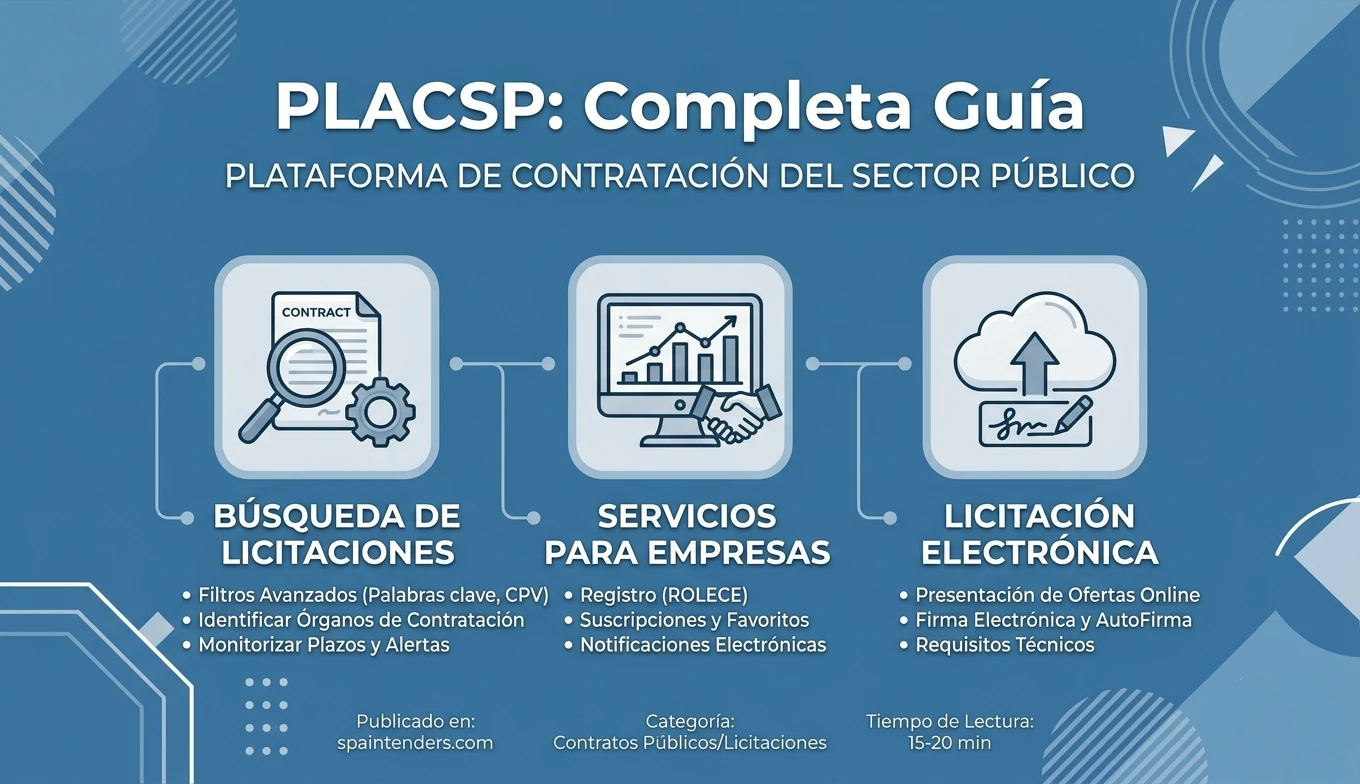
Plataforma de Contratación del Sector Público (PLACSP): Complete Guide
04 Sep 2026
Published on: spaintenders.com | Category: Contratación Pública / Licitaciones España | Reading Time: 15-20 min; Introduction For contractors, suppliers and consultants looking for public procurement opportunities in Spain, the Plataforma de Contratación del Sector Público (PLACSP) is one of the most important platforms to understand. It brings together procurement information and provides search and electronic procurement services for businesses and public organisations. Understanding how PLACSP works is important because finding a Spanish tender is only the beginning. A bidder needs to identify the right procurement opportunity, understand the contracting authority, check the CPV classification, review the tender documents, confirm the deadline and follow the required electronic submission process. This complete guide explains what PLACSP is, how to search tenders, how to use filters, how CPV codes can improve search results, how to identify contracting authorities, how to monitor deadlines and alerts, and what businesses should know before submitting an offer. Tabla de Contenidos / Table of Contents What Is the Plataforma de Contratación del Sector Público? Why PLACSP Is Important for Spanish Tenders Who Uses PLACSP? How to Search for Tenders on PLACSP How to Use Keywords in PLACSP Search Using CPV Codes on PLACSP How to Search PLACSP by Contracting Authority How to Search PLACSP by Location How to Identify the Contracting Profile How to Check Tender Status on PLACSP How to Check the Tender Deadline What Documents Can Be Found Through PLACSP? Does PLACSP Provide Alerts for New Tenders? How Company Registration Works on PLACSP Electronic Tender Submission Through PLACSP PLACSP and Electronic Procurement Can PLACSP Be Used to Research Previous Tenders? PLACSP Open Data and Procurement Intelligence PLACSP Search: Keyword vs CPV vs Authority Common PLACSP Search Mistakes How Contractors Can Build a PLACSP Tender Search Strategy How Suppliers Can Use PLACSP for Market Research PLACSP for SMEs and International Companies PLACSP vs Spain Tender Search Platforms How SpainTenders Can Complement PLACSP Research PLACSP Tender Search Checklist Final Thoughts on the Plataforma de Contratación del Sector Público Related Resources What Is the Plataforma de Contratación del Sector Público? The Plataforma de Contratación del Sector Público, commonly known as PLACSP, is Spain's central public procurement platform. It provides access to procurement information published through contracting profiles hosted on the platform and also incorporates information through aggregation mechanisms from autonomous communities with their own procurement platforms. For businesses, this makes PLACSP an important starting point when searching for Spain government tenders, Spanish public procurement and licitaciones públicas España. PLACSP is not simply a page containing tender titles. Its ecosystem includes tender search, contracting profiles, company services, public-organisation information, notifications and electronic procurement functionality. The platform also provides open procurement data that can be processed automatically. This distinction matters for professional bidders because procurement research often requires more than finding a matching keyword. A supplier must understand the complete procurement record and determine whether the opportunity is commercially and technically suitable. Why PLACSP Is Important for Spanish Tenders Public procurement in Spain involves different levels of government and many types of public-sector organisations. National authorities, regional administrations, municipalities and other contracting entities can publish procurement opportunities through different procurement environments. PLACSP is important because it acts as a major national reference point and also connects with procurement information from autonomous communities through aggregation mechanisms. For a contractor searching only through general search engines, relevant opportunities can be difficult to identify because procurement information may use Spanish administrative terminology, CPV classifications, formal contract descriptions and different names for similar business activities. A structured PLACSP search allows businesses to move beyond a simple keyword search and examine procurement opportunities using different characteristics of the contract. Who Uses PLACSP? PLACSP serves both sides of the public procurement process. Public-sector organisations use the platform in connection with their contracting activity, while businesses can use the services provided for companies to research and participate in procurement opportunities. The business side is particularly relevant to: Construction contractors Manufacturers and suppliers IT and technology companies Engineering companies Consulting firms Healthcare suppliers Facility management companies Cleaning and maintenance companies Transport and logistics providers Professional service providers International companies targeting Spanish public contracts The platform therefore has relevance across a wide range of industries rather than being limited to a particular procurement sector. How to Search for Tenders on PLACSP The PLACSP search environment provides a dedicated Search for tenders function. The platform separates different search areas according to the type of procurement information being researched, including tenders, minor contracts, in-house assignments and preliminary market inquiries. It also provides a document-search function. For a supplier, the basic process should begin with identifying the type of opportunity being sought and then applying the available search criteria. A professional tender search should answer five questions: What is being purchased? Who is buying it? Where will the contract be performed? What is the procurement status? When is the submission deadline? Searching only by the tender title is not sufficient. Procurement titles can be abbreviated, translated differently or written using technical and administrative terminology that does not exactly match a company's commercial language. How to Use Keywords in PLACSP Search Keywords remain useful when searching for Spanish government tenders, but they should be selected carefully. Suppose a company provides cybersecurity services. Searching only for "cybersecurity" may not identify every relevant procurement because the contracting authority may describe the requirement using terms related to information security, IT security, digital protection or another technical description. The same issue applies to construction, engineering, healthcare, cleaning, transport and professional services. For this reason, businesses should create a keyword set that contains: Primary product or service terms Spanish-language equivalents Technical terminology Industry terminology Common procurement descriptions Specific product names where relevant Service variations Abbreviations and recognised terminology Keyword searching becomes more powerful when it is combined with CPV codes and geographical or authority-based criteria. Using CPV Codes on PLACSP CPV stands for Common Procurement Vocabulary. CPV codes provide a standard classification system for the subject of public procurement contracts. For businesses, CPV can be useful because a contracting authority may use terminology that differs from the words a supplier uses commercially. A CPV-based search provides another way to identify potentially relevant procurement opportunities. A supplier should therefore identify the CPV codes associated with its main products and services and test those codes against actual Spanish tender records. For example, an engineering business should not automatically assume that one CPV code covers every service it provides. Different engineering activities can fall under different classifications. The best approach is to combine CPV + keywords + location + procurement status rather than depending on CPV alone. How to Search PLACSP by Contracting Authority The contracting authority is the public organisation responsible for the procurement procedure. Understanding the buyer is important because businesses can use contracting-authority research to identify recurring procurement demand. A supplier may discover that certain public organisations repeatedly purchase the same type of product or service. Once these buyers have been identified, monitoring their procurement activity can become part of a long-term business-development strategy. Authority-based research can also provide valuable context. A company can review previous procurement activity and compare contract subjects, values, procedures and suppliers involved in earlier contracts. This turns tender searching from a one-time activity into a structured procurement-market research process. How to Search PLACSP by Location Location is another important search dimension for Spanish tenders. A contractor may only operate in certain regions or cities because of workforce, transport, licensing, project-management or operational requirements. In such cases, a nationwide search can produce a large number of irrelevant results. Location-focused research can include autonomous communities, provinces, municipalities and places of contract performance, depending on the information available for the procurement procedure. Businesses can create separate search strategies for markets such as Madrid, Andalucía, Cataluña, Galicia, País Vasco, Aragón or Navarra and then further narrow the results by industry and CPV. How to Identify the Contracting Profile The Perfil del Contratante, or contracting profile, is an important part of Spanish public procurement research. It provides procurement-related information associated with a contracting authority. When researching a tender, identifying the contracting profile can help the bidder understand who is conducting the procurement and locate related information published by that authority. This is particularly useful when a company wants to move from individual tender discovery toward buyer intelligence. Instead of asking only "Is there a tender for my service?", a supplier can also ask "Which public authorities are buying my service, how frequently are they buying it and what procurement patterns can I identify?" How to Check Tender Status on PLACSP Procurement status is critical because a tender that appears relevant may no longer be available for bidding. When reviewing an opportunity, check whether the procurement is open for submission, has passed its submission stage, is under evaluation, has been awarded or has reached another stage of the procurement lifecycle. Status information should always be checked together with the official procurement record and documents. Businesses should also pay attention to updates, amendments and communications issued during the procurement process. A tender can change after its initial publication, so relying on an old copy of information can create unnecessary bidding risk. How to Check the Tender Deadline The submission deadline is one of the first details a bidder should verify after identifying a relevant tender. Before investing significant time in preparing a bid, confirm the exact closing date and time specified by the procurement procedure. The bidder should also understand the electronic submission method and any technical requirements that could affect the ability to submit the offer on time. A good internal process should record at least: Tender reference Contracting authority Contract title Submission deadline CPV code Contract value Contract duration Procurement procedure Required documents Electronic submission method This information can then be used by the bid team to decide whether the opportunity should proceed to detailed qualification. What Documents Can Be Found Through PLACSP? Procurement documentation is one of the most important parts of a tender record. The documents explain the conditions under which the public authority is purchasing the required works, supplies or services. Depending on the procedure, businesses may encounter administrative documents, technical specifications, tender forms, declarations, annexes, pricing documents, evaluation information and other procurement-related files. Two Spanish procurement terms that bidders frequently encounter are PCAP and PPT. PCAP generally refers to the Pliego de Cláusulas Administrativas Particulares and contains administrative and contractual conditions. PPT refers to the Pliego de Prescripciones Técnicas and generally establishes technical requirements and specifications. The exact documentation depends on the tender. Therefore, suppliers should review the complete set of documents rather than relying on the tender title or summary. Does PLACSP Provide Alerts for New Tenders? Yes. PLACSP provides services for companies that allow registered users to receive subscriptions relating to tenders of interest. The platform states that businesses can receive daily subscriptions about relevant tenders published on public-sector portals or in the Official Journal of the European Union, as well as notices about developments relating to favourite tenders. This is important for businesses that want to move from manual tender searching to continuous monitoring. A company can define its areas of interest and use notifications to reduce the risk of discovering an opportunity too late. However, alerts should be treated as a discovery and monitoring mechanism, not as a substitute for reviewing the official tender record and documents. How Company Registration Works on PLACSP PLACSP provides registration services for companies. The official platform states that companies can register free of charge to access services designed to facilitate contracting with public-sector organisations. The company area includes functions related to subscriptions, favourite tenders and electronic notifications. Registration therefore becomes useful for businesses that expect to participate in Spanish public procurement on a continuing basis. Businesses should ensure that their account information, email access and electronic credentials are properly maintained because procurement activity increasingly depends on electronic communication. Electronic Tender Submission Through PLACSP Finding a tender and submitting a bid are two different activities. Where a procurement procedure requires or provides electronic submission through the relevant platform, the bidder must follow the instructions specified by the contracting authority and procurement documentation. Electronic bidding can involve authentication, document preparation, electronic signatures, technical validation and final submission. The precise process can vary according to the procurement procedure and platform environment. For this reason, companies should not wait until the final minutes before the deadline to upload their offer. Technical problems, large files, electronic-signature issues or incomplete documentation can create avoidable risks. A professional bid team should complete the submission process early enough to resolve technical or administrative problems before the official deadline. PLACSP and Electronic Procurement Electronic procurement has changed how companies participate in Spanish government contracts. Instead of relying on physical document delivery, procurement procedures increasingly use digital platforms for access, communication and submission. For bidders, this means procurement readiness must include more than technical and financial capability. Companies also need to understand the digital requirements associated with bidding. Electronic procurement readiness can include: Access to the required electronic credentials Ability to electronically sign documents where required Correct document formats Prepared technical and administrative files Knowledge of the relevant submission platform Internal deadline controls Testing of the submission process where appropriate Can PLACSP Be Used to Research Previous Tenders? Yes. Procurement platforms are valuable not only for finding live opportunities but also for researching procurement history. Previous tenders can help businesses understand how a public authority has described its requirements, which CPV classifications have been used, the type of procurement procedure selected and the suppliers that have participated or received awards where the information is available. This historical information can support business-development and bidding decisions. For example, before bidding for a new service contract, a company can research earlier procurement activity for the same category and authority. This can help the business understand the buyer's procurement pattern and identify changes in requirements over time. PLACSP Open Data and Procurement Intelligence One of the less obvious features of PLACSP is its open-data environment. The platform distributes open datasets relating to contracting authorities and tenders whose contracting profiles are hosted on PLACSP, as well as information received through aggregation mechanisms from autonomous communities with their own platforms. The datasets are provided in open and machine-processable formats. PLACSP also provides OpenPLACSP, a tool designed to help users work with the open procurement datasets. This is significant for procurement analysts because tender information can be studied beyond individual procurement notices. Structured procurement data can support analysis of contracting authorities, sectors, procurement volumes, classifications and historical activity. For companies, this creates the possibility of moving from basic tender discovery toward procurement intelligence. PLACSP Search: Keyword vs CPV vs Authority Search Method Best Use Keyword Finding opportunities based on product, service or technical terminology CPV Finding opportunities through standard procurement classifications Contracting Authority Monitoring procurement activity from known public buyers Location Focusing on specific regions, provinces, cities or places of performance Status Identifying opportunities according to their procurement stage Combined Search Reducing irrelevant results by combining several procurement criteria The strongest approach is generally a combination of these search dimensions. Each method solves a different discovery problem. Common PLACSP Search Mistakes Searching with only one keyword A single keyword can be too narrow or too broad. Companies should build keyword variations in both English and Spanish where relevant. Ignoring CPV codes CPV provides an additional classification layer and can help identify opportunities that use different wording from a supplier's normal commercial terminology. Ignoring geographical targeting A company that cannot realistically operate nationwide should not treat every Spanish tender as an equally valuable opportunity. Not checking the contracting authority The buyer can provide important context about the procurement and potential future opportunities. Looking only at the tender title The tender title is not a substitute for the complete procurement documentation. Checking the deadline too late Bid preparation takes time. A relevant opportunity discovered shortly before closing may already be commercially impractical. Relying only on alerts Alerts can support discovery, but businesses should still review the procurement record and official documents. How Contractors Can Build a PLACSP Tender Search Strategy A contractor should begin by defining its ideal procurement opportunity rather than searching randomly. First, list the products, services or works the company can deliver. Second, identify the Spanish terminology used for those offerings. Third, identify relevant CPV codes. Fourth, define the regions and cities the business can serve. Finally, identify public authorities that are commercially important. This creates a structured search profile. For example: Service → Spanish keywords → CPV codes → Target regions → Target authorities → Tender status → Deadline The resulting searches can be saved and monitored regularly. This approach is much more scalable than manually browsing unrelated tender notices every day. How Suppliers Can Use PLACSP for Market Research PLACSP can also be used to understand the public procurement market before a company decides to bid. A supplier can investigate which public authorities buy its products, how often similar contracts are published, which regions generate the most relevant procurement activity and what contract structures are commonly used. Historical tender and award information can provide additional context about competition and purchasing behaviour. This research can help answer questions such as: Which Spanish public authorities buy this type of service? Which regions have recurring demand? What CPV codes are associated with the category? What contract sizes are common? Which procurement procedures appear frequently? Are opportunities divided into lots? Are there recurring or replacement contracts? When might the next procurement opportunity appear? These questions move tender research beyond individual opportunities and toward procurement-market intelligence. PLACSP for SMEs and International Companies Small and medium-sized businesses can use PLACSP to identify public-sector opportunities that match their operational capabilities. Instead of attempting to compete for every large government contract, an SME can focus on specific contract categories, geographical areas and public buyers. International companies can also use PLACSP as part of their Spain market-entry research. Before attempting to participate in a Spanish public procurement procedure, an international supplier can study the market, identify relevant authorities, understand terminology and research previous procurement activity. International bidders should separately verify the eligibility, qualification, documentation and electronic-submission requirements applicable to each procurement procedure. PLACSP vs Spain Tender Search Platforms PLACSP is an official public procurement platform. A tender search or intelligence platform serves a different purpose: helping businesses discover, organise and monitor opportunities according to their commercial requirements. This distinction is important. The official platform remains the reference point for the procurement information and documents published by the relevant authority. A specialised tender platform can make the discovery process more efficient by helping businesses search across procurement information using business-oriented criteria. For a contractor, the practical workflow can therefore be: Discover the opportunity → Analyse relevance → Open the official procurement record → Review documents → Confirm requirements → Prepare the bid → Submit through the required official channel. How SpainTenders.com Can Complement PLACSP Research For businesses whose objective is to continuously identify relevant opportunities, SpainTenders can complement official-source research by providing a dedicated environment for discovering Spain tenders and procurement opportunities. The main challenge for contractors is often not whether procurement information exists. The challenge is finding the opportunities that match their exact products, services, geography and commercial objectives. A structured tender-discovery platform can help businesses organise this research around their actual procurement interests instead of repeatedly starting with broad searches. SpainTenders.com should therefore be considered part of a wider workflow rather than a replacement for the official procurement source. The official procurement record remains important for validating the tender details, documents, deadlines and submission instructions. PLACSP Tender Search Checklist Before considering a PLACSP opportunity as a serious bid prospect, a contractor should review the following: Contract title and reference Contracting authority Contracting profile Contract object CPV code Contract type Procedure Estimated and/or contract value Contract duration Location Lots Eligibility requirements Technical requirements Financial and economic requirements Evaluation criteria PCAP PPT Required declarations and forms Submission platform Submission deadline Published amendments and clarifications This checklist can reduce the risk of spending bid-preparation resources on an opportunity that does not actually match the company's capabilities. Final Thoughts on the Plataforma de Contratación del Sector Público The Plataforma de Contratación del Sector Público is a central part of Spain's public procurement environment and an important resource for companies searching for government contracts and public tenders. Its value goes beyond the simple publication of tender notices. Businesses can use PLACSP to search procurement opportunities, examine contracting profiles, access company services, monitor relevant tenders and work with available procurement data. The most effective users do not rely on a single search phrase. They combine keywords, CPV codes, contracting authorities, geographical targeting, procurement status and deadline management to build a repeatable tender-search process. For contractors and suppliers, the real advantage comes from turning this information into a systematic workflow. The objective is not simply to find more tenders. It is to find the right Spanish tenders early enough to evaluate, qualify and bid on them properly. For businesses entering or expanding in the Spanish public procurement market, understanding PLACSP is therefore an essential step toward building a sustainable tender strategy. Related Resources Spain Public Procurement: Complete Beginner's Guide Spain Tenders: Where to Find Government and Public Procurement Opportunities How to Register and Submit a Tender in Spain Spain Public Procurement Law: Ley 9/2017 Explained Spain Tender Procedures: Types, Rules and Bid Strategies ROLECE Registration Guide for Spanish Public Procurement Electronic Signature and AutoFirma for Spain Tenders Official source: Plataforma de Contratación del Sector Público, Gobierno de España.
View Details
Seven Automotive Suppliers Secure Positions in 470 Million Euro Spanish Government Vehicle Framework Agreement
04 Sep 2026
Standfirst A group of seven automotive suppliers has been appointed to a major framework agreement for the supply of double cab pick up vehicles to the Spanish central government. The contract, managed by the Directorate General for Rationalisation and Centralisation of Procurement, carries a maximum estimated value of 470.4 million euros for this specific lot. The award follows an open procedure that prioritized strict compliance with minimum quality and environmental requirements. This procurement highlights the Spanish public sector ongoing commitment to fleet modernization and the reduction of environmental impacts in state operations. Introduction The modernization of public sector vehicle fleets represents a critical operational and environmental priority for national governments across Europe. In Spain, the central government has initiated a large scale procurement strategy to supply passenger and light commercial vehicles to various administrative bodies. This specific tender result focuses on the acquisition of double cab pick up vehicles, which are essential for field operations, maintenance, and specialized public services. By utilizing a centralized purchasing model, the contracting authority leverages the collective buying power of the state to secure favorable terms and standardized vehicle specifications. The framework agreement structure allows for both direct awards and reopened competition, providing flexibility to meet the diverse and evolving needs of different government departments. This approach ensures that public funds are deployed efficiently while maintaining strict adherence to national and European procurement regulations. Why This Contract Matters This framework agreement is vital for ensuring that Spanish public services have reliable and compliant transportation resources. The inclusion of environmental criteria aligns the procurement with the European Clean Vehicles Directive, pushing the market toward lower emission alternatives. For the automotive industry, securing a position on this official Tenders Portal list guarantees access to a massive and stable customer base. The high maximum value indicates significant future revenue potential, although actual spending will depend on the specific call off orders issued by individual government entities. Contract Timeline The procurement process culminated in the selection of the successful suppliers on June 30, 2026. Following the mandatory standstill period, the formal contract agreements were concluded on August 27, 2026. The official contract awards notice was published in the Official Journal of the European Union on September 4, 2026, ensuring full transparency for all market participants and providing a clear record of the tender result. Contract Overview The procurement is structured as a framework agreement for the supply of motor vehicles, specifically targeting double cab pick up models under Lot 5. The maximum estimated value for this lot is set at 470.4 million euros, excluding VAT. The agreement permits both direct awards without reopening competition and awards following a reopened competition, depending on the specific needs of the contracting entities. This dual mechanism balances speed of procurement with the opportunity to refine technical and commercial terms for specific orders. Key Contract Details Contract Title Acuerdo marco para el suministro de vehículos turismos (AM 14/2025) Contracting Authority Dirección General de Racionalización y Centralización de la Contratación Junta de Contratación Centralizada Maximum Framework Value (Lot 5) 470,400,000.00 EUR (excluding VAT) Procedure Type Open Procedure Number of Bids Received 7 Winners AUTOMAX ESPAÑA SL, B and M Automóviles España S.A., FORD ESPAÑA S.L., KGM AUTO SPAIN S.A., SANTANA MOTORS S.L., TECHNOLOGY AND SECURITY DEVELOPMENTS SL, TOYOTA ESPAÑA S.L.U. Contract Conclusion Date August 27, 2026 Main CPV Code 34130000 (Motor vehicles for the transport of goods) Project Scope The scope of this contract covers the supply of double cab pick up vehicles, classified under the N1 vehicle category. The procurement explicitly incorporates strategic environmental goals, including pollution prevention and climate change mitigation. Suppliers are required to meet strict minimum quality requirements, which formed the sole award criterion with a 100 percent weight. The contract also mandates compliance with the Clean Vehicles Directive, ensuring that a portion of the supplied fleet contributes to the reduction of greenhouse gas emissions. About the Contracting Authority The Directorate General for Rationalisation and Centralisation of Procurement, operating under the Centralised Procurement Board, is the primary buyer. This central government authority is responsible for streamlining public procurement processes and achieving economies of scale for the Spanish state. About the Organisations Involved Dirección General de Racionalización y Centralización de la Contratación Junta de Contratación Centralizada is the primary contracting authority. It acts as the central purchasing body for the Spanish government, managing large scale framework agreements to optimize public spending. AUTOMAX ESPAÑA SL is a successful bidder and a large economic operator. It will supply vehicles under this framework, leveraging its extensive distribution network across the country. B and M Automóviles España S.A. is a successful bidder and a large economic operator. The company brings significant market presence and logistical capacity to fulfill government vehicle orders. FORD ESPAÑA S.L. is a successful bidder and a large economic operator. As a major automotive manufacturer, it provides direct access to specific vehicle models required by public entities. KGM AUTO SPAIN S.A. is a successful bidder and a large economic operator. It contributes to the diversity of the supplier pool, offering alternative vehicle options to the government. SANTANA MOTORS S.L. is a successful bidder classified as a micro, small, or medium enterprise. Its inclusion highlights the ability of smaller domestic manufacturers to compete in high value public procurement. TECHNOLOGY AND SECURITY DEVELOPMENTS SL is a successful bidder classified as a micro, small, or medium enterprise. This company likely offers specialized vehicle configurations or security focused adaptations. TOYOTA ESPAÑA S.L.U. is a successful bidder and a large economic operator. It is a major player in the hybrid and low emission vehicle market, aligning well with the environmental goals of the tender. Tribunal Administrativo Central de Recursos Contractuales is the review organisation. This Central Administrative Court of Contractual Appeals handles any legal challenges or disputes related to the procurement process. Procurement Analysis The open procedure attracted seven bids, demonstrating healthy competition in the Spanish commercial vehicle market. Notably, the award criteria relied entirely on quality, specifically the fulfillment of minimum requirements, carrying a 100 percent weight. This binary evaluation method suggests that the technical and environmental specifications in the bidding documents were stringent enough to serve as a pass fail gateway. Once suppliers met these thresholds, they were all admitted to the framework, indicating a strategy to maximize supplier capacity and ensure supply chain resilience. Additional Procurement Facts The procurement is covered by the Government Procurement Agreement, allowing international suppliers to participate, though all successful bidders in this lot are established in Spain. The project is not financed with European Union funds, relying instead on the national budget. Market and Industry Perspective The Spanish public vehicle market is highly competitive, with major international manufacturers and local distributors vying for centralized contracts. The presence of seven winners on a single lot indicates that the contracting authority values supplier diversity to mitigate the risk of supply chain disruptions. The emphasis on the Clean Vehicles Directive signals a broader industry shift. Suppliers must continuously adapt their product lines to include hybrid and zero emission options to remain eligible for future public procurement opportunities. Economic Significance A maximum framework value of 470.4 million euros represents a substantial injection of public spending into the domestic automotive distribution sector. This supports local dealerships, service networks, and associated logistics operations across multiple Spanish regions. By centralizing this spend, the government aims to reduce administrative overhead and achieve better pricing through volume commitments, ultimately optimizing the use of taxpayer funds. Future Procurement Opportunities Suppliers who were not successful should monitor the official Tenders Portal for upcoming framework renewals or new lots covering different vehicle categories. The dynamic nature of public procurement means that new Live Notices for Tenders will emerge as government departments update their fleet requirements. Additionally, the framework agreement structure means that the real competition will now shift to the call off stage. Suppliers must prepare for mini competitions or direct award requests, requiring agile response teams to secure actual purchase orders. Opportunities for Suppliers Subcontractors and local service providers can partner with the primary winners to fulfill regional delivery and maintenance obligations. Companies specializing in vehicle upfitting, such as adding specialized equipment to pick up trucks, may find niche opportunities within the broader supply chain. What Businesses Should Watch Industry observers should monitor the activation rate of this framework agreement to gauge actual public sector demand for light commercial vehicles. The balance between direct awards and reopened competitions will reveal how contracting entities value flexibility versus price competition in subsequent phases. Furthermore, businesses should watch for any legal challenges filed with the Central Administrative Court of Contractual Appeals, although none are indicated in the current notice. The enforcement of the Clean Vehicles Directive will also be a key metric for future tender evaluations. SpainTenders.com Procurement Intelligence This contract represents a clear trend in European public procurement toward the use of multi supplier framework agreements to ensure supply chain resilience. By appointing seven different providers for a single vehicle category, the Spanish government mitigates the risk of stock shortages and manufacturer delays that have historically plagued public fleet management. This strategy prioritizes operational continuity over the traditional model of selecting a single exclusive supplier. Strategically, the award is important because it demonstrates a shift toward binary quality evaluations in high value tenders. By assigning 100 percent weight to the fulfillment of minimum requirements, the buyer effectively pre qualified all compliant bidders. Suppliers can learn that meeting stringent environmental and technical baselines is now the primary hurdle, rather than competing solely on marginal price differences during the initial framework establishment. To position themselves for future contracts, relevant suppliers must invest in clean vehicle technologies and ensure their product catalogs align with the European Clean Vehicles Directive. Future contracts in this market will likely feature even stricter zero emission mandates. Companies that proactively develop electrified or low emission commercial vehicle offerings will hold a distinct advantage when responding to future RFPs and RFQs in the public sector. Supplier Takeaways Multi supplier framework agreements are increasingly used to guarantee supply chain resilience in public procurement. Meeting strict environmental and technical minimums is now a primary gateway for winning government vehicle contracts. The real competition often shifts to the call off phase, requiring suppliers to maintain agile response capabilities. Local service networks and upfitting specialists can find valuable subcontracting opportunities with primary framework winners. Key Takeaways Seven suppliers were awarded positions on a framework agreement for double cab pick up vehicles. The maximum estimated value for this specific lot is 470.4 million euros. The award criteria was based 100 percent on quality and the fulfillment of minimum requirements. The procurement aligns with the European Clean Vehicles Directive to reduce environmental impacts. The framework allows for both direct awards and reopened competition for individual purchase orders. Conclusion This framework agreement secures a reliable supply of specialized vehicles for the Spanish central government while promoting environmental sustainability. The multi supplier award structure ensures competitive tension and operational resilience for the duration of the contract. As the government continues to modernize its fleet, this procurement model will likely serve as a blueprint for future automotive acquisitions. Source: Tenders Electronic Daily (TED), Contract Award Notice 612382-2026, Official Journal of the European Union, published on 04/09/2026.
View Details