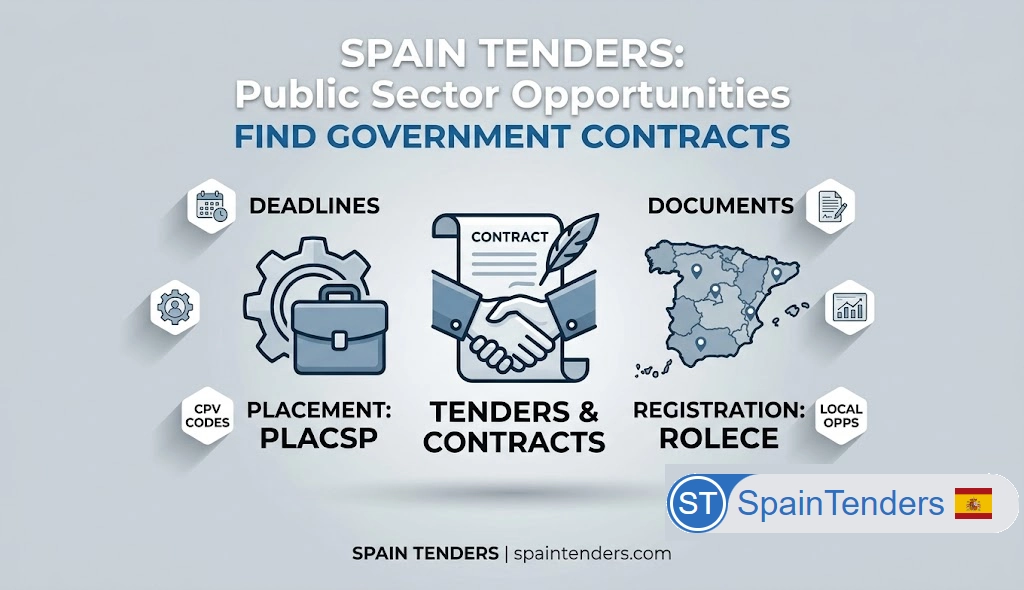
Spain Tenders: Where to Find Government and Public Procurement Opportunities
03 Sep 2026
Published on: spaintenders.com | Category: Government Contract/Licitaciones España | Reading Time: 10-15 min; Introduction Finding the right Spain tenders is the first challenge for contractors, suppliers, consultants and service providers looking to sell to the Spanish public sector. Spain has a large and multi-level procurement ecosystem, so public procurement opportunities are not limited to a single search page or one type of contracting authority. Companies searching for Spain government tenders may encounter national procurement information, European tender notices, autonomous-community platforms, municipal procurement profiles and other official contracting resources. Spanish buyers and suppliers also use terms such as licitaciones España, licitaciones públicas España, contratación pública, concursos públicos and perfil del contratante. This makes tender discovery a search and research problem as much as a procurement problem. A supplier may miss a relevant opportunity if it searches only one English keyword, checks only one geographical area or relies exclusively on a single procurement website. This guide explains where to find public tenders in Spain, how the major procurement sources fit together, how to search national and regional opportunities, and how contractors can build a practical tender-discovery process. Table of Contents Where Can You Find Tenders in Spain? Spain Official Tender Portal: Understanding the Procurement Ecosystem Plataforma de Contratación del Sector Público TED: European Public Procurement Opportunities in Spain Regional Official Tender Portals in Spain Local and Municipal Tender Opportunities How to Find Licitaciones Públicas in Spain How to Search Spain Government Department Tenders Effectively How to Search Tenders by CPV Code How to Search Tenders by Region and City How to Find Tenders by Contracting Authority How to Identify Open and Upcoming Tenders How to Check Tender Documents and Deadlines Official Tender Portals vs Tender Intelligence Platforms How SpainTenders.com Helps Businesses Find Tender Opportunities Common Problems When Searching for Spanish Tenders Best Strategy for Contractors, Suppliers and Consultants Conclusion Where Can You Find Tenders in Spain? There are several important places where businesses can find Spanish public procurement opportunities. The most important sources can be grouped into four levels: national, European, regional and local. National level: Plataforma de Contratación del Sector Público, commonly known as PLACSP. European level: TED, or Tenders Electronic Daily, for procurement notices published at European Union level. Regional level: Procurement platforms and contracting profiles operated or maintained by Spain's autonomous communities. Local level: Municipalities, provinces, public entities and local contracting authorities publishing procurement information through applicable contracting profiles and platforms. These sources should not be treated as completely interchangeable. Some are designed primarily for official publication and electronic procurement, while others provide specialised search, aggregation or procurement-intelligence functionality. For a business searching broadly across Spain, the best approach is to understand how these sources connect and then use the right source for the type of opportunity being targeted. Spain Official Tender Portal: Understanding the Procurement Ecosystem When businesses search for the Spain tender portal, they are often looking for one website containing every government contract in the country. In practice, Spain's procurement environment is broader than a single website. The Plataforma de Contratación del Sector Público is the central reference point for a substantial part of Spanish public procurement information. At the same time, regional procurement systems and contracting profiles remain important for companies targeting particular autonomous communities or public entities. For European-level opportunities, TED provides another important source. Its search system allows users to search notices using criteria such as business sector, CPV and place of performance. Therefore, a better model for finding Spanish tenders is: National portal + European portal + Regional sources + Local contracting profiles + Tender intelligence This multi-source approach is especially useful for contractors and suppliers whose target market extends across several regions. Plataforma de Contratación del Sector Público The Plataforma de Contratación del Sector Público, abbreviated as PLACSP, is one of the most important official sources for public procurement information in Spain. PLACSP provides procurement information and services connecting public-sector contracting activity with economic operators. Businesses can use the platform to search for procurement opportunities, examine contracting profiles and access documents associated with procurement procedures. The platform is therefore a central starting point for companies searching for Spain government tenders and public tenders Spain. However, contractors should not stop at the first search result. A relevant tender needs to be investigated through its complete procurement record, including the contracting authority, contract object, CPV classification, estimated value, submission deadline, technical requirements and associated documents. PLACSP should be viewed as a core official source rather than simply as a keyword search engine. TED: European Public Procurement Opportunities in Spain TED, or Tenders Electronic Daily, is the European Union's procurement notices platform. It is particularly relevant for companies looking for procurement opportunities that are published at European level. TED provides several ways to discover notices. Its search functionality includes quick search, advanced search and expert search, while users can also browse by business opportunity, business sector using CPV and place of performance. For a supplier targeting Spain, the place-of-performance filter can be combined with business-sector and CPV criteria to identify opportunities connected with Spain. TED is especially useful for international businesses because it creates a European procurement discovery layer. A company does not need to restrict its research to a Spanish-language national search when it is targeting European-level procurement notices. However, TED should complement rather than automatically replace national and regional research. The type and publication route of a procurement opportunity determine where relevant information can be found. Regional Tender Portals in Spain Regional procurement is one of the most important areas for businesses that want comprehensive coverage of Spanish tender opportunities. Spain's autonomous communities have their own administrative structures and procurement resources. As a result, companies searching for licitaciones públicas should consider the region in which the contract will be performed or where the contracting authority is located. Important regional searches can include licitaciones Andalucía, licitaciones Madrid, licitaciones Cataluña, licitaciones Galicia, licitaciones País Vasco, licitaciones Navarra and licitaciones Aragón. Region What Businesses Should Check Andalucía Regional procurement information, contracting profiles and opportunities from public authorities and entities in Andalucía Aragón Government procurement platform, contracting profiles and regional procurement resources Cataluña Regional and local contracting information and relevant procurement platforms Galicia Contratos Públicos de Galicia and associated tender information Madrid Regional and municipal procurement opportunities and contracting profiles Navarra Regional public procurement information and electronic tendering resources País Vasco Regional procurement information and contracting profiles For example, the official Galicia procurement platform provides searches by keyword, contracting authority, CPV, contract type, procedure and procurement status. It also provides information about electronic tendering and bidder services. Aragón also operates a regional public procurement platform containing contracting profiles, bidder and contract registers and other procurement resources. These examples demonstrate why a Spain-wide tender strategy should include regional research. Local and Municipal Tender Opportunities Large national contracts attract significant attention, but many business opportunities are generated by local government tenders in Spain. Municipalities, provincial bodies, public companies and other local entities can procure construction, maintenance, cleaning, security, IT, consulting, transport, landscaping, waste management and other services. A contractor targeting a particular city should therefore search both the city or municipality name and the Spanish procurement terminology. For example, businesses can build location-specific searches around: Madrid tenders Barcelona tenders Valencia tenders Seville tenders Bilbao tenders licitaciones Madrid licitaciones Barcelona licitaciones Valencia licitaciones Sevilla licitaciones Bilbao Local procurement can be particularly relevant to SMEs and specialist contractors because smaller contracts may have geographic or operational characteristics that make them more accessible than large national projects. How to Find Licitaciones Públicas in Spain Licitaciones públicas is one of the most important Spanish-language terms for public tender research. Companies searching in Spanish should combine the phrase with their sector, product, service or target location. For example, a construction company might search for licitaciones obras públicas, while an IT supplier could search for licitaciones informática or more specific service terminology. A cleaning company could combine licitaciones limpieza with a city or autonomous community. Location and procurement terminology can be combined to create searches such as licitaciones públicas Madrid, licitaciones públicas Andalucía or contratación pública Barcelona. The key is to avoid depending on one generic phrase. Different contracting authorities may describe similar requirements using different terminology. How to Search Spain Government Tenders Effectively A broad search for Spain government tenders can return a large volume of information. An effective search process should progressively narrow the results. Start with the product or service you provide. Then identify Spanish procurement terminology associated with that category. After that, add CPV codes, geographical filters and contracting authorities where available. A practical search formula is: Business category + Spanish keyword + CPV + location + procurement status For example, instead of searching only for "IT tenders Spain", an IT company can investigate relevant Spanish terminology and CPV classifications, then filter by Madrid, Cataluña, Andalucía or another target market. This approach helps separate genuine procurement opportunities from general information, expired notices and unrelated commercial content. How to Search Tenders by CPV Code CPV codes are an important part of European public procurement search. The Common Procurement Vocabulary provides a standardised classification for describing the subject of public contracts. CPV can be particularly useful when keyword variations make a normal text search unreliable. A supplier can identify the CPV categories relevant to its business and use those classifications alongside keywords and locations. TED explicitly provides browsing and search options based on business sector and CPV, making CPV a useful part of European procurement research. Businesses should remember that one product or service can relate to more than one procurement classification. CPV research should therefore be treated as an ongoing classification exercise rather than a one-time lookup. How to Search Tenders by Region and City Geographic targeting is particularly useful for contractors that cannot serve the entire country. A company can divide its Spain tender search into national, regional and city-level targets. This makes it easier to identify opportunities based on operational capacity, logistics, workforce availability and local market knowledge. For example, a contractor operating in Madrid may prioritise Madrid public tenders and licitaciones Madrid, while a business with operations throughout Andalucía can search multiple provinces and municipalities. Regional search should also be combined with the relevant procurement platform because the publication and information environment can vary between administrative areas. How to Find Tenders by Contracting Authority Searching by contracting authority can be more effective than searching by a broad industry term once a company understands its target buyers. A supplier can research which public authorities regularly purchase its products or services and then monitor their procurement activity. This strategy is useful for repeat procurement categories. For example, an engineering company may identify infrastructure authorities, while a medical supplier may identify hospitals and public healthcare organisations that regularly purchase relevant equipment. Historical procurement and contract-award information can also help a business understand which authorities have previously purchased similar goods or services. How to Identify Open and Upcoming Tenders Finding a tender is not enough. The opportunity must still be open and the company must have enough time to prepare a compliant bid. When reviewing a tender, check the procurement status and confirm the exact deadline for submission of offers. Also check whether clarifications, amendments or updated documents have been published. Regional procurement platforms can provide status-based searches. For example, Contratos Públicos de Galicia allows users to search by procurement status, including opportunities that are open for submission, pending award and resolved procedures. Businesses should maintain their own internal opportunity tracker so that promising tenders are reviewed before their deadlines rather than discovered after the submission period has closed. How to Check Tender Documents and Deadlines After identifying a potentially relevant opportunity, the next step is document review. Contract notice: Understand the basic procurement information. PCAP: Review administrative and contractual conditions. PPT: Review technical specifications and performance requirements. Annexes: Check forms, declarations, pricing templates and technical information. Deadline: Confirm the exact date and time for submission. Electronic submission: Identify the platform and technical requirements for submitting the offer. Amendments: Check whether the contracting authority has modified or clarified the tender documentation. The tender title should never be treated as the complete description of the opportunity. The detailed procurement documents determine what the bidder must actually deliver and demonstrate. Official Tender Portals vs Tender Intelligence Platforms Official procurement portals and tender intelligence platforms serve different purposes. Official portals are the authoritative publication and procurement environment for the relevant contracting process. They are important for accessing original notices, procurement documents, official communications and electronic submission functionality where applicable. Tender intelligence platforms can add another layer by aggregating opportunities, improving discovery, applying search and classification tools, monitoring multiple sources and presenting information in a more convenient format. For a contractor, the two approaches can work together. A tender intelligence platform can help discover a relevant opportunity, while the official procurement source remains essential for checking the original tender information and submission requirements. This distinction is important because businesses should not assume that a third-party summary replaces the official tender documentation. How SpainTenders Helps Businesses Find Tender Opportunities SpainTenders.com is designed around the practical problem faced by businesses searching for procurement opportunities in Spain. Instead of relying on one broad keyword or manually checking every source individually, businesses can use a structured tender-discovery approach based on sector, location, procurement category and opportunity relevance. For contractors, suppliers and consultants, the value of a dedicated Spain tender platform is not simply having more tender records. The important objective is to make relevant opportunities easier to discover and evaluate. A useful Spain tender search should help a business move through a simple process: Discover → Filter → Evaluate → Monitor → Bid Businesses can use this type of workflow to identify opportunities matching their commercial capabilities and then return to the official procurement source for detailed verification and submission. This becomes especially valuable when a company targets multiple regions, several CPV categories or both national and local public-sector buyers. Common Problems When Searching for Spanish Tenders Problem 1: Searching only in English International businesses may search only for "Spain tenders" or "Spain government contracts". Spanish-language terms such as licitaciones, contratación pública and concursos públicos can provide a more locally relevant search vocabulary. Problem 2: Using only one portal Spain has national, European, regional and local procurement resources. Depending on the target market, relying on a single source may create gaps in discovery. Problem 3: Ignoring CPV Keyword-only searches can miss opportunities because contracting authorities may describe the same business category differently. CPV can provide an additional classification layer. Problem 4: Not filtering by location A national search can produce too many opportunities. Filtering by autonomous community, province, city or place of performance can make the results more relevant. Problem 5: Finding expired tenders A search result is useful only if the opportunity is still actionable. Always verify procurement status and submission deadlines. Problem 6: Not checking the original documents A summary or listing page may not contain every requirement. Before bidding, suppliers should review the official procurement documents. Best Strategy for Contractors, Suppliers and Consultants There is no single search method that works equally well for every business. A construction contractor, software company, medical supplier and consulting firm may need completely different procurement searches. A practical strategy starts with defining the company's procurement profile. Products or services: What exactly does the company sell? CPV categories: Which procurement classifications describe those offerings? Geography: Which Spanish regions, provinces or cities can the company serve? Buyer types: Which government departments, municipalities, hospitals or public entities are relevant? Contract value: What size of procurement can the company realistically execute? Contract type: Does the company target works, supplies, services or concessions? Deadlines: How much preparation time does the company need before submitting an offer? Once these parameters are defined, the company can create a repeatable monitoring process. For example, a supplier could maintain separate searches for national tenders, regional tenders and specific contracting authorities. It could then use CPV and Spanish keywords to refine those searches. The most effective tender-discovery process is therefore not simply "search Spain tenders". It is a structured combination of keyword, CPV, geography, buyer and procurement-status intelligence. Conclusion Finding Spain tenders requires an understanding of how public procurement information is distributed across Spain's procurement ecosystem. The Plataforma de Contratación del Sector Público is a major national source, while TED provides access to European procurement notices and regional and local procurement systems add important geographic coverage. Businesses searching for licitaciones España or licitaciones públicas España should therefore avoid treating tender discovery as a single-portal activity. National, European, regional and local sources can all play a role depending on the company's sector and target market. The most effective approach combines Spanish and English procurement terminology with CPV codes, contracting authorities, locations, procurement status and deadlines. This helps contractors, suppliers and consultants identify opportunities that are relevant to their capabilities and operational reach. Official procurement portals remain essential for verifying the original tender notice, documents, requirements and submission instructions. Tender intelligence platforms can complement those sources by helping businesses discover and organise opportunities more efficiently. For companies looking for a dedicated way to discover Spain government tenders, public procurement opportunities, licitaciones públicas and government contracts, SpainTenders.com can become part of a broader procurement research workflow. The goal is simple: find the right opportunity early, understand where it is published, verify the official information, assess eligibility and prepare the bid before the deadline.
View Details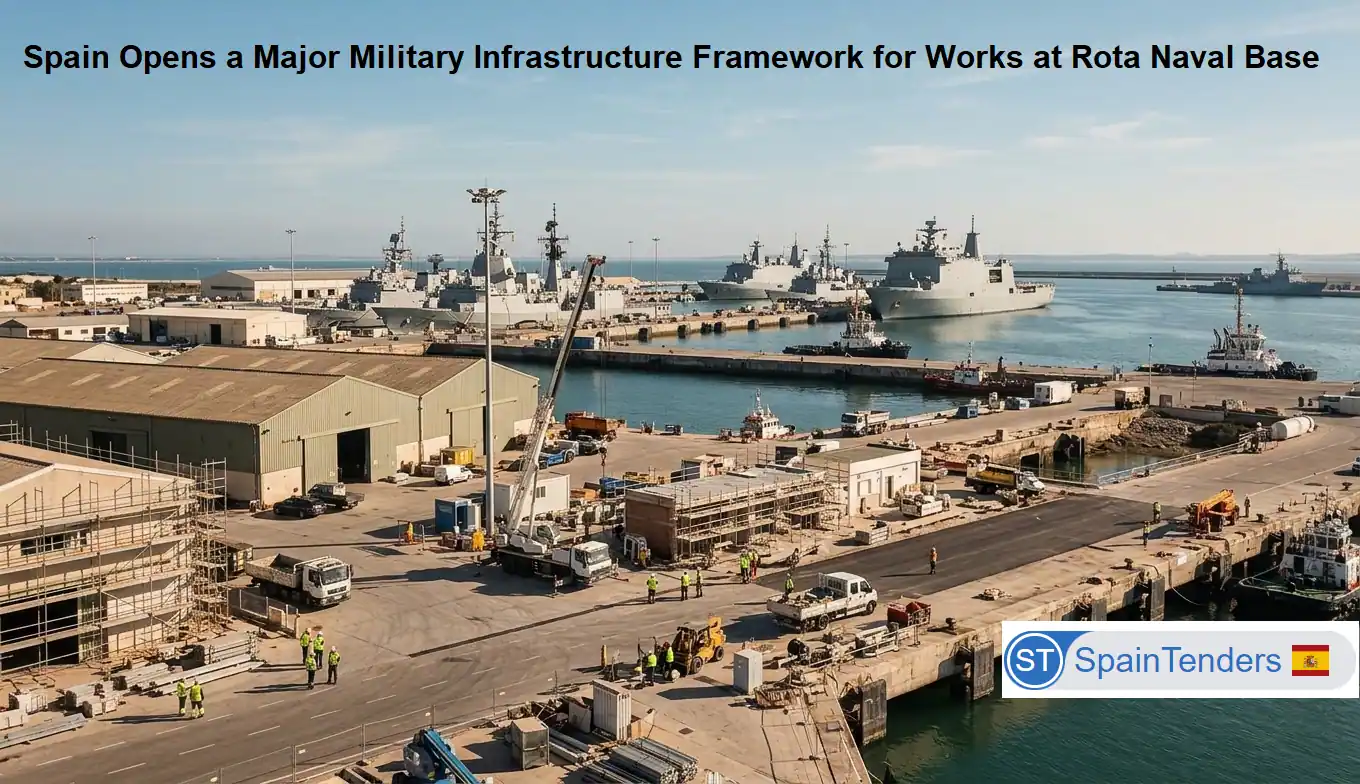
Spain Opens a Major Military Infrastructure Framework for Works at Rota Naval Base
03 Sep 2026
Standfirst Spain has selected a broad group of construction companies for a major framework covering works at the Naval Base of Rota in Cádiz. The procurement is designed to provide the Spanish Navy with a pool of qualified companies able to execute new construction, refurbishment, rehabilitation, major repairs, routine repairs, conservation, demolition and maintenance. The framework has a maximum value of EUR 13.6224 billion in the published result while the estimated value recorded for LOT 0008 is EUR 4.8 million. The unusually large framework ceiling reflects the structure of a multi supplier arrangement and should not be interpreted as guaranteed revenue for the selected companies. Introduction Military infrastructure has to remain operational even when individual facilities require construction, repair or major refurbishment. For a naval base such as Rota, this creates a continuing requirement for construction capacity that can be called upon as needs arise across buildings and installations. Spain has addressed that requirement through a framework designed to select companies capable of carrying out a wide range of construction activities within military establishments. The procurement is led by the Dirección de Gestión Económica de la Jefatura de Apoyo Logístico de la Armada, a central government authority operating in the defence field. The relevant award notice covers LOT 0008, which concerns works within the area of responsibility of the Naval Base of Rota in Cádiz. The main CPV classification is 45000000 for construction work with additional classifications covering civil engineering works, construction work for military buildings and installations and building completion work. The result is notable for the number of companies selected. The notice records 45 tenders received for the lot while the organisations section identifies 43 economic operators selected as winners. This creates a procurement structure very different from a conventional single supplier contract. Why This Contract Matters The strategic importance of the procurement comes from the location and the nature of the requirement. Rota is a major Spanish naval installation and the tender is focused specifically on construction activity within its area of operation. The framework gives the buyer access to a large pool of companies rather than depending on one contractor for every type of infrastructure requirement. Such a structure can provide flexibility when different projects vary significantly in scale, technical complexity and delivery requirements. A framework can also reduce the need to conduct a completely new procurement every time an eligible work requirement emerges. The procurement is therefore as much about creating future purchasing capacity as it is about the immediate award. The maximum framework value is substantial but individual call offs will determine the actual work assigned to participating companies. Suppliers should not regard the published maximum as a commitment to spend that amount. The result also provides a useful signal about the depth of Spain's construction market around military infrastructure. Forty five tenders were received for the lot and a large group of economic operators was selected. Contract Timeline The procurement carries the internal identifier 2025/AR40U/00000009E. The notice records 02 June 2026 as the date on which the winners were chosen. Contracts associated with the selected participants were concluded on 13 August 2026. The award result was dispatched to TED on 01 September 2026. The notice was published in OJ S issue 170/2026 on 03 September 2026 under publication number 609036-2026. The notice does not provide a clear duration in the information reviewed. The contracting authority has not disclosed a contract duration in the published award information. Contract Overview The procurement title is "AM para selección de empresas que ejecuten obras de primer establecimiento, reforma, restauración, rehabilitación o gran reparación, reparación simple, conservación, demolición y mantenimiento en las infraestructuras de los establecimientos militares". In practical terms, this is a mechanism for selecting companies that can undertake different forms of construction and maintenance work at military establishments. LOT 0008 is specifically titled "Lote 8: Obras en el ámbito de actuación de la Base Naval de Rota (Cádiz)". The lot is classified as works with an estimated value excluding VAT of EUR 4.8 million. The framework is described as partly operating without reopening of competition and partly with reopening of competition. This means the procurement model can support more than one route for assigning future work within the framework. No dynamic purchasing system is used. Key Contract Details CountrySpain Contracting AuthorityDirección de Gestión Económica de la Jefatura de Apoyo Logístico de la Armada Procurement Identifier2025/AR40U/00000009E TED Publication Number609036-2026 Procurement TypeWorks ProcedureOpen procedure LotLOT 0008 Lot TitleWorks within the area of the Naval Base of Rota in Cádiz Main CPV45000000 Construction work Additional CPV45200000, 45216200, 45400000 Estimated Lot ValueEUR 4.8 million excluding VAT Maximum Framework ValueEUR 13.6224 billion Tenders Received45 Award CriterionPrice Price CriterionDiscount on industrial profit Criterion Weight100 points Framework StructurePartly without reopening and partly with reopening of competition Dynamic Purchasing SystemNo EU FundingNo GPA CoverageNo Winner Selection Date02 June 2026 Contract Conclusion Date13 August 2026 The figures require careful interpretation. The lot level estimated value is EUR 4.8 million while the result notice records EUR 13.6224 billion as the maximum and approximate value of the framework agreements. These figures describe different procurement levels and should not be presented as though EUR 13.6224 billion represents the value of one immediate contract awarded to one supplier. Project Scope The scope covers construction work within the area of the Naval Base of Rota. The broader procedure allows works involving first establishment, reform, restoration, rehabilitation, major repair, simple repair, conservation, demolition and maintenance of military infrastructure. The CPV classifications show that the requirement extends beyond basic building work. It includes complete or partial construction and civil engineering works, construction work for military buildings and installations and building completion work. This gives the framework a wide operational reach. The contracting authority can therefore draw on companies with different construction capabilities depending on the requirements of individual projects. About the Contracting Authority Dirección de Gestión Económica de la Jefatura de Apoyo Logístico de la Armada is identified as the buyer. TED classifies the organisation as a central government authority with defence as its contracting activity. The organisation is based in Madrid and provides the procurement contact point for the procedure. About the Organisations Involved Dirección de Gestión Económica de la Jefatura de Apoyo Logístico de la Armada is the contracting authority and buyer responsible for the procurement. Tribunal Administrativo Central de Recursos Contractuales is identified as the review organisation. It provides the formal channel connected with review of procurement decisions. The framework winners for LOT 0008 are ALVAC, S.A., AQUINTA obras sl, ARC APLICACIONES, S.L., ASCH INFRAESTRUCTURAS Y SERVICIOS, S.A., CERRAJERÍA GÓMEZ LOZANO, S.L., COMPAÑÍA DE EFICIENCIA Y SERVICIOS INTEGRALES, S.L., DRYTEC MANTENIMIENTOS, S.L., Domo Frio S.L.U., EIFFAGE ENERGIA, ELECNOR SERVICIOS Y PROYECTOS, S.A.U., ELECTELCOM DEL SUR S.L., ELECTRORAYMA S.L, ELECTROSAM,S.A., ESQUEIRO, S.L., ESTUDIOS Y EJECUCIONES, S.A., Ecolog Spain LSU, FRIZONIA REFRIGERACIÓN CLIMATIZACIÓN, S.L., FRUCTUOSO PASCUAL BERMEJO SLU, Frío Clima Valentín, S.L., GRUPO DESARROYA PROYECTOS Y SISTEMAS, SLNE, GRUPO RENDER INDUSTRIAL SL, IDRACAR2018 SL, INNOVACIÓN GLOBAL DE SEGURIDAD,S.A., INVERTEILAN, S.L., J.CAMPOAMOR,S.A., JUMABEDA, S.L., LAM S.A. SEGURIDAD Y COMUNICACIONES, MANUEL ALBA, S.A., METALUR TRES CAMINOS, S.L., MONELEG SL, NERCO INFRAESTRUCTURAS SL, Proteca Hardstone Sl, Red de Innovación y Obras, S.L., Rhodas albañileria en general, S.L., SARDALLA ESPAÑOLA, S. A., SAYMA JARDIN SL, SERANCO S.A.U., TECNIA INGENIEROS, TECNOFIBRASCADIZ S.L., TUBERIAS Y MONTAJES SAN JOSE, S.L., UTE PADECASA OBRAS Y SERVICIOS, S.A.-CYCASA CANTERAS Y CONSTRUCCIONES, S.A., VEOLIA SERVICIOS LECAM, S.A.U. and VES RENEWABLE, S.A.. The notice identifies these economic operators as winners of LOT 0008. UTE PADECASA OBRAS Y SERVICIOS, S.A.-CYCASA CANTERAS Y CONSTRUCCIONES, S.A. is the joint venture named in the award information. The notice identifies the two member companies but does not disclose a division of responsibilities between them. Procurement Analysis The procurement used an open procedure under Directive 2014/24/EU. The approach created broad access to the competition while allowing the defence buyer to establish a qualified supplier pool for future infrastructure requirements. Competition was strong in terms of participation. Forty five tenders were received for LOT 0008 and the result identifies 43 selected economic operators. This is a significant difference from a single winner procurement because the commercial objective is to establish a pool rather than award all future work to one contractor. Price was the sole stated award criterion with a weighting of 100 points. The specific price measure was "Descuento Sobre el Beneficio Industrial" which refers to a discount applied to the industrial profit component of construction pricing. The framework operates partly without reopening competition and partly with reopening of competition. The distinction matters because future work can be allocated through the mechanisms established by the framework rather than treating the initial selection as a guarantee of individual projects. Additional Procurement Facts The procurement is not financed by European Union funds and LOT 0008 is not covered by the Government Procurement Agreement. No dynamic purchasing system is used. The notice gives a maximum framework value of EUR 13.6224 billion and an approximate framework value of the same amount. The authority has not disclosed a corresponding confirmed revenue allocation for individual framework participants. Market & Industry Perspective The most important market signal is the scale of the supplier pool. Selecting 43 economic operators after receiving 45 tenders indicates that the framework was designed to preserve considerable supplier capacity rather than concentrate the market around one contractor. For the Spanish construction sector this can broaden access to defence related work for companies with relevant capabilities. The winning group includes companies with different corporate profiles and locations across Spain while one selected bidder is a joint venture involving Padecasa Obras y Servicios and CYCASA Canteras y Construcciones. The framework model also changes competitive behaviour. Companies are not simply competing for a single project with a fixed scope. They are competing to become eligible for future assignments where project specific conditions can determine which framework participants receive work. That makes early framework participation commercially valuable while also making future call off monitoring essential. A company can be selected yet receive substantially less work than the framework ceiling might suggest. Economic Significance The published maximum framework value of EUR 13.6224 billion places the procurement among the more substantial public construction arrangements recorded in the notice. However the figure represents the framework ceiling rather than guaranteed spending by the Spanish Navy. The regional lot value of EUR 4.8 million provides a more specific indication of the estimated value associated with LOT 0008. The relationship between this lot estimate and the much larger framework maximum is therefore an important issue for businesses analysing the award. Future Procurement Opportunities The immediate opportunity created by this award is not necessarily another tender for the same framework. Instead, suppliers should monitor how individual construction requirements are subsequently competed or allocated within the framework. The framework structure explicitly provides for activity both without reopening and with reopening of competition. Future requirements may cover new construction, refurbishment, rehabilitation, major repairs, simple repairs, conservation, demolition and maintenance across military establishments. Companies with capabilities aligned with these categories should therefore monitor Spanish defence procurement activity beyond the Rota lot itself. The next procurement cycle will also be important. The eventual re procurement of the framework could change the number of selected companies, the award criteria, the lot structure and the commercial rules governing future assignments. Businesses should begin tracking these signals well before a replacement notice is published. Opportunities for Suppliers Construction companies can use the award as a clear indication that Spain's defence infrastructure market can support a broad supplier base. Firms should assess whether their capabilities align with military building works, civil engineering, building completion or infrastructure maintenance. The strongest positioning will come from companies that can demonstrate relevant construction capacity while understanding public procurement procedures. Joint ventures can also provide a route for combining capabilities where individual firms cannot efficiently address the full requirements alone. What Businesses Should Watch Suppliers should watch the future call off activity associated with LOT 0008 because the initial framework selection does not itself disclose the volume of work that each participant will receive. The distinction between assignments without reopening and assignments involving renewed competition will be particularly important. Businesses should also monitor changes in price competition. Since the award criterion gives 100 points to price and focuses on discount over industrial profit, cost discipline can be central to competitive positioning. Another important signal is supplier concentration in future awards. The initial result contains 43 winners but future project awards could reveal whether work is distributed broadly across the framework or becomes concentrated among a smaller group of contractors. Finally, companies should watch the Spanish defence procurement pipeline for related infrastructure programmes. Rota is only one military establishment and the procedure itself concerns infrastructure across military establishments more broadly. SpainTenders.com Procurement Intelligence This procurement represents a broader shift from isolated project tenders toward structured supplier ecosystems in public construction. For a defence authority managing multiple infrastructure requirements, maintaining access to a large pool of qualified contractors can create flexibility while reducing the administrative burden of starting from zero for every requirement. The strategic importance of the award is therefore not captured by the EUR 4.8 million lot estimate alone. The more significant procurement signal is the creation of a framework with a published maximum value of EUR 13.6224 billion and a large selected supplier pool. The scale indicates the potential importance of future work flowing through the framework while the framework mechanism determines how individual opportunities are actually allocated. Suppliers can learn several lessons from the result. First, defence construction opportunities may reward companies that are prepared to qualify for a long term procurement structure rather than focusing only on one immediate project. Second, price positioning matters when the award methodology assigns the full stated weighting to price. Third, businesses need to understand how future competition will work after framework admission because being selected is only the beginning of the commercial process. Relevant suppliers should position themselves by mapping Spanish defence buyers, monitoring CPV codes connected with military construction and maintaining strong evidence of technical capacity. Companies should also evaluate joint venture structures where complementary capabilities can improve their ability to compete for complex infrastructure requirements. Future contracts in this market could evolve toward increasingly specialised requirements as military infrastructure programmes become more complex. At the same time, broad frameworks may remain attractive to buyers that need rapid access to contractors across different categories of work. The key intelligence question will be how Spain balances supplier breadth with competition at the project assignment stage. Supplier Takeaways Monitor Spanish defence construction procurement linked to military establishments. Track LOT 0008 and subsequent assignments connected with the Rota Naval Base. Do not treat the EUR 13.6224 billion framework ceiling as guaranteed supplier revenue. Prepare strong pricing strategies because price carries the full stated award weighting. Study both direct framework assignments and procedures involving reopening of competition. Assess joint venture opportunities where combined capabilities can improve tender positioning. Track CPV codes 45000000, 45200000, 45216200 and 45400000. Key Takeaways Spain has selected a large pool of construction companies for military infrastructure work at Rota Naval Base. LOT 0008 has an estimated value of EUR 4.8 million excluding VAT. The published maximum framework value is EUR 13.6224 billion. Forty five tenders were received for LOT 0008. Forty three economic operators are identified as winners. Price is the sole stated award criterion with a weighting of 100 points. The framework operates partly without reopening and partly with reopening of competition. No dynamic purchasing system is used. The procurement is not financed by EU funds. The award decision was made on 02 June 2026 and contracts were concluded on 13 August 2026. Conclusion The Spanish defence procurement at Rota Naval Base is significant because it establishes access to a broad construction supplier pool for future military infrastructure requirements. The framework combines substantial potential value with a procurement structure that leaves actual work allocation dependent on subsequent requirements and the applicable competition mechanism. For construction businesses the message is clear: participation in the framework creates access to a future pipeline but does not guarantee individual contracts. Monitoring call offs, pricing conditions and the wider Spanish defence infrastructure programme will be essential for turning framework eligibility into commercial opportunity. Source: Tenders Electronic Daily (TED), Contract Award Notice 609036-2026, Official Journal of the European Union, OJ S 170/2026, published on 03/09/2026.
View Details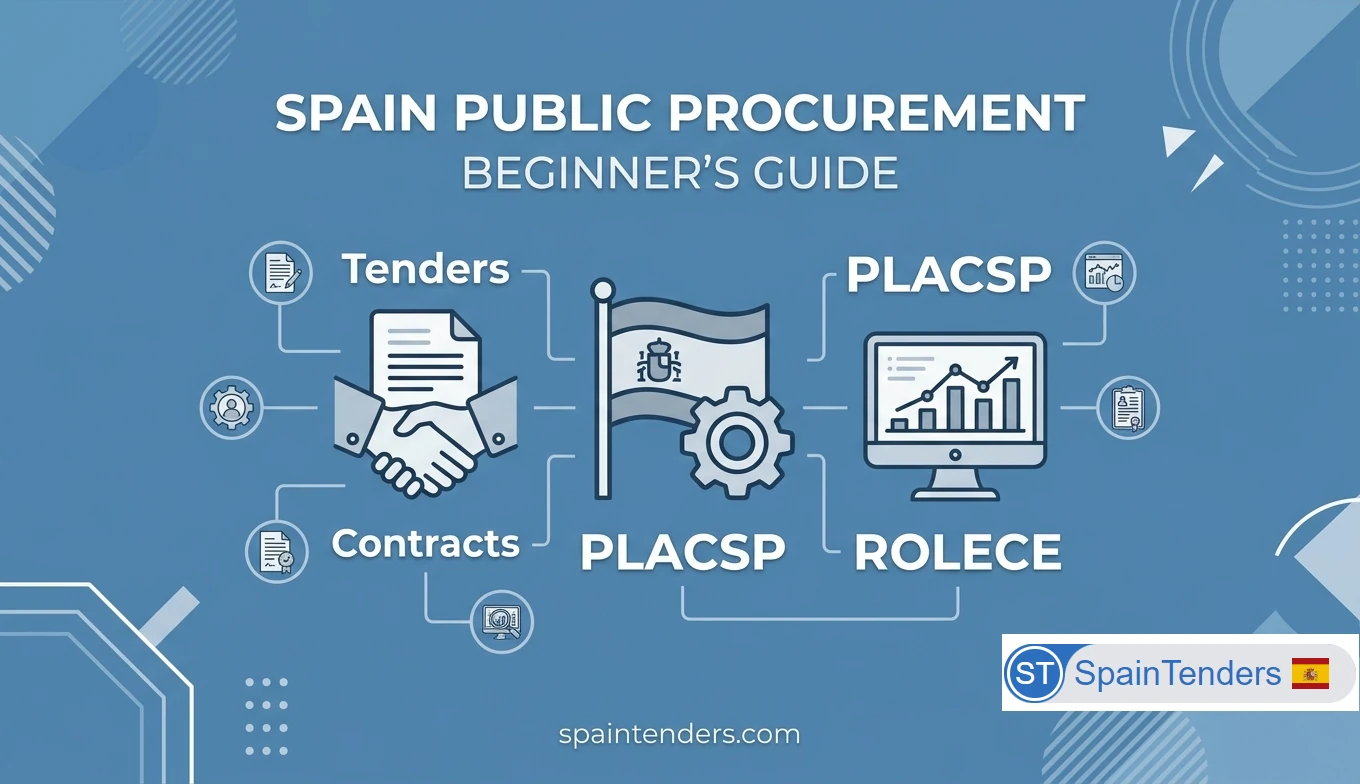
Spain Public Procurement: Beginner's Guide to Tenders and Government Contracts
02 Sep 2026
Published on: spaintenders.com | Category: Spain Public Procurement | Reading Time: 10–15 min;Introduction Public procurement in Spain is an important source of business opportunities for companies that want to supply products, deliver services or execute public-sector works. Spanish public authorities purchase a wide range of goods and services covering construction, information technology, healthcare, engineering, transport, energy, cleaning, security, consulting, maintenance and many other business categories. For a company entering this market, finding a Spanish government tender is only the first step. Businesses also need to understand how public procurement works, which authorities publish tenders, where procurement opportunities are available, how tender documents are structured and what requirements must be satisfied before submitting an offer. Companies researching this market will encounter Spanish procurement terms such as licitaciones públicas, contratación pública, contratos públicos, licitación electrónica and perfil del contratante. Understanding these terms is particularly important for companies using Spanish-language procurement platforms and search systems. The Spanish public procurement framework is primarily based on Ley 9/2017 de Contratos del Sector Público. The procurement ecosystem also includes the Plataforma de Contratación del Sector Público or PLACSP, the Registro Oficial de Licitadores y Empresas Clasificadas del Sector Público or ROLECE, regional procurement platforms and European procurement resources such as TED. This beginner's guide explains the fundamentals of Spain public procurement and shows how businesses can approach Spanish government tenders in a structured way. What This Article Covers What Is Public Procurement in Spain? How Does Public Procurement Work in Spain? Who Can Participate in Spanish Public Procurement? Where Can Companies Find Public Tenders in Spain? What Is PLACSP and Why Is It Important? What Is ROLECE? Understanding CPV Codes in Spanish Tenders What Are Spanish Tender Documents? What Information Should You Check in a Spanish Tender? Why Spanish Procurement Terminology Matters for Tender Search Common Mistakes Made by New Bidders How International Companies Can Approach Spanish Public Procurement How Companies Can Build a Spain Tender Search Strategy Benefits of Understanding Spain Public Procurement How spaintenders.com Can Help Businesses Conclusion What Is Public Procurement in Spain? Public procurement in Spain is the process through which public-sector organisations purchase works, supplies and services from businesses and other eligible economic operators. A public authority may need to construct infrastructure, purchase medical equipment, implement software, maintain public buildings, provide professional services or obtain thousands of other products and services. When the applicable procurement rules require a competitive process, the authority publishes a procurement opportunity and invites eligible companies to participate. Spanish procurement uses several important terms that beginners should understand. Licitación pública refers to a public tender or competitive procurement process. Contratación pública refers broadly to public procurement activity. Contrato público refers to a public contract established between the contracting authority and the successful supplier. Licitador refers to a bidder participating in a procurement procedure. Proveedor refers to a supplier or service provider. Órgano de contratación refers to the contracting authority responsible for the procurement. Perfil del contratante refers to the contracting profile where procurement information is published. Public procurement can take place at national, regional and local levels. This means a company targeting Spain should consider the complete procurement ecosystem rather than focusing on only one type of public authority. How Does Public Procurement Work in Spain? The exact procurement process depends on the contract and procedure but most tender opportunities follow a logical sequence from identifying a public requirement through evaluation and contract award. 1. Public Authority Identifies a Requirement The process begins when a public organisation identifies a requirement. This may involve construction, software, equipment, consulting, maintenance, healthcare services, transportation or another category. The authority determines what needs to be purchased and establishes the appropriate procurement approach. 2. Procurement Documents Are Prepared The contracting authority prepares the documentation that defines the contract. These documents can include administrative conditions, technical specifications, eligibility requirements, evaluation criteria, contract duration and financial information. For bidders, these documents are extremely important because the tender title or short notice normally does not contain every requirement. 3. Tender Is Published The procurement opportunity is published through the applicable procurement platform or contracting profile. PLACSP is a central source of public procurement information in Spain while regional systems also play an important role. 4. Suppliers Analyse the Opportunity Potential bidders examine the opportunity and decide whether they can satisfy the requirements. This is the qualification stage from the supplier's perspective. Companies should review the contract object, CPV codes, estimated value, deadlines, location, lots, technical requirements, financial requirements and evaluation criteria before deciding to participate. 5. Bid Is Prepared If the opportunity matches the company's capabilities, the supplier prepares its offer and supporting documentation. The technical proposal should respond directly to the requirements described in the tender documents. 6. Electronic Submission Spanish procurement increasingly relies on electronic processes. Depending on the procurement platform and procedure, bidders may need an account, electronic certificate and appropriate electronic signing tools to complete the submission. 7. Evaluation and Award The contracting authority evaluates the submitted offers according to the published criteria. Depending on the tender, evaluation may consider price, technical quality, methodology, experience, service arrangements, sustainability or other criteria. The contract is ultimately awarded according to the applicable procurement procedure and the published evaluation framework. Who Can Participate in Spanish Public Procurement? Eligible companies and other economic operators can participate in Spanish public procurement when they satisfy the requirements established in the relevant tender. Depending on the contract, a bidder may need to demonstrate legal capacity, professional authorisation, economic and financial solvency, technical or professional solvency and other qualifications. Some contracts can also involve classification requirements or specific technical conditions. A supplier must therefore assess every tender independently rather than assuming that general registration makes it eligible for all Spanish public contracts. Both Spanish companies and eligible foreign companies can consider the Spanish public procurement market. However, international bidders need to pay particular attention to documentation, electronic submission, language, registration and qualification requirements. Where Can Companies Find Public Tenders in Spain? Companies searching for Spain tenders should understand that procurement information can come from several levels of the Spanish and European procurement ecosystem. Plataforma de Contratación del Sector Público The Plataforma de Contratación del Sector Público or PLACSP is one of the most important sources for Spanish public procurement information. It provides access to procurement opportunities, contracting profiles, documents and other tender information. For companies beginning their Spain tender research, PLACSP should be one of the first resources to understand. TED - Tenders Electronic Daily TED is the European Union's procurement notices platform and is relevant for public procurement opportunities that are published at European level. Companies searching for larger European opportunities can use TED alongside national procurement resources. Regional Procurement Platforms Spain also has procurement systems and contracting profiles connected with autonomous communities and regional public administrations. Companies targeting a specific geography should therefore investigate the procurement resources relevant to that region. Useful search terms can include licitaciones Madrid, licitaciones Andalucía, licitaciones Cataluña, licitaciones Galicia, licitaciones País Vasco, licitaciones Navarra and licitaciones Aragón. What Is PLACSP and Why Is It Important? PLACSP stands for Plataforma de Contratación del Sector Público. It is a central digital platform for public procurement information in Spain and is one of the most important resources for companies looking for Spanish government tenders. The platform connects procurement information with public buyers and economic operators. Companies can use the platform to search procurement opportunities, examine contracting profiles and access tender-related documentation. Depending on the procurement process, supplier-side functions can also include electronic interaction and electronic offer submission. PLACSP is particularly important because it supports the discovery of procurement opportunities across a broad public-sector ecosystem. Companies can use available search options to narrow results and identify tenders relevant to their products and services. A professional Spain tender search should not rely only on a general keyword. Businesses should combine keywords with CPV classifications, geographical areas, contract types, deadlines and other available filters. What Is ROLECE? ROLECE stands for Registro Oficial de Licitadores y Empresas Clasificadas del Sector Público. It is the Official Register of Bidders and Classified Companies of the Public Sector. ROLECE provides an electronic registration and certification system for companies participating in public procurement. Information recorded through the register can relate to areas such as legal personality and capacity, representation, professional or business authorisation, economic and financial solvency and classification where applicable. For suppliers, the main value of understanding ROLECE is that registered information can help demonstrate relevant bidder qualifications in procurement processes where the applicable rules allow it. ROLECE registration is an important topic for companies that intend to participate regularly in Spanish public tenders. Businesses should understand the registration process and determine which information and certificates are relevant to their specific circumstances. Companies should also understand the relationship between electronic certificates, electronic identification and digital signing because Spanish tender participation can involve electronic procedures. Understanding CPV Codes in Spanish Tenders CPV stands for Common Procurement Vocabulary. CPV codes provide a standard classification system for describing the subject of public procurement contracts. CPV is especially useful for companies that want to improve the precision of their tender searches. A supplier may offer a specialised product or service that is described using several different keywords. Searching only one keyword can therefore produce incomplete results. For example, an IT company may search for terms such as software, information technology, IT services or digital transformation. Relevant CPV classifications can provide another layer of procurement discovery. A practical tender search model can therefore be structured as: Keyword → CPV → Region → Contract Type → Contract Value → Deadline This approach can help companies reduce irrelevant results and identify procurement opportunities that more closely match their business capabilities. What Are Spanish Tender Documents? Spanish tender documents contain the detailed conditions that suppliers need to understand before preparing an offer. PCAP stands for Pliego de Cláusulas Administrativas Particulares. It generally contains administrative and contractual conditions for the procurement. PPT stands for Pliego de Prescripciones Técnicas. It generally describes the technical requirements and specifications of the contract. DEUC stands for Documento Europeo Único de Contratación. It is a standardised European self-declaration mechanism used in relevant procurement procedures. Pliegos is a broader term used for the procurement specifications and related tender documents. Expediente refers to the procurement file or case associated with the procedure. These documents should be reviewed carefully before a company decides to bid. Important requirements can appear in administrative specifications, technical specifications, annexes and other supporting documents. What Information Should You Check in a Spanish Tender? A company should create a consistent tender evaluation checklist before deciding whether to participate. Contracting Authority: Identify the public organisation purchasing the goods, works or services. Contract Object: Understand exactly what the authority intends to purchase. CPV: Check the relevant CPV classifications and compare them with your business categories. Contract Value: Review the financial information provided in the tender documents. Deadline: Confirm the exact date and time for submitting the offer. Location: Determine where the goods or services must be delivered or performed. Contract Duration: Check the initial contract period and applicable extension options. Lots: Determine whether the tender is divided into separate lots and whether your company can participate in the relevant lots. Technical Requirements: Check required experience, personnel, equipment, certifications and technical capabilities. Financial Solvency: Review turnover and other economic requirements specified in the tender. Technical or Professional Solvency: Check experience and evidence requirements. Evaluation Criteria: Understand how the contracting authority will evaluate competing offers. Submission Method: Confirm where and how the bid must be submitted electronically. This checklist can help suppliers avoid spending significant time preparing bids for opportunities where they do not meet the basic requirements. Why Spanish Procurement Terminology Matters for Tender Search International companies often begin their research using English terms such as Spain tenders, Spain government tenders or Spain public procurement. These keywords are useful but they should be combined with Spanish procurement terminology. Spanish procurement searches commonly use terms such as: licitaciones España licitaciones públicas España contratación pública España contratos públicos concursos públicos licitación electrónica portal de contratación pública plataforma de contratación pública perfil del contratante Understanding these terms can improve tender discovery and help international suppliers navigate Spanish procurement information more effectively. Some common terminology relationships include bidder - licitador, supplier - proveedor, tender documents - pliegos, award - adjudicación, contracting authority - órgano de contratación and bid submission - presentación de ofertas. Common Mistakes Made by New Bidders New bidders can make several avoidable mistakes when entering the Spanish public procurement market. Searching only broad keywords: A general search can produce a large number of irrelevant opportunities. CPV codes, locations and contract types can make the search more precise. Ignoring tender documents: A tender title does not explain every requirement. Suppliers should examine the relevant PCAP, PPT and supporting documents. Checking deadlines too late: Electronic registration, certificate setup, document preparation and bid submission can require time. Waiting until the final day increases operational risk. Ignoring regional procurement: Companies targeting specific Spanish regions should investigate relevant autonomous-community and local procurement resources. Using only English search terms: Spanish procurement terminology can reveal opportunities and information that may not appear through English-only searches. Assuming registration solves every requirement: ROLECE and other registrations can support the procurement process but bidders must still comply with the requirements of each individual tender. Focusing only on price: Some tenders use multiple evaluation criteria. Technical quality and other factors can influence the final result. How International Companies Can Approach Spanish Public Procurement Foreign companies can consider Spain as part of their European public procurement strategy when they can satisfy the applicable legal, technical and commercial requirements. The best starting point is market research. A company should first identify the products and services it can supply and then identify relevant Spanish procurement terminology and CPV codes. The next step is to identify the public authorities and procurement platforms relevant to the company's target sector and geographic market. Foreign suppliers should also study previous procurement documents and published opportunities. This can help them understand the type of requirements that Spanish contracting authorities use and the level of detail expected in tender responses. Before participating in a live tender, companies should establish a process for handling electronic certificates, registration, document preparation, translation where required and electronic submission. International suppliers should also assess whether they can satisfy the tender's financial, technical and professional requirements. Market entry should be approached as a procurement process rather than simply as a sales exercise. How Companies Can Build a Spain Tender Search Strategy A successful Spain tender search strategy should be systematic and repeatable. Step 1 - Define your target market Identify the products, services, industries and Spanish regions that are relevant to your business. Step 2 - Build your keyword list Create a list containing English international terms and Spanish procurement terms such as licitación, contratación pública, concurso público and proveedor. Step 3 - Map relevant CPV codes Identify CPV classifications related to your products and services and use them as part of your search strategy. Step 4 - Identify relevant authorities Research national, regional and local contracting authorities that regularly purchase your products or services. Step 5 - Search procurement platforms Use PLACSP, relevant regional procurement platforms and TED where appropriate. Combine keywords, CPV, geography, contract type and other available filters. Step 6 - Review tender documents Check eligibility, technical requirements, financial requirements, evaluation criteria, deadlines and submission instructions. Step 7 - Build an opportunity pipeline Track relevant tenders using information such as contracting authority, contract value, deadline, sector, location and tender status. Step 8 - Prepare for electronic submission Ensure that the responsible team has the necessary registration, electronic certificate and signing capabilities before the submission deadline. This process turns tender discovery into a repeatable procurement intelligence workflow instead of an occasional manual search. Benefits of Understanding Spain Public Procurement Understanding the Spanish public procurement ecosystem can provide several practical benefits for suppliers. Better opportunity discovery: Companies can search using Spanish terminology, CPV classifications and geographic filters. Improved qualification: Businesses can identify unsuitable opportunities before investing significant resources in bid preparation. Better compliance: Understanding tender documents helps reduce the risk of missing important requirements. Faster tender research: A structured workflow can reduce repetitive manual searches. Regional market visibility: Businesses can identify opportunities across different autonomous communities and local authorities. Better bid preparation: Understanding PCAP, PPT, DEUC, CPV and evaluation criteria helps suppliers prepare more relevant offers. International expansion: Foreign suppliers can use Spanish procurement intelligence as part of a broader European market strategy. How Spaintenders.com Can Help Businesses Finding a tender is only one part of the procurement process. Businesses also need to identify relevant opportunities, monitor deadlines, understand procurement categories and continuously track new tender activity. For companies targeting Spain, a procurement intelligence workflow can combine tender discovery with keyword research, CPV-based classification, geographic filtering, contracting-authority research and deadline monitoring. Platforms such as Spaintenders.com can support businesses that need structured tender information and broader procurement discovery across markets. A company developing a Spain procurement strategy should aim to build a repeatable system that helps its team discover relevant opportunities, evaluate qualification requirements and monitor procurement activity rather than relying on occasional manual searches. The long-term objective is to connect procurement information with business requirements. A supplier should be able to move from identifying a market category to finding relevant tenders and then evaluating whether a specific opportunity is worth pursuing. Conclusion Spain public procurement offers opportunities across construction, technology, healthcare, engineering, transportation, energy, consulting, maintenance and many other sectors. However, entering this market successfully requires an understanding of the procurement ecosystem rather than simply searching for the phrase Spain tenders. Companies should become familiar with Spanish procurement terminology including licitaciones públicas, contratación pública, licitador, perfil del contratante and presentación de ofertas. They should also understand the role of PLACSP, ROLECE, CPV classifications and Spanish tender documents. PLACSP is a central resource for Spanish procurement information and should be an important part of a supplier's tender search process. ROLECE is relevant to bidder registration and certification while CPV codes can improve the precision of procurement searches. Companies should also pay close attention to PCAP, PPT, DEUC and other procurement documents because the detailed conditions of a tender are often contained within the complete procurement documentation. For beginners, the most effective approach is to start with procurement fundamentals, learn the Spanish terminology, identify relevant CPV codes, understand the major procurement platforms and create a structured process for finding and evaluating opportunities. Spain public procurement should therefore be viewed as a complete procurement ecosystem rather than a single tender website. Companies that understand national procurement resources, regional platforms, bidder requirements, procurement terminology and tender documentation can build a more informed and efficient approach to discovering public-sector opportunities in Spain.
View Details