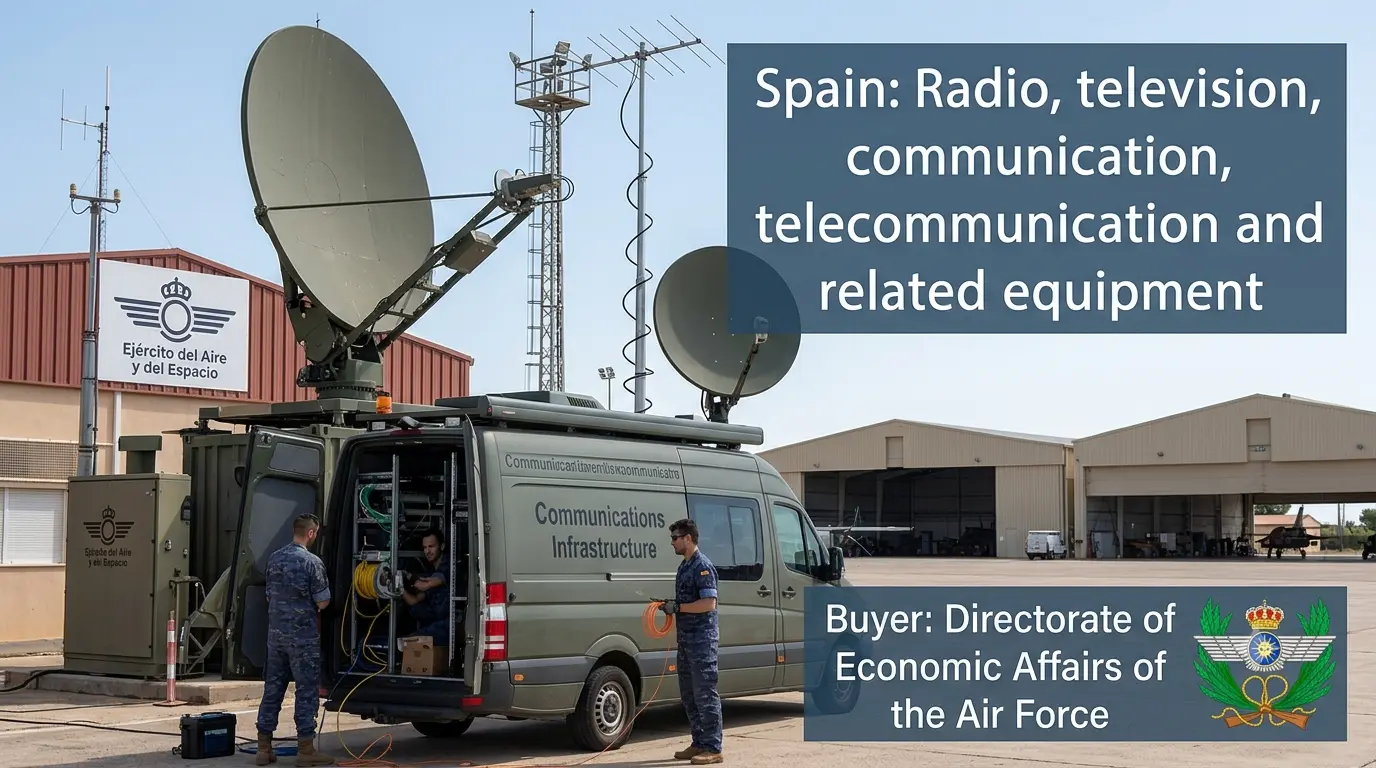
Spain Establishes €33.07 Million Framework for Military Communications Infrastructure
15 Oct 2026
SEO Title: Spain Awards €33.07M Military Communications Framework Meta Description: Spain’s Air and Space Force awards a six-lot communications infrastructure framework with a maximum value of €33.07 million covering nationwide installations. Meta Keywords: Spain military communications tender, Spanish Air and Space Force procurement, communications infrastructure contract Spain, computer network installation tender, TED contract award, public procurement Spain, CPV 32000000, framework agreement Suggested URL Slug: spain-air-space-force-communications-infrastructure-framework Spain Establishes €33.07 Million Framework for Military Communications Infrastructure Standfirst: Spain’s Dirección de Asuntos Económicos del Ejército del Aire has published the award results for a six-lot procurement covering communications infrastructure and computer network supply and installation for the country’s Air and Space Force. The framework agreement has a maximum value of €33.07 million and divides work across mainland regions, the Balearic Islands and the Canary Islands. EMATEL EMPRESA MADRILEÑA DE TELECOMUNICACION S.L, LÍNEAS Y CABLES, S.A. and NUNSYS, S.A. are named in the award notice as suppliers associated with the lots. However, the notice records tender values of €0.01 and marks those tenders as not ranked, limiting the financial conclusions that can be drawn from the published results. Introduction Spain has moved forward with a nationwide procurement framework for communications and computer network infrastructure supporting the Ejército del Aire y del Espacio, the Spanish Air and Space Force. The award notice, published on 15 October 2026 in Supplement to the Official Journal of the European Union, issue OJ S 200/2026, concerns the supply and installation of communications and information technology infrastructure at the force’s units, centres and organisations, known in Spanish as Unidades, Centros y Organismos or UCOs. The contracting authority is the Dirección de Asuntos Económicos del Ejército del Aire, the economic affairs directorate of the Air and Space Force. It used an open procedure under Directive 2014/24/EU and divided the procurement into six geographically defined lots. The arrangement covers mainland Spain as well as the Balearic and Canary Islands, with individual lots encompassing groups of provinces and territories. The notice identifies a maximum framework value of €33.07 million. It also lists estimated values for the six lots totalling €11.89 million. These figures describe different financial measures and should not be treated as interchangeable. The notice’s individual tender values are recorded as €0.01, with the tenders marked as not ranked. Consequently, the publication does not establish the actual prices payable under the framework. Why This Contract Matters Military communications infrastructure supports information exchange, network connectivity and the digital systems used by defence organisations. Maintaining these capabilities across geographically dispersed facilities can require equipment supply, installation services and coordinated technical delivery. The notice does not identify specific network technologies, security specifications or individual installations, but its scope establishes a procurement route for communications and computer network infrastructure across the Air and Space Force’s national footprint. The six-lot structure is significant because it separates delivery by geography rather than treating the entire country as one undivided service area. This can create opportunities for suppliers with regional installation capacity, logistics arrangements and technical support teams. It can also help the contracting authority manage requirements across different locations through a common procurement framework. For businesses tracking Spanish defence procurement, the award demonstrates the importance of monitoring framework agreements as well as individual contract notices. A framework can establish supplier arrangements for subsequent requirements, although the specific ordering mechanism and eventual expenditure depend on the framework terms and future call-offs. The notice states that the framework operates partly without reopening competition and partly with reopening competition. Contract Timeline The TED notice records the following dates and identifiers: Internal procedure reference: 2026/EA04/00000254E. Procedure identifier: de8a24aa-5b5f-40c3-bd5d-f0eb57ae754a. Winner selection date recorded: 9 September 2026. Contract conclusion date recorded: 9 October 2026. Notice dispatch date: 14 October 2026. TED publication date: 15 October 2026. The award notice refers to an earlier notice identifier, 6a9428c0-4596-44d8-a963-4ac2fbe337b0-01. That reference can help suppliers trace the procurement history and locate the original competition documents. Businesses undertaking due diligence should review the original notice and framework documentation alongside the published result, particularly where they need to establish technical requirements, participation conditions or the rules for future orders. Contract Overview The procurement is classified as a supplies contract, with installation services also included in its classification. The principal CPV code is 32000000, covering radio, television, communication, telecommunication and related equipment. The additional CPV code is 51300000, covering installation services of communications equipment. The procedure was conducted under the open-procedure route and is based on Directive 2014/24/EU. The award criteria recorded for the lots assign 100 points to price, described in Spanish as “DESCUENTO PONDERADO TOTAL”, meaning total weighted discount. This indicates that price or the specified discount calculation was the stated award criterion. The notice does not provide enough information to reconstruct the detailed scoring calculations or verify how each offer was evaluated. The framework agreement has a maximum value of €33.07 million, while the estimated values attached to the six lots total €11.89 million. The framework’s maximum value is a ceiling stated in the notice, not proof that this amount has already been spent or committed through individual orders. Key Contract Details FieldDetails Notice titleSupply and installation of communications infrastructure and computer networks for Air and Space Force units, centres and organisations throughout Spain TED publication number713546-2026 Publication date15 October 2026 Contracting authorityDirección de Asuntos Económicos del Ejército del Aire CountrySpain ProcedureOpen procedure Legal basisDirective 2014/24/EU Principal CPV32000000: Radio, television, communication, telecommunication and related equipment Additional CPV51300000: Installation services of communications equipment Number of lotsSix Maximum framework value€33,070,000 Combined estimated value of lots€11,890,000 excluding VAT, as listed by the notice Recorded award criterionPrice, with 100 points assigned to the stated weighted-discount criterion Framework mechanismPartly without reopening and partly with reopening of competition EU fundingThe notice states that the procurement is not financed by EU funds TED sourceNotice 713546-2026 Project Scope The contract covers the supply and installation of communications and computer network infrastructure for Air and Space Force units, centres and organisations throughout Spain. Its six lots are divided by geographical coverage: Lot 1: Includes La Coruña, Burgos, León, Salamanca and Valladolid. Lot 2: Includes Albacete, Madrid, Segovia and Toledo in the lot description. The notice’s place-of-performance fields also list several provinces across central and western Spain, including Ávila, Burgos, León, Palencia, Salamanca, Soria, Valladolid, Zamora, Ciudad Real, Cuenca, Guadalajara, Badajoz and Cáceres. Lot 3: Covers Alicante, Barcelona, Gerona, Murcia, Navarra, Tarragona, Valencia and Zaragoza in the lot description. Its listed performance areas also include Araba/Álava, Gipuzkoa, Bizkaia, La Rioja, Huesca and Teruel. Lot 4: Includes Badajoz, Cádiz, Granada, Málaga and Sevilla, as well as the Autonomous City of Melilla. The detailed place-of-performance fields also list Almería, Córdoba, Huelva, Jaén, Murcia and Ceuta. Lot 5: Covers the Balearic Islands, with Eivissa y Formentera, Mallorca and Menorca named in the notice. Lot 6: Covers the Canary Islands, including El Hierro, Fuerteventura, Gran Canaria, La Gomera, La Palma, Lanzarote and Tenerife. The notice’s lot descriptions and place-of-performance lists are not identical in every case. Suppliers should therefore consult the official procurement documents for the authoritative territorial scope of each lot rather than relying solely on a short summary. The published award notice does not specify quantities of equipment, detailed network architecture, technical standards, delivery schedules or individual site requirements. About the Contracting Authority Dirección de Asuntos Económicos del Ejército del Aire is the economic affairs directorate of Spain’s Air and Space Force and is identified as the buyer in the TED notice. It is classified as a central government authority and its contracting activity is defence. The authority’s listed contact email is sea04contratacion@ea.mde.es, and its address is in Madrid. The directorate is responsible for the procurement process described in the notice. Suppliers seeking the original specifications, framework conditions or clarification of the lot boundaries should use the official buyer profile and the tender documentation available through Spain’s public-sector procurement platform. The TED result provides the award information, but the original procurement file is the appropriate source for detailed requirements and contractual terms. About the Organisations Involved EMATEL EMPRESA MADRILEÑA DE TELECOMUNICACION S.L is a Madrid-based company identified in the notice as an economic operator and winner associated with Lots 1, 2, 3 and 4. The notice lists it as a large economic operator and gives Madrid as its location. LÍNEAS Y CABLES, S.A. is a company based in Pozuelo de Alarcón, in the Madrid region. The notice classifies it as a micro, small or medium-sized enterprise. It appears in the results for Lot 1 and is listed as a non-winning tenderer for Lots 2, 3 and 4. The organisation summary also associates it with Lot 1 as a winner, although the individual tender record marks the tender as not ranked. NUNSYS, S.A. is a technology company based in Paterna, Valencia. The notice identifies it as a large economic operator and lists it as a winner associated with Lots 1, 5 and 6. It appears among the non-winning tenderers for Lots 2, 3 and 4. As with the other suppliers, the €0.01 tender values and “not ranked” indicators mean the published result should not be interpreted as a normal price-ranked award list. Tribunal Administrativo Central de Recursos Contractuales is Spain’s Central Administrative Tribunal for Contractual Appeals. It is named in the notice in connection with review procedures. The notice gives a review deadline of 15 working days. Suppliers considering a challenge should confirm the applicable deadline and procedural requirements from the official documentation and relevant rules. Procurement Analysis The procurement combines a national operational requirement with a geographically divided framework. This arrangement can allow the authority to use a consistent procurement structure while recognising that installations must be carried out across different regions and island territories. It also gives suppliers a defined set of geographical areas against which they can assess logistics, staffing and technical support requirements. The notice records four tenders for each of Lots 1 to 4, while Lots 5 and 6 each received one tender. These are the published lot-level tender counts, not necessarily counts of unique companies across the entire procedure. The award section lists three supplier names for Lot 1, while EMATEL is associated with Lots 2 to 4 and NUNSYS with Lots 5 and 6. The tender-level records nevertheless mark the recorded tender values as €0.01 and indicate that the tenders were not ranked. That combination calls for caution. The notice establishes that at least one winner was selected for each lot and identifies the organisations associated with the results, but the displayed price fields do not support a meaningful comparison of offers. The record should not be used to claim that one supplier submitted the lowest bid, that the framework was awarded for €0.01 or that a specific discount was achieved. The actual financial terms need to be confirmed from the underlying framework documentation or subsequent award and call-off information. The notice also records a price-based award criterion, with 100 points assigned to the total weighted-discount measure. This is a relevant signal for suppliers preparing future bids, but it does not replace the detailed formula, product price schedules or other requirements that would be contained in the procurement documents. Additional Procurement Facts The procurement is not financed with European Union funds, according to the notice. The notice states that the procurement is not covered by the Government Procurement Agreement. No dynamic purchasing system is indicated. The framework agreement is described as partly operating without reopening competition and partly with reopening competition. The stated strategic procurement field says “No strategic procurement”. The notice includes a social objective relating to employment opportunities for the long-term unemployed, disadvantaged people and/or people with disabilities. The environmental-impact field is recorded as “Other”; the notice does not provide enough detail in that field to establish a specific environmental performance requirement. The review deadline is recorded as 15 working days. These details can influence supplier planning. In particular, businesses should not assume that a framework agreement guarantees a minimum order volume. The notice gives a maximum value but does not, in the information summarised here, establish a minimum spend commitment or the timing and size of future orders. Market and Industry Perspective The contract sits at the intersection of telecommunications equipment supply, network installation and public-sector technology procurement. Potentially relevant suppliers may include communications equipment distributors, network infrastructure integrators and installation companies capable of working across multiple regions. The exact technical requirements, however, are not specified in the award notice, so the procurement should not be taken as evidence that any particular technology or vendor platform is required. The six-lot structure may be particularly relevant to companies that can support a defined regional footprint rather than provide nationwide delivery independently. A supplier might assess whether it can cover one or more lots directly, work with a delivery partner where permitted, or participate in future competitions under the framework’s reopening mechanism. Any subcontracting or consortium strategy must be checked against the applicable tender conditions. The recorded participation also offers a limited view of competition. Lots 1 to 4 each received four tenders, whereas the island lots received one tender each. This suggests a difference in the number of offers recorded for mainland and island lots in this procedure, but the notice alone cannot explain the cause. Geographic delivery costs, specialist capacity, supplier interest or other factors could affect participation; these remain possible explanations rather than established findings. Economic Significance The maximum framework value of €33.07 million indicates the upper financial scale stated for the agreement. The six estimated lot values add up to €11.89 million, a separate figure that should be reported as the sum of the estimates listed for the lots. The notice also records the framework maximum and approximate framework value at €33.07 million. These figures do not establish the value of orders already placed, actual expenditure or final supplier revenue. A framework agreement can provide a mechanism for purchasing during its term, but the amount ultimately called off may differ from the maximum. Because the notice displays €0.01 as the tender value for the listed offers and marks those tenders as not ranked, it is not possible to calculate a reliable awarded contract total or verified saving against the estimates from this notice alone. For the wider market, the procurement is a potential source of demand for communications equipment and installation capacity across a range of Spanish territories. Its economic effect will depend on subsequent orders, the actual scope of work delivered and the contractual prices applied. Those details need to be verified through framework and call-off records rather than inferred from the maximum value. Future Procurement Opportunities Suppliers should monitor the framework for future requirements, including any reopening of competition where the framework terms provide for it. The award notice describes the framework as partly without reopening competition and partly with reopening competition, meaning that the applicable process may differ depending on the relevant arrangement and requirement. Businesses can also follow related communications and network procurement from Spanish defence bodies and other public authorities. A useful starting point is the official Plataforma de Contratación del Sector Público, alongside TED notices for cross-border visibility. Tender alerts and procurement intelligence services can help suppliers identify relevant notices, corrigenda, framework awards and subsequent opportunities. For broader discovery, suppliers can review current tenders on SpainTenders.com and the contract awards section. These resources can support market monitoring, but the official notice and buyer documents remain the authoritative source for participation requirements. Opportunities for Suppliers Communications equipment suppliers and installation contractors can use this award notice to understand the types of public-sector requirements being procured and how the authority has divided geographical coverage. The notice does not establish an open opportunity to join the existing framework, so companies should not assume that the award creates an immediate route for new suppliers to participate. For future competitions, businesses should prepare evidence of relevant equipment supply capability, installation experience, regional delivery coverage and the ability to meet public-sector contractual requirements. The technical specifications and eligibility conditions must be taken from each individual tender document rather than inferred from the CPV codes alone. Suppliers should also review the price criterion carefully. The award notice identifies a total weighted-discount measure, but does not reproduce its complete calculation method. Companies should understand the applicable pricing schedule and discount formula before submitting offers. The published €0.01 tender values should not be used as a benchmark for commercial pricing. Small and medium-sized businesses may find value in tracking geographically focused lots and identifying where their capabilities fit. However, any subcontracting, consortium or partnership arrangement must be permitted by the specific procurement rules. The notice records no subcontracting for the listed tender entries, so it does not demonstrate that subcontracting was part of the awarded arrangement. What Businesses Should Watch Framework call-offs: Watch for subsequent notices or buyer information showing when orders are placed and which suppliers receive them. Actual financial values: Verify call-off values and contractual prices before making any estimate of revenue or savings. Lot boundaries: Check the original tender documents because some lot descriptions and detailed performance-area lists differ in the notice. Reopening of competition: Establish which framework requirements are competed again and which can be awarded without a new competition. Technical specifications: Review the original documents for equipment requirements, installation standards, delivery obligations and acceptance procedures. Review deadlines: The notice records 15 working days for review procedures. Any potential challenge should be assessed promptly against the applicable legal rules. Supplier status and award records: Read the individual tender entries alongside the organisation summary, particularly for Lot 1, where several companies are associated with the result. SpainTenders.com Procurement Intelligence This award illustrates why public procurement intelligence needs to distinguish between a framework ceiling, estimated lot values and actual contract prices. The maximum value of €33.07 million provides a useful indicator of the potential scale of the arrangement, while the combined lot estimates of €11.89 million describe the estimated values recorded for the individual geographic packages. Neither figure proves the value of orders already placed. The notice also shows the importance of comparing the award section with the supplier and tender records. The listed supplier names and lot associations provide useful market intelligence, but the €0.01 tender entries and “not ranked” indicators prevent a dependable price comparison. Treating those figures as real commercial offers would risk misrepresenting the result. Suppliers tracking Spanish communications and defence opportunities can use SpainTenders.com’s tender listings to monitor new procurement notices and contract awards to follow published outcomes. Registered users can also access the platform through login or registration. Businesses requiring assistance with platform access can use the contact page. The most useful next step for market analysis is to follow the original tender documentation and future call-off information. These records can establish which suppliers receive orders, the actual values committed and the operational requirements that translate the framework into commercial activity. Supplier Takeaways The framework covers communications infrastructure and computer network supply and installation for Spain’s Air and Space Force. The notice divides the work into six lots spanning mainland regions, the Balearic Islands and the Canary Islands. The stated maximum framework value is €33.07 million; the six lot estimates total €11.89 million. EMATEL EMPRESA MADRILEÑA DE TELECOMUNICACION S.L, LÍNEAS Y CABLES, S.A. and NUNSYS, S.A. are named in the supplier and award records. The notice records four tenders each for Lots 1 to 4 and one tender each for Lots 5 and 6. The stated award criterion is price, expressed as a total weighted discount worth 100 points. The €0.01 tender values are not a reliable representation of actual framework prices, and the tenders are marked as not ranked. Suppliers should review the original procurement documents and monitor future call-offs before drawing conclusions about revenue or market share. Key Takeaways Spain’s Air and Space Force has published the results of a six-lot communications and computer network infrastructure framework. The contracting authority is the Dirección de Asuntos Económicos del Ejército del Aire. The framework’s maximum value is €33.07 million, while the lot estimates total €11.89 million. The award notice associates three suppliers with the results, with different lot-level records and tender outcomes. The published tender price fields are anomalous for financial analysis because they show €0.01 and mark the tenders as not ranked. Future orders and call-off notices will be important for understanding actual expenditure, supplier revenue and implementation activity. Conclusion The Spanish Air and Space Force communications infrastructure framework establishes a procurement structure for equipment supply and installation across six geographic lots. With a stated maximum value of €33.07 million, it represents a significant potential procurement channel for communications equipment and network installation suppliers. The framework’s regional design and mixed competition mechanism are relevant to businesses assessing delivery coverage and future participation routes. However, the award notice does not provide a dependable basis for comparing actual supplier prices or calculating realised savings. Its €0.01 tender values and not-ranked indicators must be treated as reporting limitations, not as evidence of the financial terms of the framework. Suppliers and procurement analysts should use the official tender documents and subsequent call-off information to establish the actual commercial position. The TED notice remains the primary published source for the award details summarised in this article. Source TED, “Spain – Radio, television, communication, telecommunication and related equipment – Supply and installation of communications infrastructure and computer networks for units, centres and organisations of the Air and Space Force throughout Spain,” publication number 713546-2026, OJ S 200/2026, published 15 October 2026. Read the official TED notice.
View Details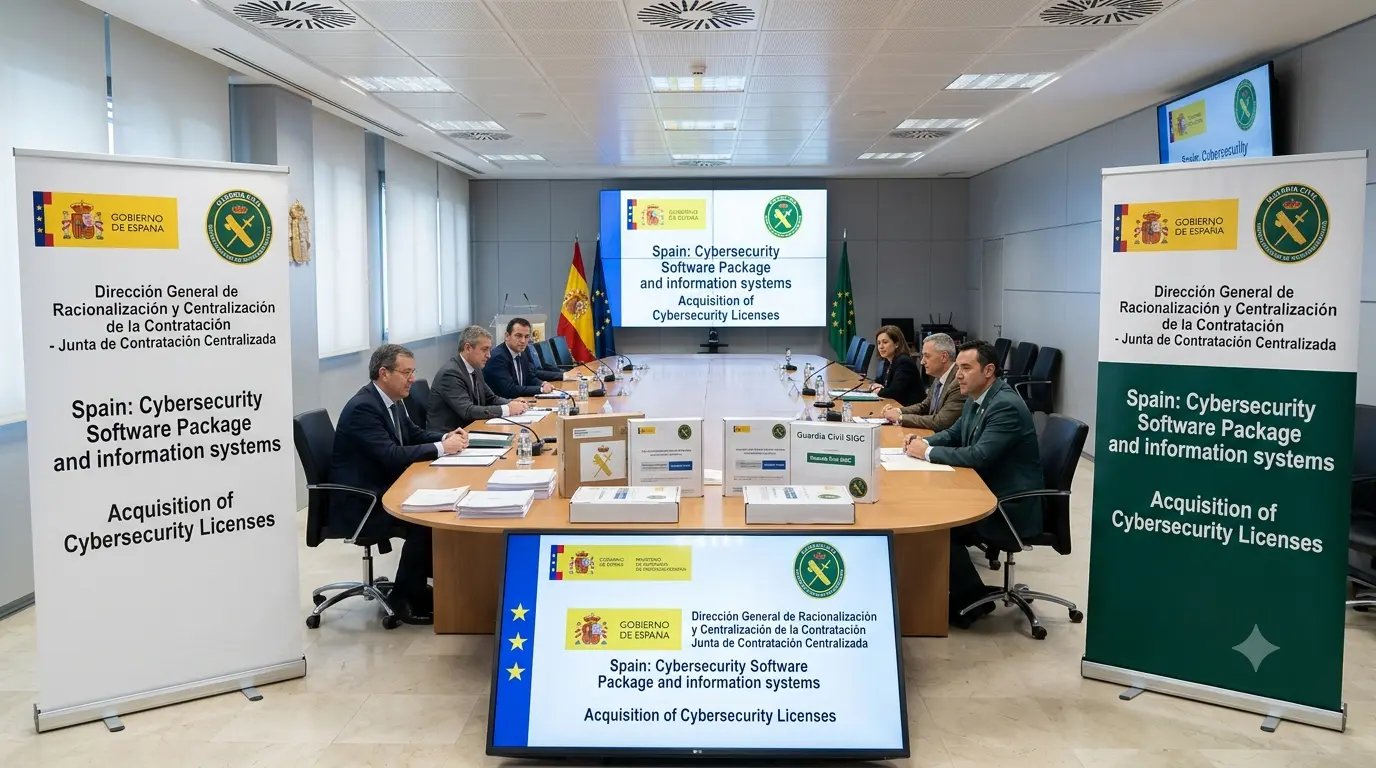
Spain's Civil Guard Buys Cybersecurity Licences for Its Intelligence Unit in a EUR 204,159 Deal
14 Oct 2026
Standfirst Spain's centralised procurement body has awarded a contract to Dars Telecom SL for cybersecurity licences used by the Civil Guard's Intelligence Headquarters. The contract is worth EUR 204,158.62 and was awarded under a restricted procedure. Two bids were received, neither from an SME, and the winning bid came in at the awarded value. The contract was concluded on 9 October 2026 and is covered by the Government Procurement Agreement. Introduction The Guardia Civil is Spain's national gendarmerie, responsible for policing rural areas, borders, coasts and a wide range of criminal investigations. Its Jefatura de Información, or Intelligence Headquarters, is the unit responsible for gathering, analysing and acting on intelligence related to terrorism, organised crime, extremism and other threats to national security. The work of that unit depends on secure communications, protected data handling and specialised analytical tools. Cybersecurity licences are part of that operational toolkit. They cover software used to protect systems, detect intrusions, analyse threats and secure communications. For an intelligence unit, the licences are not administrative purchases. They are operational necessities, and their procurement is handled through Spain's centralised procurement system rather than by the unit itself. The Dirección General de Racionalización y Centralización de la Contratación has now awarded a contract for those licences to Dars Telecom SL. Why This Contract Matters This contract matters because it supports the operational capability of a national intelligence unit. The Guardia Civil's Intelligence Headquarters works on some of the most sensitive investigations in Spain, and its systems must be protected against sophisticated threats. Cybersecurity licences provide the tools that keep those systems secure, and a lapse in licensing or support can leave vulnerabilities unpatched and systems exposed. It also matters because of the procurement model. The contract was awarded through Spain's centralised procurement body rather than by the Civil Guard directly. That reflects the wider Spanish approach of aggregating demand for commonly used goods and services, including software and IT security, to achieve better terms and reduce administrative duplication. Centralised procurement for security licences also helps standardise what different units use, which can simplify support and interoperability. The contract also matters because of its competition and price outcome. Two bids were received, neither from an SME, and the winning bid matched the awarded value exactly. That is a modest field for a specialist security procurement, and it suggests that the market for these particular licences is narrow, possibly because they are tied to specific manufacturers or authorised channels. The absence of SME bids is notable, since smaller suppliers often compete in software licensing, and it may indicate that the requirements were difficult for smaller firms to meet. Contract Timeline Previous notice: 22a14bcd-1b69-4747-a679-62dfd5a199d8-01 Contract concluded: 9 October 2026 Notice dispatched: 12 October 2026 Notice published: 14 October 2026 Contract Overview The contract covers the acquisition of various cybersecurity licences for the area of operation of the Guardia Civil's Intelligence Headquarters, under the Ministry of the Interior's Security division. It is classified as a supplies contract, under CPV 48000000 (software package and information systems). It is a single-lot procurement, identified as LOT-0000, with the internal identifier CEA4398/2026 and the contract identifier A4398/2026. The place of performance is Madrid (ES300), Spain. The notice does not disclose an estimated value, so it is not possible to compare the awarded value with the buyer's pre-tender estimate. The procurement was conducted as a restricted procedure under Directive 2014/24/EU. In a restricted procedure, suppliers must first be selected through a pre-qualification process before they can submit a tender. The contract is not a framework agreement and does not use a dynamic purchasing system. It is not financed with EU funds. It is covered by the Government Procurement Agreement. The awarded value is EUR 204,158.62, which was also the value of the winning tender. Key Contract Details Notice ID 711087-2026 OJ S issue 199/2026 Publication date 14 October 2026 Contracting authority Dirección General de Racionalización y Centralización de la Contratación – Junta de Contratación Centralizada Contract type Supplies Main CPV code 48000000 – Software package and information systems Procedure type Restricted procedure Legal basis Directive 2014/24/EU Lot LOT-0000 Winner Dars Telecom SL Winning bid EUR 204,158.62 Number of bids 2 Award criteria Quality – 50 points for automatically quantifiable criteria; 50 points for value-judgement criteria Framework agreement No Dynamic purchasing system No EU funding No GPA covered Yes Subcontracting No SME participation 0 SME tenders received Strategic procurement Reduction of environmental impacts – transition to a circular economy Contract identifier A4398/2026 Project Scope The scope is the acquisition of various cybersecurity licences for the area of operation of the Guardia Civil's Intelligence Headquarters. The notice describes the subject in Spanish as "Adquisición De Diversas Licencias De Ciberseguridad En El Ámbito De Actuación De La Jefatura De Información De La Guardia Civil." The notice does not disclose which specific licences are being acquired, which manufacturers or products they relate to, how many licences are involved, or what the licences are used for. Those details would be in the tender documents, which are not included in the TED notice. For an intelligence unit, such information is often sensitive, and the notice is deliberately non-specific. The contract is classified under CPV 48000000, which covers software packages and information systems generally. That is a broad classification, and it does not narrow down whether the licences are for endpoint protection, network monitoring, encryption, forensic analysis, threat intelligence or some other security function. The contracting authority has not disclosed this information. The contract does not include a disclosed duration, and it does not include any renewal provisions. That suggests it may be a one-off licence purchase or a short-term arrangement rather than a long-term subscription. The contracting authority has not disclosed the delivery timeline or the licence term. About the Contracting Authority The buyer is the Dirección General de Racionalización y Centralización de la Contratación, the Directorate General for the Rationalisation and Centralisation of Procurement, acting through the Junta de Contratación Centralizada, the Central Procurement Board. It is part of Spain's Ministry of Finance and is classified as a central government authority with general public services activity. Its registration numbers are S2801213F and 10000380072701, and its address is in Madrid, postcode 28014. The directorate is responsible for centralising and rationalising public procurement across Spain's central government. It runs framework agreements and centralised contracts that other public bodies can use, and it manages the Central Procurement Board. Its role in this procurement is as buyer and review organisation, and it acts on behalf of the Guardia Civil's Intelligence Headquarters, which is the end user of the licences. Its contact email is secretaria.contratacioncentralizada@hacienda.gob.es, and its telephone number is +34 915958100. Its buyer profile is hosted on the Spanish national procurement platform at contrataciondelestado.es. The notice lists the Tribunal Administrativo Central de Recursos Contractuales (TACRC) and the Tribunal Superior de Justicia (TSJ) as review bodies in its other contact points. About the Organisations Involved Dirección General de Racionalización y Centralización de la Contratación – Junta de Contratación Centralizada The directorate is the contracting authority. It is a central government body within Spain's Ministry of Finance, responsible for centralising public procurement. Its role in this procurement is as buyer, manager of the tender process and review organisation. It is registered in Madrid, with registration numbers S2801213F and 10000380072701. It runs the centralised procurement framework through which the Guardia Civil's cybersecurity licences are acquired. It will manage the contract and ensure that the licences are delivered to the end user. Dars Telecom SL Dars Telecom SL is the winning bidder. It is classified as a large economic operator. Its registration number is B84767300, and it is based in Madrid, postcode 28008, in the Madrid NUTS region (ES300). Its email address is comercial@darstelecom.es, and its telephone number is 659686020. Its beneficial owner is of Spanish nationality. Dars Telecom is a Spanish technology company that provides telecommunications and security solutions to public and private sector clients. It submitted the winning tender for LOT-0000, valued at EUR 204,158.62. It declared no subcontracting, meaning it will deliver the full scope itself. Its role is as tenderer and winner of LOT-0000. It will supply the cybersecurity licences to the Guardia Civil's Intelligence Headquarters through the centralised procurement framework. The notice does not disclose which manufacturers or products the licences relate to, or whether Dars Telecom is acting as a reseller, integrator or manufacturer. The contracting authority has not disclosed this information. Guardia Civil – Jefatura de Información The Guardia Civil is Spain's national gendarmerie, and the Jefatura de Información is its Intelligence Headquarters. The unit is the end user of the cybersecurity licences procured under this contract. It is not the contracting authority, but it is the organisation whose operational capability the contract supports. Its role is materially relevant to understanding why the contract was awarded and what it is for, even though it is not named as a buyer in the notice. Review bodies The notice lists the Tribunal Administrativo Central de Recursos Contractuales (TACRC) and the Tribunal Superior de Justicia (TSJ) as review bodies. The TACRC is Spain's central administrative tribunal for public procurement disputes, and the TSJ is the regional high court. Together they provide the legal routes through which bidders can challenge procurement decisions. The notice refers suppliers to the general information on review procedures rather than specifying deadlines. Other organisations The notice does not identify the non-winning bidder by name. It records that two tenders were received, neither from an SME, but only the winner is named. No consortium members, framework participants or subcontractors are disclosed. No other organisation materially affects the understanding of this award. Procurement Analysis The procurement was conducted as a restricted procedure under Directive 2014/24/EU. In a restricted procedure, suppliers must first submit a request to participate and be selected through a pre-qualification process. Only those selected are invited to submit a tender. That limits the field to pre-qualified suppliers, but it also ensures that bidders meet the buyer's qualification standards. For a security-sensitive procurement involving an intelligence unit, a restricted procedure is a logical choice, because it allows the buyer to control who can bid. The award criteria were split into two equal halves. Quality criteria that can be quantified automatically carried 50 points, and quality criteria based on value judgements carried 50 points. Price is not listed as a separate criterion in the notice. That is unusual, and it suggests that the evaluation focused on technical merit and quality rather than cost, or that the commercial terms were fixed by the centralised framework and the competition was on capability. The contracting authority has not explained this in the notice. Two bids were received, both submitted electronically, and neither from an SME. The absence of SME bids is notable. Cybersecurity licensing for an intelligence unit typically requires authorised partner status with the relevant manufacturers, security clearances or a track record of delivering to sensitive government clients. Those requirements narrow the field to a small number of large, established suppliers. The fact that the winning bid matched the awarded value exactly means the recorded value is the supplier's own price rather than a figure adjusted after evaluation. Additional Procurement Facts Legal basis: Directive 2014/24/EU. Procedure: Restricted procedure. Award criteria: Quality – 50 points for automatically quantifiable criteria; 50 points for value-judgement criteria. Price is not listed as a separate criterion in the notice. Number of bids: 2, both submitted electronically. SME participation: 0 SME tenders received. Awarded value: EUR 204,158.62. Estimated value: Not disclosed. EU funding: The procurement project is not financed with EU funds. GPA: Covered by the Government Procurement Agreement. Framework agreement: None. Dynamic purchasing system: None. Subcontracting: The winning tenderer declared no subcontracting. Strategic procurement: Reduction of environmental impacts through a transition to a circular economy. Review bodies: Tribunal Administrativo Central de Recursos Contractuales (TACRC) and Tribunal Superior de Justicia (TSJ). Complaints: None recorded. Market and Industry Perspective Spain's public sector cybersecurity market is large and centralised. The Dirección General de Racionalización y Centralización de la Contratación runs framework agreements for security software and related services that public bodies can use without running their own tenders. That model reduces administrative burden and gives the public sector greater purchasing power, but it also tends to favour suppliers that are already on the relevant frameworks and hold the necessary vendor authorisations. Cybersecurity licensing for intelligence and law enforcement units is a specialised segment of that market. The products involved are often subject to export controls, security clearances and vendor restrictions on who can resell or support them. That narrows the field of qualified suppliers and explains why no SMEs bid for this contract. Large Spanish integrators and specialist security resellers dominate this segment, and they compete on their vendor relationships, their security clearances and their track record of delivering to sensitive clients. This contract reflects that structure. Two large suppliers bid, and the winner was Dars Telecom, a Madrid-based technology company. The notice does not disclose the specific products involved, which is consistent with the sensitivity of the end user. The fact that price is not listed as a separate award criterion suggests that the evaluation prioritised capability and quality, which is typical for security-sensitive procurements where technical suitability matters more than cost. The inclusion of an environmental objective for reducing impacts through a circular economy is notable, though the notice does not explain how it applies to a software licence purchase. Economic Significance At EUR 204,158.62, this is a modest contract in absolute terms. It is small relative to Spain's overall public sector cybersecurity spending and small relative to the Guardia Civil's total procurement budget. Its economic significance lies mainly in what it supports: the secure operation of a national intelligence unit. The contract also has a direct economic effect. The money flows to Dars Telecom SL, a large Spanish company based in Madrid, and through it to the manufacturers whose licences are being supplied. Because the winner declared no subcontracting, the economic benefit is concentrated in the winning company rather than spread across a supply chain. The value of the licences to the manufacturers is not disclosed, but in most reseller arrangements a substantial share of the contract value passes through to the vendor. The absence of SME participation has an economic dimension. SMEs are often competitive in software licensing, but in this segment the qualification requirements, vendor authorisations and security considerations exclude them. That limits competition and may reduce the price pressure that SMEs would otherwise provide. From the buyer's perspective, the trade-off is between broader competition and the assurance that only suitably qualified suppliers handle sensitive licences. Future Procurement Opportunities The most likely future opportunity is the renewal or replacement of these licences when they expire. The notice does not disclose the licence term, so it is not possible to say when a renewal will be required. If the licences are annual, a renewal could be expected within a year. Suppliers should monitor the centralised procurement body's buyer profile on contrataciondelestado.es for future notices. There may also be opportunities arising from the broader cybersecurity needs of the Guardia Civil's Intelligence Headquarters. Intelligence units require a range of security capabilities beyond licensing, including integration, configuration, training and support. Those could be procured separately or added to existing arrangements. More broadly, other Spanish security and intelligence bodies have similar needs, and the centralised procurement body may run similar contracts for other units. Suppliers with a track record in this segment will be well positioned to bid for that work. Suppliers should also monitor framework agreements covering cybersecurity software and services, because those are often the route through which individual purchases are made. Opportunities for Suppliers Authorised security software resellers: Suppliers with vendor authorisation for major cybersecurity products are the most likely candidates for similar contracts. Suppliers with security clearances: Contracts for intelligence and law enforcement units often require clearances or a track record of delivering to sensitive clients. Suppliers with those credentials are better positioned. Integration and support providers: Security licences often come with integration, configuration and support requirements. Suppliers with those capabilities may find opportunities alongside licence supply. Framework participants: Suppliers already on relevant centralised framework agreements may be invited to bid for specific licence purchases. Monitoring the buyer: The centralised procurement body's buyer profile on contrataciondelestado.es is the best source for future opportunities. Adjacent security services: The Guardia Civil and other security bodies require a range of security services beyond licensing. Suppliers with capability in those areas should monitor procurement activity. What Businesses Should Watch Whether the licences are renewed: The notice does not disclose the licence term. Suppliers should watch for a renewal or follow-on procurement. Whether the products are disclosed: The notice does not identify the specific licences. Suppliers should watch for any further disclosure or related notices. Whether competition improves: Only two bids were received. Suppliers should watch whether future procurements attract more bidders. Whether the environmental objective is explained: The notice records an environmental objective but does not explain how it applies to a software licence purchase. Suppliers should watch for clarification. Whether similar contracts follow for other units: Other security and intelligence bodies may require similar licences. Suppliers should monitor the centralised procurement body's activity. Whether SME participation increases: No SMEs bid for this contract. Suppliers should watch whether future procurements are structured to allow smaller firms to compete. SpainTenders.com Procurement Intelligence This contract represents a broader trend in European public sector security procurement: centralised purchasing bodies are aggregating demand for cybersecurity licences and services, and restricted procedures are being used where the end user is sensitive. That combination gives the buyer control over who can bid, ensures that suppliers meet qualification standards, and allows the public sector to negotiate terms centrally rather than unit by unit. For suppliers, it means that being on the right framework, holding the right vendor authorisations and having the right security credentials matters more than ever. The award is strategically important because it supports a national intelligence capability. The Guardia Civil's Intelligence Headquarters works on terrorism, organised crime and other threats to national security, and its systems must be protected against sophisticated adversaries. The licences procured under this contract are part of that protection, and their continuous availability is an operational requirement rather than an administrative preference. Suppliers can learn several things from this procurement. First, restricted procedures favour qualified suppliers. The buyer controlled who could bid, and only two large suppliers qualified. Second, SME participation is difficult in this segment. The absence of SME bids reflects the qualification requirements, vendor authorisations and security considerations involved. Third, quality can outweigh price. The notice does not list price as a separate award criterion, which suggests the evaluation focused on capability and technical merit. Fourth, centralised frameworks matter. Being on the right framework is often a precondition for bidding on specific licence purchases. Fifth, confidentiality limits disclosure. The notice does not identify the specific products, quantities or licence terms, which is consistent with the sensitivity of the end user. Suppliers should position themselves accordingly. Cybersecurity resellers and integrators should ensure they hold the vendor authorisations and security credentials needed to compete in this segment. Suppliers on relevant centralised frameworks should monitor the buyer profile for licence purchases that fall within their scope. And suppliers in adjacent security services should look for opportunities that arise from the broader operational needs of intelligence and law enforcement units, even where the specific licences are procured through a separate channel. Future contracts in this market are likely to evolve in two directions. First, centralised procurement of cybersecurity licences will continue to grow, as public bodies seek to aggregate demand and standardise their security estates. Second, restricted procedures and security-sensitive requirements will remain common where the end user is an intelligence, defence or law enforcement unit, which will keep competition narrow and favour established suppliers with the right credentials. Suppliers that can meet those requirements will be well positioned. Suppliers that cannot will find themselves excluded from a segment that is small in individual contract value but strategically important in aggregate. Supplier Takeaways Spain's centralised procurement body awarded a contract for cybersecurity licences for the Guardia Civil's Intelligence Headquarters to Dars Telecom SL. The contract value is EUR 204,158.62. The procurement was a restricted procedure under Directive 2014/24/EU. Two bids were received, neither from an SME. Award criteria were quality-based: 50 points for automatically quantifiable criteria and 50 points for value-judgement criteria. Price is not listed as a separate criterion in the notice. The winner, Dars Telecom SL, is a large Spanish company based in Madrid and declared no subcontracting. The contract is not a framework agreement, not a dynamic purchasing system and not EU-funded. It is covered by the Government Procurement Agreement. The notice does not disclose the specific licences, quantities or licence term. The contract includes a strategic procurement objective for reducing environmental impacts through a transition to a circular economy. The review bodies include the Tribunal Administrativo Central de Recursos Contractuales (TACRC) and the Tribunal Superior de Justicia (TSJ). Key Takeaways Spain's Dirección General de Racionalización y Centralización de la Contratación awarded a contract for cybersecurity licences to Dars Telecom SL for use by the Guardia Civil's Intelligence Headquarters. The contract value is EUR 204,158.62. The procurement was a restricted procedure, which limited the field to pre-qualified suppliers. Two bids were received, both from large suppliers, with no SME participation. Award criteria were split equally between automatically quantifiable quality criteria and value-judgement quality criteria. Price is not listed as a separate criterion in the notice. The contract is not a framework agreement, not a dynamic purchasing system and not EU-funded. It is covered by the Government Procurement Agreement. The winner declared no subcontracting. The contract includes a strategic procurement objective for reducing environmental impacts through a circular economy. The notice does not disclose the specific licences, quantities or licence term. The review bodies include the Tribunal Administrativo Central de Recursos Contractuales (TACRC) and the Tribunal Superior de Justicia (TSJ). Conclusion Spain's centralised procurement body has secured cybersecurity licences for the Guardia Civil's Intelligence Headquarters, awarding a EUR 204,158.62 contract to Dars Telecom SL. The contract supports the operational security of a unit working on some of the most sensitive investigations in the country, and it was procured through a restricted procedure that limited the field to pre-qualified suppliers. The contract is modest in value but significant in function. It reflects the wider Spanish approach of centralising procurement for security software, and it shows how restricted procedures and quality-based evaluation are used where the end user is sensitive. For suppliers, the contract reinforces the importance of vendor authorisations, security credentials and framework participation in this segment. The notice leaves several questions unanswered, including the specific licences, the licence term and the weighting of the award criteria, but the core award is clear: Dars Telecom will supply the licences, and the Guardia Civil's Intelligence Headquarters will use them to protect its systems. Source: Tenders Electronic Daily (TED), Contract Award Notice 711087-2026, Official Journal of the European Union, OJ S 199/2026, published on 14 October 2026.
View Details
How Foreign Companies Can Bid for Government Contracts in Spain
13 Oct 2026
Introduction Spain offers public procurement opportunities across construction, engineering, information technology, healthcare, transport, energy, consultancy, equipment supply and many other sectors. Foreign companies can pursue these contracts, but the requirements depend on the company's country of establishment, the type and value of the contract and the conditions specified by the contracting authority. For international suppliers, understanding Spanish public procurement law is only the first step. Companies must also identify suitable tenders, demonstrate legal capacity and professional competence, prepare the required documentation, meet electronic signature requirements and submit a compliant offer before the deadline. This guide explains how foreign businesses can participate in Spanish government tenders, how EU and non-EU companies differ under the applicable rules, what documents may be required and how to prepare for electronic bidding. It is intended for international contractors, exporters, service providers, manufacturers and suppliers seeking public sector contracts in Spain. Table of Contents Can Foreign Companies Bid for Government Contracts in Spain? Spain's Public Procurement Legal Framework EU and EEA Companies vs Non-EU Companies Special Rules for Non-EU Companies How to Find Spanish Government Tenders How to Identify Suitable Contracts How to Register and Prepare for Electronic Bidding Documents Foreign Companies May Need How to Prove Legal Capacity and Representation Economic and Financial Solvency Requirements Technical and Professional Qualification Requirements ROLECE Registration and Foreign Suppliers Electronic Signatures and Digital Certificates How to Submit a Tender in Spain Spanish Language, Translation and Document Formalities Can Foreign Companies Bid Through a Spanish Partner? Taxes, Social Security and Contract Performance How Contract Awards Are Published Common Mistakes Foreign Bidders Should Avoid Practical Checklist for International Suppliers How SpainTenders.com Helps Foreign Suppliers Conclusion Can Foreign Companies Bid for Government Contracts in Spain? Yes. Foreign businesses may participate in Spanish public procurement when they meet the legal eligibility requirements applicable to their country of establishment and the particular contract. Spain's public procurement framework recognises the capacity of companies established in other EU Member States and countries covered by the European Economic Area (EEA) arrangements. Companies from outside these arrangements may also be eligible, subject to the applicable legislation, international agreements and tender conditions. Foreign status alone does not determine whether a company can win a contract. The supplier must also demonstrate that it has the legal capacity to contract, is not subject to a relevant exclusion ground and meets the economic, financial, technical and professional requirements specified for the procurement. Before investing in a bid, international suppliers should therefore confirm both their eligibility to participate and their ability to satisfy the specific contract requirements. Spain's Public Procurement Legal Framework The main national legislation is Ley 9/2017, de Contratos del Sector Público, commonly called LCSP. It establishes rules for public sector contracting, including eligibility, exclusion, solvency, procurement procedures, award criteria and contract performance. Relevant provisions for foreign businesses include Article 67, which addresses companies from EU Member States and EEA signatory states, and Article 68, which addresses companies from non-EU and non-EEA countries, subject to the statutory wording and applicable international commitments. European Union procurement directives and applicable international agreements may also affect access to particular contracts. Contract-specific requirements remain important: a supplier should read the procurement notice and administrative specifications rather than relying on a general assumption that all foreign companies receive identical access. For each opportunity, examine the eligibility provisions, grounds for exclusion, evidence of capacity, solvency thresholds and any special conditions that apply to the supplier's country or the contract's subject matter. EU and EEA Companies vs Non-EU Companies The distinction between EU/EEA suppliers and businesses established in other countries is important when assessing access to Spanish government contracts. ConsiderationEU/EEA companiesCompanies outside the EU/EEA Legal capacityMust be authorised to perform the relevant activity under the law of the country of establishment.Must meet applicable Spanish procurement rules and any additional conditions relevant to their country. Market accessGoverned by EU/EEA rules and the applicable procurement framework.Depends on applicable international commitments, agreements and Spanish law. EvidenceMay need company registration, authority to perform the activity and solvency evidence.May need comparable evidence and, where applicable, a reciprocity report or other country-specific documentation. Electronic biddingMust comply with the selected platform's identification and submission requirements.Must comply with the same tender-specific technical requirements and establish suitable access and signing arrangements. Local establishmentNot automatically required simply because the company is foreign.A Spanish branch may be required in certain circumstances, including where the tender conditions validly require it for a non-EU company awarded a works contract. This comparison is a general guide, not a substitute for checking the law and the tender documents. Companies from countries with specific procurement agreements may have different rights from companies without relevant market-access commitments. Special Rules for Non-EU Companies Article 68 of Spain's LCSP establishes particular rules for companies from countries outside the EU and EEA, subject to Spain's international obligations. Under the statutory framework, such companies may need to provide a report demonstrating that their country of origin admits Spanish companies to comparable public sector contracts on substantially similar terms. The law identifies Spain's relevant Economic and Commercial Office abroad as the body responsible for preparing this report. It also provides an exception to the reciprocity-report requirement for certain harmonised contracts involving companies from countries that are parties to the World Trade Organization's Agreement on Government Procurement. Article 68 also states that administrative specifications may require a non-EU company awarded a works contract to establish a branch in Spain, appoint representatives for its operations and register with the Commercial Register. These requirements should not be treated as automatic conditions for every foreign bidder. Their applicability depends on the company's country, the contract, relevant international agreements and the specific legal provisions in force. Obtain advice on the current requirements before submitting an offer. How to Find Spanish Government Tenders Foreign suppliers should begin by identifying relevant procurement notices and the contracting authority responsible for each opportunity. Spain's Plataforma de Contratación del Sector Público (PLACSP) is an important national source for public procurement information. Regional and local procurement platforms may also be relevant. Search by product or service, CPV code, contracting authority, location, procedure and submission deadline. International suppliers should try Spanish-language search terms as well as English descriptions because tender titles and specifications commonly use Spanish terminology. Some regional authorities also publish information in their regional language. Use SpainTenders.com tender listings as an additional discovery channel for Spain-related procurement opportunities. Verify the complete notice and the latest documents through the official contracting authority before making a bid decision. How to Identify Suitable Contracts Not every published contract is commercially or legally suitable for an international supplier. Assess each opportunity against your company's capabilities and capacity before preparing a bid. Contract scope: confirm that the goods, services or works match your business activities. Eligibility: determine whether your company can participate under the applicable rules. Estimated value: evaluate whether the contract is commercially viable after logistics, staffing, tax and compliance costs. Solvency: check financial and technical thresholds and the evidence accepted by the authority. Location: determine whether delivery, installation, staffing or local support is necessary. Deadline: allow time for translations, certificates, signatures and internal approvals. Evaluation criteria: understand how price, technical quality and other criteria will be scored. A structured qualification process helps businesses avoid spending resources on tenders they cannot satisfy or deliver profitably. How to Register and Prepare for Electronic Bidding Many Spanish public procurement procedures require electronic submission. The exact platform and technical process depend on the contracting authority and the individual tender. Before a deadline approaches, identify the official electronic submission tool and check whether it requires an account, a recognised electronic certificate, an authorised representative or particular signing software. Where a platform requires registration, complete the process early and test access. Make sure the person responsible for bidding has the necessary authority and that the company's electronic credentials are valid for the required actions. Registration on a tender platform is not the same as registration in a supplier register. A platform account enables access to its functions, while supplier-register entries and tender-specific evidence address separate administrative requirements. Documents Foreign Companies May Need The precise documentation is determined by the tender specifications and the supplier's legal circumstances. A foreign bidder may need to prepare the following: Company incorporation or commercial-register evidence. Evidence of the company's legal capacity and permitted business activities. Documents identifying directors, authorised signatories and representatives. Proof of authority for the person signing or submitting the bid. Declarations concerning exclusion grounds and eligibility. Financial statements, turnover evidence or other proof of economic solvency. References, project records, staff qualifications or equipment information to demonstrate technical capability. Certificates, licences or professional authorisations required for the contract. Technical proposal and financial offer prepared in the prescribed format. Translations, legalisations or authentication documents where required. This is a preparation list rather than a universal mandatory document set. Some procedures allow an initial declaration of eligibility or use a standard form, with supporting evidence requested later. Follow the exact requirements and submission stages stated in the tender. How to Prove Legal Capacity and Representation A company must demonstrate that it legally exists, is entitled to perform the relevant activity and is represented by a person authorised to act on its behalf. Foreign businesses should ensure that their company records and authorisation documents are current and consistent. Differences in company names, registration numbers, addresses or signatory details can lead to clarification requests or compliance problems. Where a bid is submitted by an agent or representative, confirm that the power of attorney or other authorisation meets the tender's requirements. Do not assume that an employee, consultant or local distributor automatically has authority to bind the company. Economic and Financial Solvency Requirements Contracting authorities may require evidence that the bidder has the financial capacity to perform the contract. Depending on the tender, this may include annual turnover, financial statements, professional indemnity insurance or other specified evidence. Foreign suppliers should check the required accounting periods, currency and acceptable document formats. If the tender permits equivalent evidence from the company's home jurisdiction, prepare it in the required form and provide a clear explanation where local reporting terminology differs. Do not assume that a high turnover figure alone satisfies the requirement. The authority may specify a particular reference period, minimum annual turnover, insurance level or other financial test. Technical and Professional Qualification Requirements Technical and professional solvency may be assessed through previous contracts, staff expertise, professional qualifications, equipment, quality assurance arrangements or other evidence specified in the tender. International bidders should select references that are comparable in scope, complexity and value to the Spanish contract. Explain the nature of the work, the client's identity, the delivery period and the bidder's role. If a reference was delivered through a consortium or subcontracting arrangement, accurately describe the company's contribution. Where the procurement requires a professional licence or sector-specific authorisation, confirm that your existing credentials are accepted in Spain or determine what recognition or additional authorisation is needed. ROLECE Registration and Foreign Suppliers ROLECE is the Registro Oficial de Licitadores y Empresas Clasificadas del Sector Público, Spain's Official Register of Tenderers and Classified Undertakings. It records specified information about registered businesses and may simplify the proof of certain eligibility or capacity details in applicable procedures. ROLECE registration is not a universal prerequisite for every Spanish public tender. Its relevance depends on the procurement procedure and the applicable legal requirements. Certain simplified open procedures have specific rules concerning registration in ROLECE or a corresponding regional register, subject to the law and any permitted exceptions. Foreign companies should verify whether registration is available and useful for their circumstances and whether the particular tender requires it. Do not confuse a ROLECE entry with the tender's separate obligations to submit an offer, declarations or evidence that is not covered by the register. Electronic Signatures and Digital Certificates Electronic bidding systems may require documents to be signed electronically or the offer to be submitted through an authenticated account. Foreign companies should check which signature formats and certificates the relevant platform accepts. A digital certificate issued in another country should not be assumed to work with every Spanish procurement system. Confirm compatibility, identification requirements and the authority of the signatory before the submission date. Test the platform, signing application and document-upload process in advance. Keep copies of the signed documents and the submission receipt or other platform-generated evidence. How to Submit a Tender in Spain A practical submission workflow for an international bidder includes these stages: Review the official tender notice and all current documents. Confirm eligibility and identify every required certificate or declaration. Check the contract's solvency, technical and professional requirements. Prepare administrative, technical and financial documents in the prescribed format. Arrange translations, authentication and signatures where required. Register or authenticate on the designated electronic tendering platform. Upload each document into the correct section or electronic envelope. Complete the final submission steps before the deadline. Save the submission receipt and retain the final bid version. Allow sufficient time for large files, digital signatures and unexpected platform issues. A draft or incomplete upload should not be treated as a successfully submitted tender. Spanish Language, Translation and Document Formalities Foreign companies should examine the tender's language requirements before preparing their documentation. Spanish is commonly used in procurement notices and contract documents, while some regional authorities may also use a co-official language. Documents issued abroad may need translation into the language accepted by the contracting authority. Depending on the document, jurisdiction and tender rules, an official or sworn translation, legalisation or apostille may be required. These formalities are not identical for every document or country. Check the exact instructions and applicable international arrangements before ordering translations or authentication. Allow enough time for these steps so that missing formalities do not delay the bid. Can Foreign Companies Bid Through a Spanish Partner? Foreign suppliers may explore participation through a consortium, joint venture, temporary grouping of businesses or subcontracting arrangement where permitted by the procurement rules. Spain's procurement legislation recognises temporary unions of businesses, commonly known as UTEs. Such arrangements can allow companies to combine technical expertise, financial capacity and delivery resources, subject to the tender's conditions and the applicable legal formalities. A local partner can also help with logistics, language, customer support or local operational knowledge. However, partnering does not automatically remove the foreign company's eligibility obligations or guarantee that the proposed structure will satisfy the contracting authority. Before forming a consortium or subcontracting arrangement, establish responsibilities, allocation of work, representation, liability and the evidence each participant must provide. Taxes, Social Security and Contract Performance Winning a Spanish public contract may create obligations beyond tender submission. Depending on the supplier's establishment, activities and contract, these may include tax compliance, employment and social security requirements, sector-specific licences, insurance, data protection, labour standards and environmental obligations. Foreign companies should assess whether staff will work in Spain, whether goods must be imported, whether a local establishment is needed and how the contract will be delivered. Tax and employment treatment can depend on the specific facts and applicable treaties or laws. These issues should be reviewed before bidding so the commercial offer reflects the full cost of performance and the company can meet the contract's conditions if awarded. How Contract Awards Are Published After evaluation, the contracting authority publishes the relevant award information according to the applicable procurement rules. The official procurement record may include the successful bidder, award amount, procedure information and subsequent formalisation details. Foreign suppliers can use award notices to research competitors, understand purchasing patterns and identify buyers with recurring requirements. Historical outcomes can inform a bid strategy, but they do not guarantee future awards or reveal every factor behind an evaluation decision. Use SpainTenders.com contract award information alongside official records to support wider market and competitor research. Common Mistakes Foreign Bidders Should Avoid Assuming all foreign companies have the same access: EU/EEA status, international agreements and the tender's legal framework can affect eligibility. Ignoring Article 68: non-EU companies should assess whether reciprocity evidence or other conditions apply. Using incomplete documents: company records, authorisations and solvency evidence must match the tender requirements. Assuming a foreign certificate is accepted: verify digital signature and authentication compatibility. Leaving translations until the last minute: document formalities can take time. Relying only on a tender summary: read the official notice, PCAP, PPT and amendments. Submitting too close to the deadline: electronic submission failures can put the bid at risk. Underestimating delivery costs: logistics, staff, insurance, tax and local compliance may affect profitability. Practical Checklist for International Suppliers AreaWhat to confirm Market accessCountry-specific eligibility and applicable international commitments Legal capacityCompany registration, permitted activity and authorised representation ReciprocityWhether Article 68 evidence is required for a non-EU/EEA company SolvencyFinancial, technical and professional evidence DocumentsRequired declarations, certificates, translations and authentication RegistrationAny platform account or relevant supplier-register requirements Digital biddingAccepted electronic certificate, signature software and submission tool Commercial viabilityDelivery costs, tax implications, insurance and contract risks DeadlineFinal submission time and proof of successful transmission How SpainTenders.com Helps Foreign Suppliers International businesses often need to identify opportunities across multiple Spanish regions, sectors and contracting authorities. SpainTenders.com can provide an additional discovery channel for researching Spanish public tenders and identifying contracts relevant to a supplier's capabilities. Suppliers can explore Spain public tender listings, review contracting authority information and research procurement sectors relevant to their products and services. Businesses can register on SpainTenders.com to explore available services or log in to an existing account. For assistance with the platform or procurement research, suppliers can contact SpainTenders.com. SpainTenders.com supports opportunity discovery and market research. Final eligibility decisions, legal requirements, amendments and submission instructions must always be verified in the official tender documents and applicable law. Conclusion Foreign companies can pursue government contracts in Spain, but successful participation requires more than finding a suitable tender. Businesses must establish their eligibility, understand the distinction between EU/EEA and non-EU/EEA rules, demonstrate capacity and solvency, prepare compliant documents and meet electronic submission requirements. For companies established outside the EU and EEA, Article 68 of Spain's public procurement law deserves particular attention because reciprocity evidence and other requirements may apply depending on the circumstances. International suppliers should develop a repeatable process for tender discovery, qualification, document preparation and deadline management. Combining official procurement platforms with SpainTenders.com research can help businesses identify relevant opportunities and prepare a more disciplined approach to bidding in Spain.
View Details