Andalucía Public Tenders & Procurement Portal
01 Oct 2026
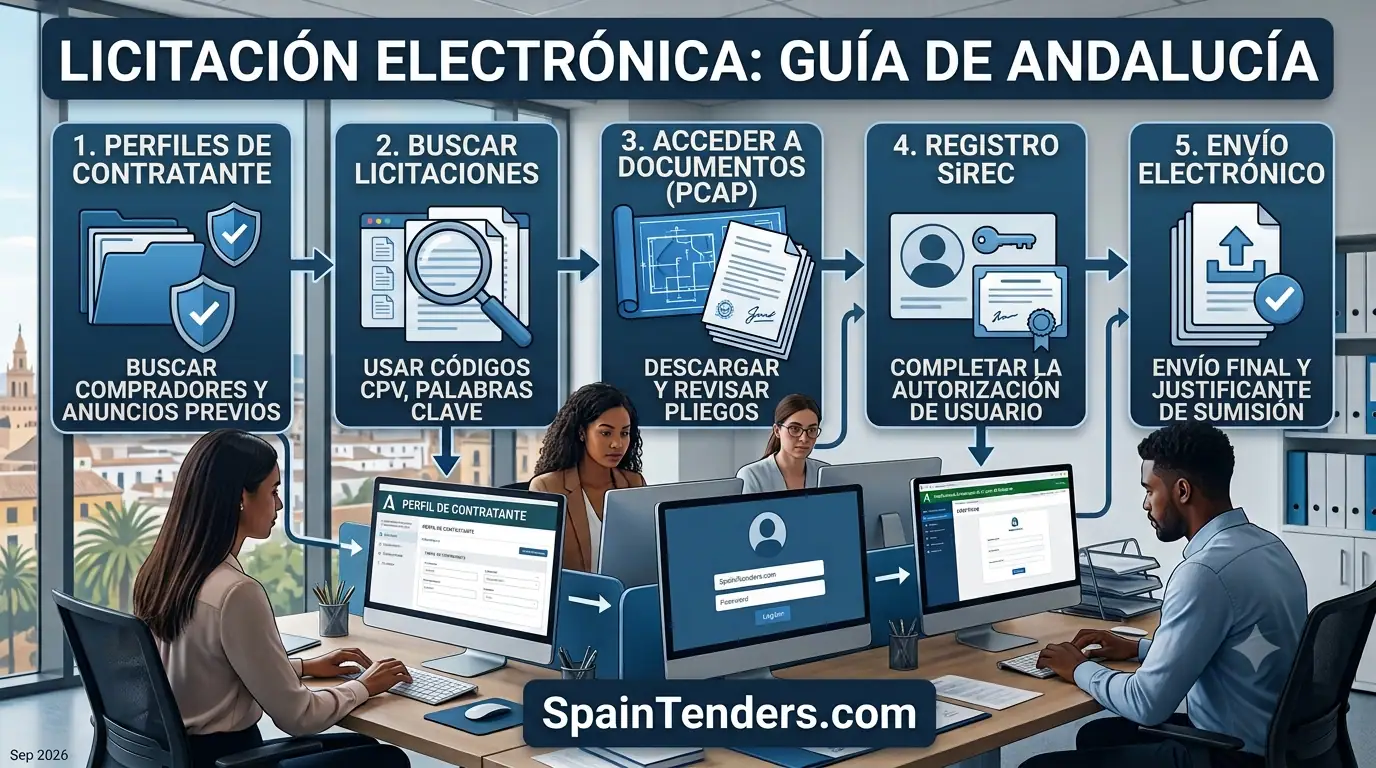
Introduction Andalucía is one of Spain's major autonomous communities and an important market for companies seeking public procurement opportunities. Government departments, public agencies, healthcare organisations, universities, local authorities and other public-sector bodies purchase a wide range of works, supplies and services across the region. For suppliers targeting licitaciones Andalucía, understanding the regional procurement system is essential. The Plataforma de Contratación de la Junta de Andalucía provides access to contracting profiles, tender notices, awards, formalised contracts and other procurement information. The Junta also provides dedicated search tools and an electronic tendering environment through SiREC-Portal de licitación electrónica. The official Junta de Andalucía procurement service currently provides separate access to contracting profiles, tenders currently open for submission, a general tender search, electronic tendering, programmed procurement, minor contracts and supplier subscriptions. This guide explains how businesses can find Andalucía public tenders, understand the regional procurement portal, identify relevant contracting authorities, review tender documents, use electronic bidding and monitor procurement opportunities. Table of Contents What Is the Andalucía Public Procurement Portal? Why Andalucía Tenders Matter for Suppliers Junta de Andalucía Contracting Profiles What Can You Find on the Andalucía Procurement Portal? How to Search Andalucía Public Tenders Search Tenders by Contracting Authority Search by Contract Type and Procedure Search Andalucía Tenders by Province Search by Tender Value Search Andalucía Tenders by CPV Code How to Find Tenders Currently Open How to Access Tender Documents How to Check Tender Deadlines SiREC-Portal de Licitación Electrónica How to Register for Electronic Tendering How to Submit an Andalucía Tender Electronically Andalucía Tender Subscriptions and Alerts How to Search Andalucía Contract Awards Important Andalucía Contracting Authorities Andalucía Tenders for Foreign Companies Common Mistakes When Searching Andalucía Tenders Andalucía Tender Research Strategy SpainTenders.com Procurement Intelligence Conclusion What Is the Andalucía Public Procurement Portal? The Plataforma de Contratación de la Junta de Andalucía is the regional procurement platform used to publish and provide access to public contracting information for the Junta de Andalucía and its contracting bodies. The official platform includes sections for prior notices, tenders, awards, formalised contracts, cancelled procedures, unsuccessful procedures, suspended procedures, minor contracts, contracts based on framework agreements, negotiated procedures without publication and contracts under dynamic purchasing systems. The Junta also provides a broader procurement information area through its official website. This includes contracting profiles, current tenders, a general tender search, electronic tendering and subscription services. For suppliers, the portal is therefore more than a simple tender listing. It provides access to different stages of the procurement lifecycle. Why Andalucía Tenders Matter for Suppliers Andalucía has a large public administration and a broad public-sector purchasing base. Procurement can cover construction, healthcare, information technology, transport, education, environmental services, agriculture, tourism, facilities management, security, professional services and many other sectors. A company targeting the Spanish market may therefore find opportunities in Andalucía that are highly relevant to its products or services. Regional procurement can also be important for companies that want to establish a track record with Spanish public-sector buyers. Researching previous awards and contracting authorities can help suppliers understand the types of services and products purchased in the region. The official Junta procurement environment provides both current tender information and historical procurement information, making it possible to research opportunities as well as previous contracting activity. Junta de Andalucía Contracting Profiles The Perfil de Contratante is the official area where contracting authorities publish relevant information about their procurement procedures. The Junta's contracting-profile system provides access to information and documents relating to the contractual activity of its contracting bodies. The official service currently allows users to consult profiles with procurement announcements published during at least the previous five years. Contracting profiles can include information about the authority, procurement notices, tender documentation, awards and other developments associated with a procurement procedure. When researching a buyer, suppliers should examine its contracting profile rather than relying only on individual tender titles. What Can You Find on the Andalucía Procurement Portal? The procurement platform provides access to several categories of procurement information. InformationSupplier Use Prior noticesResearch planned or forthcoming procurement activity Open tendersIdentify opportunities currently accepting offers AwardsResearch procurement outcomes and successful suppliers Formalised contractsReview completed contracting information Cancelled proceduresUnderstand discontinued procurement activity Unsuccessful proceduresResearch tenders declared unsuccessful Suspended proceduresCheck procurement procedures temporarily suspended Minor contractsResearch smaller procurement activity Framework-related contractsIdentify contracts based on framework agreements Dynamic purchasing systemsResearch procurement under dynamic systems These categories are available through the Junta's procurement platform and provide a broader view of procurement than current tender notices alone. How to Search Andalucía Public Tenders The Junta de Andalucía provides a general Buscador de licitaciones for searching tenders processed by the administration. The official procurement service describes this as a general search covering tenders processed by the Junta from 2008 onwards. A practical search process is: Open the official Andalucía procurement search. Identify the relevant contracting profile. Enter the contract name or relevant search terms. Use the available procurement filters. Review the resulting tender records. Open the individual procurement file. Check the publication date and submission deadline. Download and review the tender documentation. Suppliers should use multiple search terms because procurement titles can vary significantly even when the underlying products or services are similar. Search Tenders by Contracting Authority Searching by contracting authority is particularly useful for suppliers that already understand their target buyers. The Junta procurement platform allows users to select specific contracting profiles. The platform contains profiles associated with different ministries, delegations and other contracting bodies. For example, a supplier specialising in healthcare technology may want to research health-related contracting bodies rather than searching every Andalucía tender. Authority-based research can also reveal recurring procurement patterns, contract sizes and purchasing categories. Search by Contract Type and Procedure Suppliers should identify the type of procurement before deciding whether to participate. Depending on the search interface and tender record, procurement information can be examined according to contract category, procurement procedure and contracting system. The Andalucía platform provides search functionality covering different procurement procedures and contracting systems. Its advanced search interfaces can include fields such as contract designation, publication reference, expediente number, contractual form, award procedure, contracting system and financial ranges. Understanding the procedure is important because the participation process can vary between an open procedure, simplified procedure, negotiated procedure and other procurement methods. Search Andalucía Tenders by Province Andalucía consists of eight provinces: Almería Cádiz Córdoba Granada Huelva Jaén Málaga Seville Location can be particularly important for suppliers providing construction, maintenance, healthcare, transport, security, catering, facility management or other services requiring physical delivery. The procurement search environment includes provincial information for both the place of processing and the place of execution in applicable search interfaces. Companies should distinguish between the location of the contracting authority and the actual location where the contract will be performed. Search by Tender Value Financial filters can help suppliers focus their research on procurement opportunities within a commercially relevant range. The Andalucía procurement search tools can include financial fields such as tender amount and estimated value. However, suppliers should understand the terminology used for each financial figure. Estimated contract value, tender budget and final awarded value are not necessarily interchangeable. Before preparing a commercial bid, review the detailed financial provisions in the procurement documentation. Search Andalucía Tenders by CPV Code Common Procurement Vocabulary (CPV) codes provide a standardised way to classify the subject matter of public procurement. CPV-based searching can be useful when a supplier's products or services have a clearly defined procurement classification. It can reduce dependence on exact wording in Spanish tender titles. However, suppliers should combine CPV research with keywords, contracting authorities and sector information. A CPV code should be treated as a discovery tool rather than a substitute for reading the contract description. How to Find Tenders Currently Open The Junta de Andalucía provides a dedicated area for licitaciones en plazo de presentación de ofertas, allowing users to access recent tenders that remain within their offer-submission period. This is useful when the immediate objective is to identify opportunities for which bids can still be submitted. Even when a tender appears as open, suppliers should check the individual procurement record for the exact deadline, required documentation, electronic submission method and any subsequent amendments. How to Access Tender Documents Once a relevant tender has been identified, suppliers should open the complete procurement record and review the available documents. The Junta's guidance explains that companies interested in participating should check that the contract object corresponds with their business activity and then prepare the documentation specified in the procurement conditions. The PCAP provides administrative instructions and the PPT contains the technical characteristics of the requested goods or services. Suppliers should therefore avoid making a bid decision based only on the tender title or short description. How to Check Tender Deadlines The submission deadline should be checked immediately after identifying a potentially relevant tender. Record: Publication date. Deadline date. Deadline time. Any amendments affecting the deadline. Electronic submission requirements. Allow additional time for preparing declarations, technical documents, pricing files, electronic signatures and uploading the final submission. Do not assume that an opportunity remains open simply because it appears in a general search result. Confirm its current status in the official procurement record. SiREC-Portal de Licitación Electrónica SiREC is the Junta de Andalucía's electronic procurement information system for managing electronic relationships relating to procurement by the Junta and its public sector. According to the Junta, SiREC allows economic operators to prepare and submit offers electronically. It also supports electronic opening of tenders and the management of electronic communications and notifications within procurement procedures. SiREC is therefore an important part of the bidding process for tenders that require electronic submission through the Junta's system. How to Register for Electronic Tendering To participate in an electronic tender through the Junta's system, the supplier needs to register in the SiREC-Portal de licitación electrónica. The Junta states that access requires identification using a recognised or qualified electronic certificate in accordance with the applicable Andalusian electronic-administration framework. Suppliers should complete registration and verify access before a tender deadline. Waiting until the final day can create avoidable problems if the electronic certificate, user authorisation or technical environment is not correctly configured. How to Submit an Andalucía Tender Electronically The exact submission workflow depends on the individual procurement, but suppliers should generally prepare the required documentation, complete the electronic forms, sign the required files and submit the offer through the designated electronic procurement system. The Junta provides a dedicated electronic tendering service and publishes manuals and guidance for SiREC. The official page currently references a SiREC-Portal manual updated on 18 February 2026 and guidance for uploading large documentation. A practical preparation checklist includes: Active supplier account. Valid electronic certificate. Correct user authorisation. Required tender documents. Correct file formats. Completed electronic forms. Required signatures. Correct lot selection. Final validation before submission. Evidence of successful submission. Andalucía Tender Subscriptions and Alerts The Junta provides a Tus suscripciones service designed for companies and individuals participating in tenders. Users can discover new tenders and follow procurement opportunities that interest them. A user account is required to manage subscriptions. This can be useful for suppliers that repeatedly target the same contracting authorities, sectors or procurement categories. For businesses monitoring a larger number of procurement opportunities, a broader tender-intelligence system can complement individual portal subscriptions. How to Search Andalucía Contract Awards Procurement research should not end when a tender closes. Award information can provide useful intelligence about purchasing patterns and successful suppliers. The Junta's procurement platform provides a dedicated search for adjudications and includes fields such as contract name, publication reference, expediente number, procedure, awarded amount, tendered amount, estimated value and successful bidder information. The Junta also maintains a public contract register containing contracts registered by its contracting bodies. The official transparency information states that the register can be searched using criteria including award dates, modifications, extensions and resolutions and links to the relevant procurement publication. Businesses can use award information to understand which companies have previously supplied a contracting authority and which types of procurement are being awarded. Important Andalucía Contracting Authorities The Andalucía procurement environment contains contracting profiles associated with different government departments, delegations, agencies and other public bodies. The official contracting-profile directory includes profiles associated with areas such as education, health, agriculture, environment, infrastructure, employment, tourism, culture and other government functions. Suppliers should identify the authorities most relevant to their business and monitor their procurement activity separately. For example, a technology company may monitor health, education and public-administration buyers, while a construction company may focus on infrastructure, housing, transport and municipal procurement. Andalucía Tenders for Foreign Companies Foreign companies can research Andalucía public procurement opportunities through the same public procurement information systems used to identify regional tenders. Before participating, however, international suppliers should carefully examine the individual tender's eligibility and qualification requirements. Important areas include: Economic and financial capacity. Technical and professional capacity. Professional registrations or classifications. Required declarations. Electronic signature requirements. Language and document requirements. Local delivery or service obligations. Electronic submission requirements. Lot-specific conditions. The Junta's supplier guidance emphasises that companies should first confirm that the contract object corresponds to their business activity and then prepare the documentation required by the tender documents. Common Mistakes When Searching Andalucía Tenders Searching only by tender title: Spanish procurement titles can vary. Use keywords, CPV codes and contracting authorities together. Ignoring the contracting profile: A buyer's profile can provide historical procurement information and related opportunities. Checking only current tenders: Historical awards can provide useful information about procurement activity and previous suppliers. Ignoring SiREC: Finding a tender is not the same as being technically prepared to submit an electronic offer. Waiting until the deadline: Electronic registration, certificates, document preparation and upload can require additional time. Not checking amendments: Always review the latest version of the procurement record before submitting. Ignoring smaller procurement: Minor contracts and other procurement categories can provide additional market intelligence. Andalucía Tender Research Strategy A structured Andalucía procurement strategy can combine several information sources rather than relying on a single search. Research StageWhat to Check Market discoveryAndalucía sectors, authorities and procurement categories Tender searchKeywords, CPV codes, procedures and current tenders Authority researchRelevant contracting profiles Opportunity screeningScope, value, location and deadline Qualification reviewEligibility and technical or financial requirements Document reviewPCAP, PPT, DEUC where applicable and annexes Submission preparationSiREC registration, certificate and electronic documents Market intelligenceAwards, successful bidders and historical procurement This approach helps suppliers move from simply finding tenders to developing a repeatable procurement-monitoring process. SpainTenders.com Procurement Intelligence Businesses targeting licitaciones Andalucía can use SpainTenders.com to complement their research of the official Junta de Andalucía procurement environment. Suppliers can explore Spain Tenders to identify procurement opportunities and use SpainTenders.com Authorities to research public-sector buyers. Businesses can also use SpainTenders.com Sectors to explore opportunities according to their business category. Existing users can access SpainTenders.com Login, while companies new to the platform can use SpainTenders.com Registration. Researching completed procurement is also useful. Suppliers can review Spain contract awards to understand procurement outcomes and identify companies that have previously won contracts. For information about the service or procurement intelligence requirements, businesses can use the SpainTenders.com Contact page. Conclusion The Andalucía public procurement market provides opportunities across a broad range of sectors and public-sector organisations. The Junta de Andalucía's procurement environment gives suppliers access to contracting profiles, current tenders, historical procurement information, awards and electronic tendering services. The most important resources include the Plataforma de Contratación, the Perfil de Contratante, the tender search service and SiREC-Portal de licitación electrónica. Companies searching for Andalucía tenders should combine keyword and CPV searches with contracting-authority and provincial research. Once a relevant opportunity is identified, suppliers should review the complete tender documents, confirm eligibility, check the deadline and prepare their electronic submission well in advance. For businesses targeting the Spanish public procurement market, Andalucía should be treated as a distinct regional procurement market with its own important contracting profiles, search resources and electronic bidding workflow.
View Details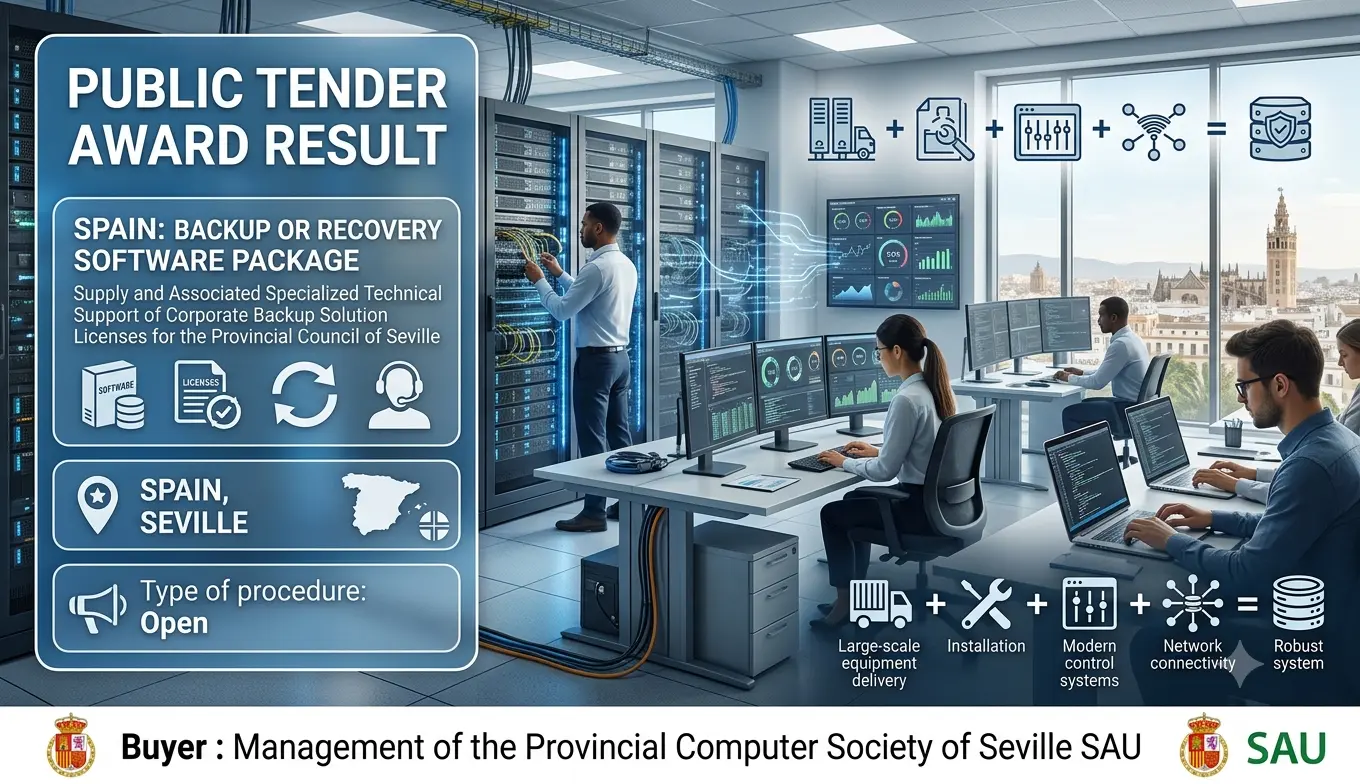
Seville Province Turns to a Single Bidder for Its Corporate Backup Licensing and Support
01 Oct 2026
Standfirst The Diputación de Sevilla has awarded a contract for corporate backup software licences and associated specialised technical support. The contract, worth EUR 227,732.79, went to IaaS365, S.L., a large Spanish technology company based in Mérida, Extremadura. Only one bid was received, and the winner declared no subcontracting. The procurement was run by the province's own IT company, INPRO, under an open procedure governed by Directive 2014/24/EU. Introduction Backup software is one of those unglamorous parts of public administration that becomes visible only when something goes wrong. If a provincial government loses data — because of hardware failure, human error, ransomware or a natural disaster — the consequences can be severe. Citizen records, financial systems, planning files and internal correspondence all depend on reliable backup and recovery. The Diputación Provincial de Sevilla, the provincial government of Seville in southern Spain, has taken steps to keep that protection current. Through its provincial IT company, the Sociedad Provincial de Informática de Sevilla S.A.U. (INPRO), it has awarded a contract for the supply of corporate backup software licences and the specialised technical support that goes with them. The contract is modest in value compared with large infrastructure deals. But it is a useful window into how Spanish provincial governments procure critical software, how they structure evaluations when licence renewals are involved, and how competitive — or uncompetitive — this segment of the market has become. Why This Contract Matters This contract matters because backup software is not a discretionary purchase. Public administrations are legally and operationally required to protect their data. When licences expire, protection lapses. When support lapses, problems take longer to resolve and upgrades become harder. Renewing backup licensing and support is therefore a continuity issue, not a nice-to-have. It also matters because of how the procurement was designed. Price was weighted at 74 points out of 100, but three quality criteria accounted for the remaining 26 points. Two of those criteria reward additional licence capacity for specific backup functions, and one rewards an expanded pool of support hours. In other words, the authority was not just buying the minimum. It was inviting bidders to offer more capacity and more support than the baseline. Finally, the contract matters because only one bid was received. In an open procedure, any qualifying supplier could have bid. The fact that only one did raises questions about the breadth of competition in this specific corner of the Spanish public sector software market. Contract Timeline Previous notice: 007f33d2-6b5a-4aeb-b633-4a3213dac389-01 Winner selected: 3 September 2026 Contract concluded: 29 September 2026 Notice dispatched: 30 September 2026 Notice published: 1 October 2026 Contract Overview The contract covers the supply of corporate backup solution licences and the associated specialised technical support for the Diputación de Sevilla. It is a single-lot procurement, identified as LOT-0000, with the internal identifier A41119033-2026/000062-PcA. The main classification is CPV 48710000, backup or recovery software package. Additional classifications cover software maintenance and repair services (CPV 72267000) and technical computer support services (CPV 72611000). This combination confirms what the title suggests: the contract is not just a licence purchase but a package that includes ongoing maintenance and support. The procurement was conducted as an open procedure under Directive 2014/24/EU, the general EU public sector procurement directive. It is not a framework agreement and does not use a dynamic purchasing system. It is not financed with EU funds and is not covered by the Government Procurement Agreement. The contract was awarded to IaaS365, S.L. at EUR 227,732.79, which was also the value of the only admissible tender. Key Contract Details Notice ID 677778-2026 OJ S issue 190/2026 Publication date 1 October 2026 Contracting authority Gerencia de la Sociedad Provincial de Informática de Sevilla S.A.U. (INPRO) Contract type Supplies Main CPV code 48710000 – Backup or recovery software package Additional CPV codes 72267000 – Software maintenance and repair services; 72611000 – Technical computer support services Procedure type Open procedure Legal basis Directive 2014/24/EU Lot LOT-0000 Winner IaaS365, S.L. Winning bid EUR 227,732.79 Number of bids 1 Award criteria Price – 74 points; additional licence capacity for CV DP VM10 31 VM 10 Pack – 9 points; additional licence capacity for CV UBKRC FT 31 unstructured data – 11 points; expanded support hours pool – 6 points Contract duration The contracting authority has not disclosed this information in the notice. Framework agreement No Dynamic purchasing system No EU funding No GPA covered No Subcontracting No SME participation 0 SME tenders received Contract identifier 62/2026.1 Project Scope The scope is the supply of licences for a corporate backup solution and the specialised technical support associated with it. The notice refers to minimum characteristics defined in the PCAP (administrative clauses) and PPT (technical specification), but those documents are not included in the notice itself. The contracting authority has not disclosed the specific products, brands or licence volumes in the TED notice. The award criteria give some indication of what was being purchased. One criterion covers additional licence capacity for "CV DP VM10 31 VM 10 Pack." This appears to relate to backup capacity for virtual machines. Another covers additional licence capacity for "CV UBKRC FT 31 Datos no estructurado" — backup capacity for unstructured data. A third covers an expanded pool of support hours. These criteria suggest that the authority was buying a baseline licence package and then inviting bidders to offer extra capacity on top. The bidder that offered more virtual machine backup capacity, more unstructured data backup capacity, and more support hours would score higher on the quality criteria, while still competing primarily on price. The notice does not disclose the duration of the contract, the licence volumes, the specific backup product involved, or the number of support hours in the pool. The contracting authority has not disclosed this information. About the Contracting Authority The buyer is the Gerencia de la Sociedad Provincial de Informática de Sevilla S.A.U., known as INPRO. INPRO is the provincial IT company of the Diputación Provincial de Sevilla. It is classified as a public undertaking controlled by a local authority, with general public services activity. INPRO is registered in Sevilla, postcode 41004, with registration numbers 31136190157379 and A41119033. Its website is inpro.dipusevilla.es, and its email contact is admoninpro@dipusevilla.es. It uses the Spanish national procurement platform, contrataciondelestado.es, as its buyer profile. INPRO's role in this procurement is as buyer and review organisation. The notice also identifies the Tribunal Administrativo de Recursos Contractuales de la Junta de Andalucía (TARCJA) as a contact point for review matters. TARCJA is the regional administrative tribunal that hears procurement disputes in Andalusia. The notice's review section is somewhat inconsistent. It names INPRO as the review organisation but also lists TARCJA as the organisation providing more information on review procedures, and describes the review deadline in general terms rather than giving a specific date. The contracting authority has not clarified these points. About the Organisations Involved Gerencia de la Sociedad Provincial de Informática de Sevilla S.A.U. (INPRO) INPRO is the contracting authority. It is a publicly controlled company owned by the Diputación Provincial de Sevilla, the provincial government of Seville. Its purpose is to provide information technology services to the provincial administration and its associated bodies. It is classified as a public undertaking controlled by a local authority. Its registered office is in Sevilla. It has two registration numbers listed in the notice: 31136190157379 and A41119033. It is the buyer and the organisation signing the contract. INPRO's role in this procurement is central. It defined the technical requirements, ran the open procedure, evaluated the single bid and concluded the contract. It will also manage the resulting licence and support arrangement. IaaS365, S.L. IaaS365, S.L. is the winning bidder. It is classified as a large economic operator. It is registered in Mérida, in the province of Badajoz, Extremadura, with postcode 06800 and NUTS region ES431. Its registration number is B86679362. Its beneficial owner is of Spanish nationality. The company submitted the only bid for LOT-0000, valued at EUR 227,732.79. It declared no subcontracting. The notice does not disclose how IaaS365 will deliver the licences or the support, what products it proposed, or what additional capacity it offered under the quality criteria. The contracting authority has not disclosed this information. The company's name, IaaS365, suggests a focus on infrastructure-as-a-service and cloud-related offerings, but the notice does not confirm this. It should not be assumed that the contract involves cloud services simply because of the company's name. Tribunal Administrativo de Recursos Contractuales de la Junta de Andalucía (TARCJA) TARCJA is the administrative tribunal responsible for reviewing public procurement decisions in Andalusia. It is listed as a contact point in the notice's organisation section, with an address in Sevilla, postcode 41001. Its role is to hear appeals from bidders who believe a procurement has been conducted improperly. The notice describes the review deadline in general terms, stating only that it concerns the deadline for filing an appeal against this procurement. The contracting authority has not provided a specific date. Other organisations The notice does not list any other tenderers, consortium members, framework participants or subcontractors. No other organisation materially affects the understanding of this award. Procurement Analysis The procurement was conducted as an open procedure under Directive 2014/24/EU. The open procedure is the standard route for contracts of this size and allows any qualifying supplier to bid. The evaluation was structured around four criteria. Price carried 74 points out of 100, making it dominant. Three quality criteria accounted for the remaining 26 points: additional licence capacity for virtual machine backup (9 points), additional licence capacity for unstructured data backup (11 points), and an expanded support hours pool (6 points). This is a hybrid evaluation. On paper, it rewards bidders who offer more than the baseline. In practice, with price weighted at nearly three-quarters of the score, the scope for quality to change the outcome is limited. A bidder offering significantly more capacity but a higher price would still lose to a cheaper bidder offering the baseline, unless the quality gap were very large. The most significant feature of this procurement is that only one bid was received. In an open procedure, that is unusual but not unheard of. It may indicate that the technical requirements were tightly drawn around a specific backup product, that the timeline was short, or that potential bidders judged the contract unattractive. It may also indicate that the market for this particular backup solution in Andalusia is narrow. Backup software licensing and support often runs through authorised partners of a specific vendor. If the authority's requirements effectively point to one vendor's product, the number of qualifying bidders may be small. The notice does not explain why only one bid was received. The contracting authority has not disclosed this information. The single bid came from a large economic operator, and the statistical section records zero SME tenders. This is consistent: the winner is classified as large in the organisations section, and no SME bids were received. There is no discrepancy on this point, unlike some notices where classification differs between sections. No tenders were received from other EEA countries or from outside the EEA. The procurement was therefore entirely domestic in its competition. The contract is not covered by the Government Procurement Agreement. The notice does not explain why. The contracting authority has not disclosed this information. The contract is not financed with EU funds. It is therefore funded from the provincial budget or from INPRO's own resources. The notice does not disclose an estimated contract value, so it is not possible to compare the awarded value to the authority's pre-tender estimate. The value of the only admissible tender is EUR 227,732.79, which is also the awarded value. The notice does not disclose the contract duration. The contracting authority has not disclosed this information. This makes it difficult to assess the annual value of the contract or to predict when a renewal might be expected. Additional Procurement Facts Legal basis: Directive 2014/24/EU. Procedure: Open procedure, not accelerated. Award criteria: Price (74 points); additional licence capacity for CV DP VM10 31 VM 10 Pack (9 points); additional licence capacity for CV UBKRC FT 31 unstructured data (11 points); expanded support hours pool (6 points). EU funding: The procurement project is not financed with EU funds. GPA: Not covered by the Government Procurement Agreement. Framework agreement: None. Dynamic purchasing system: None. Subcontracting: The winning tenderer declared no subcontracting. SME participation: Zero SME tenders received. Cross-border participation: No tenders from other EEA countries or non-EEA countries were received. Review body: INPRO is named as review organisation, with TARCJA listed as a contact point for review information. Review deadline: The notice describes the review deadline in general terms without a specific date. Market & Industry Perspective The Spanish public sector backup software market is mature. Most public administrations run some form of backup and recovery solution, and most of those solutions are licensed and supported through authorised partners. The market is dominated by a handful of international vendors, with a network of Spanish resellers and integrators delivering licences, implementation and support. This contract sits squarely in that market. It is a licence and support renewal, not a new deployment. The authority is buying continued access to a backup solution and the specialised support that keeps it working. The evaluation criteria suggest that the authority wanted to improve its position slightly — more virtual machine backup capacity, more unstructured data backup capacity, more support hours — rather than change its underlying platform. The single-bid outcome is notable in this context. When a procurement is tied to a specific vendor's product and that vendor's authorised partners are limited, single-bid outcomes become more likely. The authority may have designed the procurement around its existing platform to avoid migration risk. That is a rational choice, but it reduces competition. For suppliers, the lesson is that backup software contracts are often platform-specific. Winning them requires authorised partner status, proven delivery capability, and the ability to offer additional capacity and support at competitive prices. Suppliers that are not authorised partners of the relevant vendor are unlikely to be able to bid, regardless of their broader capabilities. Economic Significance A EUR 227,732.79 contract is small by public sector IT standards. It is unlikely to move markets or transform the winning supplier's fortunes. Its economic significance lies in what it protects: the data of a provincial government that serves more than a million people across 105 municipalities in the province of Seville. The contract also has a modest direct economic effect. The money flows to IaaS365, S.L., a large Spanish company based in Mérida. The contract therefore supports employment and economic activity in Spain's IT sector, though not necessarily in Seville itself. The winner is based in Extremadura, not Andalusia. The single-bid outcome has an economic dimension. Without competition, the authority has less assurance that it is paying a market price. The notice does not disclose how the price was benchmarked or whether the authority considered it reasonable. The contracting authority has not disclosed this information. The absence of SME participation is also economically relevant. SMEs are often the most competitive bidders in software support and maintenance. Their absence from this procurement suggests that the requirements — whether technical, financial or licensing-related — may be difficult for smaller suppliers to meet. Future Procurement Opportunities The most likely future opportunity is the renewal or extension of this contract. The notice does not disclose the contract duration, so it is not possible to say when a renewal might be expected. If the support element runs for one or more years, a follow-on procurement may come within that window. Suppliers should monitor INPRO's buyer profile on contrataciondelestado.es for future notices. There may also be opportunities arising from the support hours pool. If the authority consumes the pool faster than expected, it may need to procure additional hours. If it expands its backup coverage to new systems or new data types, it may need additional licences. More broadly, the Diputación de Sevilla and INPRO are likely to have ongoing software licensing and support needs across their IT estate. Backup is one component; storage, security, networking and application support are others. Suppliers with a broad capability and authorised partner status may find multiple opportunities over time. There may also be opportunities with other Andalusian provincial governments and municipal administrations. If Seville's approach to backup licensing and support is replicated elsewhere, suppliers with a proven track record in the region may be well positioned. Opportunities for Suppliers Authorised backup software partners: Suppliers with authorised partner status for major backup vendors are the most likely candidates for similar contracts. Support capability: The contract includes a pool of specialised support hours. Suppliers that can offer high-quality, flexible support will score better on the relevant criterion. Additional licence capacity: The evaluation rewards bidders who offer more virtual machine backup capacity and more unstructured data backup capacity. Suppliers should be prepared to offer above-baseline capacity. Price competitiveness: With price weighted at 74 points, suppliers must be able to compete on cost. Technical superiority alone will not win. Monitoring the buyer: Suppliers should monitor INPRO's buyer profile on contrataciondelestado.es for future opportunities. Regional presence: The winner is based in Extremadura, not Andalusia. Regional presence is not a barrier, but familiarity with the Andalusian public sector may help. What Businesses Should Watch Whether the contract is renewed or extended: The notice does not disclose the contract duration, so the timing of any renewal is unclear. Suppliers should monitor INPRO's buyer profile. Whether competition improves: The single-bid outcome is a concern. If future procurements attract more bidders, that would indicate a healthier market. Whether SME participation increases: Zero SME bids were received. If future procurements attract SMEs, that could signal that requirements have become more accessible. Whether the authority clarifies the review deadline: The notice describes the review deadline in general terms without a specific date. Suppliers should watch for any clarification. Whether other Andalusian administrations follow suit: If Seville's approach to backup licensing is replicated, similar contracts may emerge elsewhere in the region. Whether the backup platform changes: The contract appears to be a renewal of an existing solution. If the authority decides to migrate to a different platform in future, that would create a much larger opportunity — and a much more complex procurement. SpainTenders.com Procurement Intelligence This contract represents a broader procurement trend: the shift from one-off software purchases to bundled licence-and-support arrangements. Public buyers increasingly want not just the right to use software, but the assurance that someone will keep it working. That is why support hours, maintenance services and additional capacity are built into the evaluation. The trend favours suppliers that can offer an integrated package rather than a simple licence resale. The award is strategically important because it shows how a Spanish provincial IT company structures a software renewal. INPRO did not simply renew its existing licences at whatever price the incumbent offered. It ran an open procedure with a mixed evaluation, inviting bidders to offer more capacity and more support. That approach gives the authority some leverage, even when competition is thin. It also creates a template that other provincial IT bodies could follow. Suppliers can learn several things from this procurement. First, authorised partner status matters. Backup software licensing runs through vendor-approved channels, and suppliers outside those channels cannot bid. Second, support capability matters. The authority allocated points specifically to an expanded support hours pool. Third, additional capacity matters. Bidders that offered more virtual machine backup and more unstructured data backup capacity scored higher. Fourth, price still dominates. With 74 points out of 100, price is the single most important factor. Suppliers must be able to compete on cost without sacrificing the quality elements that earn the remaining points. Suppliers should position themselves accordingly. They should secure authorised partner status with the relevant backup vendors. They should develop the ability to offer above-baseline licence capacity and flexible support hours. They should monitor INPRO's buyer profile and be ready to bid when the contract is renewed. And they should assess whether the single-bid outcome reflects a narrow market or a narrow specification — because if it is the latter, there may be room to challenge or influence future requirements. Future contracts in this market are likely to evolve in two directions. First, more public buyers will bundle licences, maintenance and support into single contracts, rather than procuring them separately. Second, buyers will continue to use quality criteria to extract additional value — more capacity, more support, better service levels — even when price remains dominant. Suppliers that can meet those expectations at competitive prices will be well positioned. Suppliers that cannot will find themselves locked out of a market that is small in value but critical in function. Supplier Takeaways Authorised partner status for major backup vendors is a prerequisite. Without it, suppliers cannot bid for this kind of contract. Price dominates the evaluation at 74 points out of 100. Suppliers must be price-competitive. Additional licence capacity for virtual machine backup and unstructured data backup is rewarded. Suppliers should be prepared to offer above-baseline capacity. An expanded support hours pool is rewarded. Suppliers should be able to offer flexible, high-quality support. Subcontracting was not used by the winner. Suppliers should be prepared to deliver the full scope themselves. Only one bid was received, and no SME tenders were submitted. The market for this kind of contract appears narrow. The contract is not covered by the GPA and not financed by EU funds. It is a domestic Spanish procurement. The notice does not disclose the contract duration, licence volumes or specific products. Suppliers should seek the PCAP and PPT documents for detail. INPRO's buyer profile on contrataciondelestado.es is the best source for future opportunities. The winner, IaaS365, S.L., is based in Extremadura, not Andalusia. Regional presence is not a barrier to winning Andalusian contracts. Key Takeaways INPRO, the provincial IT company of the Diputación de Sevilla, awarded a contract for corporate backup software licences and associated specialised technical support to IaaS365, S.L. The contract value is EUR 227,732.79. Only one bid was received, and it came from a large economic operator. No SME tenders were submitted. Award criteria were price (74 points), additional licence capacity for virtual machine backup (9 points), additional licence capacity for unstructured data backup (11 points) and an expanded support hours pool (6 points). The procurement was an open procedure under Directive 2014/24/EU. It is not a framework agreement, not a dynamic purchasing system, not EU-funded and not GPA-covered. The winning bidder declared no subcontracting. The notice does not disclose the contract duration, estimated value, specific backup products or licence volumes. The review section names INPRO as review organisation and TARCJA as a contact point, and describes the review deadline in general terms without a specific date. The contract is a licence and support renewal tied to a specific backup solution, which helps explain the single-bid outcome. Conclusion The Diputación de Sevilla has renewed the licensing and support underpinning its corporate backup solution. Through INPRO, it awarded a EUR 227,732.79 contract to IaaS365, S.L., a large Spanish technology company based in Mérida. The contract covers backup software licences and specialised technical support, with evaluation criteria that reward additional capacity and more support hours alongside price. The procurement was conducted as an open procedure, but only one bid was received. That single-bid outcome is the most notable feature of the award. It suggests that the requirements were tightly drawn around a specific backup platform, or that the market for this kind of contract in Andalusia is narrow. Either way, the authority had limited competition to test its price. For suppliers, the contract reinforces the importance of authorised partner status, support capability and price competitiveness. For the buyer, the challenge will be to ensure that future renewals attract enough competition to provide price discipline. The notice leaves several questions unanswered — contract duration, licence volumes, specific products, review deadlines — but the core award is clear: IaaS365 will supply and support the backup licences, and the province's data protection will depend on them. Source: Tenders Electronic Daily (TED), Contract Award Notice 677778-2026, Official Journal of the European Union, OJ S 190/2026, published on 1 October 2026.
View Details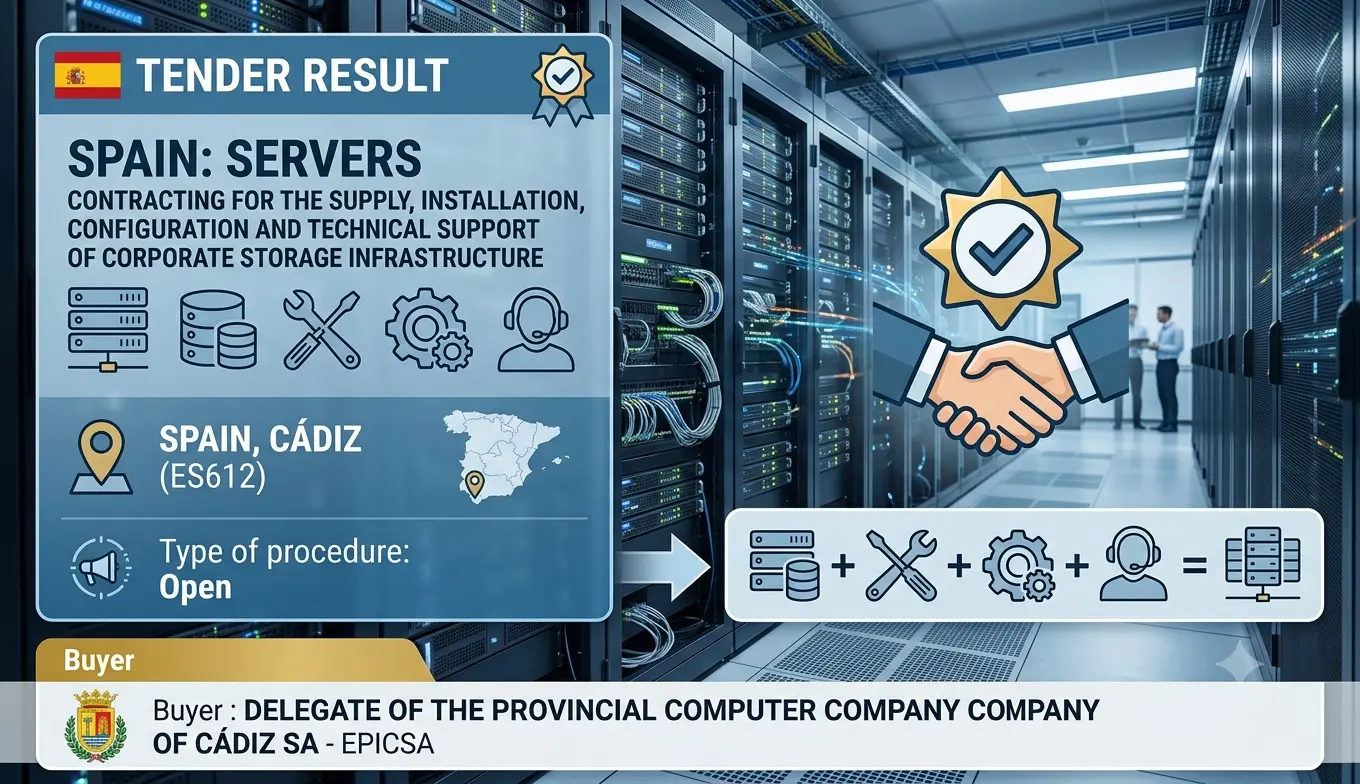
Cádiz Province Overhauls Its Corporate Storage and Backup Infrastructure in a Single-Bid Contract Worth EUR 517,460
30 Sep 2026
Standfirst The provincial government of Cádiz has awarded a contract to renew the data storage, distributed file systems and backup platforms that underpin its administrative operations. The deal covers supply, installation, configuration, commissioning, migration and ongoing technical support for a unified technology solution. It was awarded to SEIDOR SOLUTIONS, S.L, a large Spanish technology provider based in Barcelona. Only one bid was received. Introduction Public administrations in Spain handle enormous volumes of data. Tax records, social services case files, planning documents, procurement records and internal correspondence all have to be stored, protected and made retrievable. When storage systems age, the risks multiply: slower performance, higher failure rates, difficulty integrating with newer applications, and greater exposure to data loss. The Diputación Provincial de Cádiz, the provincial government body for the province of Cádiz in southern Spain, has decided to address that risk directly. Through its provincial IT company, EPICSA, it has awarded a contract to replace and unify its corporate storage infrastructure, distributed file systems and backup platforms. The contract is worth EUR 517,460.33 and covers not just hardware and software but also migration and post-implementation support. This article explains what was procured, who was involved, how the procurement was structured, and what the award signals for the Spanish public sector IT market. Why This Contract Matters Data storage is not glamorous, but it is foundational. If a provincial government cannot store and retrieve its data reliably, its ability to deliver public services is compromised. This contract matters because it is a full infrastructure renewal, not a piecemeal upgrade. It covers block storage, distributed file systems and backup platforms in a single unified solution. It also matters because of the way it was awarded. Only one bid was received. In a market with many Spanish IT infrastructure providers, a single-bid outcome is a signal. It may indicate that the technical requirements were highly specific, that the timeline was tight, or that potential bidders judged the contract terms unattractive. Whatever the cause, single-bid public contracts deserve scrutiny because they reduce the price discipline that competition provides. The contract also matters because of its structure. It is a supplies contract with a significant services component: installation, configuration, commissioning, migration and technical support. That blend of hardware, software and services is increasingly common in public sector IT procurement, and it requires suppliers to offer integrated capability rather than just product resale. Contract Timeline Previous notice: a2fe6b2c-90f3-4e83-b8f1-6cd78ca88e63-01 Winner selected: 3 September 2026 Contract concluded: 28 September 2026 Notice dispatched: 29 September 2026 Notice published: 30 September 2026 Contract Overview The contract is for the supply, installation, configuration, commissioning, migration and subsequent technical support and comprehensive maintenance of a unified technology solution. The purpose is to renew the corporate storage infrastructure, distributed file systems and backup platforms of the Diputación Provincial de Cádiz. It is a single-lot procurement, identified as LOT-0000. The contract is classified as a supplies contract, with the main CPV code 48820000 for servers. Additional CPV codes cover backup or recovery software packages (48710000) and software implementation services (72263000). The contract was awarded through an open procedure under Directive 2014/24/EU, the general EU public sector procurement directive. It is not a framework agreement and does not use a dynamic purchasing system. It is not financed with EU funds, and it is not covered by the Government Procurement Agreement. Key Contract Details Notice ID 672518-2026 OJ S issue 189/2026 Publication date 30 September 2026 Contracting authority Delegada de la Empresa Provincial de Informática de Cádiz S.A. – EPICSA Contract type Supplies Main CPV code 48820000 – Servers Additional CPV codes 48710000 – Backup or recovery software package; 72263000 – Software implementation services Procedure type Open procedure Legal basis Directive 2014/24/EU Lot LOT-0000 Winner SEIDOR SOLUTIONS, S.L Winning bid EUR 517,460.33 Number of bids 1 Award criteria Price – 80 points; specialised engineering support hours – 10 points; improvements in the number of All-Flash NVMe disks in the block storage subsystem – 10 points Contract duration The contracting authority has not disclosed this information in the notice. Framework agreement No Dynamic purchasing system No EU funding No GPA covered No Subcontracting No SME participation 1 SME tender received Contract identifier 2026 CCC071 Project Scope The scope is a unified technology solution for corporate storage, distributed file systems and backup. The winning supplier must supply, install, configure, commission and migrate the new infrastructure, and then provide technical support and comprehensive maintenance. The notice describes the purpose as the renewal of the Diputación Provincial de Cádiz's corporate storage infrastructure, distributed file systems and backup platforms. The word "renewal" indicates that this is a replacement of existing systems, not a greenfield deployment. That means migration is a central part of the work. Data must be moved from old systems to new ones without loss or disruption. The award criteria reveal some of the technical priorities. One criterion rewards improvements in the number of All-Flash NVMe disks in the block storage subsystem. NVMe, or Non-Volatile Memory Express, is a high-speed interface for solid-state storage. All-Flash NVMe storage offers much faster read and write performance than traditional disk-based storage. The authority is clearly prioritising performance in its block storage layer. Another criterion relates to a "bolsa de soporte especializado de ingeniería" — a pool of specialised engineering support hours. This suggests the authority expects to need ongoing engineering expertise beyond routine maintenance, and it wants bidders to commit to providing a certain number of support hours. The notice does not disclose the specific brands, models or software products involved. The contracting authority has not disclosed this information. About the Contracting Authority The buyer is the Delegada de la Empresa Provincial de Informática de Cádiz S.A. – EPICSA. EPICSA is the provincial IT company of the Diputación Provincial de Cádiz, the provincial government of Cádiz. It acts as a delegated contracting body, handling IT procurement on behalf of the provincial administration. EPICSA is registered in Cádiz, with a registered office in the city at postcode 11010. Its registration numbers are 31054970149257 and A11039344. It is classified as a local authority buyer with general public services activity. The organisation's role in this procurement is significant. It is the buyer, the review organisation, and the organisation providing more information on review procedures. That means it is both the contracting party and the first point of contact for any challenge to the award. This concentration of roles is not unusual for a delegated IT body, but it does mean that bidders with concerns about the procurement must raise them with the same organisation that ran it. The notice lists two contact points for EPICSA, both under the name EPICSA, one with a Cádiz address and one with a Madrid NUTS classification. The notice does not explain this discrepancy. It may reflect different administrative offices, but the contracting authority has not disclosed this information. About the Organisations Involved Delegada de la Empresa Provincial de Informática de Cádiz S.A. – EPICSA EPICSA is the contracting authority. It is a provincial IT company owned or controlled by the Diputación Provincial de Cádiz. Its role is to provide information technology services to the provincial government and, in this case, to procure the infrastructure that supports those services. It is classified as a local authority buyer with general public services activity. Its registered office is in Cádiz. It uses the Spanish national public procurement platform, contrataciondelestado.es, as its buyer profile. EPICSA is also listed as the review organisation and the organisation providing more information on review procedures. This means that any bidder wishing to challenge the award must direct its challenge to EPICSA in the first instance. The notice states that the review deadline is until 2024-10-05+02:00. This date appears to be inconsistent with the 2026 procurement timeline and may be an error in the notice. The contracting authority has not clarified this discrepancy. SEIDOR SOLUTIONS, S.L SEIDOR SOLUTIONS, S.L is the winning bidder. It is classified as a large economic operator. It is registered in Barcelona, with postcode 08014, in the Barcelona NUTS region (ES511). Its registration number is B61172219. SEIDOR is a Spanish technology services company. The notice identifies its beneficial owner as having Spanish nationality. The company submitted the only bid for LOT-0000, valued at EUR 517,460.33. It declared no subcontracting. The notice does not disclose SEIDOR's specific technical approach, the brands it proposed, or the details of its solution. The contracting authority has not disclosed this information. Other organisations The notice does not list any other tenderers, consortium members, framework participants or subcontractors. The Publications Office of the European Union is not listed as a TED eSender in this notice, unlike some other notices. No other organisation materially affects the understanding of this award. Procurement Analysis The procurement was conducted as an open procedure under Directive 2014/24/EU. The open procedure is the most common EU procurement route for contracts of this size. It allows any interested supplier to bid, subject to meeting qualification criteria. The award criteria were mixed, with price dominating but quality factors also carrying weight. Price was worth 80 points out of 100. A pool of specialised engineering support hours was worth 10 points. Improvements in the number of All-Flash NVMe disks in the block storage subsystem were worth 10 points. This is a heavily price-weighted evaluation. With 80% of the score determined by price, bidders had a strong incentive to compete on cost. The two quality criteria together accounted for only 20% of the score. That means technical superiority alone would not win the contract unless the price was competitive. The most striking feature of this procurement is that only one bid was received. In an open procedure, any qualifying supplier could have bid. The fact that only one did raises questions. It may be that the technical requirements were so specific that only one supplier could meet them. It may be that the contract terms, including the balance between price and quality, deterred other bidders. It may be that the market for this particular combination of storage, file systems and backup in the Cádiz region is thin. The notice does not explain why only one bid was received. The contracting authority has not disclosed this information. The single bid came from an SME, according to the notice's statistical information. SEIDOR SOLUTIONS is classified as a large economic operator in the organisations section, but the statistical section records one SME tender. This is a discrepancy in the notice. It may be that SEIDOR bid through a subsidiary or that the classification differs between sections. The contracting authority has not clarified this inconsistency. No tenders were received from other EEA countries or from outside the EEA. The procurement was therefore entirely domestic in its competition. The contract is not covered by the Government Procurement Agreement. The notice does not explain why. The contracting authority has not disclosed this information. The contract is not financed with EU funds. That means the funding comes from the provincial budget or from EPICSA's own resources. The notice does not disclose the estimated value of the contract, so it is not possible to compare the awarded value to the authority's pre-tender estimate. The value of the lowest admissible tender and the highest admissible tender are both EUR 517,460.33, because there was only one admissible tender. The notice does not disclose the contract duration. The contracting authority has not disclosed this information. Additional Procurement Facts Legal basis: Directive 2014/24/EU. Procedure: Open procedure, not accelerated. Award criteria: Price (80 points); specialised engineering support hours pool (10 points); improvements in the number of All-Flash NVMe disks in the block storage subsystem (10 points). Strategic procurement: The notice states "No strategic procurement." However, it also lists an approach to reducing environmental impacts as "Other" and a social objective promoted as "Other." The notice does not explain these entries. EU funding: The procurement project is not financed with EU funds. GPA: Not covered by the Government Procurement Agreement. Framework agreement: None. Dynamic purchasing system: None. Subcontracting: The winning tenderer declared no subcontracting. Review deadline: The notice states "hasta 2024-10-05+02:00." This date is inconsistent with the 2026 procurement timeline and may be an error. Review body: EPICSA is listed as the review organisation and the organisation providing more information on review procedures. Market & Industry Perspective The Spanish public sector IT market is large and competitive. National and regional governments, provincial councils, municipalities and public agencies all procure IT infrastructure, software and services. The market includes major international vendors, large Spanish integrators and a long tail of regional specialists. Storage infrastructure is a mature but evolving market. Traditional disk-based storage is being replaced by all-flash and hybrid systems. NVMe technology is pushing performance boundaries further. Backup and recovery have become more complex as data volumes grow and regulatory requirements tighten. Distributed file systems are increasingly used to manage large unstructured data sets across multiple locations. The contract reflects these trends. The authority is not just buying storage capacity. It is buying performance (All-Flash NVMe), resilience (backup and recovery), and integration (distributed file systems). It is also buying migration services, which means the supplier must be able to move data from legacy systems without disruption. The single-bid outcome is notable in this context. In a competitive market, single-bid public contracts can indicate that the buyer's requirements are too narrowly drawn, that the contract terms are unattractive, or that the procurement was not widely publicised. They can also indicate that the buyer has a preferred supplier and has designed the procurement around that supplier's capabilities. The notice does not provide enough information to determine which of these explanations applies. For suppliers, the lesson is that public sector storage contracts are not just about product. They are about integration, migration, support and compliance. Suppliers that can offer a complete solution, including migration and ongoing engineering support, are better positioned than those that only resell hardware or software. Economic Significance A EUR 517,460 contract is a moderate-sized public sector IT procurement. It is large enough to be significant for the winning supplier, but not so large that it dominates the market. The money flows to SEIDOR SOLUTIONS, a large Spanish technology company based in Barcelona. The contract therefore supports economic activity in Spain's IT services sector, though not necessarily in Cádiz itself. The economic significance of the contract lies mainly in what it enables. Reliable storage and backup infrastructure allows the provincial government to deliver services efficiently, protect citizen data and comply with legal requirements. If the infrastructure fails, the economic and social costs can be far greater than the cost of the contract. The contract also has a smaller, indirect economic effect. By renewing its infrastructure, the provincial government reduces the risk of costly downtime and data recovery exercises. It also positions itself to adopt newer applications and services that require modern storage and backup capabilities. The single-bid outcome has an economic dimension too. Without competition, the authority has less assurance that it is paying a competitive price. The notice does not disclose how the price was benchmarked or whether the authority considered the price reasonable. The contracting authority has not disclosed this information. Future Procurement Opportunities The most likely future opportunity is the renewal or extension of this contract. The notice does not disclose the contract duration, so it is not possible to say when a renewal might be expected. If the contract includes multi-year support and maintenance, a follow-on procurement may be some years away. If the support element is shorter, a renewal may come sooner. There may also be opportunities arising from the migration and support work. If the authority needs additional engineering support beyond the contracted pool, it may need to procure more. If the new infrastructure reveals gaps in other areas, such as network or security, further procurements may follow. More broadly, the Diputación Provincial de Cádiz and EPICSA are likely to have ongoing IT infrastructure needs. Suppliers should monitor EPICSA's buyer profile on contrataciondelestado.es for future notices. The notice provides the buyer profile link, which is the best way to track future opportunities. There may also be opportunities with other Spanish provincial governments. If Cádiz's approach works well, other provinces may follow a similar path. Suppliers with a proven track record in provincial storage and backup projects may be well positioned. Opportunities for Suppliers Storage and backup specialists: Suppliers with expertise in enterprise storage, distributed file systems and backup platforms are the most obvious candidates for similar contracts. Migration capability: The ability to migrate data from legacy systems without disruption is a key differentiator. Suppliers should be able to demonstrate a proven migration methodology. NVMe and all-flash expertise: The award criteria specifically reward improvements in All-Flash NVMe disk numbers. Suppliers with deep knowledge of high-performance storage will be better positioned. Engineering support pools: The contract includes a pool of specialised engineering support hours. Suppliers that can offer flexible, high-quality engineering support will score better on this criterion. Price competitiveness: With price weighted at 80%, suppliers must be able to offer competitive pricing. Technical quality alone will not win. Monitoring the buyer: Suppliers should monitor EPICSA's buyer profile for future notices. The buyer profile is the authoritative source for upcoming opportunities. What Businesses Should Watch Whether the contract is renewed or extended: The notice does not disclose the contract duration, so it is not clear when a renewal might be expected. Suppliers should monitor EPICSA's buyer profile. Whether other Spanish provinces follow suit: If Cádiz's infrastructure renewal is successful, other provincial governments may launch similar projects. Whether competition improves: The single-bid outcome is a concern. If future procurements attract more bidders, that would indicate a healthier market. Whether the review deadline discrepancy is resolved: The notice states a review deadline of 2024-10-05, which is inconsistent with the 2026 timeline. Suppliers should watch for any clarification. Whether the SME classification discrepancy matters: The notice classifies SEIDOR as a large economic operator in one section but records an SME tender in another. This inconsistency may affect how the procurement is reported and analysed. Whether the strategic procurement entries are clarified: The notice states "No strategic procurement" but also lists environmental and social objectives as "Other." Suppliers should watch for any clarification of these entries. SpainTenders.com Procurement Intelligence This contract is a useful example of a broader trend in public sector IT procurement: the shift from buying hardware and software separately to buying integrated solutions. The Cádiz contract bundles storage, file systems, backup, migration and support into a single package. That approach places a premium on suppliers that can manage complexity, not just supply products. The award is strategically important for two reasons. First, it shows how a Spanish provincial government is approaching the renewal of critical data infrastructure. Second, it shows the risks of single-bid procurement. When only one bid is received, the buyer has limited ability to test the market price or to compare technical approaches. That does not mean the outcome is wrong, but it does mean the buyer has less assurance than it would have with multiple bids. Suppliers can learn several things from this procurement. First, integrated capability matters. The winner had to offer supply, installation, configuration, migration and support, not just product. Second, price discipline matters. With 80% of the score determined by price, suppliers cannot rely on technical superiority alone. Third, migration experience matters. The authority is renewing existing infrastructure, so the ability to move data safely is essential. Fourth, engineering support matters. The authority has allocated points specifically for a pool of specialised engineering support hours. Suppliers should position themselves accordingly. They should build integrated storage, file system and backup capabilities. They should develop proven migration methodologies. They should be able to offer flexible engineering support. And they should be prepared to compete on price, because price dominates the evaluation. Future contracts in this market are likely to evolve in two directions. First, more public administrations will bundle storage, backup, migration and support into single contracts, rather than procuring them separately. Second, performance requirements will continue to rise, with all-flash and NVMe becoming standard rather than premium options. Suppliers that can meet those requirements at competitive prices will be well positioned. The single-bid outcome also raises a question about how buyers in this market can attract more competition. If technical requirements are too narrow, or if contract terms are unattractive, bidders will stay away. Buyers that want competition may need to review their requirements and their engagement with the market. Suppliers should watch for any signs that EPICSA or other Spanish buyers are adjusting their approach. Supplier Takeaways Integrated storage, file system, backup, migration and support capability is essential for this kind of contract. Product-only suppliers are at a disadvantage. Price dominates the evaluation at 80 points out of 100. Suppliers must be price-competitive. Migration experience is critical. The authority is renewing existing infrastructure, not building from scratch. All-Flash NVMe performance is a scored criterion. Suppliers with high-performance storage expertise will score better. A pool of specialised engineering support hours is a scored criterion. Suppliers should be able to offer flexible engineering support. Subcontracting was not used by the winner. Suppliers should be prepared to deliver the full scope themselves. The procurement attracted only one bid. That may indicate a thin market or narrow requirements. Suppliers should assess whether similar contracts are worth bidding for. The contract is not covered by the GPA and not financed by EU funds. It is a domestic Spanish procurement. EPICSA's buyer profile on contrataciondelestado.es is the best source for future opportunities. The notice contains inconsistencies (review deadline, SME classification, strategic procurement entries) that suppliers should watch for in future notices. Key Takeaways EPICSA, the provincial IT company of the Diputación Provincial de Cádiz, awarded a contract for the renewal of corporate storage, distributed file systems and backup infrastructure to SEIDOR SOLUTIONS, S.L. The contract value is EUR 517,460.33. The contract covers supply, installation, configuration, commissioning, migration and subsequent technical support and comprehensive maintenance. Only one bid was received, from an SME, according to the statistical section. SEIDOR is classified as a large economic operator in the organisations section. The notice contains a discrepancy on this point. Award criteria were price (80 points), specialised engineering support hours (10 points) and improvements in All-Flash NVMe disk numbers in the block storage subsystem (10 points). The procurement was an open procedure under Directive 2014/24/EU. It is not a framework agreement, not a dynamic purchasing system, not EU-funded and not GPA-covered. The contract is not a strategic procurement, according to the notice, though environmental and social objectives are listed as "Other." The notice does not disclose the contract duration or the estimated contract value. The notice states a review deadline of 2024-10-05, which is inconsistent with the 2026 procurement timeline. Conclusion The Diputación Provincial de Cádiz has taken a significant step in renewing the data infrastructure that supports its administrative operations. Through EPICSA, it has awarded a EUR 517,460.33 contract to SEIDOR SOLUTIONS for a unified storage, file system and backup solution, including migration and ongoing support. The procurement was structured to prioritise price, with 80% of the evaluation based on cost. Technical quality, in the form of engineering support hours and All-Flash NVMe performance, accounted for the remaining 20%. The contract was awarded through an open procedure, but only one bid was received. That single-bid outcome is the most notable feature of the procurement and raises questions about competition in this segment of the Spanish public sector IT market. For suppliers, the contract reinforces the importance of integrated capability, migration experience and price competitiveness. For the buyer, the challenge will be to ensure that future procurements attract enough competition to provide price discipline and technical choice. The notice contains several inconsistencies that may warrant clarification, but the core award is clear: SEIDOR SOLUTIONS will deliver the new infrastructure, and the provincial government will depend on it for years to come. Source: Tenders Electronic Daily (TED), Contract Award Notice 672518-2026, Official Journal of the European Union, OJ S 189/2026, published on 30 September 2026.
View Details