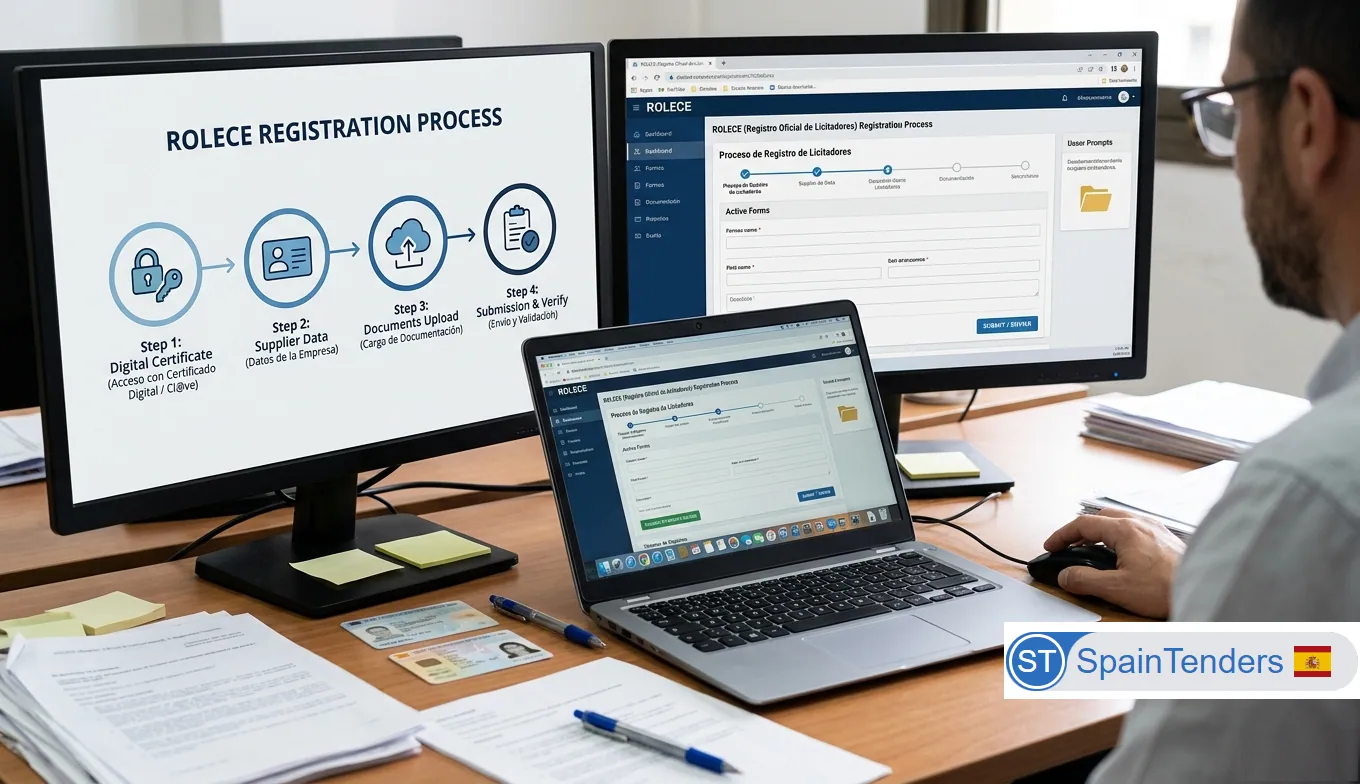
ROLECE Registration in Spain: Complete Guide for Suppliers
17 Sep 2026
Introduction For companies planning to participate in Spain public tenders, understanding supplier registration is an important part of procurement preparation. One of the key systems is the Registro Oficial de Licitadores y Empresas Clasificadas del Sector Público, commonly known as ROLECE or ROLECSP. It provides a formal record of information about businesses that participate in public procurement in Spain. ROLECE is particularly relevant for companies searching for licitaciones España, licitaciones públicas España, contratación pública and government contracts. Depending on the procurement procedure and requirements stated in the tender documents, registration can help a company demonstrate information relating to its legal identity, representation, professional authorisations, economic and financial solvency, technical or professional solvency and classification. This guide explains what ROLECE is, who should consider registering, what information can be recorded, how the application process works, how certificates are used and what suppliers should check before participating in Spanish public procurement. Table of Contents What Is ROLECE in Spain? Why Is ROLECE Important for Spain Public Tenders? Who Can Register in ROLECE? What Information Can Be Recorded in ROLECE? ROLECE Registration and Supplier Eligibility How to Register in ROLECE Electronic Identification for ROLECE Documents Required for ROLECE Registration How to Submit Supporting Documents ROLECE Certificate: What Is It? How ROLECE Can Help in Spanish Tender Participation ROLECE and the Simplified Open Procedure ROLECE and Economic and Financial Solvency ROLECE and Technical or Professional Solvency ROLECE and Company Classification ROLECE Registration vs ROLECE Classification Keeping ROLECE Information Updated What Happens If ROLECE Information Is Outdated? ROLECE for SMEs and Regular Tender Bidders ROLECE for Foreign Companies ROLECE and Regional Supplier Registers ROLECE Registration Checklist for Spanish Tender Suppliers Common ROLECE Registration Mistakes How ROLECE Fits Into the Spain Tender Workflow How SpainTenders.com Helps Businesses Discover Spain Tenders ROLECE Registration and Tender Readiness Conclusion What Is ROLECE in Spain? ROLECE stands for Registro Oficial de Licitadores y Empresas Clasificadas del Sector Público, which can be translated as the Official Register of Tenderers and Classified Companies of the Public Sector. It is the official supplier register regulated by Spanish public procurement legislation. The register allows companies to record relevant information concerning their capacity and suitability to participate in public contracts. The information may include company identity, legal capacity, representation, professional or business authorisations, economic and financial solvency, technical or professional solvency and company classification where applicable. For contractors, ROLECE is therefore more than a simple company registration database. It can form part of the documentary infrastructure used to demonstrate that a business meets particular requirements for Spanish government tenders. Why Is ROLECE Important for Spain Public Tenders? Spanish public procurement requires contracting authorities to verify whether participating businesses meet the applicable conditions for entering into public contracts. ROLECE can simplify the verification of information that has already been properly registered. For a supplier, having accurate ROLECE information can reduce the need to repeatedly establish certain company details during procurement procedures when those details can be verified through the register. ROLECE can therefore be particularly useful for companies that regularly participate in public tenders Spain, including construction companies, engineering firms, technology suppliers, professional service providers, manufacturers, consultants and other contractors. Who Can Register in ROLECE? Businesses participating in public procurement can use ROLECE to register information covered by the applicable registration rules. The official system provides procedures for companies and other eligible economic operators to submit registration information. The registration process is relevant to Spanish companies as well as businesses that need to establish their procurement credentials for contracts within the Spanish public sector, subject to the applicable legal and procedural requirements. Foreign companies should not assume that ROLECE registration alone establishes eligibility for every Spain tender. Each procurement may contain specific requirements relating to professional qualifications, licences, technical capacity, financial standing, experience, taxation, social security, geographic conditions and other requirements. What Information Can Be Recorded in ROLECE? The information that can be registered depends on the circumstances of the company and the applicable legal framework. Important categories can include the company's personality and capacity to act, representation, professional or business authorisations, economic and financial solvency, technical or professional solvency and classification. This information is valuable because procurement authorities may need to verify whether a bidder has the legal and professional capacity required for a particular contract. Company identification information Legal capacity and constitution of the company Representative and power-of-attorney information Professional or business authorisations Economic and financial solvency information Technical and professional solvency information Applicable company classification Other registered circumstances relevant to public procurement ROLECE Registration and Supplier Eligibility Registration should be understood as part of a wider supplier qualification process. A company may be registered in ROLECE and still need to demonstrate additional requirements for a specific tender. For example, a Spanish public tender may require particular technical experience, minimum turnover, professional licences, personnel qualifications, equipment, certifications or project references. These requirements may be specific to the contract and may need to be demonstrated through the documents identified in the tender documentation. Therefore, suppliers should treat ROLECE as a mechanism for recording and evidencing relevant company information rather than as a universal qualification for every Spanish government contract. How to Register in ROLECE The ROLECE registration process is conducted electronically through the relevant official system. Companies need to identify themselves using an accepted electronic identification method and complete the appropriate registration application. The official registration procedure provides separate electronic application options for individuals and legal entities. The supporting documentation must meet the required evidentiary standards and should correspond with the company information that the applicant wants to register. A company should prepare its corporate documentation before beginning the process. Depending on the entity and information being registered, this may include incorporation documents, updated articles or amendments, representation documentation and other supporting evidence. Electronic Identification for ROLECE Because ROLECE is an electronic public administration service, electronic identification is an important part of the registration process. The official system indicates that applicants can access the register using an electronic certificate issued by a trusted electronic service provider, including certificates appropriate for individuals or representatives. Companies should ensure that the person completing the procedure has the appropriate authority and electronic identification credentials before starting the application. Technical problems with certificates or electronic signatures can delay administrative procedures, so these should be checked in advance. Documents Required for ROLECE Registration The exact documentation depends on the company type, the information being registered and the circumstances of the application. The official ROLECE procedure requires evidence supporting the information requested for registration. For example, companies such as sociedades anónimas or sociedades de responsabilidad limitada may need to provide their incorporation deed and subsequent amendments that reflect the current circumstances for which registration is requested. Other legal entities may need to provide their constitutive documents, statutes and relevant amendments. Supporting documents must meet the applicable requirements concerning authenticity and certification. Companies should therefore prepare current documentation rather than relying on old corporate records. Differences between the information in company documents and the information submitted to ROLECE can create additional administrative work. How to Submit Supporting Documents The official ROLECE procedure provides several mechanisms for submitting supporting documentation, including electronically signed files issued by an appropriate authority such as a notary or registrar, original or authenticated copies and other accepted submission channels. Annual accounts may also be transmitted through the procedure established between the relevant commercial register and ROLECE. Suppliers should always follow the current instructions associated with the registration procedure because administrative requirements and electronic procedures can change over time. ROLECE Certificate: What Is It? A ROLECE certificate provides evidence of information registered for a company in the official register. It can be used in public procurement procedures to demonstrate registered circumstances concerning the company's suitability to participate in public contracts. The certificate may contain information relevant to the company's personality and capacity to act, representation, professional or business authorisations, economic and financial solvency, technical or professional solvency, classification and other registered circumstances. The certificate should be treated as an official procurement document and suppliers should check that the information it contains remains accurate before using it in a tender. How ROLECE Can Help in Spanish Tender Participation ROLECE can make the qualification stage of public procurement more efficient because contracting authorities may be able to verify registered information through the official register. This can be especially useful for businesses that participate in multiple licitaciones públicas España. Instead of repeatedly preparing evidence for information that is already properly registered, a company may be able to rely on the corresponding registration and certificate where the applicable procurement rules permit it. However, this does not mean that a bidder can ignore the tender documents. Contract-specific technical and commercial requirements must still be reviewed carefully. ROLECE and the Simplified Open Procedure ROLECE has particular importance in the procedimiento abierto simplificado. Under the applicable Spanish procurement framework, bidders using this procedure generally need to be registered in ROLECE or, where applicable, the corresponding official register of an Autonomous Community by the final offer submission date, provided that competition is not restricted. The legal framework also provides for circumstances in which a bidder may demonstrate that it submitted an application for registration before the final submission date together with the required documentation. The bidder may need to provide the relevant application receipt and a responsible declaration concerning the submitted documentation and absence of a request for correction. This makes registration planning particularly important for companies that regularly search for simplified Spanish public tenders. ROLECE and Economic and Financial Solvency Economic and financial solvency is an important component of supplier qualification. Where relevant information is registered and accepted for the particular procurement, ROLECE can provide evidence of the registered circumstances. However, the specific tender documents remain important because the contracting authority may establish particular minimum solvency requirements and specify how those requirements must be demonstrated. Companies should therefore compare their ROLECE information with the financial requirements of every tender before submitting an offer. ROLECE and Technical or Professional Solvency Technical and professional solvency can include experience, professional capability and other evidence relevant to the procurement. ROLECE may contain registered information relating to the supplier's technical or professional solvency where applicable. Nevertheless, contract-specific experience requirements can vary significantly. A company should check whether the tender requires specific project experience, personnel qualifications, equipment, certifications or other technical evidence that is not fully established by general registration. ROLECE and Company Classification Company classification is another important area of Spanish public procurement. Classification can be relevant particularly to works contracts and can also interact with the way a company demonstrates its solvency. Current Spanish government guidance states that for works contracts with an estimated value of EUR 500,000 or more, the contractor must generally have the required works classification. For works contracts below that threshold, classification can be used as a means of demonstrating economic, financial and technical solvency. The applicable tender documents and current legislation should always be checked for the specific procurement. For service contracts, classification is not generally mandatory, although an undertaking may use classification where permitted as an alternative means of establishing the required standing. ROLECE Registration vs ROLECE Classification ROLECE registration and company classification should not be treated as exactly the same thing. Registration records information about the economic operator and can provide evidence of relevant conditions of suitability. Classification is a formal procurement classification that applies to eligible companies under the applicable rules and can establish particular forms of solvency for relevant contracts. A contractor should therefore identify whether a tender requires ordinary supplier registration information, a specific classification or both. Keeping ROLECE Information Updated Maintaining accurate information is an important responsibility of registered businesses. Companies are required to communicate changes to information recorded in the register and relevant circumstances that may affect their contracting status. Changes that may require attention can include corporate structure, representation, authorisations, financial information, technical information and other registered circumstances. A company should establish an internal process for checking its ROLECE information whenever significant corporate or procurement-related changes occur. What Happens If ROLECE Information Is Outdated? Outdated registration information can create problems when a company uses the register to demonstrate its eligibility for a public contract. If information no longer reflects the company's current circumstances, the supplier may need to provide additional evidence or update the registration. Companies should therefore avoid treating registration as a one-time administrative task. ROLECE should be maintained as part of the company's broader Spain public procurement compliance process. ROLECE for SMEs and Regular Tender Bidders For small and medium-sized businesses entering the Spanish public procurement market, administrative preparation can represent a significant part of the tendering process. A properly maintained ROLECE record can help establish a structured procurement profile and reduce repeated administrative work where its information can be used. For companies submitting tenders regularly, the benefit can become more significant because the same corporate information may be relevant across multiple procurement opportunities. ROLECE for Foreign Companies Foreign companies interested in Spain tenders should understand the difference between registration requirements and general eligibility requirements. Depending on the procurement and the company, evidence from an equivalent national register or other recognised documentation may be relevant. International suppliers should examine the tender notice and procurement documents to determine exactly which registration, qualification, solvency and legal documents are required. A foreign company should also consider electronic identification, Spanish procurement documentation, tax and social-security requirements, professional authorisations, local regulatory requirements and the specific submission system used for the tender. ROLECE and Regional Supplier Registers Spain also has official registers of tenderers and classified companies maintained by certain Autonomous Communities. The applicable register can depend on the procurement authority and the relevant legal framework. The Spanish procurement system provides mechanisms for cooperation and information exchange between the state register and regional registers. Contractors should therefore check the procurement documentation when a tender is issued by an Autonomous Community or another regional public authority. ROLECE Registration Checklist for Spanish Tender Suppliers Confirm that your company details are current. Identify the person authorised to complete the electronic procedure. Check the required electronic identification or certificate. Prepare current corporate and constitutive documents. Prepare representation and power-of-attorney information where required. Review professional licences and business authorisations. Review economic and financial solvency information. Review technical and professional solvency information. Determine whether company classification is applicable. Submit the registration application through the official system. Retain the application acknowledgement and supporting records. Obtain and review the ROLECE certificate. Correct or update outdated information when circumstances change. Before each tender, compare ROLECE information with the specific tender requirements. Common ROLECE Registration Mistakes One common mistake is assuming that ROLECE registration automatically qualifies a company for every Spain government tender. It does not replace the need to satisfy contract-specific requirements. Another mistake is allowing registered information to become outdated. Changes in company representation, financial circumstances or other registered information should be addressed according to the applicable rules. Companies can also make the mistake of confusing registration with classification. These are related but distinct concepts and their relevance depends on the type and value of the procurement. Finally, suppliers should not wait until the last moment to review ROLECE requirements when targeting a tender with a registration condition. Registration planning should form part of the company's tender-readiness process. How ROLECE Fits Into the Spain Tender Workflow ROLECE is one component of a wider procurement workflow. A supplier may first discover a tender, examine the contracting authority, review the CPV classification, download the procurement documents and assess eligibility. ROLECE information can then support the qualification and compliance stage where applicable. After that, the supplier may need to prepare technical documentation, financial information, declarations and electronic submission files. The precise process depends on the procurement procedure and the requirements contained in the tender documents. How SpainTenders.com Helps Businesses Discover Spain Tenders ROLECE registration prepares a supplier for participation, but businesses still need to identify relevant procurement opportunities. SpainTenders.com can support tender discovery by helping businesses identify Spain tender opportunities across procurement categories and contracting authorities. For contractors, the combination of opportunity discovery and supplier readiness can create a more structured approach to the Spanish public procurement market. Businesses can identify relevant licitaciones España, review the opportunity and then assess whether their ROLECE information, qualifications and resources match the specific procurement requirements.Contact us to grow your business by registering or subscribing to us ROLECE Registration and Tender Readiness Being prepared for Spanish public procurement involves more than finding a tender before its deadline. Suppliers need an organised approach to legal documentation, registration, qualifications, technical capability, financial standing and electronic submission. ROLECE can form an important part of that preparation because it provides an official mechanism for recording and evidencing relevant supplier information. Keeping that information accurate and aligned with the company's current circumstances can make procurement participation more organised. Conclusion ROLECE is an important part of the Spanish public procurement ecosystem for companies participating in government tenders and public contracts. The register provides a structured way to record information concerning a company's identity, legal capacity, representation, authorisations, solvency and classification where applicable. For businesses targeting Spain public tenders, registration should be considered alongside tender-specific eligibility, technical requirements, financial conditions, professional qualifications and electronic submission rules. ROLECE does not replace the need to read the procurement documents, but it can provide an important foundation for demonstrating supplier suitability. Companies that regularly participate in licitaciones públicas España should keep their registration information current, understand when ROLECE or a regional register is relevant and review the exact requirements of each procurement before submitting an offer. Combined with systematic tender discovery and document review, this creates a more organised foundation for participating in Spanish public procurement.
View Details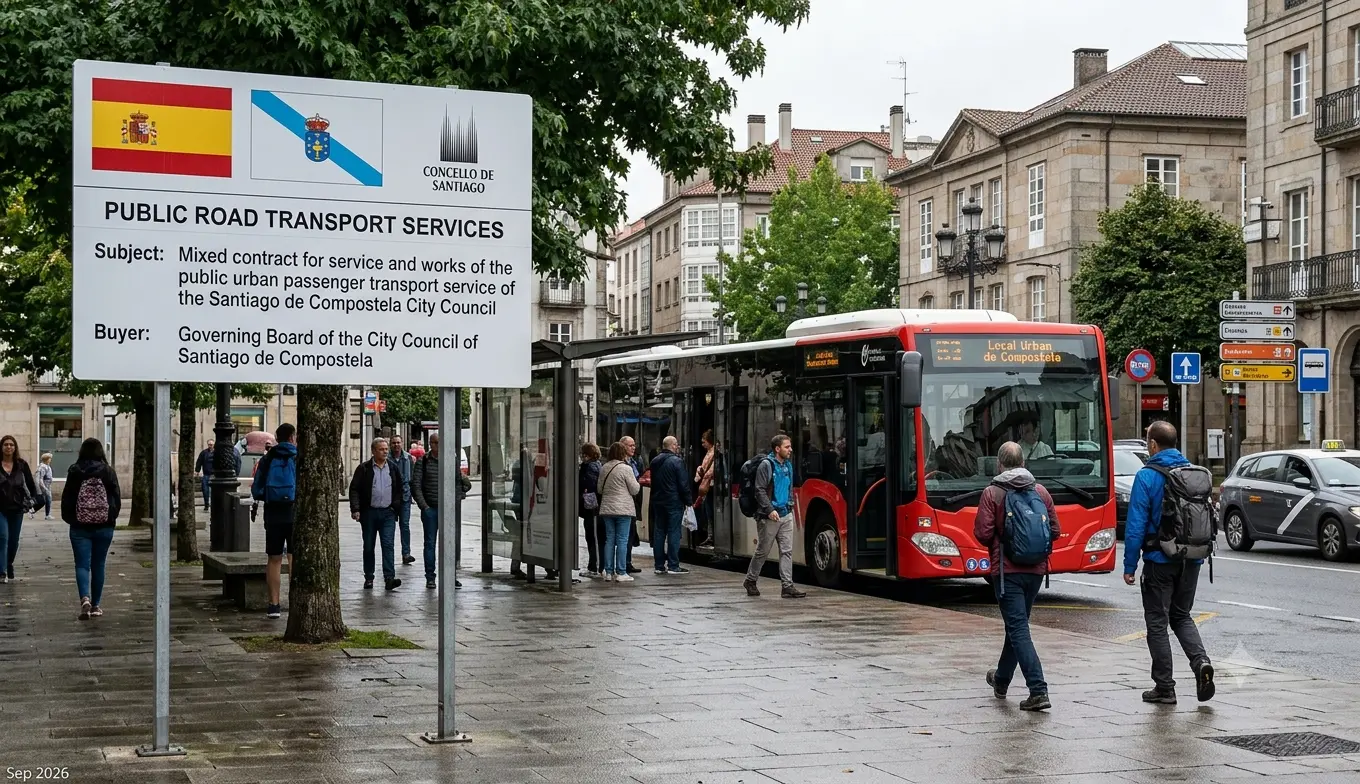
CASTROMIL Secures 118.8 Million Euro Urban Transport Contract for Santiago de Compostela
17 Sep 2026
Standfirst CASTROMIL, S.A. has been awarded a major mixed services and works contract valued at approximately 118.8 million euros to operate the public collective urban passenger transport service for the municipality of Santiago de Compostela. The procurement mandates the deployment of a modernized fleet, including 27 clean vehicles and 40 zero emission vehicles, alongside associated transport infrastructure and software systems. This tender result highlights the Spanish municipal commitment to sustainable urban mobility and the strategic use of balanced evaluation criteria in public procurement. Introduction The modernization of municipal public transport networks remains a critical priority for local governments aiming to enhance urban mobility and reduce environmental impacts. In Spain, the municipality of Santiago de Compostela has initiated a targeted procurement strategy to secure a reliable operator for its collective urban passenger transport service. This recent contract award ensures that residents and visitors have access to efficient, sustainable, and technologically advanced transit solutions across urban, rural, and bordering zones. By executing this procurement through a transparent open procedure, the contracting authority ensured rigorous evaluation of both financial and technical proposals. The selection criteria heavily emphasized a balanced approach, weighting economic offers alongside technical quality, fleet age, and the implementation of advanced ticketing systems. This holistic approach guarantees that public funds are deployed efficiently while prioritizing environmental sustainability and operational excellence in public road transport services. Why This Contract Matters This procurement is vital for ensuring that the public mobility needs of Santiago de Compostela are met with modern, low emission transit solutions. The inclusion of stringent environmental criteria, specifically the mandate for 40 zero emission vehicles and 27 clean vehicles, directly elevates the standard of urban transport and aligns with the European Clean Vehicles Directive. For the domestic transport sector, securing this high value public procurement validates the operational capacity and environmental commitment of the awarded firm. It also demonstrates how regional authorities can leverage public procurement to drive continuous improvement in sustainable community development. Contract Timeline The procurement process culminated in the formal selection of the winning bidder on July 22, 2026. Following standard administrative procedures, the formal contract was signed on September 11, 2026. The official contract awards notice was published in the Official Journal of the European Union on September 17, 2026. This timeline reflects a standard and transparent execution of public procurement regulations in the Spanish municipal sector. Contract Overview The agreement covers a mixed contract of services and works for the public collective urban passenger transport service. The total awarded value is 118,877,647.00 euros, reflecting a substantial investment in regional transport infrastructure. The supplier is responsible for deploying a fleet of 67 vehicles, managing associated transport buildings, and implementing modern software packages and information systems. This turnkey approach places the responsibility for technical optimization and lifecycle management squarely on the awarded firm. Key Contract Details Contract Title Contrato mixto de servicio y obras del servicio público de transporte colectivo urbano de viajeros Contracting Authority Xunta de Goberno do Concello de Santiago de Compostela Contract Value 118,877,647.00 EUR Procedure Type Open Procedure Number of Bids Received 5 Winner CASTROMIL, S.A. Contract Conclusion Date September 11, 2026 Main CPV Code 60112000 (Public road transport services) Project Scope The core scope involves the provision of public road transport services across urban and rural zones, as well as bordering areas with urban continuity. The contractor must supply and operate 67 vehicles, ensuring that 40 are zero emission and 27 are clean vehicles, in strict compliance with the Clean Vehicles Directive. Additionally, the service requires the management of associated transport buildings and the deployment of advanced software packages for ticketing, sales, and recharge systems at commercial establishments and fixed stop points. About the Contracting Authority The Xunta de Goberno do Concello de Santiago de Compostela is the primary buyer for this procurement. It is a local authority responsible for managing and delivering public services, including urban mobility and community amenities, within the municipality of Santiago de Compostela in the province of A Coruña. About the Organisations Involved Xunta de Goberno do Concello de Santiago de Compostela is the contracting authority and buyer. It manages municipal public services and drives the procurement of sustainable transport solutions for city residents. CASTROMIL, S.A. is the successful bidder and a large economic operator. This Spanish transport company specializes in passenger road transport services and brings significant operational capacity and fleet modernization expertise to this award. Tribunal Administrativo de Contratación Pública de la Comunidade Autónoma de Galicia is the review organisation. This administrative court handles any legal appeals or disputes related to public procurement procedures in the autonomous community of Galicia. Procurement Analysis The open procedure attracted five bids, demonstrating healthy competition in the Spanish regional transport market. The award criteria were balanced, allocating 70 points to price related metrics and 30 points to quality factors such as technical memory, vehicle age, and ticketing infrastructure. This balanced evaluation method indicates that the technical and environmental baselines were strict, ensuring that only highly capable firms with proven track records could advance. Consequently, the competition focused on delivering optimal value without compromising the quality of the public service provided. Additional Procurement Facts The procurement project is not financed with European Union funds, relying entirely on the municipal budget. However, the procurement falls within the scope of the European Parliament and Council Clean Vehicles Directive, mandating specific environmental standards for passenger road transport services. The procurement is covered by the Government Procurement Agreement, allowing international competition, though all received bids were from domestic Spanish entities. Market and Industry Perspective The Spanish regional transport market is characterized by established operators capable of meeting stringent public sector specifications and environmental mandates. The success of a specialized transport firm highlights the importance of scale and proven operational reliability in winning major public contracts. Suppliers must continuously modernize their fleets and integrate advanced telematic and software systems to align with evolving public sector requirements detailed in procurement documents. Economic Significance An investment of over 118 million euros represents a substantial injection of capital into the regional transport and logistics sector. This spending supports local jobs in vehicle operation, maintenance, and dispatch operations across the A Coruña province. By securing these services through a competitive tender, the public sector ensures cost predictability while stimulating continuous investment in green transport infrastructure. Future Procurement Opportunities Suppliers who were not successful should monitor the official Tenders Portal for upcoming transport service renewals in other municipalities of Galicia. As regional mobility needs evolve, public institutions will continuously generate new tenders opportunities for specialized logistics and mobility services. Stakeholders should also track the Latest Active Tenders Procurement notices to anticipate upcoming infrastructure projects in the broader Spanish public transport sector. Opportunities for Suppliers While the primary service contract has been awarded, specialized software providers and infrastructure developers can find valuable subcontracting opportunities. Companies offering advanced ticketing systems, electric vehicle charging infrastructure, or fleet management software may position themselves to support the primary contractor in fulfilling the strict technical requirements of the agreement. What Businesses Should Watch Industry observers should monitor the activation and performance metrics of this contract to gauge the municipal emphasis on fleet modernization and zero emission vehicle integration. The enforcement of strict environmental criteria will be a key metric for future live tender evaluations in the public transport sector. Stakeholders should also review Live Notices for Tenders to anticipate upcoming mobility modernization projects funded by regional or national programs. SpainTenders.com Procurement Intelligence This contract represents a clear trend in European public procurement toward the strategic integration of environmental mandates into core municipal service contracts. By weighting the award criteria heavily toward a mix of price and technical quality, the contracting authority signaled that operational reliability and environmental compliance are far more critical than marginal cost savings alone. This approach is highly effective for mission critical public services, allowing public buyers to secure high quality solutions that ensure continuous, sustainable, and accessible passenger transport. Strategically, this award is important because it demonstrates how local authorities can leverage the Clean Vehicles Directive to accelerate the transition to zero emission fleets. Suppliers can learn that forming strategic partnerships with technology and infrastructure providers is often necessary to meet the stringent technical and environmental qualification thresholds of such procurements. To position themselves for future contracts, relevant suppliers should focus on demonstrating deep domain expertise in sustainable mobility and proven track records in fleet electrification. Future contracts in this market are likely to evolve by incorporating even stricter carbon footprint reporting and real time energy monitoring mandates. As public institutions face increasing pressure to deliver on climate goals, companies that proactively develop green fleet solutions and offer transparent supply chain practices will hold a distinct advantage. Suppliers must also prepare for increased scrutiny on their environmental claims, making robust documentation and compliance tracking essential for future public procurement success. Supplier Takeaways Balanced award criteria in public transport prioritize fleet modernization and environmental compliance alongside financial competitiveness. Forming strategic partnerships with technology providers enhances the ability to meet complex technical and software requirements in RFPs and RFQs. Subcontracting opportunities exist for specialized software and charging infrastructure providers supporting the primary transport operator. Future bids and GPNs in this sector will likely mandate stricter carbon footprint reporting and real time energy monitoring. Key Takeaways CASTROMIL, S.A. won the 118.8 million euro urban transport contract for Santiago de Compostela. The procurement mandates the deployment of 67 vehicles, including 40 zero emission and 27 clean vehicles. Five bids were received, indicating healthy competition among domestic Spanish transport operators. The award criteria balanced price metrics at 70 points and quality factors at 30 points. The project falls under the European Clean Vehicles Directive, driving sustainable public road transport services. Conclusion This contract secures vital public transport capabilities for the municipality of Santiago de Compostela. The transparent procurement process ensures optimal value for public money while supporting the domestic transport industry and safeguarding regional climate goals. Source: Tenders Electronic Daily (TED), Contract Award Notice 640322-2026, Official Journal of the European Union, published on 17/09/2026.
View Details
UTE IVEMON CLM Secures 117 Million Euro Ambulance Services Contract for Castilla La Mancha
16 Sep 2026
Standfirst A joint venture comprising Ivemon Ambulancias Egara, S.L. and Ivemon Servicios Sanitarios, S.L. has been awarded a major contract to provide urgent and non urgent land health transport services in the Albacete province of Spain. The agreement, managed by the General Secretariat of the Castilla La Mancha Health Service, carries an awarded value of approximately 117 million euros. This tender result underscores the regional government commitment to maintaining high quality and technologically advanced emergency medical response capabilities across its public healthcare network. The award follows a competitive open procedure that prioritized service quality and fleet modernization over pure cost reduction. Introduction The reliable and efficient transportation of patients is a foundational pillar of any modern public healthcare system. In Spain, the autonomous community of Castilla La Mancha has initiated a targeted procurement strategy to secure land health transport services for the province of Albacete. This recent contract award ensures that residents have continuous access to both urgent and non urgent medical transport, bridging the gap between remote communities and specialized healthcare facilities. By executing this procurement through a transparent open procedure, the contracting authority ensured rigorous evaluation of technical and operational capabilities. The selection criteria heavily emphasized service quality, vehicle modernization, and the integration of advanced telematic tracking solutions. This holistic approach guarantees that public funds are deployed efficiently while prioritizing patient safety and operational excellence in emergency medical services. Why This Contract Matters This procurement is vital for ensuring that the public health system in Albacete can respond rapidly and effectively to medical emergencies. The inclusion of stringent quality criteria, such as the age of ambulances and the provision of advanced analytical devices, directly elevates the standard of emergency medical care. For the domestic healthcare logistics sector, securing this high value public procurement validates the operational capacity of the awarded consortium. It also demonstrates how regional authorities leverage public procurement to drive continuous improvement in emergency medical service delivery. Contract Timeline The procurement process culminated in the formal selection of the winning bidder on July 10, 2026. Following standard administrative procedures, the formal contract was signed on July 11, 2026. The official contract awards notice was published in the Official Journal of the European Union on September 16, 2026. The exact duration of the contract was not explicitly disclosed in the notice, though it represents a significant medium to long term service commitment. Contract Overview The agreement covers the provision of urgent and non urgent land health transport services specifically within the Albacete province. The total awarded value is 117,085,381.08 euros, reflecting a substantial investment in regional healthcare logistics. The supplier is responsible for deploying a modern fleet of ambulances equipped with specialized medical devices and telematic tracking systems to ensure uninterrupted service delivery. Key Contract Details Contract Title Transporte Sanitario Terrestre de Castilla La Mancha Contracting Authority Secretaria General del Servicio de Salud de Castilla La Mancha Awarded Value 117,085,381.08 EUR Procedure Type Open Procedure Number of Bids Received 9 Winner UTE IVEMON CLM (Ivemon Ambulancias Egara, S.L. / Ivemon Servicios Sanitarios, S.L.) Contract Conclusion Date July 11, 2026 Main CPV Code 85143000 (Ambulance services) Project Scope The core scope involves the comprehensive management and execution of land health transport, encompassing both emergency responses and scheduled non urgent patient transfers. The contractor must supply ambulances that meet strict age and technical specifications, including dry analytics devices and specialized transfer chairs. Additionally, the service requires the implementation of a telematic solution for the real time tracking and management of scheduled health transport operations. About the Contracting Authority The General Secretariat of the Castilla La Mancha Health Service is the primary buyer for this procurement. It is a regional public authority responsible for managing and delivering public healthcare services across the autonomous community of Castilla La Mancha. About the Organisations Involved Secretaria General del Servicio de Salud de Castilla La Mancha is the primary contracting authority and buyer. It manages regional public health services and drives the procurement of essential medical transport for the community. UTE IVEMON CLM (Ivemon Ambulancias Egara, S.L. / Ivemon Servicios Sanitarios, S.L.) is the successful bidding consortium and a large economic operator. This joint venture combines the resources of two specialized healthcare transport companies to deliver emergency and non urgent medical services. Tribunal Administrativo Central De Recursos Contractuales is the review organisation. This Central Administrative Court of Contractual Appeals handles any legal challenges or disputes related to public procurement procedures in Spain. Procurement Analysis The open procedure attracted nine bids, demonstrating healthy competition in the Spanish regional health transport market. The award criteria were entirely quality based, allocating points across eight distinct categories including ambulance age, technical improvements, and economic proposals. This balanced evaluation method indicates that the technical and operational baselines were strict, ensuring that only highly capable firms with proven track records could advance. Consequently, the competition focused on delivering optimal clinical value and operational reliability rather than competing solely on the lowest price. Additional Procurement Facts The procurement is not financed with European Union funds, relying entirely on the regional healthcare budget of Castilla La Mancha. The notice does not specify whether the procurement is covered by the Government Procurement Agreement, though it operates under standard Spanish public procurement directives. Market & Industry Perspective The Spanish regional health transport market is characterized by established operators capable of meeting stringent public sector specifications. The success of a specialized joint venture highlights the importance of scale and proven operational reliability in winning major public health contracts. Suppliers must continuously modernize their fleets and integrate advanced telematic and medical technologies to align with evolving public sector requirements detailed in procurement documents. Economic Significance An investment of over 117 million euros represents a substantial injection of capital into the regional healthcare logistics sector. This spending supports local jobs in emergency medical services, vehicle maintenance, and dispatch operations across the Albacete province. By securing these services through a competitive tender, the public sector ensures cost predictability while stimulating continuous investment in medical transport infrastructure. Future Procurement Opportunities Suppliers who were not successful should monitor the official Tenders Portal for upcoming health transport renewals in other provinces of Castilla La Mancha. As regional healthcare needs evolve, public institutions will continuously generate new tenders opportunities for specialized medical logistics and emergency response services. Stakeholders should also track the Latest Active Tenders Procurement notices to anticipate upcoming infrastructure projects in the broader Spanish healthcare sector. Opportunities for Suppliers While the primary service contract has been awarded, specialized medical equipment manufacturers and telematic software providers can find valuable subcontracting opportunities. Companies offering advanced dry analytics devices, specialized evacuation chairs, or fleet tracking software may position themselves to support the primary contractor in fulfilling the strict technical requirements of the agreement. What Businesses Should Watch Industry observers should monitor the activation and performance metrics of this contract to gauge the regional government emphasis on fleet modernization and telematic integration. The enforcement of strict quality criteria will be a key metric for future live tender evaluations in the health transport sector. Stakeholders should also review Live Notices for Tenders to anticipate upcoming medical modernization projects funded by regional health programs. SpainTenders.com Procurement Intelligence This contract represents a clear trend in European public procurement toward the strategic outsourcing of complex health logistics to specialized consortia. By weighting the award criteria heavily toward quality and technical improvement, the contracting authority signaled that operational reliability and patient safety are far more critical than marginal cost savings. This approach is highly effective for mission critical emergency services, allowing public buyers to secure high quality solutions that ensure continuous and safe patient transport. Strategically, this award is important because it demonstrates how regional authorities can leverage joint ventures to meet the extensive resource demands of large scale health transport contracts. Suppliers can learn that forming strategic partnerships is often necessary to meet the stringent technical and operational qualification thresholds of such procurements. To position themselves for future contracts, relevant suppliers should focus on demonstrating deep domain expertise in emergency medical logistics and proven track records in fleet modernization. Future contracts in this market are likely to evolve by incorporating even stricter environmental mandates, such as requirements for low emission or electric ambulances, alongside traditional operational metrics. As public institutions face increasing pressure to deliver sustainable healthcare services, companies that proactively develop green fleet solutions and offer transparent supply chain practices will hold a distinct advantage. Suppliers must also prepare for increased scrutiny on telematic integration, making robust data tracking and compliance reporting essential for future public procurement success. Supplier Takeaways Quality based award criteria in health transport prioritize fleet modernization and technical capability over pure cost reduction. Forming joint ventures or consortia is a proven strategy to meet the extensive resource demands of large scale regional health contracts. Subcontracting opportunities exist for specialized medical device and telematic software providers supporting the primary contractor. Future RFPs and RFQs in this sector will likely mandate stricter environmental and data tracking standards for ambulance fleets. Key Takeaways UTE IVEMON CLM won the 117 million euro ambulance services contract for the Albacete province. The procurement utilized an open procedure and received nine bids from established market operators. Award criteria were entirely quality based, evaluating factors like ambulance age and telematic solutions. The contract is funded entirely by the regional healthcare budget without European Union financial support. This tender result sets a benchmark for quality driven emergency medical service procurement in Spain. Conclusion This contract secures vital emergency and non urgent transport capabilities for the Castilla La Mancha health system. The transparent procurement process ensures optimal value for public money while supporting the domestic healthcare logistics industry and safeguarding patient care in the Albacete province. Source: Tenders Electronic Daily (TED), Contract Award Notice 638449-2026, Official Journal of the European Union, published on 16/09/2026.
View Details