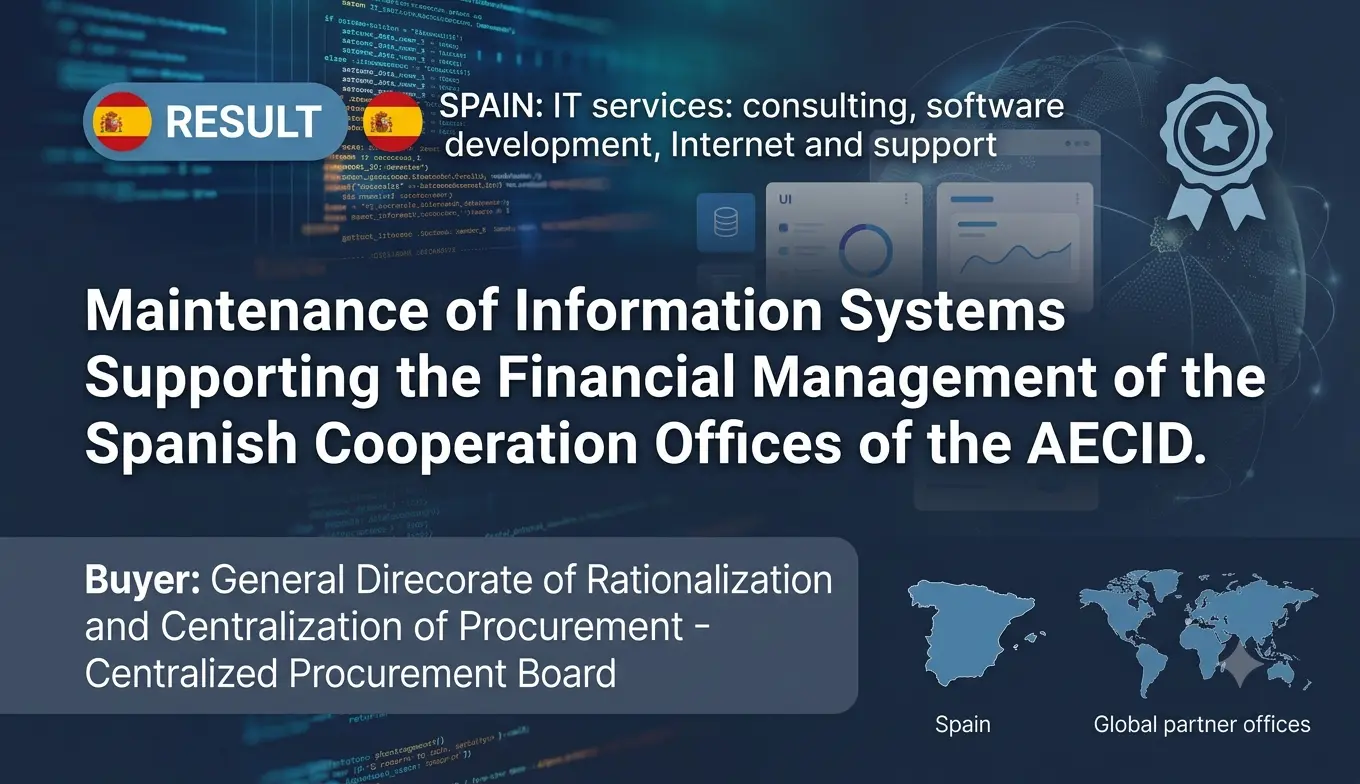
Oesia Networks Secures 368 Thousand Euro IT Maintenance Contract for Spanish International Cooperation Agency
28 Sep 2026
Standfirst Oesia Networks has been awarded a 368,793 euro contract to provide technical assistance for the maintenance of information systems supporting the economic management of the Spanish Agency for International Development Cooperation. The procurement, managed by the central government contracting authority, ensures the operational continuity of critical financial platforms used across global diplomatic and development offices. This tender result follows a restricted procedure that attracted two bids from specialized technology integrators. The award highlights the strategic reliance on established domestic firms to maintain complex software environments essential for international aid and cooperation programs. Introduction The continuous maintenance of information technology systems is a critical priority for government agencies managing international development and cooperation programs. In Spain, the central government has initiated a targeted procurement strategy to ensure the operational continuity of the economic management platforms used by the Spanish Agency for International Development Cooperation. This recent contract award for technical assistance represents a significant step toward guaranteeing that diplomatic and development offices worldwide have reliable digital infrastructure to manage public funds and development projects. By executing this procurement through a restricted procedure, the contracting authority ensured a focused evaluation of specialized IT service providers capable of handling complex software maintenance demands. The selection criteria heavily weighted technical quality and value judgment, reflecting the high stakes associated with managing financial systems for international cooperation. This approach guarantees that public funds are deployed efficiently while prioritizing operational stability and strict compliance with national and international financial regulations. The strategic allocation of capital toward such specialized IT services underscores a commitment to sustainable digital growth within the public sector. It also provides a stable pipeline of work for domestic technology firms, fostering economic stability within the local supply chain and encouraging further investment in advanced software support solutions. Monitoring the procurement portal for similar Active Tenders allows suppliers to stay ahead of the curve in public procurement and identify emerging opportunities in government IT maintenance. Why This Contract Matters This procurement is vital for ensuring that the Spanish international cooperation network can process financial data and manage development projects without interruption. The maintenance of these economic management systems directly impacts the ability of field offices to execute aid programs, track expenditures, and maintain transparency with international partners. For the domestic IT sector, securing this public procurement validates the technical capabilities of the awarded firm in handling sensitive government data. It also demonstrates how central government authorities leverage centralized purchasing to drive continuous improvement in digital public services. The extension of this contract ensures that institutional knowledge regarding the specific architecture of the economic management systems is retained, minimizing the risks associated with transitioning to new service providers. This strategic approach protects taxpayer investments while maintaining high standards of operational reliability. Contract Timeline The procurement process culminated in the formal selection of the winning bidder in September 2026. Following standard administrative procedures and mandatory evaluation periods, the formal contract was concluded on 24 September 2026. The official contract awards notice was published in the Official Journal of the European Union on 28 September 2026. This timeline reflects a standard and transparent execution of public procurement regulations in the Spanish central government sector. Contract Overview The agreement covers the provision of technical assistance for the maintenance of information systems that support the economic management of the Spanish Cooperation offices. The total awarded value is 368,793.60 euros. The supplier is responsible for ensuring the ongoing functionality, security, and performance of the software platforms utilized by the Ministry of Foreign Affairs and the international development agency. This structured approach places the responsibility for technical optimization and lifecycle management squarely on the awarded firm. The contractor must manage all aspects of the software support, including bug resolution, security patching, and user assistance, ensuring that the economic management systems remain fully operational for global deployment. Key Contract Details Contract Title Extension of IT Maintenance for AECID Economic Management Systems Contracting Authority Dirección General de Racionalización y Centralización de la Contratación Contract Value 368,793.60 EUR Procedure Type Restricted Procedure Number of Bids Received 2 Winner Oesia Networks, Sl Contract Conclusion Date 24 September 2026 Main CPV Code 72000000 (IT services: consulting, software development, Internet and support) Project Scope The core scope involves the ongoing technical assistance and maintenance of the specific software applications used for economic management within the Spanish Cooperation offices. This includes monitoring system performance, applying necessary updates, resolving technical incidents, and providing specialized support to the administrative staff managing international development funds. The contractor must ensure that all maintenance activities comply with strict data protection regulations and cybersecurity standards mandated by the central government. The scope requires a deep understanding of the existing software architecture, ensuring that any modifications or fixes do not disrupt the critical financial workflows of the international development agency. About the Contracting Authority The Dirección General de Racionalización y Centralización de la Contratación is the primary buyer for this procurement. It is a central government body responsible for managing and coordinating public procurement processes across various ministries, ensuring efficiency, transparency, and compliance with national and European procurement directives. About the Organisations Involved Dirección General de Racionalización y Centralización de la Contratación is the contracting authority and buyer. It manages centralized public procurement for the Spanish government and drives the acquisition of essential IT services for state agencies. Oesia Networks, Sl is the successful bidder and a large economic operator. Based in Madrid, the company specializes in advanced technology services, digital transformation, and complex IT maintenance for public and private sector clients. Tribunal Administrativo Central de Recursos Contractuales is the review organisation. This central administrative court handles any legal appeals or disputes related to public procurement procedures in Spain, ensuring fair competition and strict regulatory compliance. Procurement Analysis The restricted procedure attracted two bids, demonstrating focused competition in the specialized Spanish government IT maintenance market. The award criteria were balanced, allocating 50 percent weight to automatic quality metrics and 50 percent to value judgments regarding the technical proposal. This evaluation method indicates that the technical baselines were strict, ensuring that only highly capable firms with proven track records could advance to the final selection. Consequently, the competition focused on delivering optimal technical value and demonstrating deep institutional knowledge of the existing economic management systems. The use of a restricted procedure for this extension highlights the authority's preference for continuity and risk mitigation in mission critical software environments. Additional Procurement Facts The procurement project is not financed with European Union funds, relying entirely on the national budget of the Spanish Ministry of Foreign Affairs. The procedure is covered by the Government Procurement Agreement, allowing international suppliers to participate, although the successful bidder is a domestic entity. Market & Industry Perspective The Spanish public sector IT market is characterized by a strong presence of established domestic integrators capable of meeting stringent security and accessibility specifications. The success of a specialized large enterprise highlights the importance of localized support and proven integration capabilities in winning central government IT contracts. Suppliers must continuously update their service management methodologies to align with evolving cybersecurity standards and the specific requirements detailed in public sector RFPs and RFQs. The dominance of large economic operators in this space suggests that future tenders opportunities will continue to favor established contractors with proven financial stability and extensive technical resources. Economic Significance An investment of over 368 thousand euros represents a targeted injection of capital into the domestic IT services sector. This spending supports high skilled jobs in software maintenance, technical support, and system administration within the region. By securing these services through a competitive tender, the public sector ensures cost predictability while stimulating continuous investment in digital infrastructure. The multiplier effect of this expenditure extends beyond the primary contractor, benefiting downstream software developers and specialized logistics providers. Future Procurement Opportunities Suppliers who were not successful should monitor the official Tenders Portal for upcoming software renewals or new digital transformation projects in other Spanish ministries. As administrative needs evolve, public institutions will continuously generate new tenders opportunities for specialized IT services and system integrations. Stakeholders should also track the Latest Active Tenders Procurement notices to anticipate upcoming infrastructure projects in the broader European public sector. The dynamic nature of public procurement means that new Live Notices for Tenders will emerge as regional authorities update their technology roadmaps and transition toward modern cloud environments. Opportunities for Suppliers While the primary maintenance contract has been awarded, specialized subcontractors can find valuable opportunities. Firms offering niche cybersecurity auditing, advanced database management, or specialized user training may position themselves to support the primary contractor in fulfilling the detailed technical requirements of the agreement. What Businesses Should Watch Industry observers should monitor the execution phase of this contract to gauge the effectiveness of the mandated service level agreements and system uptime metrics. The enforcement of strict quality criteria will be a key metric for future live tender evaluations in this sector. Stakeholders should also review Live Notices for Tenders to anticipate upcoming administrative modernization projects funded by national programs. Any shifts in government IT budgets or regulatory frameworks concerning data sovereignty will directly influence future procurement volumes in this sector. SpainTenders.com Procurement Intelligence This contract represents a clear trend in European public procurement toward the strategic extension of specialized IT maintenance agreements to ensure operational continuity for critical government functions. By utilizing a restricted procedure for this extension, the contracting authority prioritized institutional knowledge and technical familiarity with the existing economic management systems over open market competition. This approach is highly effective for mission critical software environments, allowing public buyers to secure guaranteed service levels and minimize the disruption risks associated with transitioning to new service providers. Suppliers can learn that demonstrating deep domain expertise and maintaining rigorous compliance tracking is essential for winning public sector IT maintenance contracts. Strategically, this award is important because it demonstrates how central government bodies leverage centralized procurement frameworks to manage specialized technical assistance across multiple international offices. The balanced evaluation criteria, weighting automatic quality metrics and value judgments equally, signal that the authority values both measurable performance indicators and expert human judgment in software support. To position themselves for future contracts, relevant suppliers must invest in advanced service management capabilities and ensure their operational methodologies align with the specific financial and regulatory requirements of international development agencies. Future contracts in this market are likely to evolve by incorporating stricter data sovereignty and cybersecurity mandates alongside traditional maintenance metrics. As public institutions face increasing pressure to deliver transparent and efficient international aid, companies that proactively develop secure architectures and offer verifiable service level guarantees will hold a distinct advantage. Suppliers must prepare for increased scrutiny on their subcontracting arrangements and data handling practices, making rigorous governance essential for future public procurement success. Monitoring Live Notices for Tenders and understanding the specific BOQs of government agencies will be critical for maintaining a competitive edge in the European public sector technology market. Supplier Takeaways Restricted procedures are increasingly used for IT extensions to prioritize institutional knowledge and minimize transition risks. Meeting strict quality and value judgment criteria is a primary gateway for winning central government software contracts. Forming strategic partnerships with niche cybersecurity providers enhances the ability to meet complex technical requirements in RFPs and RFQs. Monitoring the official Tenders Portal is crucial for anticipating future software renewals and digital transformation projects. Key Takeaways Oesia Networks won the 368,793 euro IT maintenance contract for the Spanish International Cooperation Agency. The procurement utilized a restricted procedure, resulting in two bids from specialized market operators. Award criteria were balanced at 50 percent automatic quality metrics and 50 percent value judgments. The contract ensures the operational continuity of economic management systems used globally. The project relies entirely on the national budget and is not financed with European Union funds. Conclusion This contract secures vital technical assistance capabilities for the Spanish international cooperation network, enhancing operational efficiency and financial transparency. The transparent procurement process ensures optimal value for public money while supporting the domestic IT industry and advancing national digitalization goals. As the government continues to modernize its public services, this procurement model will likely serve as a blueprint for future IT maintenance acquisitions across the European public sector. Source: Tenders Electronic Daily (TED), Contract Award Notice 666887-2026, Official Journal of the European Union, published on 28/09/2026.
View Details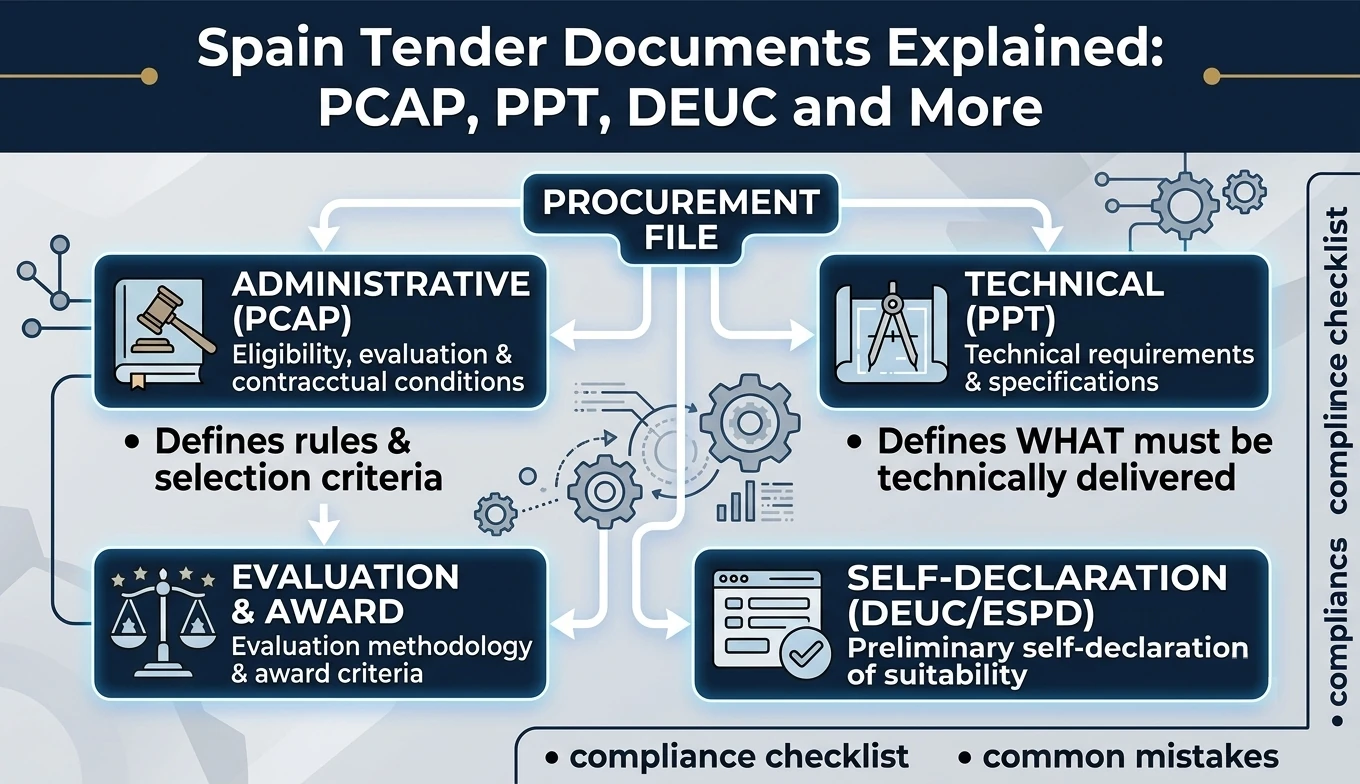
Spain Tender Documents Explained: PCAP, PPT, DEUC and More
25 Sep 2026
Introduction Understanding bid documents is one of the most important steps when preparing a bid for a Spanish public contract. A tender notice may tell you that an opportunity exists, but the detailed procurement documents explain what the contracting authority actually requires, how suppliers must prepare their offers, what eligibility conditions apply and how bids will be evaluated. For suppliers participating in Spanish public procurement, documents such as the PCAP, PPT and DEUC are particularly important. Other documents may include the tender announcement, descriptive documents, technical annexes, pricing schedules, declarations, forms, draft contracts and supporting evidence. Knowing the role of each document helps suppliers avoid a common problem in licitaciones España: preparing a commercially attractive offer without correctly following the administrative or technical requirements established in the procurement documents. This guide explains the main Spain tender documents, what each document means, what suppliers should look for and how the documents work together during a Spanish public procurement procedure. Table of Contents What Are Spain Tender Documents? Main Spain Tender Documents What Is PCAP in Spanish Public Procurement? What Information Does the PCAP Contain? How to Read a PCAP Before Bidding What Is PPT in Spanish Public Procurement? What Information Does the PPT Contain? PCAP vs PPT: What Is the Difference? What Is DEUC in Spain Tenders? DEUC and ESPD: Are They the Same? How Does the DEUC Work? Other Important Spain Tender Documents Tender Forms and Annexes Technical Documentation Financial and Pricing Documentation Draft Contract and Contract Conditions How to Review Spain Tender Documents Spain Tender Document Compliance Checklist Common Tender Document Mistakes Tender Documents for Foreign Companies Where to Find Spain Tender Documents SpainTenders.com Procurement Intelligence Conclusion What Are Spain Tender Documents? Spain tender documents are the official documents that establish the conditions, requirements, specifications and procedures applicable to a public procurement opportunity. They provide the detailed information suppliers need to decide whether to participate and how to prepare a compliant bid. The exact document set depends on the type of contract, procurement procedure and requirements of the contracting authority. A procurement file may therefore contain several administrative, technical, financial and contractual documents. Suppliers should not treat these documents as optional background information. The requirements contained in the applicable procurement documents can directly affect eligibility, technical compliance, pricing, evaluation and contract performance. Main Spain Tender Documents The most important documents commonly encountered in Spanish public procurement include: PCAP: Pliego de Cláusulas Administrativas Particulares, which establishes the particular administrative clauses of the procurement. PPT: Pliego de Prescripciones Técnicas, which establishes the technical requirements and specifications of the required works, supplies or services. DEUC: Documento Europeo Único de Contratación, the Spanish form of the European Single Procurement Document used as a preliminary self-declaration in applicable procurement procedures. Tender notice: The published announcement providing key information about the procurement opportunity. Annexes: Additional forms, technical information, pricing templates and other supporting documents. Draft contract: Where provided, the document showing contractual terms applicable to the successful bidder. What Is PCAP in Spanish Public Procurement? PCAP stands for Pliego de Cláusulas Administrativas Particulares. In English, it can be understood as the document containing the particular administrative clauses governing a public procurement contract. The PCAP is one of the most important documents for a supplier because it sets out many of the administrative and contractual conditions of the tender. It can define eligibility requirements, selection criteria, award criteria, submission requirements, contract conditions and other procurement rules applicable to the specific procedure. Spanish Law 9/2017 provides the legal framework for the procurement documents and establishes that contracts are subject to the content of the applicable administrative clauses. What Information Does the PCAP Contain? The exact structure varies between tenders, but suppliers may find information covering: Contracting authority and procurement reference. Object and scope of the contract. Contract value and estimated value where applicable. Contract duration and possible extensions. Procurement procedure. Supplier eligibility conditions. Economic and financial solvency requirements. Technical and professional solvency requirements. Classification requirements where applicable. Exclusion grounds and declarations. Bid submission requirements. Electronic submission conditions. Evaluation and award criteria. Pricing and other commercial conditions. Special conditions of contract performance. Subcontracting provisions. Contract modification provisions. Penalties or other contractual consequences. How to Read a PCAP Before Bidding Start by identifying the contract object, procurement procedure, deadline and eligibility requirements. Then examine the solvency conditions and the evidence required to demonstrate compliance. Next, review the award criteria carefully. A supplier should understand not only the maximum score available but also what information must be submitted to obtain the relevant evaluation. Finally, review the contractual conditions. Some requirements may become obligations after award rather than merely conditions for submitting an offer. What Is PPT in Spanish Public Procurement? PPT stands for Pliego de Prescripciones Técnicas. It is the technical specifications document that describes the technical requirements of the works, supplies or services being procured. The PPT can describe required characteristics, performance standards, quantities, technical parameters, quality requirements, delivery conditions, implementation requirements, testing requirements and other technical aspects relevant to the contract. Spanish procurement law provides specific rules for technical specifications. The technical specifications must provide equal access to the procurement procedure and should not create unjustified obstacles to competition. What Information Does the PPT Contain? Depending on the contract, the PPT may contain: Technical description of the required service, supply or work. Performance specifications. Minimum technical characteristics. Required quantities and dimensions. Quality standards. Materials and equipment requirements. Delivery or implementation conditions. Testing and inspection requirements. Maintenance and support requirements. Service-level requirements. Environmental or sustainability requirements. Accessibility requirements where relevant. Technical documentation requirements. PCAP vs PPT: What Is the Difference? DocumentMain Purpose PCAPAdministrative, eligibility, evaluation and contractual conditions PPTTechnical requirements and specifications of the procurement DEUCPreliminary supplier self-declaration concerning eligibility and selection requirements where applicable A simple way to understand the distinction is that the PCAP explains the administrative and contractual rules, while the PPT explains what must technically be delivered. Both should be reviewed together. A technically strong proposal can still be non-compliant if it fails to meet an administrative requirement in the PCAP, while an administratively complete bid can fail to meet mandatory technical requirements in the PPT. What Is DEUC in Spain Tenders? DEUC stands for Documento Europeo Único de Contratación. It is the Spanish name for the European Single Procurement Document, commonly abbreviated as ESPD in English. The DEUC is designed as a preliminary self-declaration concerning the supplier's suitability for participation in a public procurement procedure. Instead of requiring suppliers to submit every supporting certificate at the initial stage, the declaration can provide preliminary evidence relating to exclusion and selection criteria in applicable procedures. The European Commission describes the ESPD as a self-declaration form that helps companies meet initial documentary obligations through a single declaration, with supporting evidence subsequently requested where required. DEUC and ESPD: Are They the Same? Yes. DEUC is the Spanish terminology for the European Single Procurement Document, while ESPD is the English abbreviation for the same European procurement concept. The terminology you encounter may depend on the language of the tender documents. Spanish procurement documentation may refer to the DEUC, while EU-level resources generally use ESPD. The European framework established the ESPD as a standardised preliminary self-declaration intended to reduce the administrative burden associated with demonstrating exclusion and selection requirements. How Does the DEUC Work? The contracting authority establishes the relevant selection and exclusion requirements for the procurement. The supplier then completes the applicable DEUC information and declares that the required conditions are satisfied. The DEUC does not mean that a supplier can ignore the evidence requirements. The contracting authority may require supporting documentation and verification according to the procurement rules and the specific tender. Suppliers should therefore treat every DEUC declaration seriously. Information declared in the form should correspond to the company's actual circumstances and the requirements stated in the tender documentation. Other Important Spain Tender Documents Beyond PCAP, PPT and DEUC, a Spanish tender may include several additional documents. These can differ significantly according to the contract and procurement procedure. Common examples include the procurement announcement, descriptive document, technical annexes, pricing forms, declaration forms, bill of quantities, drawings, schedules, draft contractual documents and other supporting files. Suppliers should download and review the complete document package rather than relying only on the summary information displayed in a tender search result. Tender Forms and Annexes Annexes may contain forms that bidders are expected to complete and submit. These may include declarations, pricing tables, technical response templates or other procurement-specific information. Do not replace an official template with a redesigned document unless the tender expressly allows it. If the authority provides a specific form, follow the instructions concerning format, signature, file type and submission method. Technical Documentation Technical documentation demonstrates how the supplier's proposed solution satisfies the technical requirements. Depending on the contract, it may include methodology, technical specifications, implementation plans, staffing information, experience, quality documentation or product information. The technical response should be mapped carefully against the PPT. A useful approach is to create a requirement-by-requirement compliance matrix before preparing the final technical offer. Financial and Pricing Documentation Financial documents may include pricing schedules, bills of quantities, unit prices, total bid prices or other commercial information specified by the tender. Pricing should be checked against the PCAP and the relevant financial template. Suppliers should also verify whether taxes, discounts, optional items and other price components must be presented in a particular format. Draft Contract and Contract Conditions Some tenders include a draft contract or detailed contractual conditions. This document can help suppliers understand the obligations that will apply after award. Review provisions relating to contract duration, extensions, payment, performance obligations, liability, subcontracting, modifications, penalties, termination and other important contractual matters. How to Review Spain Tender Documents A structured review process can reduce the risk of missing an important requirement. Step 1: Download the complete tender document package. Step 2: Identify the PCAP and PPT. Step 3: Check the submission deadline and submission method. Step 4: Read eligibility and solvency requirements. Step 5: Identify all mandatory declarations and forms. Step 6: Review the technical requirements line by line. Step 7: Review the award criteria and scoring methodology. Step 8: Check pricing requirements and financial templates. Step 9: Identify electronic signature and file-format requirements. Step 10: Complete a final compliance review before submission. Spain Tender Document Compliance Checklist Before submitting a bid, suppliers should verify: PCAP has been reviewed. PPT has been reviewed. All mandatory annexes have been identified. DEUC requirements have been checked where applicable. Eligibility requirements have been satisfied. Solvency requirements have been checked. Technical requirements have been addressed. Award criteria have been considered. Pricing forms have been completed correctly. Required declarations have been prepared. Required signatures have been applied. Required supporting evidence is available. Files comply with specified formats and limits. Submission method has been tested where appropriate. Bid will be submitted before the official deadline. Common Tender Document Mistakes One of the most common mistakes is reading only the tender announcement. The announcement provides important information, but the detailed procurement documents contain the requirements that suppliers must follow. Other mistakes include ignoring annexes, overlooking technical requirements, submitting an incomplete declaration, using an incorrect pricing template, failing to sign required documents or confusing eligibility requirements with award criteria. Another risk is relying on a previous tender response without checking the new documentation. Requirements can differ from one procurement procedure to another. Tender Documents for Foreign Companies Foreign companies considering public tenders in Spain should pay particular attention to qualification documents, declarations, evidence of professional standing, financial and technical capacity and any requirements relating to legal establishment or representation. The DEUC/ESPD framework is particularly relevant to cross-border procurement because it was designed to facilitate the preliminary declaration of eligibility and selection information across EU public procurement systems. Foreign suppliers should also check whether documents issued in another country require translation, certification or other formalities under the specific tender requirements. Where to Find Spain Tender Documents Official Spanish public procurement opportunities are commonly published through the relevant contracting authority and procurement platforms, including the Plataforma de Contratación del Sector Público. Tender records normally provide access to the procurement documentation associated with the opportunity. Suppliers can also use specialist tender intelligence services to identify opportunities across sectors, contracting authorities and geographic areas. For example, SpainTenders.com Spain Tenders can be used to discover Spanish procurement opportunities, while SpainTenders.com Authorities provides procurement authority information. For sector-specific research, suppliers can explore SpainTenders.com Sectors. Users who want to access their account can use the SpainTenders.com Login page, while new users can use the SpainTenders.com Registration page. SpainTenders.com Procurement Intelligence SpainTenders.com can support suppliers that need to identify Spanish tender opportunities across different procurement categories, authorities and business sectors. Instead of reviewing every procurement source manually, suppliers can use tender intelligence tools to identify opportunities relevant to their products and services. This can help create a more structured tender discovery workflow. Suppliers can also review Spain contract awards to understand previously awarded procurement opportunities and monitor purchasing activity. For assistance regarding Spain tender research, suppliers can contact SpainTenders.com through its contact page. Conclusion Understanding tender documents is essential for participating effectively in Spanish public procurement. The PCAP provides the key administrative and contractual framework, the PPT explains the technical requirements and the DEUC provides a standardised preliminary self-declaration for applicable eligibility and selection requirements. However, suppliers should not focus on these three documents alone. Annexes, pricing forms, declarations, technical templates, contractual documents and other procurement files can contain important requirements that affect the preparation and evaluation of a bid. A disciplined document-review process allows suppliers to identify mandatory requirements early, prepare the correct evidence and build a bid that responds to both the administrative and technical conditions of the tender. For companies targeting licitaciones España, the ability to read and interpret procurement documents is therefore an important part of the complete tendering process.
View Details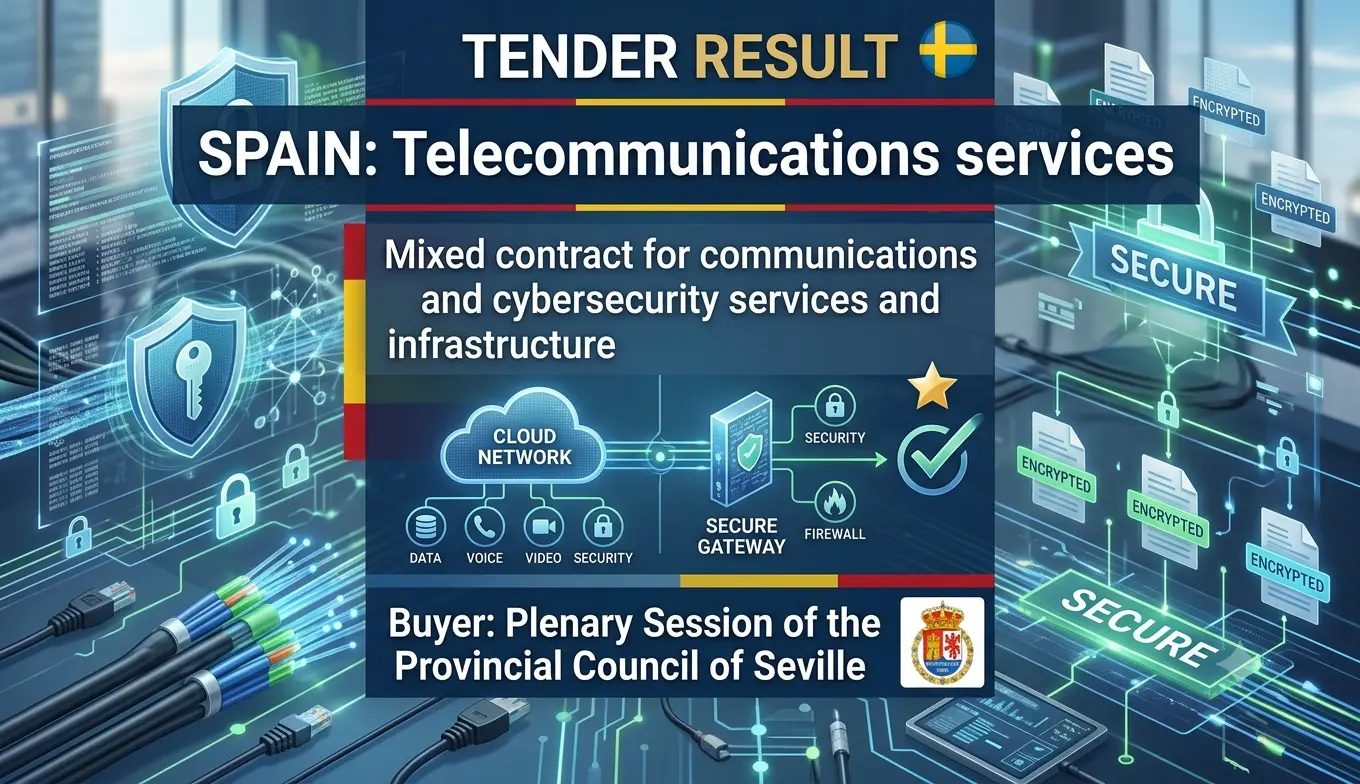
Spain Awards €7.78 Million TARSIS Communications and Cybersecurity Contract to Telefónica Consortium
25 Sep 2026
Standfirst The Provincial Council of Seville has awarded a €7.78 million contract for communications services, infrastructure and cybersecurity supporting its TARSIS interadministrative private network. The contract has been awarded to the UTE Telefónica de España S.A.U. and Telefónica Soluciones de Informática y Comunicaciones de España S.A.U. The project covers the infrastructure and services required to operate the network while introducing advanced cybersecurity measures. Three electronic tenders were received during the open procurement procedure. Introduction The Provincial Council of Seville has completed a major procurement for telecommunications, communications infrastructure and cybersecurity services supporting the TARSIS network. The network is described as a private interadministrative network intended to serve the Provincial Council, its companies, autonomous organisations, affiliated consortia and municipalities and local entities with populations below 20,000 inhabitants in the province. The procurement combines telecommunications services with communications infrastructure, information systems, security software and internet services. The successful tender was submitted by a consortium formed by Telefónica de España and Telefónica Soluciones de Informática y Comunicaciones de España. Why This Contract Matters The procurement is significant because TARSIS provides communications infrastructure for multiple public sector entities across Seville. The project is not limited to connectivity services because the scope also includes advanced cybersecurity measures and associated information technology components. The combination of telecommunications, communications infrastructure, security software and internet services indicates a multi layer digital infrastructure requirement. The contract therefore supports the connectivity and security environment used by a broad group of public sector organisations in the province. Contract Timeline The procurement was identified under internal reference 2025/000423 PEA and was conducted as an open procedure. The successful consortium was selected on 30 July 2026. Contract 423/2025.1 was subsequently concluded on 23 September 2026. The TED result notice was dispatched on 24 September 2026 and published in the Official Journal of the European Union on 25 September 2026. Contract Overview The procurement covers a single lot for the communications services and infrastructure required for the TARSIS network of the Provincial Council of Seville. The main CPV classification is 64200000 for telecommunications services. Additional classifications cover communications infrastructure, software packages and information systems, security software packages and internet services. The procurement was conducted under Directive 2014/24/EU and did not use a framework agreement or dynamic purchasing system. Key Contract Details CountrySpain Contracting AuthorityPleno de la Diputación Provincial de Sevilla ProjectTARSIS communications services, infrastructure and cybersecurity LocationSevilla, Spain ProcedureOpen procedure Legal BasisDirective 2014/24/EU Main CPV64200000 - Telecommunications services Additional CPVs32571000, 48000000, 48730000, 72400000 Lots1 Contract Value€7,777,483.38 WinnerUTE Telefónica de España S.A.U. and Telefónica Soluciones de Informática y Comunicaciones de España S.A.U. Winner Selection Date30 July 2026 Contract Conclusion23 September 2026 Tenders Received3 Electronic Tenders3 SME Tenders0 SubcontractingNo EU FundingNo GPA CoveredNo Framework AgreementNo Dynamic Purchasing SystemNo Project Scope The project provides the infrastructure and services required for the operation of the TARSIS network, described in the notice as a private interadministrative network. The objective is to improve the capabilities and services available to the Provincial Council of Seville, its companies, autonomous organisations, affiliated consortia and municipalities and local entities with populations below 20,000 inhabitants. The procurement also incorporates advanced cybersecurity measures. The classification structure reflects the broad technical scope. Telecommunications services form the principal classification, while communications infrastructure, information systems, security software and internet services are included as additional classifications. This indicates that the procurement addresses both connectivity and supporting digital infrastructure. About the Contracting Authority Pleno de la Diputación Provincial de Sevilla is the contracting authority identified in the TED notice. It is a local authority responsible for general public services and is based in Sevilla, Spain. The authority procured the TARSIS communications and cybersecurity services for its wider network of public sector users. About the Organisations Involved Pleno de la Diputación Provincial de Sevilla acted as the buyer and contracting authority. It established the procurement requirements for the TARSIS network and conducted the open procedure. The authority's procurement profile and contact information are recorded in the TED notice. UTE Telefónica de España S.A.U. and Telefónica Soluciones de Informática y Comunicaciones de España S.A.U. was the successful tenderer and winner of the single lot. TED identifies the consortium as a large economic operator. The consortium submitted a tender valued at €7,777,483.38 and did not indicate subcontracting. Telefónica de España S.A.U. and Telefónica Soluciones de Informática y Comunicaciones de España S.A.U. are the two companies identified within the winning consortium. The consortium's registered location in the notice is Sevilla, Spain. Tribunal Administrativo de Recursos Contractuales de la Junta de Andalucía (TARCJA) is identified as the review organisation associated with the procurement. The organisation is based in Sevilla and is responsible for the relevant contractual review process. Procurement Analysis The procurement was conducted through an open procedure, allowing suppliers to compete for the single lot. Three tenders were received electronically. The TED result identifies the Telefónica consortium as the successful tenderer and records the value of its tender at €7,777,483.38. The award structure combined economic and technical considerations. Price received 30 points, the technical offer received 35 points and technical value received another 35 points. The criteria therefore allocated a total of 70 points to technical aspects and 30 points to price. This evaluation structure is relevant for suppliers because technical capability represented the larger share of the published award criteria. Businesses competing for similar telecommunications and cybersecurity contracts therefore need to demonstrate not only competitive pricing but also the technical quality and value of their proposed solution. Additional Procurement Facts The contract was not financed with EU funds and the procurement was not covered by the Government Procurement Agreement. There was no framework agreement and no dynamic purchasing system. All three tenders were submitted electronically. The TED notice records three tenders from the overall market and separately records zero tenders from micro, small or medium tenderers. This means the competition involved three submissions but none came from an SME classified tenderer. Market and Industry Perspective The TARSIS procurement reflects the growing integration of telecommunications infrastructure and cybersecurity within public sector digital networks. Rather than procuring connectivity independently from security, the Provincial Council of Seville has combined communications infrastructure, telecommunications services, security software and internet services within one procurement package. This type of integrated requirement can create opportunities for major telecommunications providers and technology integrators with the ability to manage network infrastructure and cybersecurity services together. It can also create specialist opportunities in areas such as network security, software, monitoring, infrastructure management and digital connectivity. The project also illustrates the importance of secure interadministrative connectivity. A network serving multiple public bodies needs to support communication between participating organisations while addressing cybersecurity requirements across the wider infrastructure. Economic Significance With a contract value of €7,777,483.38, the procurement represents a substantial technology services opportunity in the Seville public sector market. The value covers a broad combination of telecommunications and supporting digital infrastructure requirements. The procurement also demonstrates how regional and local government organisations can consolidate multiple technology requirements into a single contract. For suppliers, such contracts can provide opportunities to participate in larger digital infrastructure programmes rather than individual connectivity procurements. Future Procurement Opportunities The TARSIS project may provide a reference point for future public sector demand involving secure communications networks, cybersecurity services and digital infrastructure. Public authorities managing interadministrative networks may require continued investment in network upgrades, security technologies, monitoring and software systems as their digital services expand. Future procurement opportunities may also emerge from the growing need to protect public sector networks against cyber threats while maintaining reliable connectivity between government organisations. Suppliers specialising in network security, communications infrastructure and managed services can monitor such requirements through public procurement channels. Opportunities for Suppliers Telecommunications companies, network infrastructure providers, cybersecurity specialists and technology integrators can monitor Spanish public sector procurement for similar integrated requirements. The TARSIS procurement shows that technical evaluation can account for a substantial proportion of the overall award assessment. Suppliers should therefore maintain strong technical documentation, demonstrate relevant network and cybersecurity capabilities and prepare solutions that address both operational requirements and security objectives. Smaller specialist suppliers may also consider partnerships or consortium structures when a procurement combines several technical disciplines within one contract. What Businesses Should Watch Businesses should monitor procurement notices that combine telecommunications, cybersecurity and information systems rather than searching only for conventional telecom service contracts. The CPV structure of this procurement shows how a single opportunity can span communications infrastructure, security software and internet services. Suppliers should also examine award criteria carefully before deciding whether to bid. In this case, price accounted for 30 points while the two technical criteria together accounted for 70 points. Technical differentiation therefore formed a substantial part of the published evaluation structure. SpainTenders.com Procurement Intelligence The Seville TARSIS contract highlights an important procurement intelligence trend: public sector digital infrastructure is increasingly being procured as an integrated technology environment. A supplier tracking only telecommunications CPV codes could miss opportunities where cybersecurity, software and network infrastructure are combined under a broader procurement description. For procurement intelligence teams, this type of notice should be classified across multiple technology categories. The main CPV is telecommunications services, but the additional classifications provide important signals about communications infrastructure, information systems, security software and internet services. This broader classification approach can improve supplier matching and opportunity discovery. The competition also provides useful intelligence about supplier structure. Three electronic tenders were received and none came from an SME classified tenderer. The winning consortium consisted of two Telefónica entities, demonstrating how larger technology providers can combine complementary capabilities within a single bid structure. For suppliers monitoring Spain, the contract is also an example of how regional government digital transformation can generate multi million euro opportunities. Tracking buyer history, network modernisation plans, cybersecurity requirements and related CPV combinations can help identify future procurement cycles before they become visible through individual service categories. Supplier Takeaways The Provincial Council of Seville awarded the TARSIS contract to a Telefónica consortium. The contract value is €7,777,483.38. The procurement covers telecommunications services, communications infrastructure and cybersecurity. The TARSIS network is described as a private interadministrative network. The project supports the Provincial Council and a wider group of public sector entities in Seville. The procurement used an open procedure. Three electronic tenders were received. No SME tenderers participated according to the statistical information in the notice. Price accounted for 30 points. The technical offer accounted for 35 points. Technical value accounted for another 35 points. No subcontracting was reported by the winning consortium. The procurement was not financed with EU funds. Suppliers should monitor integrated telecommunications and cybersecurity procurements in Spanish public sector markets. Key Takeaways Country: Spain. Buyer: Pleno de la Diputación Provincial de Sevilla. Project: TARSIS communications services, infrastructure and cybersecurity. Winner: UTE Telefónica de España S.A.U. and Telefónica Soluciones de Informática y Comunicaciones de España S.A.U. Contract Value: €7,777,483.38. Main CPV: 64200000. Additional CPVs: 32571000, 48000000, 48730000 and 72400000. Procedure: Open. Lots: 1. Tenders Received: 3. Winner Selection: 30 July 2026. Contract Conclusion: 23 September 2026. Subcontracting: No. EU Funding: No. GPA: No. Conclusion The Provincial Council of Seville has awarded a €7.78 million contract to a Telefónica consortium for communications services, infrastructure and cybersecurity supporting the TARSIS interadministrative network. The procurement combines telecommunications and digital security requirements within a single contract and was contested by three electronic tenders. The project demonstrates the scale of public sector demand for integrated and secure communications infrastructure in Spain. Source: TED result notice 663362-2026, OJ S186/2026, published 25 September 2026.
View Details