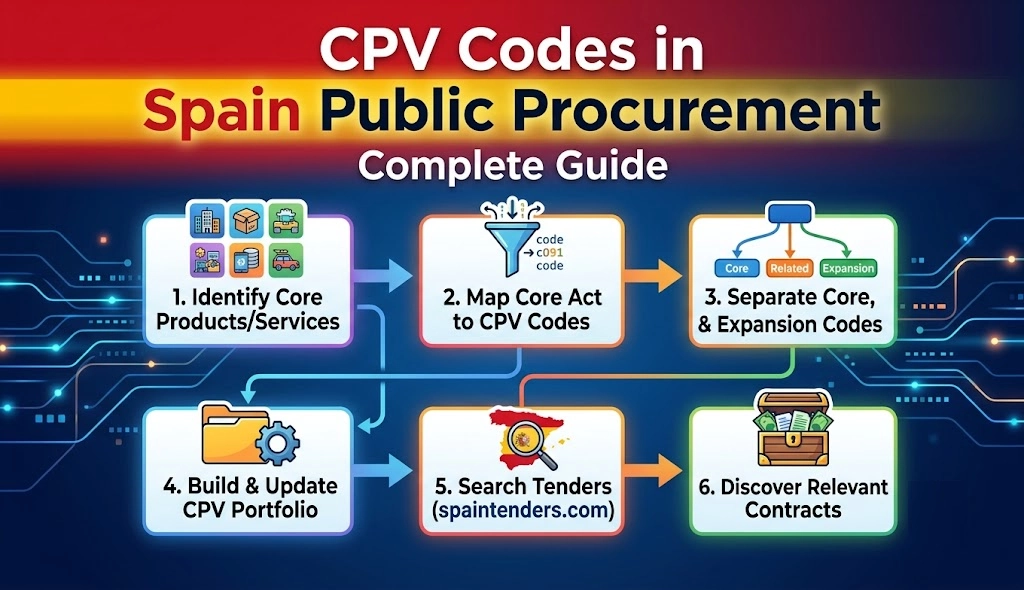
CPV Codes in Spain Public Procurement: Complete Guide
24 Sep 2026
Introduction CPV codes are one of the most important classification tools used in European public procurement and are highly relevant to suppliers searching for Spanish government contracts. CPV stands for Common Procurement Vocabulary. It provides a standardized classification system for describing the goods, works and services purchased through public contracts. For companies looking for Spain tenders, understanding CPV codes can make tender discovery more precise. A supplier that searches only by company-specific terminology or individual Spanish keywords may miss relevant opportunities because contracting authorities can describe similar requirements using different wording. CPV codes provide a standardized classification reference that can help connect procurement opportunities with the type of goods, works or services being purchased. The CPV system was established at European Union level and its structure was revised by Commission Regulation (EC) No 213/2008. The main vocabulary follows a hierarchical tree structure and uses numerical codes associated with descriptions of supplies, works and services. The system also contains a supplementary vocabulary that can provide additional detail about the subject of a contract. This guide explains how CPV codes work in Spanish public procurement, how the hierarchy is structured, how contracting authorities use CPV classifications, how suppliers can use CPV codes when researching licitaciones España and how to build a practical CPV-based tender monitoring strategy. Table of Contents What Are CPV Codes in Spain Public Procurement? Why CPV Codes Matter for Spanish Tenders How the CPV Code Structure Works CPV Divisions, Groups, Classes and Categories Main CPV Vocabulary CPV Supplementary Vocabulary Primary and Additional CPV Codes Where CPV Codes Appear in Spanish Tender Notices How Suppliers Can Search Spain Tenders by CPV Code How to Choose Relevant CPV Codes Why a Tender Can Have Multiple CPV Codes CPV Codes and Tender Keywords Using CPV Codes for Industry-Specific Tender Research Combining CPV Codes With Spanish Locations Combining CPV Codes With Procurement Procedures Using CPV Codes to Monitor Tender Deadlines Common CPV Code Search Mistakes Building a CPV-Based Spain Tender Strategy CPV Codes for Foreign Companies Finding Spain Tenders Using CPV Intelligence CPV Tender Research Checklist Conclusion What Are CPV Codes in Spain Public Procurement? CPV codes are standardized classification codes used to describe the subject of public procurement contracts. CPV means Common Procurement Vocabulary and provides a common reference system for procurement activities. The purpose of the system is to standardize the way contracting authorities describe what they are buying. Instead of relying exclusively on different national terms, languages or commercial descriptions, procurement opportunities can be associated with standardized CPV classifications. For a supplier, this means that CPV can be used as a procurement language in addition to normal keywords. A Spanish tender may use terminology that differs from the terminology normally used by a supplier, while the relevant CPV classification can still point toward the same procurement category. Why CPV Codes Matter for Spanish Tenders CPV codes are particularly useful when a company is monitoring a large number of public procurement opportunities. Spanish contracting authorities publish tenders across different sectors, regions, authorities and contract types. Searching only by tender title can therefore create gaps in tender discovery. A CPV-based search allows suppliers to define procurement categories according to standardized classifications. This can support the discovery of opportunities involving supplies, services or works that match a company's commercial capabilities. CPV classification can also help suppliers organize historical tender information, analyze purchasing patterns, identify relevant contracting authorities and develop sector-specific tender monitoring strategies. How the CPV Code Structure Works The CPV main vocabulary is organized as a hierarchical tree. The numerical code contains eight digits followed by a ninth check digit. The hierarchy becomes progressively more specific as additional digits are used. The first two digits identify the division. The first three digits identify the group. The first four digits identify the class and the first five digits identify the category. The remaining digits provide additional precision within the category and the ninth digit serves as a verification digit. This hierarchy allows procurement data to be analyzed at different levels. A supplier can work with a broad procurement family when developing a market overview or use a more specific CPV code when monitoring a specialized product or service. CPV Divisions, Groups, Classes and Categories Understanding the hierarchy is important because not every supplier needs to monitor only the most detailed code available. Division: the broadest major numerical classification level. Group: a more specific procurement grouping within a division. Class: a narrower classification describing a particular procurement family. Category: a more detailed classification within the relevant class. Detailed CPV code: a further level of specificity within the category. For tender monitoring, companies can build a CPV portfolio containing several related codes. The objective should be to balance coverage with relevance rather than selecting every code that appears remotely related to the business. Main CPV Vocabulary The main vocabulary is the primary numerical classification system. It associates CPV codes with descriptions covering supplies, works and services that form the subject of procurement contracts. Because it is hierarchical, the main vocabulary can support both broad and narrow procurement analysis. A supplier may start with a relevant procurement division or group and then identify more specific classes, categories and detailed codes relevant to its products or services. When building a Spain tender search strategy, suppliers should review the complete description associated with a code rather than relying only on the numerical sequence. The wording and the position of the code in the hierarchy help determine whether it is relevant to the company's actual offering. CPV Supplementary Vocabulary The CPV system also includes a supplementary vocabulary. Its purpose is to add further characteristics or details to the description of the procurement subject. The supplementary vocabulary is different from the main numerical vocabulary. It can provide additional information concerning characteristics or specific aspects of the goods or services being procured. For suppliers, the main CPV code generally provides the primary classification reference, while supplementary information can help provide additional context about the procurement requirement. Primary and Additional CPV Codes A public procurement opportunity can involve more than one CPV classification when the contract contains multiple related goods, services or work elements. The procurement documentation should therefore be reviewed rather than assuming that a single CPV code represents every aspect of the contract. One classification may represent the principal subject of the procurement while additional classifications can describe secondary or related elements. This distinction is important for suppliers because searching for only one very specific CPV code can exclude tenders where the company's relevant activity is represented by an additional classification. Where CPV Codes Appear in Spanish Tender Notices CPV information can form part of the procurement data associated with a Spanish public tender. Suppliers reviewing a tender should examine the CPV classification together with the contract title, description, technical specifications, lots, estimated value, procedure, qualification requirements and deadline. CPV should not be treated as a substitute for reading the procurement documents. A CPV code provides a classification reference, but it does not by itself explain the complete technical requirements, eligibility conditions or scope of work. For this reason, CPV is most effective as a tender discovery and categorization tool followed by detailed document review. How Suppliers Can Search Spain Tenders by CPV Code Suppliers can use CPV classifications as one component of a structured Spain tender search. The process should begin by identifying the company's actual products, services and capabilities and then mapping those activities to relevant CPV classifications. List the products and services the company can supply. Identify the corresponding CPV classifications. Separate broad codes from highly specific codes. Identify related codes that may capture the same commercial activity. Monitor relevant tenders using the selected CPV portfolio. Review the actual tender documentation before deciding whether an opportunity is relevant. Suppliers can also use SpainTenders.com Spain tender search to discover procurement opportunities and combine CPV intelligence with other tender information. How to Choose Relevant CPV Codes Choosing CPV codes should begin with the company's actual commercial scope rather than with a random list of codes. A supplier should identify the goods or services it can realistically deliver and then determine which CPV classifications describe those activities. It is useful to create three categories of CPV codes: Core CPV codes: codes directly representing the company's principal products or services. Related CPV codes: classifications covering adjacent products or services that the company can also provide. Expansion CPV codes: classifications connected with markets the company may enter in the future. This approach can make tender monitoring more manageable while reducing irrelevant procurement results. Why a Tender Can Have Multiple CPV Codes Public contracts can contain several procurement components. For example, a contract may involve equipment supply together with installation, maintenance, technical support or related services. A contracting authority may therefore use multiple classifications to describe different elements of the requirement. Suppliers should examine the relationship between the CPV codes rather than evaluating each code in isolation. The tender description, lots and technical documentation provide the context needed to determine the actual scope. CPV Codes and Tender Keywords CPV codes and keywords serve different but complementary purposes. Keywords describe procurement using words and phrases, while CPV provides a standardized classification structure. Spanish procurement terminology can vary between contracting authorities. The same commercial activity may be described using different Spanish expressions, abbreviations or technical terms. CPV searching can therefore supplement keyword searching. A strong monitoring strategy can combine CPV codes + Spanish keywords + contracting authority + location + procurement procedure. This creates a broader discovery framework than relying on a single search method. Using CPV Codes for Industry-Specific Tender Research CPV classification can be used to organize procurement research by industry. Companies in construction, information technology, healthcare, engineering, transportation, energy, telecommunications, security, consulting and other sectors can develop their own CPV portfolios. For example, an IT company may need to monitor several related classifications covering hardware, software, information systems, maintenance and professional services rather than monitoring one general technology keyword. The same principle applies to engineering companies, medical suppliers, construction contractors and professional service providers. The CPV portfolio should reflect the actual commercial activities the supplier wants to pursue. Suppliers can also review procurement authorities through the SpainTenders.com authority directory and combine authority intelligence with CPV-based research. Combining CPV Codes With Spanish Locations CPV classification identifies the procurement subject, while geographic information identifies where the opportunity is located or which authority is conducting the procurement. Combining the two can be useful for suppliers that operate only in particular Spanish autonomous communities, provinces or cities. A company may therefore create search combinations such as a selected CPV category together with Madrid, Andalucía, Catalonia, Valencia, Galicia or another target market. This approach can reduce irrelevant results and help suppliers focus on procurement opportunities that match both their capabilities and geographic operating model. Combining CPV Codes With Procurement Procedures CPV codes identify the subject of procurement, while the procurement procedure explains how the contracting authority is conducting the award process. Suppliers can therefore combine CPV research with procedure information when evaluating opportunities. For example, a company may monitor a particular CPV portfolio and separately identify open procedures, simplified procedures, restricted procedures or negotiated procedures that match its business requirements. Understanding the procedure remains essential because CPV relevance does not mean that a supplier automatically satisfies the eligibility, qualification or submission requirements of the tender. Using CPV Codes to Monitor Tender Deadlines CPV codes are useful for identifying relevant opportunities, but deadline management is equally important. After identifying a tender through CPV classification, suppliers should record the submission deadline and allow sufficient time for eligibility checks, document preparation, electronic signatures and final submission. Companies can also monitor contract awards associated with procurement categories to understand which types of organizations are purchasing particular goods and services. SpainTenders.com provides a dedicated Spain contract awards section for procurement award research. Common CPV Code Search Mistakes Several mistakes can reduce the usefulness of CPV-based tender research. Using only one CPV code: related procurement may be classified under additional codes. Choosing a code only from its number: the official description should always be reviewed. Using an overly broad classification: broad searches can generate a large amount of irrelevant procurement data. Using an overly narrow classification: relevant opportunities may be missed if the authority uses a related code. Ignoring tender documents: CPV does not replace technical and contractual review. Ignoring Spanish terminology: keyword variations can still be important for tender discovery. Not reviewing multiple lots: different lots can have different scopes and classifications. Failing to update the CPV portfolio: commercial activities and target markets can change over time. Building a CPV-Based Spain Tender Strategy A practical CPV strategy should be built around the company's actual procurement interests. Start with the products and services that represent the highest commercial relevance and identify their corresponding CPV classifications. Next, add related classifications that may capture procurement opportunities with different terminology or broader scopes. The resulting CPV portfolio can then be used alongside Spanish keywords, geographic filters and contracting authority information. Companies can also maintain historical records showing which CPV codes generate relevant tenders, which authorities repeatedly purchase those services and which procurement categories result in successful opportunities. This can turn CPV from a simple search filter into a procurement intelligence tool. For companies that want to maintain a regular Spain tender workflow, register with SpainTenders.com and use the platform to support ongoing tender discovery. CPV Codes for Foreign Companies Foreign companies interested in Spanish public procurement can also use CPV classifications when researching the Spanish market. Because CPV is a European procurement classification system, it provides a standardized reference that can be useful when comparing procurement opportunities across European markets. For an international supplier, CPV research can begin before entering the Spanish market. A company can identify relevant procurement categories, analyze Spanish purchasing activity and then examine individual tender requirements, qualification conditions and submission procedures. Foreign suppliers should remember that CPV relevance does not establish eligibility. The company must separately assess the legal, technical, professional, financial and procedural requirements specified in each procurement process. Finding Spain Tenders Using CPV Intelligence CPV-based procurement intelligence becomes more useful when it is connected with broader tender information. Suppliers can combine CPV classifications with sector information, contracting authorities, locations, deadlines, procedures and contract awards. SpainTenders.com can be used as part of this workflow. Suppliers can explore the SpainTenders.com sectors directory to identify procurement areas and use the platform's tender information to investigate opportunities relevant to their CPV portfolio. Companies that require assistance with their tender research or procurement information can also use the SpainTenders.com contact page for further assistance. CPV Tender Research Checklist Before relying on a CPV-based Spain tender search strategy, suppliers should check the following: Identify the company's core products and services. Map each core activity to relevant CPV classifications. Separate core, related and expansion CPV codes. Review the official description of every selected CPV code. Monitor more than one relevant classification where appropriate. Combine CPV research with Spanish procurement keywords. Use geographic information where location matters. Review contracting authorities purchasing within the selected category. Check procurement procedure requirements. Record submission deadlines. Review the complete tender documentation. Track contract awards and historical procurement activity. Regularly review and update the CPV portfolio. Conclusion CPV codes provide a standardized way to classify the subject of public procurement contracts and are an important part of tender intelligence for suppliers targeting the Spanish public procurement market. Their hierarchical structure allows procurement activity to be analyzed at broad and highly specific levels. For suppliers searching Spain tenders, CPV should be used together with keywords, locations, contracting authorities, procedures, deadlines and detailed tender documents. A carefully developed CPV portfolio can improve procurement discovery and help companies organize their tender monitoring more systematically. CPV classification is a discovery and categorization tool rather than a replacement for tender evaluation. The final decision to participate should always be based on the complete procurement notice, technical specifications, qualification requirements, contractual conditions and submission instructions. For ongoing research into Spanish public procurement opportunities, suppliers can use SpainTenders.com Spain tenders, review Spain contract awards and access their account through the SpainTenders.com login page.
View Details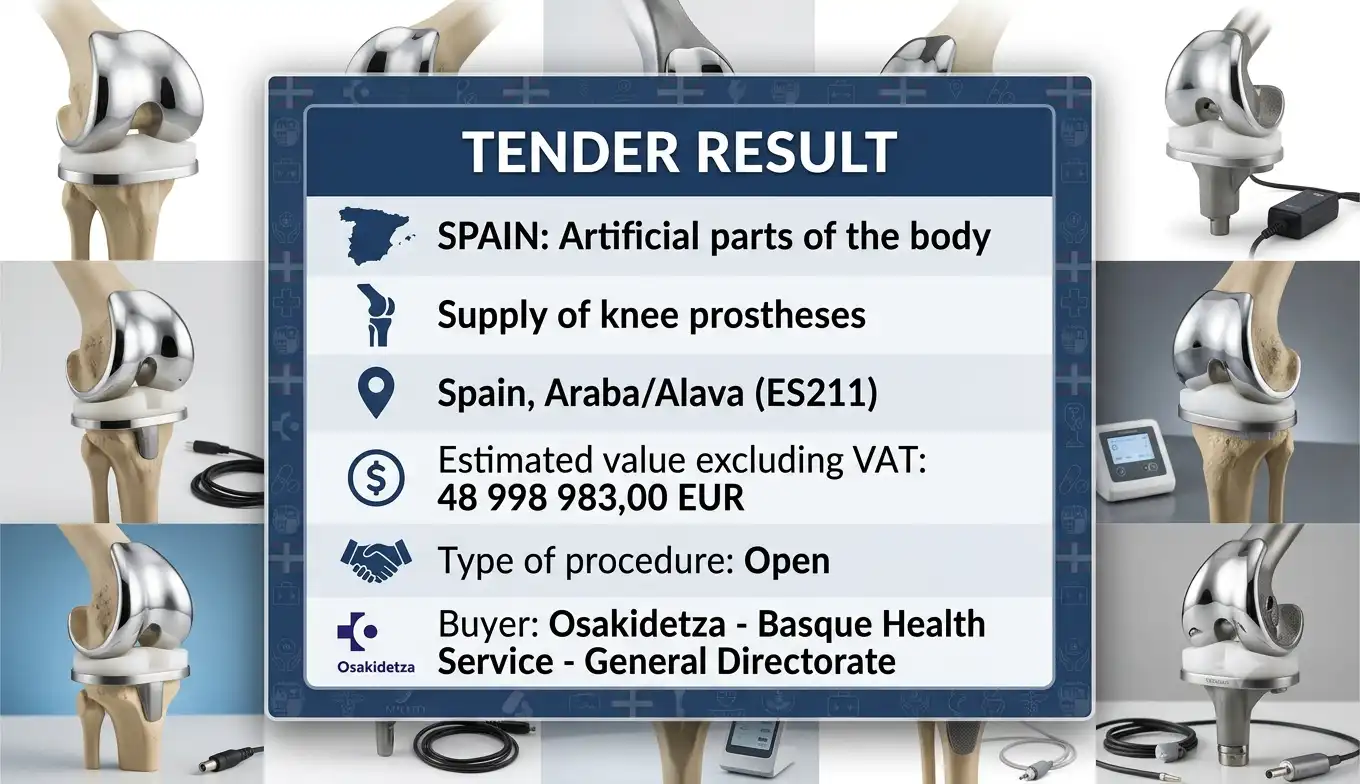
Multiple Medical Device Suppliers Secure Framework for Knee Prostheses Across Basque Health Service
24 Sep 2026
Standfirst Osakidetza, the Basque Health Service, has awarded a major framework agreement valued at approximately 22.2 million euros for the supply of knee prostheses and necessary implantation components. The procurement covers 13 distinct lots addressing various orthopedic needs, ranging from primary replacements to complex tumor prostheses and antiallergic implants. This tender result highlights the strategic approach of the regional health authority to maintain clinical excellence through a framework that allows for the reopening of competition. Multiple specialized suppliers secured positions, ensuring a diverse and resilient supply chain for regional hospitals while prioritizing advanced surgical outcomes. Introduction The continuous modernization of orthopedic care requires a reliable and highly specialized supply of medical devices to support complex surgical interventions. In the Basque Country, the regional health authority has initiated a targeted procurement strategy to equip its hospitals with advanced knee prostheses and associated surgical components. This recent contract award ensures that medical professionals have uninterrupted access to the specific implants required for diverse patient anatomies and clinical conditions. By executing this procurement through an open procedure, the contracting authority ensured rigorous evaluation of both technical quality and financial efficiency. The selection criteria heavily weighted clinical outcomes and international registry data alongside cost considerations. This holistic approach guarantees that public funds are deployed efficiently while prioritizing patient safety and operational excellence in specialized surgical environments. Why This Contract Matters This procurement is vital for ensuring that regional healthcare facilities can perform life saving orthopedic surgeries without interruption due to equipment shortages. The inclusion of specialized lots for antiallergic implants and robotic surgery compatibility demonstrates a forward looking approach to patient care. For the medical device industry, securing a position in this public procurement validates the technical superiority of the awarded products. It also demonstrates how regional authorities can leverage framework agreements with reopening of competition to drive continuous improvement in healthcare delivery. This structure allows the health service to adapt to evolving clinical guidelines and technological advancements over the contract duration. Suppliers must continuously innovate to meet the stringent quality metrics outlined in the bidding documents. Contract Timeline The procurement process concluded with the formal selection of the winning bidders on August 17, 2026. Following standard administrative procedures and mandatory standstill periods, the formal framework agreements were concluded on the same date. The official contract awards notice was published in the Official Journal of the European Union on September 24, 2026. This timeline reflects a standard and transparent execution of public procurement regulations in the Spanish healthcare sector. Contract Overview The procurement is structured as a framework agreement with reopening of competition, divided into 13 distinct lots covering a wide array of orthopedic devices. The maximum awarded value of the framework agreements is 22,272,265.00 euros, reflecting a substantial investment in specialized medical supplies. The suppliers are responsible for delivering these devices in accordance with strict clinical specifications and maintaining consistent supply levels throughout the agreement duration. The reopening mechanism ensures that pricing and technical offerings remain competitive for future call offs. Key Contract Details Contract Title Suministro de prótesis de rodilla y de los componentes necesarios para su implantación, con destino a las organizaciones de servicios de Osakidetza Contracting Authority Osakidetza, Servicio Vasco de Salud Maximum Framework Value 22,272,265.00 EUR Procedure Type Open Procedure Number of Lots 13 Winners Zimmer Biomet Spain, Establecimientos Sumisan, Johnson and Johnson, Medacta España, Palex Medical, Traumédica, Medicina Analítica Consumibles MAC, Waldemar Link España Contract Conclusion Date August 17, 2026 Main CPV Code 33184000 (Artificial parts of the body) Project Scope The core scope involves the supply of highly specialized medical devices for orthopedic surgery units. This includes primary and revision total knee prostheses, medial pivot designs, unicondylar implants, and patellofemoral replacements. The framework also encompasses specialized needs such as antiallergic components for sensitive patients, navigation system compatibility, arthrodesis nails, and complex tumor prostheses. The contracting authority evaluated bids based on implant design quality, instrument versatility, and survival rates recorded in international registries. Additional criteria included the provision of complementary services, such as surgical training and hospital support, ensuring that the supplied devices integrate smoothly into existing clinical workflows and robotic surgery platforms. About the Contracting Authority Osakidetza, Servicio Vasco de Salud is the primary buyer for this procurement. It is a regional public authority responsible for managing and delivering healthcare services across the Basque Country, ensuring high standards of medical care for the local population. About the Organisations Involved Osakidetza, Servicio Vasco de Salud is the contracting authority and buyer. It manages regional public health services and drives the procurement of essential medical supplies for public hospitals. Zimmer Biomet Spain, S.L.U. is a successful bidder and a micro, small, or medium enterprise. It secured positions across seven lots, including primary and revision total knee prostheses, unicondylar implants, and patellofemoral replacements, demonstrating strong market presence. Establecimientos Sumisan, S.A. is a successful bidder and a micro, small, or medium enterprise. It secured positions in Lot 1 and Lot 13, covering primary knee prostheses and complex tumor prostheses. Johnson and Johnson, S.A. is a successful bidder and a micro, small, or medium enterprise. It secured a position in Lot 1 for primary and revision total knee prostheses. Medacta España, S.L. is a successful bidder and a micro, small, or medium enterprise. It secured a position in Lot 2 for medial pivot knee prostheses. Palex Medical, S.A. is a successful bidder and a micro, small, or medium enterprise. It secured positions in Lot 2 and Lot 10, covering medial pivot and antiallergic medial pivot prostheses. Traumédica, S.L. is a successful bidder and a micro, small, or medium enterprise. It secured a position in Lot 9 for antiallergic patellofemoral prostheses. Medicina Analítica Consumibles MAC, S.A. is a successful bidder and a micro, small, or medium enterprise. It secured a position in Lot 11 for navigation system compatible prostheses. Waldemar Link España, S.A. is a successful bidder and a micro, small, or medium enterprise. It secured a position in Lot 12 for arthrodesis nails. Órgano Administrativo de Recursos Contractuales de la Comunidad Autónoma de Euskadi is the review organisation. This administrative body handles any legal appeals or disputes related to public procurement procedures in the Basque Country. Procurement Analysis The open procedure attracted varying levels of competition across the 13 lots, with bid counts generally ranging from one to seven submissions per lot. The award criteria utilized a balanced approach, assigning significant weight to technical quality and clinical evidence alongside a 50 percent weight to price. This evaluation method indicates that the clinical baselines were strict, ensuring that only highly capable firms with proven track records could advance to the final selection. Notably, all received bids originated from micro, small or medium enterprises, highlighting the strong presence of specialized agile firms in the regional medical device market. Additional Procurement Facts The procurement project is not financed with European Union funds, relying entirely on the regional healthcare budget of the Basque Country. The procedure is covered by the Government Procurement Agreement, allowing international suppliers to participate in the bidding process. Market & Industry Perspective The Spanish medical device market for orthopedics is characterized by a strong presence of established multinational manufacturers alongside specialized domestic distributors. The success of multiple winners across different lots highlights the importance of clinical efficacy and regulatory compliance in winning major public contracts. Suppliers must continuously update their product lines to align with evolving medical standards and the specific requirements detailed in GPNs and BOQs. The dominance of small and medium enterprises in this tender result suggests that specialized niche expertise is highly valued alongside the broad capabilities of larger corporate groups. Economic Significance An investment of approximately 22.2 million euros represents a substantial injection of capital into the regional healthcare supply chain. This spending supports local distribution networks, logistics operations, and clinical training programs, ensuring that advanced medical technologies remain accessible to public health facilities. By securing these supplies through a competitive framework, the public sector protects its clinical operations from short term market volatility while fostering a sustainable ecosystem for medical device innovation. Future Procurement Opportunities Suppliers who were not successful should monitor the official Tenders Portal for upcoming medical device renewals in other Spanish regions. As clinical guidelines evolve, public institutions will continuously generate new tenders opportunities for advanced surgical supplies and implants. Stakeholders should also track the Latest Active Tenders Procurement notices to anticipate upcoming infrastructure projects in the broader European healthcare sector. The dynamic nature of public procurement means that new Live Notices for Tenders will emerge as regional authorities update their clinical requirements. Opportunities for Suppliers While the primary framework positions have been awarded, specialized logistics providers and medical device distributors can find valuable subcontracting opportunities. Companies offering advanced inventory management software or specialized clinical training for hospital staff may also position themselves to support the supply chain operations of the awarded firms. Additionally, manufacturers of niche surgical instruments or robotic surgery integration tools should monitor the reopening of competition phases to introduce next generation technologies to the Basque Health Service. What Businesses Should Watch Industry observers should monitor the activation rates for each lot to gauge the actual clinical demand for specialized knee prostheses in the Basque Country. The enforcement of strict technical evaluation criteria will be a key metric for future live tender evaluations in this sector. Stakeholders should also review Live Notices for Tenders to anticipate upcoming medical modernization projects funded by regional health programs. The integration of robotic surgery compatibility and antiallergic materials will likely become standard requirements in future RFPs and RFQs. SpainTenders.com Procurement Intelligence This contract represents a clear trend in European public procurement toward the use of multi lot framework agreements with reopening of competition for highly specialized medical devices. By appointing numerous suppliers across 13 distinct lots, the contracting authority mitigates the risk of supply chain bottlenecks and ensures broad market access for critical surgical tools. This strategy prioritizes operational continuity and strict adherence to clinical mandates over the traditional model of awarding exclusive contracts to a single provider. Suppliers can learn that meeting fundamental technical requirements and providing verifiable clinical data is the primary gateway for winning public procurement contracts in the medical device sector. Future contracts in this market are likely to evolve by incorporating even stricter material traceability and post market surveillance mandates. As public institutions face increasing pressure to ensure patient safety and optimize surgical outcomes, companies that proactively develop transparent supply chains and offer verifiable clinical data will hold a distinct advantage. Suppliers must prepare for increased scrutiny on their product certifications, making rigorous documentation and compliance tracking essential for future public procurement success. Monitoring Active Tenders and understanding the specific BOQs of regional health authorities will be critical for maintaining a competitive edge. Supplier Takeaways Multi lot framework agreements with reopening of competition are increasingly used to guarantee supply chain resilience in public healthcare procurement. Meeting strict clinical and regulatory minimums is a primary gateway for winning government medical device contracts. Evaluation criteria heavily weighting technical quality and international registry data require suppliers to maintain high product certification levels. Specialized logistics and distribution providers can find valuable subcontracting opportunities with primary framework winners. Key Takeaways Multiple specialized suppliers were awarded positions across 13 distinct knee prosthesis lots. The maximum awarded value of the framework agreements is 22,272,265.00 euros. The award criteria balanced technical quality and clinical evidence with a 50 percent weight to price. The procurement ensures a continuous supply of critical surgical implants for regional hospitals. All received bids originated from micro, small or medium enterprises. Conclusion This framework agreement secures a reliable and diversified supply of critical orthopedic devices for the Basque regional health system. The multi supplier award structure ensures competitive tension and operational resilience for the duration of the contract. As the region continues to modernize its healthcare delivery, this procurement model will likely serve as a blueprint for future medical acquisitions across Spain. Source: Tenders Electronic Daily (TED), Contract Award Notice 659844-2026, Official Journal of the European Union, published on 24/09/2026.
View Details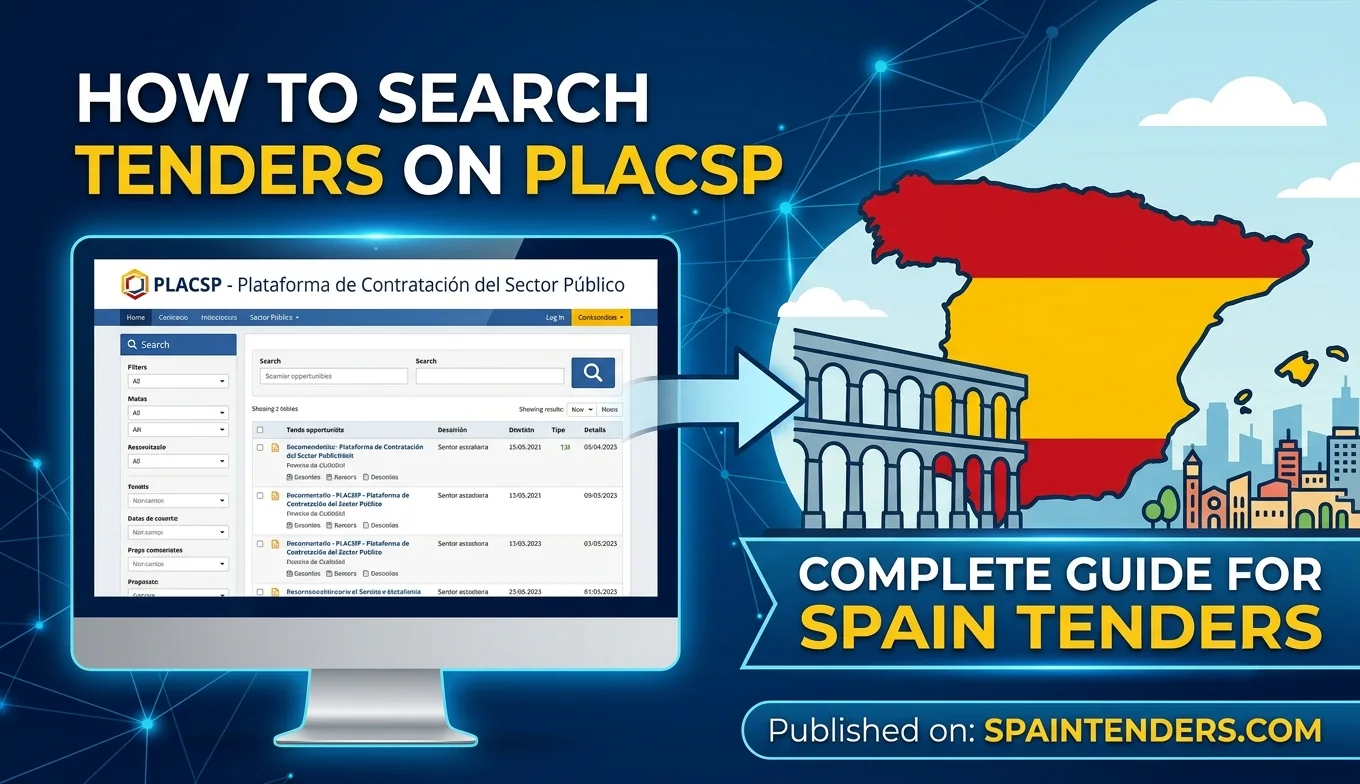
How to Search Tenders on PLACSP: Complete Guide for Spain Tenders
23 Sep 2026
Introduction Finding the right public procurement opportunity is one of the most important steps for any company entering the Spanish government contracting market. Spain publishes a large number of procurement opportunities across central government, Autonomous Communities, municipalities, public institutions and other contracting authorities. For suppliers, the challenge is not simply finding tenders but identifying the opportunities that match their products, services, technical capabilities, location and eligibility. The Plataforma de Contratación del Sector Público, commonly known as PLACSP, provides an important search environment for Spanish public procurement. Suppliers can use the platform to search for published tenders, examine contracting profiles, review procurement information and access documents associated with individual opportunities. For companies searching for licitaciones España, licitaciones públicas España, contratación pública España and Spain government tenders, understanding how to use PLACSP search functions can make tender discovery more structured and efficient. This guide explains how to search tenders on PLACSP, how to use basic and advanced search filters, how to search by CPV, contracting authority and location, how to review tender results, how to identify electronic procedures and how suppliers can save and monitor opportunities that match their business. Table of Contents What Is the PLACSP Tender Search? Why Should Suppliers Search Tenders on PLACSP? How to Access the PLACSP Tender Search How to Perform a Basic Tender Search How to Search Spanish Tenders by Keyword How to Search Spain Tenders by CPV Code How to Search by Contracting Authority How to Search Tenders by Location How to Search by Procurement Procedure How to Search by Contract Type How to Search by Tender Deadline How to Use Advanced Search on PLACSP How to Find Electronic Tender Procedures How to Read PLACSP Search Results How to Open and Review Tender Details How to Find Tender Documents on PLACSP How to Use My Tenders on PLACSP How to Monitor Tender Updates and Alerts Common PLACSP Tender Search Mistakes How to Build a Better PLACSP Search Strategy Find Spain Tenders Beyond PLACSP PLACSP Tender Search Checklist Conclusion What Is the PLACSP Tender Search? The PLACSP tender search is the search environment provided through the Plataforma de Contratación del Sector Público for locating procurement opportunities and related procurement information. It allows users to search published procurement records and access information associated with contracting authorities and individual procurement procedures. The platform provides a general search form as well as more detailed search functionality. The available search environment can include fields relating to the tender, contracting authority, procurement category, location, procedure and other characteristics of the procurement. For suppliers, the search function provides a starting point for identifying Spanish public tenders before examining the complete procurement documentation. Why Should Suppliers Search Tenders on PLACSP? PLACSP is an important source for companies looking for public procurement opportunities in Spain because it brings together procurement information associated with a large number of public-sector contracting authorities and contracting profiles. The Ministry of Finance also provides open procurement datasets containing information from PLACSP. These datasets cover tenders published by contracting authorities whose profiles are hosted on the platform as well as information aggregated through other mechanisms. This demonstrates the breadth of procurement information associated with the platform. However, suppliers should remember that the official tender notice and procurement documents remain the authoritative sources for the actual requirements, deadlines and submission instructions. How to Access the PLACSP Tender Search Suppliers can access the public search functions of PLACSP without treating tender discovery as a separate commercial database. The platform provides search functionality for published procurement opportunities and related procurement information. The search environment includes options for locating licitaciones, contratos menores, encargos a medios propios and consultas preliminares del mercado, depending on the search area being used. A company does not need to search randomly through hundreds of procurement notices. The objective should be to use structured filters and business-specific search terms to narrow the results to relevant opportunities. How to Perform a Basic Tender Search A basic PLACSP tender search begins by identifying the information that best describes the procurement opportunity a company wants to find. For example, a technology company may begin with terms such as software, cybersecurity, cloud services or information systems. A construction company may search for works, infrastructure, building renovation or engineering-related terms. After entering a relevant search term, the supplier can review the resulting opportunities and narrow the search using additional fields where available. The most useful approach is usually to combine several search dimensions instead of relying on a single keyword. How to Search Spanish Tenders by Keyword Keyword searching is useful when a company knows the product, service or project type it wants to supply. However, Spanish procurement notices may use terminology that differs from the terminology used internally by a supplier. For this reason, companies should develop several keyword variations. An international supplier searching for IT opportunities, for example, may consider English and Spanish terminology relating to software, information technology, digital services, cybersecurity, cloud computing and systems integration. Spanish search terms such as licitación, contratación, suministro, servicios, obras and concurso can also be combined with the actual product or service description. Suppliers should avoid relying on only one exact phrase because contracting authorities may describe similar requirements using different terminology. How to Search Spain Tenders by CPV Code CPV codes provide a structured way to classify public procurement according to the subject matter of the contract. Searching by CPV can therefore be useful when keyword searches produce either too many unrelated results or fail to identify tenders using different wording. A supplier should identify the CPV codes that correspond with its main products and services and use them as part of its tender discovery strategy. CPV searching is especially useful for international businesses because procurement terminology can vary between languages while the CPV classification provides a common procurement classification system. Businesses should nevertheless review the actual tender description because a CPV code alone does not establish the complete scope or eligibility requirements of a procurement. How to Search by Contracting Authority Searching by contracting authority can be particularly useful when a company already understands its target buyers. A supplier may have identified ministries, municipalities, public hospitals, universities, transport authorities or other public organisations that regularly purchase its products or services. Searching by authority can help a supplier identify current and related procurement activity from a particular buyer. Companies should also examine the contracting profile because it can provide additional information about procurement activity and published documents associated with the authority. How to Search Tenders by Location Location can be an important search dimension for companies whose services require physical presence, local delivery, installation, maintenance or regional operations. Depending on the available search fields, suppliers can narrow opportunities using Autonomous Community, province, municipality or other geographic information. For example, a supplier may separately research opportunities in Madrid, Andalucía, Cataluña, Galicia, País Vasco, Valencia or other Spanish regions rather than treating the entire Spanish procurement market as one undifferentiated search. Location should not be used as the only qualification factor. Some contracts can be performed nationally or internationally even when the contracting authority is located in a particular region. How to Search by Procurement Procedure Procedure can help suppliers understand the procurement environment associated with an opportunity. Search information may distinguish between procedures such as open, restricted, negotiated and other procurement methods. For suppliers, procedure filtering can be useful when their internal bid process is designed around specific types of opportunities. It can also help identify whether a tender requires a prior participation stage or whether companies can submit offers directly. However, the procedure field should be treated as a discovery filter. The complete procurement documents should always be reviewed before a company decides whether and how to bid. How to Search by Contract Type Spanish public procurement can involve works, supplies and services as well as other procurement categories and arrangements. Contract type can therefore be an important filter for companies that specialise in a particular area. A construction company may focus on works contracts, while a manufacturer may primarily target supplies and a consulting business may focus on services. Combining contract type with CPV, location and keywords can substantially improve the relevance of a tender search. How to Search by Tender Deadline The submission deadline is one of the most important pieces of information for a bidder. A tender that matches a company's capabilities may have little practical value if insufficient time remains to prepare a compliant offer. Suppliers should therefore use available date-related search filters and then verify the final deadline in the official tender documentation. Deadlines can also change after publication. Corrigenda, amendments or other procurement updates can modify dates and other conditions, so companies should monitor relevant opportunities after the initial discovery. How to Use Advanced Search on PLACSP Advanced search is useful when a supplier wants to move beyond simple keyword discovery and analyse procurement opportunities according to more specific characteristics. Official Spanish procurement supervision information identifies advanced PLACSP search capabilities for fields including emergency procurement, contract modifications, estimated value, electronic processing, number of bidders, SME participation, bidders from the European Union or third countries, design contests, innovation partnerships and procurement based on dynamic purchasing systems. These filters can be valuable for suppliers conducting more specialised market research. They can also help businesses investigate patterns in public procurement rather than simply searching for currently open tenders. Advanced search should therefore be used not only for daily tender discovery but also for procurement intelligence and market analysis. How to Find Electronic Tender Procedures Electronic submission is an important part of modern Spanish public procurement. PLACSP provides information that can help suppliers identify procurement procedures associated with electronic tendering. The electronic tendering guide explains that for procedures without invitation, such as open, restricted and certain negotiated procedures and competitive dialogues, the tenderer searches for the published procedure on the platform and then selects the relevant procurement from the search results. Procedures identified with the relevant electronic indicator can then provide access to the tender preparation and submission process where applicable. Businesses should review Article 8 of this Spain procurement guide for information about digital certificates, electronic signatures and AutoFirma before attempting an electronic submission. How to Read PLACSP Search Results Finding a tender is only the beginning. Suppliers need to interpret the search results carefully before deciding whether an opportunity deserves further investigation. Important information can include the tender title, contracting authority, location, procurement type, estimated value, publication information, deadline, procedure and tender reference. Suppliers should also identify whether the tender is still open, whether amendments have been published and whether electronic submission is available. The search-result summary should never replace reading the full procurement documentation. How to Open and Review Tender Details Once a relevant opportunity is identified, the supplier should open the detailed procurement record. This is where the company can examine information that is not necessarily visible in the initial search results. Companies should review the contracting authority, contract subject, procurement procedure, CPV information, contract value, duration, location, eligibility conditions, submission deadline and electronic submission requirements. The supplier should then access the complete procurement documents before making a bid or no-bid decision. How to Find Tender Documents on PLACSP Tender documents are essential because the summary record may not contain all the technical and commercial information required to prepare an offer. Depending on the procurement, suppliers may need to review the PCAP, PPT, DEUC, technical specifications, pricing documents, declarations, contract conditions, annexes, drawings and other files. A supplier should check whether documents have been amended or supplemented after the original publication. The latest official version should be used when preparing the bid. Businesses should also verify whether any documents need to be signed electronically and whether particular files must be submitted in designated electronic sections. How to Use My Tenders on PLACSP For businesses that regularly search procurement opportunities, saving relevant tenders can make monitoring more manageable. PLACSP's electronic tendering guidance describes “My Tenders” as the collection of procurement procedures that are of interest to a tenderer. Once a tender has been added to My Tenders, the business user can receive email alerts when an update occurs, according to the platform's functionality. This is particularly useful for opportunities where the supplier expects amendments, clarifications or other changes before the submission deadline. How to Monitor Tender Updates and Alerts Tender monitoring is important because procurement information can change after the initial notice. Contracting authorities can publish amendments, clarifications, revised documents or other updates. A supplier that discovers a tender on the first day and never checks it again could potentially work with outdated information. Businesses should therefore establish a monitoring routine for important opportunities. Saved tender functionality and email notifications can help, but suppliers should also verify the current information in the official procurement record. Common PLACSP Tender Search Mistakes One common mistake is searching with only one keyword. Spanish public procurement notices can use different terminology for similar goods and services, so a single phrase may miss relevant opportunities. Another mistake is ignoring CPV codes. Classification-based searching can identify opportunities where the tender title uses unfamiliar terminology. Suppliers can also make the mistake of filtering too aggressively. Excessive restrictions on location, procedure, contract type or keywords may eliminate potentially relevant opportunities. Another important mistake is treating the initial search result as sufficient. The tender documents should always be reviewed before making a bid decision. How to Build a Better PLACSP Search Strategy A structured search strategy can combine multiple discovery methods. Start with the company's core products and services. Create Spanish and English keyword variations. Identify relevant CPV codes. Identify target contracting authorities. Identify important Spanish regions and locations. Filter by contract type where appropriate. Review procurement procedures relevant to the business. Use date filters to focus on current opportunities. Use advanced search for specialised procurement research. Review tender documents before qualifying the opportunity. Save important tenders for monitoring. Track amendments and deadline changes. This approach turns PLACSP from a simple search page into a repeatable procurement research workflow. Find Spain Tenders Beyond PLACSP PLACSP is an important official procurement source, but suppliers may also benefit from a broader tender-discovery approach. Companies operating in Spain can research procurement opportunities across sectors, authorities and geographic markets while using the official procurement documents for final verification. SpainTenders.com tenders can help businesses discover Spain tender opportunities and organise their initial procurement research before reviewing the official tender record. Businesses can also explore Spain procurement sectors to identify opportunities by industry and use contracting authority information to research public buyers. For companies that want to review procurement outcomes as part of their market research, Spain contract awards can provide another useful research area. Existing users can access their account through the SpainTenders.com login page, while companies that want to create an account can use the SpainTenders.com registration page. PLACSP Tender Search Checklist Define the products or services you want to supply. Prepare Spanish and English keyword variations. Identify relevant CPV codes. Identify target contracting authorities. Identify relevant regions and locations. Select suitable contract types. Use appropriate procurement procedure filters. Check publication and submission dates. Review current tender status. Open the complete tender record. Download and review all relevant procurement documents. Check amendments and corrigenda. Confirm the final submission deadline. Check whether electronic submission is required. Save important opportunities for monitoring. Verify final requirements against the official procurement documents. Conclusion Learning how to search tenders on PLACSP can significantly improve the way businesses approach the Spanish public procurement market. Instead of relying on a single keyword or manually reviewing unrelated opportunities, suppliers can combine keywords, CPV codes, contracting authorities, locations, contract types, procedures and date filters. The platform also provides advanced search capabilities and tools for monitoring procurement opportunities. For companies that regularly participate in licitaciones España, using saved tenders and available alerts can help maintain awareness of changes to relevant opportunities. Most importantly, tender discovery should always be followed by detailed document review. Search results provide a starting point, while the official procurement notice and tender documents contain the information suppliers need to determine eligibility, prepare their bid and meet the submission requirements. By combining structured PLACSP searches with broader tender discovery, CPV-based research, authority research and continuous monitoring, companies can build a more systematic approach to finding Spanish public tenders and identifying opportunities that match their capabilities.
View Details