Spain Tender Procedures Explained
15 Sep 2026
Introduction Not every Spanish government tender follows the same bidding process. A company looking for Spain tenders may encounter an open procedure, restricted procedure, simplified open procedure, competitive procedure with negotiation, negotiated procedure without publication, competitive dialogue or innovation partnership. Understanding these procedures is important because the procedure determines how a company can participate, whether there is a prior selection stage, whether negotiation is possible, how offers are submitted and what stages the bidder must complete before the contract can be awarded. For contractors and suppliers, the words procedimiento abierto, procedimiento restringido, procedimiento abierto simplificado, licitación con negociación and diálogo competitivo are therefore more than legal terminology. They describe different routes through which a public authority can purchase works, supplies or services. The Spanish Government's procurement guidance currently identifies open procedure, simplified open procedure, restricted procedure, competitive procedure with negotiation, negotiated procedure without publication, competitive dialogue, innovation partnership and design contest among the award procedures used in Spain. This guide explains how these procedures work and what each one means for a company considering participation in Spanish public procurement. Table of Contents What Is a Tender Procedure in Spain? How Are Spanish Tender Procedures Selected? Overview of Tender Procedures in Spain Open Procedure in Spain Simplified Open Procedure in Spain Super-Simplified Open Procedure Restricted Procedure in Spain Competitive Procedure with Negotiation Negotiated Procedure Without Publication Competitive Dialogue Innovation Partnership Design Contest Open Procedure vs Restricted Procedure Open Procedure vs Simplified Open Procedure Negotiation Procedures vs Open Procedures Which Spanish Tender Procedure Is Best for a Contractor? What Contractors Should Check in a Tender Procedure How Tender Procedures Affect Bid Strategy Common Mistakes When Choosing or Understanding a Procedure Spain Tender Procedure Checklist How SpainTenders Helps Businesses Discover Opportunities Conclusion What Is a Tender Procedure in Spain? A tender procedure is the legal and administrative route used by a contracting authority to select an economic operator for a public contract. The procedure establishes how interested businesses can participate and how the contracting authority moves from identifying its procurement need to receiving, evaluating and awarding offers. Depending on the procedure, the process may involve: Direct access to the tender for eligible economic operators An initial request to participate Selection of qualified candidates Submission of technical and financial offers Negotiation with selected bidders Dialogue concerning possible solutions Research and development activities Evaluation using published award criteria The procedure selected by the contracting authority must correspond to the circumstances and legal conditions established for that procurement. How Are Spanish Tender Procedures Selected? The contracting authority does not normally choose a procedure simply according to commercial preference. The Spanish Public Sector Contracts Law establishes the circumstances in which different award procedures can be used. For public administrations, Article 131 establishes the open and restricted procedures as the ordinary procedures for awarding contracts. It also provides for negotiated procedures without publication, competitive dialogue, competitive procedures with negotiation and innovation partnerships in the specific circumstances established by the law. The nature and complexity of the procurement can therefore influence the procedure. A standard supply purchase available from multiple suppliers may be suitable for an open procedure, while a highly complex project where the contracting authority needs to work through possible solutions may require a different procurement route. Overview of Tender Procedures in Spain Procedure Basic Characteristics Open procedure Any eligible economic operator can submit an offer and negotiation of the contract terms is excluded. Simplified open procedure A faster form of open procurement available when statutory conditions are satisfied. Super-simplified procedure A particularly streamlined form applicable to qualifying lower-value procurements. Restricted procedure Companies can request participation but only selected candidates can submit offers. Competitive procedure with negotiation Selected economic operators can negotiate aspects of their offers within the legal framework. Negotiated procedure without publication Can be used without prior publication only in circumstances specifically permitted by law. Competitive dialogue Selected candidates participate in a dialogue to develop solutions capable of satisfying the contracting authority's needs. Innovation partnership Used for developing innovative solutions and potentially purchasing the resulting works, supplies or services. Design contest Used to obtain plans or projects, particularly in areas such as architecture, planning and engineering. Open Procedure in Spain The procedimiento abierto is one of the most important procurement procedures for businesses entering the Spanish public sector. In an open procedure, all eligible economic operators can submit a tender. There is no preliminary selection stage in which the contracting authority chooses which interested companies will be allowed to submit an offer. The Spanish Government describes the open procedure as one in which all economic operators may submit an offer and negotiation concerning the contract terms is excluded. For a contractor, this creates a relatively direct procurement route: Find the published opportunity. Review the eligibility requirements. Check technical and financial capacity. Study the procurement documents. Prepare the required offer. Submit the offer within the deadline. Wait for evaluation and award. Although the procedure is open to eligible businesses, this does not mean that every company automatically qualifies. The bidder must still satisfy the requirements established in the procurement documents. Simplified Open Procedure in Spain The procedimiento abierto simplificado is designed to provide a faster and more streamlined form of open procurement when the legal conditions for using it are met. Unlike a conventional open procedure, the simplified procedure has additional requirements concerning the participating economic operators and the processing of the procurement. Current Spanish Government guidance describes it as a faster open procedure in which economic operators must be registered in ROLECE or the equivalent register of an Autonomous Community. The procedure is therefore particularly important for businesses that regularly participate in Spanish public procurement because maintaining appropriate bidder registration can become operationally significant. However, businesses should not assume that every tender below a particular value automatically uses the simplified procedure. The contracting authority must satisfy the statutory conditions for using it. Super-Simplified Open Procedure The LCSP also provides a particularly streamlined form of the open simplified procedure for qualifying lower-value procurements. This route is sometimes referred to as the super-simplified procedure or abierto simplificado abreviado. The purpose is to reduce procedural complexity for qualifying procurement while maintaining the basic principles of public procurement. For suppliers, this can mean a shorter and more straightforward bidding process. However, the exact requirements should always be taken from the individual tender documentation. A contractor should check the applicable contract value, technical requirements, documentation and evaluation method rather than assuming that the same simplified process applies to every procurement. Restricted Procedure in Spain The procedimiento restringido differs fundamentally from the open procedure because interested companies do not immediately submit their final offers. Any interested economic operator can initially request participation. The contracting authority then selects candidates according to the applicable selection and solvency requirements. Only the selected candidates are subsequently invited to submit tenders. Spanish Government guidance confirms that any economic operator may request participation in a restricted procedure but only those selected by the contracting authority can submit an offer. This creates two distinct stages for a bidder: Participation and qualification stage Offer submission stage Businesses therefore need to prepare for the first stage carefully. A company that fails to demonstrate the required capacity may never reach the offer stage. The restricted procedure is particularly relevant to complex intellectual services, including certain consulting, architecture and engineering procurements. Competitive Procedure with Negotiation The licitación con negociación or competitive procedure with negotiation allows the contracting authority to negotiate with participating bidders when the statutory conditions for using this procedure are satisfied. This is different from an open procedure, where negotiation of the terms and conditions of the contract is excluded. The contracting authority may use a competitive procedure with negotiation in situations identified by law, including circumstances involving innovative solutions, complexity or situations where technical specifications cannot be sufficiently established through the permitted references. Previous open or restricted procedures producing only irregular or unacceptable offers can also form part of the circumstances identified by the law. Negotiation does not mean that every aspect of the procurement is open to change. The law provides that minimum requirements and award criteria are not negotiated. The contracting authority must also ensure equal treatment of bidders during the negotiation process. For suppliers, this procedure requires stronger commercial and technical preparation because the company may need to improve or adapt its offer during successive negotiation stages. Negotiated Procedure Without Publication The procedimiento negociado sin publicidad is more restricted than the competitive procedure with negotiation. It can be used without prior publication only in the circumstances expressly established by the LCSP. One example is where a previous open or restricted procedure has received no offers, no suitable offers or no suitable participation requests and the statutory conditions for moving to a negotiated procedure are met. The original contract conditions generally cannot be substantially changed in such circumstances. Other legally defined circumstances can include particular technical, artistic or exclusivity situations, extreme urgency under the conditions established by law or other specific circumstances. For companies, the key point is that a negotiated procedure without publication is not simply a procurement route that a contracting authority can use whenever it prefers to negotiate privately. Its use is limited by the legal framework. Competitive Dialogue The diálogo competitivo is designed for procurements where the contracting authority needs to discuss possible solutions with selected candidates before receiving final offers. Any interested company can request participation in response to the procurement notice, subject to the qualitative selection requirements. Selected candidates then participate in the dialogue. The purpose of the dialogue is to develop one or more solutions capable of satisfying the contracting authority's needs. After the dialogue is closed, the selected participants are invited to submit their final offers based on the viable solutions developed during the process. This procedure can be relevant to complex projects involving technology, infrastructure, major services or other procurements where the contracting authority cannot simply define the complete solution at the beginning. For a bidder, competitive dialogue requires more than preparing a conventional tender document. The business needs to demonstrate technical expertise and contribute constructively to the solution-development process. Innovation Partnership The asociación para la innovación or innovation partnership is designed for situations where the contracting authority needs an innovative product, service or works that cannot be satisfied through solutions already available on the market. The procedure combines development and potential subsequent acquisition. Under the LCSP, the contracting documents identify the need for an innovative product, service or work and establish the minimum requirements. The process can involve research and development followed by acquisition when the resulting solution meets the agreed performance and cost conditions. This procedure can be particularly relevant to companies working in: Advanced technology Research and development Digital transformation Energy innovation Advanced engineering Healthcare technology Smart infrastructure Specialised industrial solutions Innovation partnerships are therefore strategically different from ordinary supply tenders. The procurement can involve developing something that is not already commercially available in the required form. Design Contest The concurso de proyectos or design contest is another procurement mechanism recognised within the Spanish framework. It can be used to obtain plans or projects, particularly in areas such as architecture, town planning, engineering and data processing. Design contests can have a different structure from conventional tenders because the central objective may be the selection of a design, plan or project rather than the immediate purchase of a standard product. Architectural practices, engineering firms, urban planners and specialist design organisations should therefore monitor this type of procurement separately from standard supply and service tenders. Open Procedure vs Restricted Procedure Feature Open Procedure Restricted Procedure Initial access Eligible operators can submit offers Operators first request participation Selection stage No separate candidate selection before the offer Candidates are selected before offers are submitted Offer submission Open to eligible participants Only selected candidates submit offers Negotiation Excluded Excluded Bid strategy Focus on complete offer preparation First qualify, then prepare the final offer The key distinction is therefore the selection stage. A company participating in a restricted procedure must successfully pass the participation stage before it can submit the tender. Open Procedure vs Simplified Open Procedure Feature Open Procedure Simplified Open Procedure Purpose General open procurement route Streamlined route for qualifying procurements Eligibility Must meet tender requirements Must meet tender requirements and applicable simplified-procedure conditions Bidder registration Depends on the procurement requirements Registration in ROLECE or equivalent can be required Processing Standard procedure Designed to be faster and more streamlined Businesses should always check the actual procurement documents because the legal availability of a simplified procedure depends on the conditions established by the LCSP. Negotiation Procedures vs Open Procedures The biggest strategic difference between open and negotiation-based procedures is the treatment of the offer after initial submission. In an open procedure, the bidder submits its offer based on the published procurement conditions and there is no negotiation of the contract terms. In a competitive procedure with negotiation, the contracting authority can negotiate permitted aspects of the offers while maintaining equal treatment and respecting minimum requirements and award criteria. This changes how a supplier should prepare. For an open tender, the bid should be as complete and compliant as possible before submission. In a negotiation procedure, the business should also understand its commercial boundaries, technical alternatives and areas where it can improve its proposal without compromising its economic position. Which Spanish Tender Procedure Is Best for a Contractor? There is no universally best procedure for every contractor. The most suitable opportunity depends on the company's capabilities and the procurement structure. Business Profile Procedures That May Be Relevant Standard product supplier Open and simplified open procedures SME with specialised services Open, simplified and restricted procedures Engineering company Open, restricted, competitive dialogue and design contests depending on the project Technology company Open, restricted, competitive dialogue and innovation partnership R&D company Innovation partnership and selected complex procedures Architecture firm Restricted procedures and design contests where applicable Complex infrastructure provider Restricted procedures, competitive dialogue or negotiation procedures depending on the procurement The important point is not to search for a preferred procedure in isolation. Companies should search for contracts where their capabilities match the requirements and then understand the procedure used by the contracting authority. What Contractors Should Check in a Tender Procedure When a business discovers a Spanish tender, the first step should be identifying the procedure stated in the procurement notice and administrative documentation. The following questions can help: Which procurement procedure is being used? Can any eligible company submit an offer? Is there an initial participation stage? Does the procedure require prior candidate selection? Is negotiation permitted? Can the contracting authority use successive negotiation stages? Is a dialogue stage involved? Does the procurement involve innovation or research? Are there specific registration requirements? What solvency evidence is required? What are the award criteria? What is the final submission deadline? Which electronic system must be used? These questions help a company understand the actual route from opportunity discovery to possible contract award. How Tender Procedures Affect Bid Strategy Different procedures require different internal workflows. In an open procedure, a business can concentrate on identifying the opportunity, checking qualification requirements and developing its final proposal. In a restricted procedure, the company needs to treat the participation request as a separate milestone. The initial submission must demonstrate sufficient capacity to reach the tender stage. In a negotiation procedure, commercial preparation becomes more important because the business may need to respond to negotiation stages without compromising its financial or technical position. Competitive dialogue requires a different type of expertise. The company may be evaluated on its ability to contribute to developing a viable solution before the final offer. Innovation partnership requires still another approach because the procurement can combine development work with subsequent acquisition. Understanding the procedure therefore allows a company to allocate the right people, time and resources before committing to a bid. Common Mistakes When Choosing or Understanding a Procedure Assuming every Spanish tender is an open procedure Open procurement is important, but Spanish public procurement includes several other legally recognised procedures. Confusing restricted procurement with private tendering A restricted procedure is still a regulated public procurement process. Interested operators can request participation and candidates are selected according to the applicable requirements. Assuming negotiation is always possible Negotiation is not a standard feature of every public tender. In an open procedure, negotiation of contract terms is excluded. Ignoring the initial selection stage In restricted and certain other procedures, failing to satisfy the participation requirements can prevent a company from reaching the offer stage. Treating innovation partnership as an ordinary supply contract An innovation partnership can involve research, development and subsequent acquisition. It requires a different commercial and technical approach. Using outdated procedure information Procurement rules can be amended. Businesses should rely on current official legislation and the procurement documents applicable to the specific opportunity. Spain Tender Procedure Checklist Check Question Procedure What award procedure is being used? Access Can any eligible operator submit an offer? Participation Is a prior request for participation required? Selection Will the contracting authority select candidates before receiving offers? Negotiation Are negotiations permitted? Dialogue Does the procurement involve competitive dialogue? Innovation Does the procedure involve research and development? Registration Is ROLECE or another registration required? Solvency Does the company satisfy the required financial and technical capacity? Evaluation How will the final offers be evaluated? Submission Which electronic system must be used? Deadline When must the participation request or offer be submitted? How SpainTenders Helps Businesses Discover Opportunities Understanding tender procedures is most useful when businesses can identify suitable opportunities early enough to analyse the procurement route. SpainTenders.com can support the opportunity-discovery stage by helping businesses research Spanish procurement opportunities relevant to their products, services and sectors. Once a company identifies an opportunity, the procedure shown in the tender documentation can be used as the starting point for its bid strategy. A practical workflow is: Discover tender → Identify procedure → Check participation requirements → Assess eligibility → Review procurement documents → Prepare participation request or offer → Submit electronically → Monitor the procurement process. SpainTenders supports tender discovery, while the official procurement notice, specifications and applicable legislation remain the authoritative sources for the legal requirements of each procurement. Why Understanding Tender Procedures Matters A company can find a tender that appears commercially attractive but still waste significant resources if it does not understand the procedure before starting its bid. The procedure determines the route that the company must follow. A restricted procurement can require an initial qualification stage. A negotiation procedure can require preparation for further discussions. A competitive dialogue can require participation in solution development. An innovation partnership can involve research and development before acquisition. Understanding these differences allows companies to make better bid-or-no-bid decisions. It also helps procurement teams estimate the time and resources required for each opportunity. For international companies entering Spain, procedure knowledge is particularly valuable because the terminology used in Spanish procurement documents can initially be unfamiliar. Conclusion Spanish public procurement uses several tender procedures, each designed for different procurement circumstances. The open procedure provides broad access for eligible economic operators, while the restricted procedure introduces a prior candidate-selection stage. The simplified open procedure provides a streamlined route for procurements that satisfy the statutory conditions. Competitive procedures with negotiation can allow permitted aspects of offers to be negotiated, while negotiated procedures without publication are limited to specific circumstances established by law. Competitive dialogue is designed for situations where the contracting authority needs to develop suitable solutions with selected candidates. Innovation partnership connects procurement with the development and potential acquisition of innovative solutions. Design contests provide another specialised route for obtaining plans or projects. For contractors and suppliers, the procedure should be one of the first things checked after identifying a Spanish tender. It tells the bidder how participation works, whether there is a selection stage, whether negotiation or dialogue is possible and what type of preparation may be required. The most effective approach is therefore to match the company's capabilities and bid strategy to the procedure used by the contracting authority rather than treating every Spain tender as if it followed the same process. Businesses should always verify the current legal requirements and the specific procurement documents before submitting a participation request or offer because the applicable conditions depend on the individual procurement. For companies building a long-term presence in the Spanish public procurement market, understanding Spanish tender procedures is an essential step toward making faster, better-informed and more commercially disciplined bidding decisions.
View Details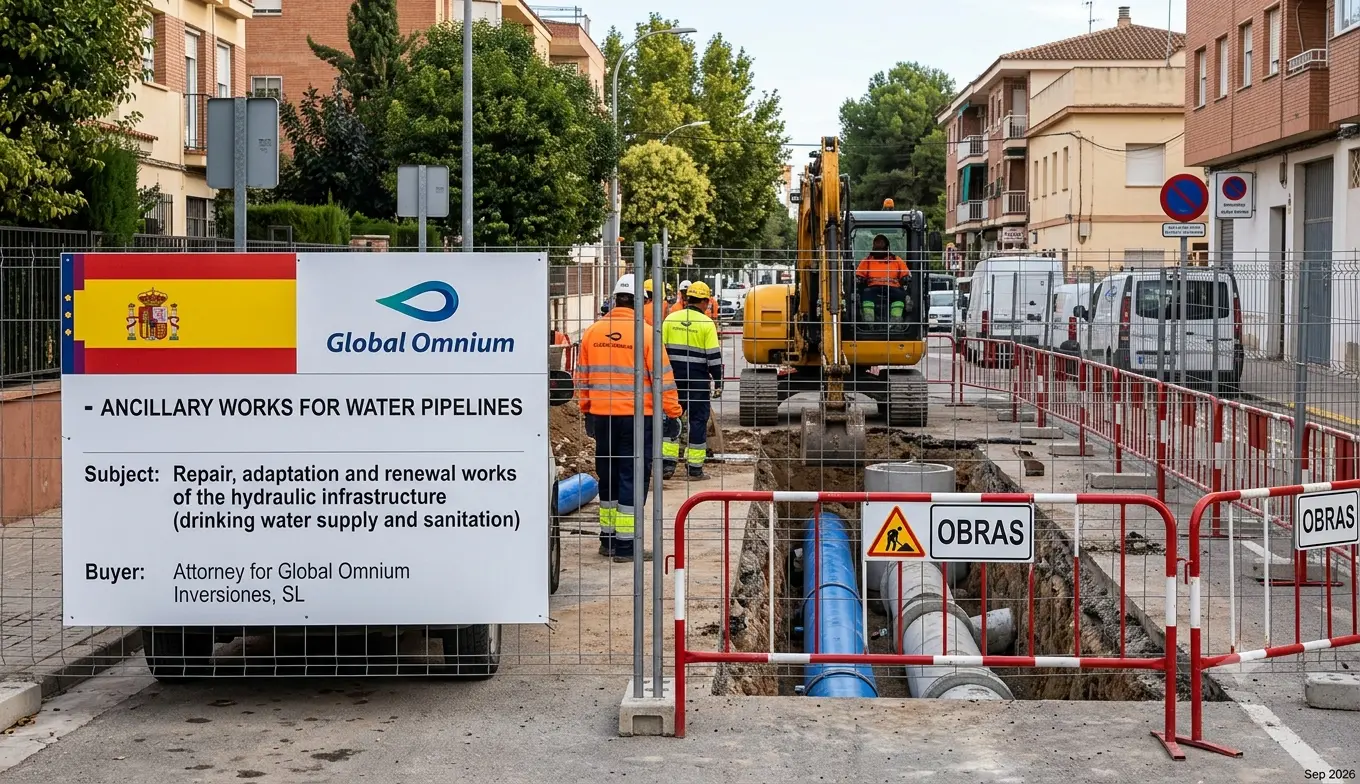
Global Omnium Awards €11.95 Million Paiporta Water Infrastructure Contract to Guerola Infraestructuras
15 Sep 2026
Standfirst: Global Omnium Inversiones has awarded an €11.95 million contract to GUEROLA INFRAESTRUCTURAS S.L.U. for emergency works to repair, renew and adapt water supply and sanitation infrastructure in Paiporta, Valencia. The project responds to severe damage and disruption caused by the DANA flooding episode of October 2024. The contract covers critical works in both sanitation and water supply infrastructure with a particular focus on restoring the functionality of the urban water cycle and supporting the recovery of the productive fabric. The winning tender was selected through an open procedure with price accounting for 60 points and several quality criteria accounting for the remaining 40 points. Introduction A major water infrastructure recovery project has moved into the contract execution stage in Paiporta, Valencia, following the award of a €11.95 million contract to GUEROLA INFRAESTRUCTURAS S.L.U. The procurement concerns emergency works for the repair, renewal and adaptation of hydraulic infrastructure covering both potable water supply and sanitation within the municipality. According to the contract notice, the infrastructure had suffered serious disruption following the DANA flooding episode of October 2024. The project is therefore focused on restoring the functionality of the urban water cycle while addressing critical infrastructure requirements in affected areas. The contracting organisation identified in the notice is Apoderado de Global Omnium Inversiones, S.L., an entity with special or exclusive rights whose contracting authority activity is classified as environmental protection. The procurement was conducted under Directive 2014/24/EU using an open procedure. The contract was concluded on 1 September 2026 after the winner was selected on 6 August 2026. Why This Contract Matters The Paiporta project demonstrates how public procurement can support the recovery of essential infrastructure following a major natural disaster. Water supply and sanitation networks are fundamental municipal services and damage to these systems can affect households, businesses, industrial activity and wider urban recovery. The notice specifically states that the works are directed at restoring the functionality of the urban water cycle after the October 2024 DANA flooding episode. The project is also significant because it combines infrastructure rehabilitation with the restoration of productive activity. Lot 1 is specifically described as focusing on critical sanitation and water supply actions aimed at recovering the operability of the productive fabric. This makes the contract relevant not only to civil engineering companies but also to suppliers and contractors with expertise in water distribution, sewer construction, emergency infrastructure rehabilitation and project management. Contract Timeline The procurement is identified by internal reference EC 1750/2026 and was conducted through an open procedure. The successful tenderer was selected on 6 August 2026. The contract with GUEROLA INFRAESTRUCTURAS S.L.U. was subsequently concluded on 1 September 2026. The result notice was dispatched on 14 September 2026 and published in the Official Journal of the European Union under OJ S issue 178/2026 on 15 September 2026. The notice records the procedure identifier as 9d05c9a7 6684 43de 8c3c 6aa85850e10e. Contract Overview The contract covers emergency infrastructure works in the municipality of Paiporta in Valencia, Spain. The overall procurement concerns repair, renewal and adaptation of hydraulic infrastructure for water supply and sanitation. The contract is classified as works rather than services or supplies and is located within the Valencia / València NUTS region, ES523. The estimated value of the lot excluding VAT was €16,465,846.31. However, the result notice records the value of all contracts awarded under this notice as €11,950,165.63. The awarded tender value for GUEROLA INFRAESTRUCTURAS S.L.U. is also €11,950,165.63. These figures should be distinguished from the original estimated value when analysing the procurement. Key Contract Details CountrySpain RegionValencia / València, NUTS ES523 MunicipalityPaiporta Contracting OrganisationApoderado de Global Omnium Inversiones, S.L. Contract TitleWorks for repair, adaptation and renewal of hydraulic infrastructure Procurement ReferenceEC 1750/2026 ProcedureOpen procedure Contract NatureWorks Main CPV45232100, Ancillary works for water pipelines Additional CPV45232150, Works related to water distribution pipelines; 45232400, Sewer construction work LotLOT 0001, Zona Industrial Estimated Lot Value Excluding VAT€16,465,846.31 Awarded Contract Value€11,950,165.63 WinnerGUEROLA INFRAESTRUCTURAS S.L.U. Winner ClassificationMicro, small or medium enterprise Winner Selected6 August 2026 Contract Concluded1 September 2026 Tenders Received19 Lowest Admissible Tender€0.00 Highest Admissible Tender€14,446,450.06 EU FundingNo EU funds GPA CoverageNo Framework AgreementNo Dynamic Purchasing SystemNo Project Scope The project involves emergency works intended to repair, renew and adapt hydraulic infrastructure for sanitation and water supply in Paiporta. The objective is to restore the operational functionality of the urban water cycle after infrastructure was seriously affected by flooding associated with the DANA event of October 2024. The awarded lot, Lot 1 or Zona Industrial, focuses on critical interventions in both sanitation and water supply. Its stated purpose is to help recover the operability of the productive fabric, making the project particularly relevant to industrial and commercial areas where reliable water and wastewater infrastructure is essential for normal economic activity. The CPV structure provides further insight into the technical nature of the works. The main classification is CPV 45232100 for ancillary works for water pipelines. Additional classifications include CPV 45232150 for works related to water distribution pipelines and CPV 45232400 for sewer construction work. About the Contracting Authority Apoderado de Global Omnium Inversiones, S.L. is identified in the TED notice as the buyer for the procurement. The organisation is classified as an entity with special or exclusive rights and its contracting authority activity is identified as environmental protection. The notice also identifies the organisation as the review organisation together with the Tribunal Administrativo Central de Recursos Contractuales. The buyer is located in Valencia / València, Spain and provides the buyer profile information associated with the procurement. About the Organisations Involved Global Omnium Inversiones, S.L. is represented in the notice through Apoderado de Global Omnium Inversiones, S.L., which is identified as the buyer for the procurement. The organisation is responsible for the contracting process covered by the award notice and its activity is classified under environmental protection. GUEROLA INFRAESTRUCTURAS S.L.U. is the successful tenderer for Lot 1. The company is classified in the notice as a micro, small or medium economic operator and is based in Ontinyent, Valencia. Its tender was identified as REF TEN 0001/LOT 0001 and was awarded a value of €11,950,165.63. The notice also records that no subcontracting was indicated for the winning tender. Tribunal Administrativo Central de Recursos Contractuales is identified as the review organisation contact point. The organisation is based in Madrid and forms part of the procurement review framework specified in the notice. Procurement Analysis The procurement demonstrates a strong emphasis on price while retaining significant consideration for technical and operational quality. Price accounted for 60 points, while quality related criteria accounted for 40 points. This structure means suppliers could not rely solely on offering a competitive financial proposal and needed to demonstrate credible execution planning, monitoring capabilities, resource continuity, environmental management and machinery availability. The quality criteria included a detailed works plan and assessment of impacts, a progress monitoring and reporting plan, a commitment to maintaining the key team, environmental and waste management and the suitability and availability of proposed machinery. These requirements are particularly relevant for emergency infrastructure works where construction coordination, continuity and resource availability can directly influence project delivery. Additional Procurement Facts The tender attracted 19 submissions, demonstrating substantial supplier interest in the opportunity. The notice records the lowest admissible tender at €0.00 and the highest admissible tender at €14,446,450.06. The €0.00 lowest tender figure should be treated as a reported procurement statistic rather than interpreted as evidence that the successful contractor was required to deliver the project free of charge. The procurement was not financed with EU funds and was not covered by the Government Procurement Agreement. It was also not established as a framework agreement and did not use a dynamic purchasing system. Market & Industry Perspective The contract provides an important signal for Spain's water infrastructure and civil engineering market because it demonstrates continuing demand for rehabilitation projects following extreme weather events. Municipal water supply and sanitation infrastructure can require substantial investment when flooding damages networks, pumping systems, pipelines and associated assets. For contractors, the procurement highlights the importance of combining civil works capability with emergency response capacity. Companies able to mobilise machinery, engineering personnel and construction teams quickly may be well positioned for similar infrastructure recovery opportunities. The evaluation methodology also indicates that buyers may increasingly assess how contractors intend to manage environmental impacts, waste, machinery resources and project monitoring alongside price. This creates opportunities for suppliers that can demonstrate structured delivery methodologies rather than competing purely on cost. Economic Significance The project has an economic role beyond the physical repair of water infrastructure. Reliable water supply and sanitation are essential for businesses and industrial operations and the procurement specifically links Lot 1 to restoring the operability of the productive fabric in the affected area. The €11.95 million awarded value therefore represents an investment in both infrastructure recovery and the conditions required for local economic activity to resume. It also demonstrates how emergency public procurement can channel substantial expenditure into specialised construction and infrastructure markets. Future Procurement Opportunities The Paiporta award may be an important reference point for suppliers monitoring future water infrastructure rehabilitation projects in Valencia and other Spanish regions exposed to flooding and extreme weather events. Similar requirements can emerge around water distribution networks, sewer systems, drainage infrastructure and associated municipal assets. Future procurement opportunities may place greater emphasis on resilience, emergency restoration and adaptation of existing infrastructure. Contractors with experience in network rehabilitation, water pipeline construction and sewer construction should therefore monitor procurement notices using relevant CPV classifications and local authority procurement channels. The CPV codes used in this procurement are particularly useful for procurement intelligence. Suppliers targeting comparable projects should monitor CPV 45232100, CPV 45232150 and CPV 45232400 together with keywords related to emergency repairs, water supply, sanitation, infrastructure renewal and flood recovery. Opportunities for Suppliers The award demonstrates that SMEs can compete successfully for sizeable infrastructure contracts when they can combine technical capability with an effective delivery strategy. GUEROLA INFRAESTRUCTURAS S.L.U. was classified as a micro, small or medium economic operator in the notice and secured the €11.95 million contract. For suppliers, the opportunity is therefore not limited to large national contractors. Specialist regional construction companies with relevant hydraulic infrastructure expertise can potentially compete for significant projects when their resources, methodology and project controls satisfy the buyer's requirements. What Businesses Should Watch Businesses operating in the Spanish water infrastructure market should watch for procurement programmes associated with flood recovery, network rehabilitation and infrastructure resilience. Particular attention should be given to contracts where existing water and sanitation networks need rapid restoration after extreme weather events. Suppliers should also study the evaluation criteria before preparing bids. In this procurement, the buyer allocated 60 points to price and 40 points to quality factors covering the works plan, progress control, key personnel continuity, environmental management and machinery availability. Companies should maintain evidence of their ability to mobilise appropriate machinery and qualified personnel. Environmental and waste management capabilities should also be documented because these factors can form a meaningful part of evaluation methodologies for infrastructure works. SpainTenders.com Procurement Intelligence From a procurement intelligence perspective, the Paiporta award illustrates how disaster recovery can create specialised procurement demand across the infrastructure value chain. The opportunity is not simply a conventional pipeline or sewer construction project. It sits within a broader requirement to restore essential municipal infrastructure after a major flooding event and reconnect affected productive areas to functioning water and sanitation systems. The procurement also provides an important supplier positioning lesson. The winning tenderer was an SME operating from the Valencia region, showing that regional infrastructure specialists can compete for high value emergency works when they align their capabilities with a clearly defined local requirement. Suppliers seeking similar opportunities should therefore combine CPV based monitoring with geographic intelligence rather than restricting their searches to large national programmes. Another strategic lesson concerns bid preparation. The 60 point price component created substantial financial competition, but 40 points remained linked to quality. Suppliers that invest in detailed construction planning, progress reporting, continuity of key personnel, environmental controls and machinery readiness can strengthen their position in procurements where technical quality is explicitly scored. Future contracts of this type could increasingly move from emergency restoration towards resilience and prevention. Once damaged networks are restored, authorities and infrastructure operators may require projects designed to improve the ability of water systems to withstand future extreme weather. This could generate additional demand for network renewal, capacity improvements, drainage systems, monitoring technology, pumping infrastructure and resilient construction methods. For businesses using spaintenders.com for procurement intelligence, the key opportunity is to identify these patterns before individual tenders are published. Tracking buyers, CPV codes, regions, infrastructure requirements and previous awards can help suppliers identify emerging procurement clusters and build a more targeted pipeline around water infrastructure and climate related resilience projects. Supplier Takeaways Monitor Spanish procurement opportunities involving water supply, sanitation and hydraulic infrastructure rehabilitation. Track CPV 45232100 for ancillary works for water pipelines. Track CPV 45232150 for water distribution pipeline works. Track CPV 45232400 for sewer construction work. Prepare competitive pricing because price represented 60 points in this procurement. Strengthen technical submissions covering detailed construction planning and project impacts. Demonstrate effective progress monitoring, reporting and project control systems. Show clear arrangements for maintaining key project personnel. Document environmental and waste management procedures. Maintain evidence of machinery availability and suitability for emergency infrastructure works. SMEs should not automatically exclude themselves from high value infrastructure opportunities. Monitor Valencia and other regions where infrastructure recovery programmes may create additional demand. Key Takeaways Global Omnium Inversiones awarded an €11.95 million contract for hydraulic infrastructure works in Paiporta, Valencia. GUEROLA INFRAESTRUCTURAS S.L.U. was selected as the winner of Lot 1. The project responds to serious disruption caused by the DANA flooding episode of October 2024. The work covers critical water supply and sanitation infrastructure. The awarded contract value was €11,950,165.63. The estimated lot value excluding VAT was €16,465,846.31. The procurement attracted 19 tenders. Price represented 60 points of the award evaluation. Quality criteria represented the remaining 40 points. The contract was concluded on 1 September 2026. The winning company was classified as a micro, small or medium enterprise. No EU funding was reported for the procurement. The procurement was not covered by the GPA. No framework agreement or dynamic purchasing system was used. Conclusion The €11.95 million Paiporta contract represents a significant infrastructure recovery investment focused on restoring water supply and sanitation services after the October 2024 DANA flooding. The award to GUEROLA INFRAESTRUCTURAS S.L.U. also demonstrates the potential for regional SMEs with specialised infrastructure capabilities to win substantial public works contracts. For suppliers, the procurement provides a valuable benchmark for understanding future opportunities in Spanish water infrastructure recovery, flood resilience and network rehabilitation. Competitive pricing combined with strong technical planning, environmental management, project control and resource availability will remain important factors in similar tenders. Source: Official Journal of the European Union, TED Contract or Concession Award Notice 633047 2026, OJ S 178/2026, published 15 September 2026.
View Details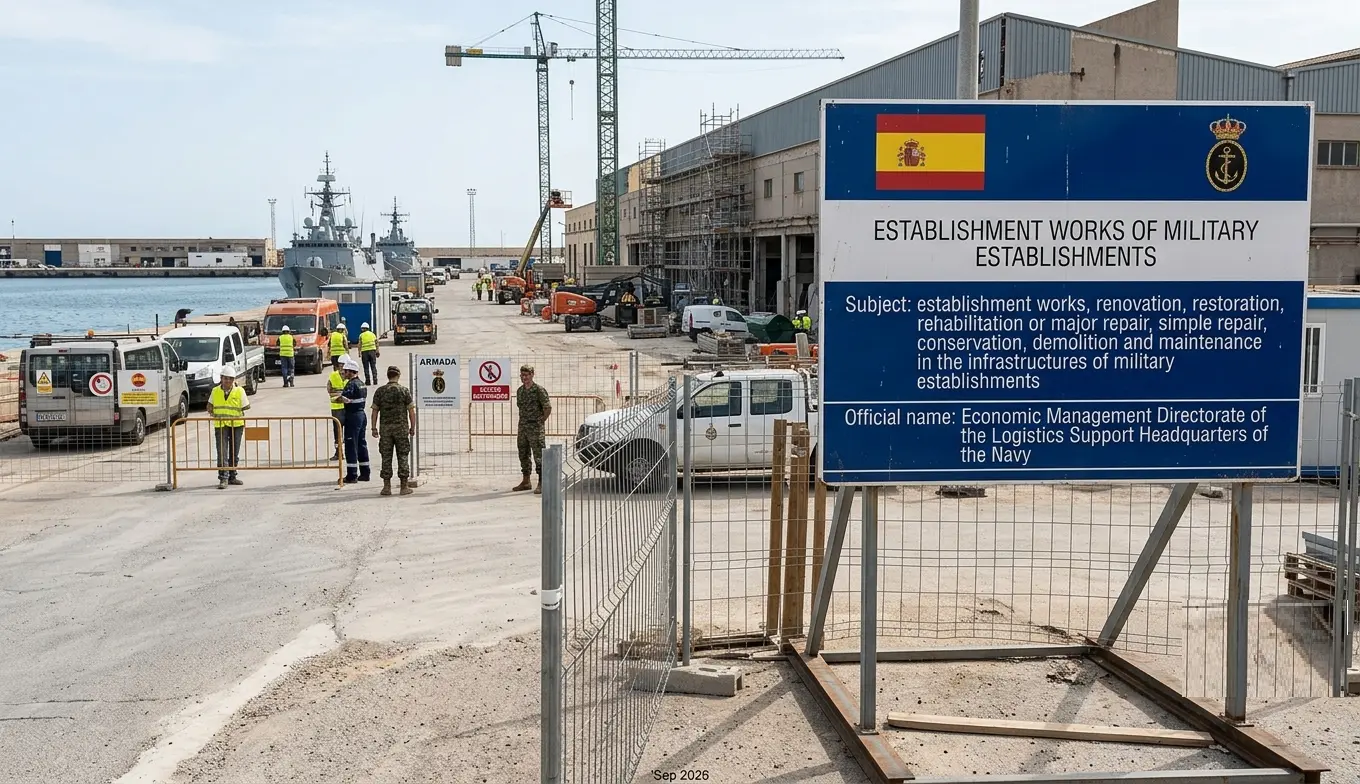
Spanish Navy Logistics Command Awards 11 Billion Euro Framework for Military Infrastructure Maintenance
14 Sep 2026
Standfirst The Directorate of Economic Management of the Logistics Support Command of the Navy has awarded a massive framework agreement valued at up to 11.08 billion euros for the maintenance and construction of military infrastructure across Spain. This specific tender result focuses on Lot 12, covering works within the Madrid operational area, where 35 construction and engineering firms were selected to provide services. The procurement follows a highly competitive open procedure that attracted 38 bids, emphasizing strict price competition through discounts on industrial profit. This strategic consolidation of maintenance contractors ensures the Spanish armed forces have immediate access to pre qualified vendors for urgent repairs, restorations, and facility upgrades. Introduction The modernization and maintenance of military infrastructure represent a critical priority for national defense strategies across Europe. In Spain, the Directorate of Economic Management of the Logistics Support Command of the Navy has initiated a massive procurement strategy to secure specialized construction and maintenance services for military establishments. This recent tender result focuses on the selection of multiple companies to execute works ranging from first establishment and restoration to demolition and routine maintenance. By utilizing a framework agreement model, the contracting authority leverages centralized purchasing to streamline future project deployments. This approach ensures that the armed forces have immediate access to pre qualified contractors, reducing administrative delays when urgent repairs or upgrades are required. The inclusion of numerous suppliers in this official Tenders Portal listing highlights a strategic effort to maintain a diverse and highly competitive supply chain for defense infrastructure. The scale of this procurement underscores the ongoing commitment to preserving the operational readiness of naval and military facilities. By distributing the potential workload among 35 approved vendors for the Madrid region alone, the buyer mitigates supply chain risks and fosters a dynamic market environment where contractors must continuously offer competitive value. Why This Contract Matters This framework agreement is vital for ensuring that Spanish military facilities remain operational, safe, and compliant with modern defense standards. The inclusion of a vast array of specialized construction tasks allows the armed forces to address both routine maintenance and major rehabilitation projects without initiating new procurement processes for every individual need. For the domestic construction and engineering sector, securing a position on this framework provides a stable pipeline of potential work and validates the technical capabilities of the awarded firms. The high level of competition, evidenced by 38 bids for a single lot, demonstrates the strong market interest in public procurement opportunities within the defense sector. Additionally, the reliance on a 100 percent price based evaluation criterion ensures that taxpayer funds are utilized with maximum fiscal efficiency. This model forces suppliers to optimize their operational costs and offer the most aggressive pricing structures while still meeting the stringent technical and safety requirements mandated by the military. Contract Timeline The procurement process culminated in the formal selection of the winning suppliers on June 2, 2026. Following the mandatory administrative and standstill periods, the framework contracts were officially concluded on August 13, 2026. The contract awards notice was subsequently published in the Official Journal of the European Union on September 14, 2026. This timeline reflects a standard and transparent execution of public procurement regulations for large scale defense infrastructure projects in Spain. Contract Overview The procurement is structured as a framework agreement that permits both direct awards and reopened competition for individual project call offs. The total maximum value of the framework agreements across all lots in this notice is set at 11.08 billion euros, with Lot 12 specifically estimated at 4.8 million euros. The scope encompasses a wide variety of construction works, including first establishment, reform, restoration, rehabilitation, major repair, simple repair, conservation, demolition, and general maintenance. This broad scope ensures that the contracting authority has the flexibility to address any infrastructure need that arises within the designated geographic area. Key Contract Details Contract Title AM para selección de empresas que ejecuten obras de primer establecimiento, reforma, restauración, rehabilitación o gran reparación, reparación simple, conservación, demolición y mantenimiento en las infraestructuras de los establecimientos militares Contracting Authority Dirección de Gestión Económica de la Jefatura de Apoyo Logístico de la Armada Maximum Framework Value 11,088,000,000.00 EUR (Total across all lots) Procedure Type Open Procedure Number of Bids Received 38 Winners (Lot 12) 35 suppliers including ALVAC S.A., EIFFAGE ENERGIA, and ELECNOR SERVICIOS Y PROYECTOS S.A.U. Contract Conclusion Date August 13, 2026 Main CPV Code 45000000 (Construction work) Project Scope The core scope involves the execution of diverse construction and maintenance works within military establishments. This includes structural reforms, restorations, rehabilitations, major and simple repairs, conservation efforts, and demolition activities. Lot 12 specifically targets the operational area of the JESAT in Madrid. The contractors must be prepared to mobilize quickly and deliver high quality work that adheres to strict military security and safety protocols. The framework structure allows the buyer to issue specific work orders as needs arise, ensuring continuous facility upkeep. About the Contracting Authority The Dirección de Gestión Económica de la Jefatura de Apoyo Logístico de la Armada is the primary contracting authority. It is a central government body responsible for managing the economic and logistical support infrastructure for the Spanish Navy, ensuring that military facilities are maintained to operational standards. About the Organisations Involved Dirección de Gestión Económica de la Jefatura de Apoyo Logístico de la Armada is the primary contracting authority and buyer. It manages the economic and logistical support infrastructure for the Spanish Navy and drives the procurement of maintenance services for military facilities. ALVAC S.A. is a successful bidder and a large economic operator. The company specializes in construction and infrastructure projects, bringing significant operational capacity to military maintenance contracts. AQUINTA obras sl is a successful bidder and a large economic operator. It provides general construction and civil engineering services tailored to public sector requirements. ARENAS JIMENEZ DISEÑO S.L. is a successful bidder and a large economic operator. The firm focuses on design and construction services, offering integrated solutions for facility rehabilitation. ASCH INFRAESTRUCTURAS Y SERVICIOS S.A. is a successful bidder and a large economic operator. It specializes in infrastructure development and comprehensive facility management services. COMPAÑÍA DE EFICIENCIA Y SERVICIOS INTEGRALES S.L. is a successful bidder and a large economic operator. The company provides integrated efficiency and maintenance services for large scale facilities. CROSSMAGLEN DOS IBERICA is a successful bidder and a large economic operator. It delivers specialized construction and infrastructure maintenance solutions. DEMOLICIONES DEMA S.L. is a successful bidder and a large economic operator. The company specializes in demolition and site preparation services, ensuring safe and compliant removal of obsolete structures. Decoraciones Morote S.L.U is a successful bidder and a large economic operator. It provides specialized decoration, finishing, and interior rehabilitation services for public buildings. EIFFAGE ENERGIA is a successful bidder and a large economic operator. As part of a major European group, it brings extensive expertise in energy infrastructure and electrical installations. ELECNOR SERVICIOS Y PROYECTOS S.A.U. is a successful bidder and a large economic operator. The company is a leader in engineering, construction, and maintenance of electrical and telecommunications infrastructure. ELECTELCOM DEL SUR S.L. is a successful bidder and a large economic operator. It specializes in electrical and telecommunications installations for complex facilities. ELECTRORAYMA S.L is a successful bidder and a large economic operator. The firm provides electrical installation and maintenance services for industrial and public sector clients. ESQUEIRO S.L. is a successful bidder and a large economic operator. It offers general construction and civil engineering services with a focus on regional infrastructure. ETOSA OBRAS Y SERVICIOS BUILDING S.L.U. is a successful bidder and a large economic operator. The company provides comprehensive building construction and maintenance services. Ecolog Spain LSU is a successful bidder and a large economic operator. It specializes in logistics, facility management, and environmental services for complex operational sites. Elsamex Gestión de Infraestructuras is a successful bidder and a large economic operator. The company focuses on the comprehensive management and maintenance of large scale infrastructure assets. FRIZONIA REFRIGERACIÓN CLIMATIZACIÓN S.L. is a successful bidder and a large economic operator. It provides specialized refrigeration and climate control installation and maintenance services. GRUPO DESARROYA PROYECTOS Y SISTEMAS SLNE is a successful bidder and a large economic operator. The group offers project development and systems integration for construction projects. GRUPO RENDER INDUSTRIAL SL is a successful bidder and a large economic operator. It specializes in industrial construction and specialized maintenance services. INNOVACIÓN GLOBAL DE SEGURIDAD S.A. is a successful bidder and a large economic operator. The company provides security systems installation and related infrastructure services. Imesapi S.A. is a successful bidder and a large economic operator. It is a major player in civil engineering and public works construction across Spain. JUMABEDA S.L. is a successful bidder and a large economic operator. The firm provides general construction and facility maintenance services. MESAT S.L. is a successful bidder and a large economic operator. It offers specialized construction and technical installation services. Multiservicios Tecnológicos S.A. is a successful bidder and a large economic operator. The company provides a wide range of technological and facility maintenance services. NERCO INFRAESTRUCTURAS SL is a successful bidder and a large economic operator. It specializes in infrastructure development and civil engineering works. ORMEÑO Y ARRIBAS SL is a successful bidder and a large economic operator. The company provides construction and maintenance services for public and private facilities. PROYECON GALICIA S.A. is a successful bidder and a large economic operator. It offers comprehensive engineering and construction services with a strong regional presence. PROYECTOS CRANFIELD SHINGLE is a successful bidder and a large economic operator. The firm provides project management and specialized construction services. SERANCO S.A.U. is a successful bidder and a large economic operator. It specializes in large scale construction and infrastructure rehabilitation projects. TECNIA INGENIEROS is a successful bidder and a large economic operator. The company provides engineering design and technical supervision for construction projects. TRAUXIA S.A. - URBAN S.L is a successful bidder and a large economic operator. It focuses on urban development and civil engineering construction works. TUBERIAS Y MONTAJES SAN JOSE S.L. is a successful bidder and a large economic operator. The company specializes in piping and mechanical installation services. UTE PADECASA OBRAS Y SERVICIOS S.A.-CYCASA CANTERAS Y CONSTRUCCIONES S.A. is a successful bidding consortium. This joint venture combines the resources of two large construction firms to deliver comprehensive civil engineering and building services. VEOLIA SERVICIOS LECAM S.A.U. is a successful bidder and a large economic operator. It provides specialized facility management, energy, and water treatment services. ZIMA DESARROLLOS INTEGRALES S.L. is a successful bidder and a large economic operator. The company offers integrated development and construction services for public sector clients. Tribunal Administrativo Central de Recursos Contractuales is the review organisation. This Central Administrative Court of Contractual Appeals handles any legal challenges or disputes related to public procurement procedures in Spain. Procurement Analysis The open procedure attracted 38 bids, demonstrating intense competition in the Spanish defense construction market. The award criteria relied entirely on price, specifically the discount offered on industrial profit, carrying a weight of 100 percent. This evaluation method indicates that the technical and safety specifications in the bidding documents were stringent enough to serve as a strict pass or fail gateway. Once suppliers met these baseline requirements, the competition focused purely on financial efficiency, driving down costs for the public buyer while ensuring all operational standards were satisfied. Additional Procurement Facts The procurement is not covered by the Government Procurement Agreement, reflecting its status as a domestic defense contract governed primarily by Spanish national legislation and EU Directive 2014/24/EU. The project is not financed with European Union funds, relying entirely on the national defense budget. Market & Industry Perspective The Spanish public construction market remains highly competitive, with major domestic contractors vying for centralized maintenance contracts. The presence of 35 winners on a single lot indicates that the contracting authority values supplier diversity to mitigate the risk of capacity bottlenecks during peak demand periods. This approach ensures that if one contractor is unavailable, alternative approved firms remain ready to execute urgent repair works. The dominance of large economic operators in this space suggests that future RFPs and RFQs will continue to favor established contractors with proven financial stability and extensive technical resources. Economic Significance A maximum framework value of 11.08 billion euros represents a substantial allocation of public defense spending. This investment supports thousands of jobs in engineering, construction, and facility management across the country. By securing these services through a centralized framework, the government achieves significant budgetary predictability and protects against market volatility in construction material costs. The efficient allocation of these resources stimulates the broader domestic construction ecosystem. Future Procurement Opportunities Suppliers who were not successful should monitor the official Tenders Portal for upcoming framework renewals or new geographic lots covering other military regions. As infrastructure ages, public institutions will continuously generate new tenders opportunities for major rehabilitation and modernization projects. Stakeholders should also track the Latest Active Tenders Procurement notices to anticipate upcoming defense infrastructure projects. The dynamic nature of public procurement means that new Live Notices for Tenders will emerge as regional military commands update their facility maintenance requirements. Opportunities for Suppliers While the primary framework positions have been awarded, specialized subcontractors can find valuable opportunities by partnering with the primary winners. Firms specializing in niche trades, such as advanced security system installation or specialized climate control, may be subcontracted to fulfill specific work orders under the framework. What Businesses Should Watch Industry observers should monitor the activation rate of this framework agreement to gauge actual public sector demand for military facility maintenance. The frequency of call offs will reveal how contracting entities value flexibility versus price competition in subsequent phases. Stakeholders should also review Live Notices for Tenders to anticipate upcoming infrastructure modernization projects funded by national defense programs. Any shifts in defense budget allocations will directly influence future procurement volumes in this sector. SpainTenders.com Procurement Intelligence This contract represents a clear trend in European defense procurement toward the extensive use of multi supplier framework agreements for facility management and construction. By pre qualifying 35 companies for a single geographic lot, the Spanish Navy mitigates the risk of supply chain bottlenecks and ensures rapid response capabilities for critical infrastructure maintenance. This strategy prioritizes operational readiness and administrative efficiency over the traditional model of awarding exclusive contracts to a single provider. Strategically, this award is important because it demonstrates how defense authorities balance strict fiscal responsibility with the need for specialized technical expertise. The 100 percent price based evaluation criteria indicate that the baseline technical qualifications were treated as a strict pass or fail requirement during the initial screening. Suppliers can learn that meeting these fundamental technical and safety baselines is the primary gateway for winning public procurement contracts in the defense sector. To position themselves for future contracts, relevant suppliers must optimize their operational costs and develop agile pricing models that can compete in highly saturated bidding environments. Future contracts in this market are likely to evolve by incorporating stricter environmental and sustainability mandates alongside traditional cost metrics. Companies that proactively develop green construction methodologies and energy efficient retrofitting capabilities will hold a distinct advantage when responding to future RFPs and RFQs in the defense infrastructure sector. Supplier Takeaways Multi supplier framework agreements are increasingly used to guarantee operational readiness in defense infrastructure procurement. Meeting strict technical and safety minimums is a primary gateway for winning government construction contracts. Price only evaluation criteria require suppliers to optimize operational costs to remain competitive in saturated bidding environments. Specialized subcontractors can find valuable opportunities by partnering with primary framework winners for niche work orders. Key Takeaways Thirty five suppliers were awarded positions on a framework agreement for military infrastructure maintenance in Madrid. The maximum estimated value of the framework agreements across all lots is 11.08 billion euros. The award criteria was based 100 percent on price, reflecting a mature market for standardized construction services. Thirty eight bids were received, indicating intense competition among large economic operators. The framework allows for both direct awards and reopened competition for individual project call offs. Conclusion This framework agreement secures a reliable and diversified supply of construction and maintenance services for Spanish military establishments. The multi supplier award structure ensures competitive tension and operational resilience for the duration of the contract. As the armed forces continue to modernize their facilities, this procurement model will likely serve as a blueprint for future infrastructure acquisitions. Source: Tenders Electronic Daily (TED), Contract Award Notice 630230-2026, Official Journal of the European Union, published on 14/09/2026.
View Details