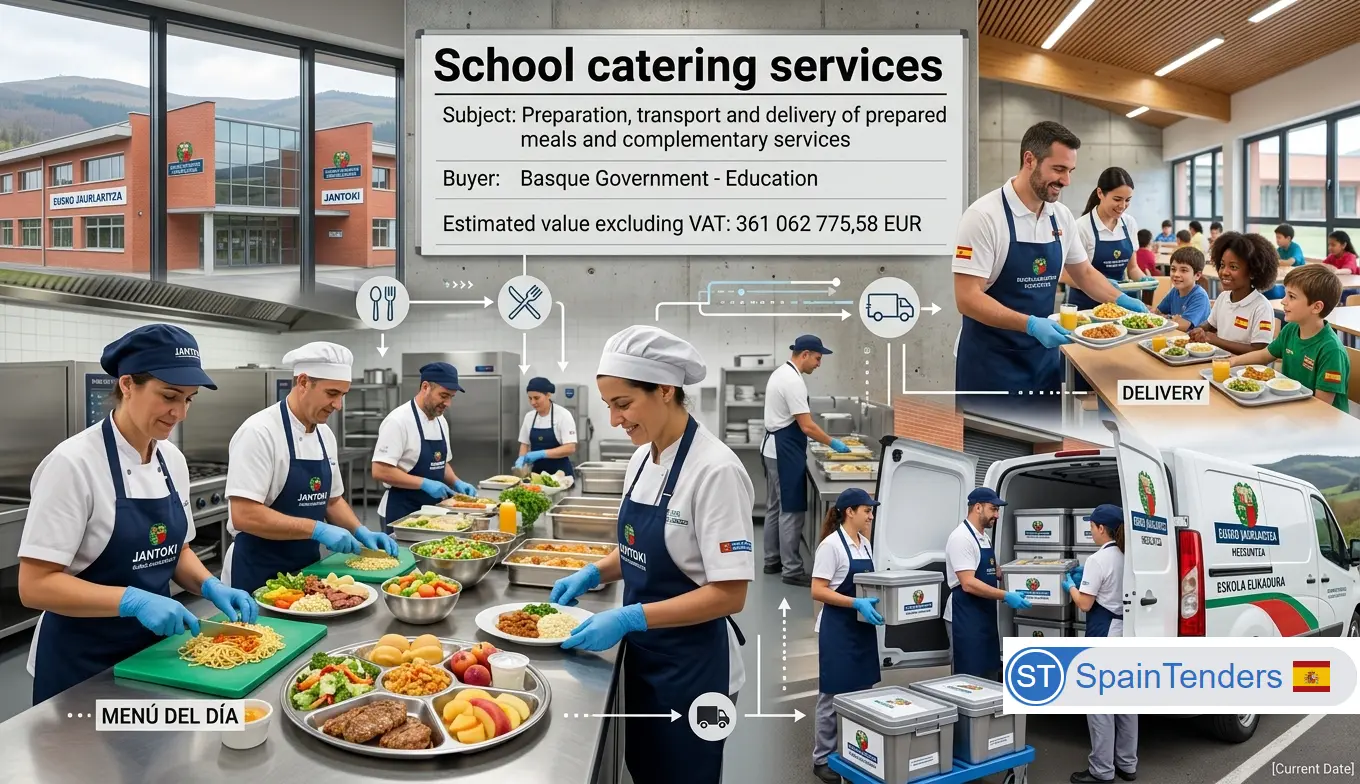
Basque Country Awards School Catering Contracts Worth EUR 180.5 Million Across 23 Lots
09 Sep 2026
Standfirst School meals across the Basque Country are moving into a new contracting cycle after Gobierno Vasco - Educación awarded catering services covering the preparation transportation and delivery of meals at publicly managed school dining facilities. The procurement generated competition across 23 lots with several specialist catering companies securing multiple lots. The award notice reports a combined value of EUR 180,531,387.80 for all contracts awarded through the notice. The result gives AUZO LAGUN, S. COOP. the largest number of lots while GASTRONOMÍA CANTÁBRICA, S.L. EUREST EUSKADI S L SHARMA AUSOLAN, S.L. and COCINA CENTRAL GOÑI, S.L. also secured contracts. Introduction School catering is a public service where procurement decisions reach directly into everyday life. The quality of food preparation logistics and delivery affects pupils schools staff and the public administration responsible for maintaining the service. In the Basque Country this responsibility has been translated into a multi lot procurement for the preparation transportation and delivery of prepared meals together with complementary services required to operate directly managed school dining facilities. The award notice covers services at various public centres dependent on the Department of Education of the Basque Government. Rather than concentrating the requirement in a single contract the procurement divides the service geographically or operationally into 23 lots. The result creates a broad supplier landscape. AUZO LAGUN, S. COOP. secured seven lots while GASTRONOMÍA CANTÁBRICA, S.L. secured eight lots. EUREST EUSKADI S L won four lots while SHARMA AUSOLAN, S.L. won two lots and COCINA CENTRAL GOÑI, S.L. won one lot. The notice confirms that all contracts were concluded on 05-09-2026. Why This Contract Matters The procurement matters because school food is a recurring operational requirement rather than a one time purchase. The contracting authority needs suppliers capable of preparing meals consistently while also handling transportation and delivery to multiple public education facilities. Splitting the procurement into 23 lots changes the competitive dynamics. A supplier does not necessarily need the scale to serve every location covered by the education system. Lotting can allow established regional operators to compete for defined service areas while still giving the authority access to several suppliers. The award also demonstrates the importance of operational scale in public catering. Winners secured multiple lots rather than the market being divided equally among a large number of companies. This suggests that proven capacity can remain important even when a procurement is divided into numerous lots. The reported contract value adds another dimension. At EUR 180.5 million across all awarded contracts the procurement represents a substantial flow of public expenditure into food preparation logistics staffing facilities and related services. The figure is the value of the contracts recorded in the notice and should not be confused with revenue already earned by the suppliers. Contract Timeline The procurement was published as a contract or concession award notice under the standard regime. The notice publication number is 622722-2026 and the notice appears in OJ S 174-2026. The award notice was published on 09-09-2026. The notice dispatch date was 08-09-2026. The contracts associated with the 23 lots were concluded on 05-09-2026. Individual contract identifiers follow the procurement reference C02/003/20261244 with separate identifiers corresponding to the individual lots. Contract Overview The procurement title concerns the preparation transportation and delivery of prepared meals together with complementary services for the operation of directly managed dining facilities at various public centres under the Department of Education in the Basque Autonomous Community. The main nature of the procurement is services. The main CPV code is 55524000 for school catering services while the additional CPV code is 85312110 for child daycare services. The award covers 23 lots. The notice reports the value of all contracts awarded as EUR 180,531,387.80. Each lot represents a separate award result with the winning supplier identified in the notice. Key Contract Details CountrySpain RegionBasque Autonomous Community BuyerGobierno Vasco - Educación Procurement TitlePreparation transportation and delivery of prepared meals and complementary services for directly managed school dining facilities Number of Lots23 Main CPV55524000 School catering services Additional CPV85312110 Child daycare services Value of All ContractsEUR 180,531,387.80 ProcedureStandard regime EU FundingNo GPA CoverageNo Dynamic Purchasing SystemNo SubcontractingNo for the awarded tender records reviewed Contract Conclusion Date05-09-2026 Winning OrganisationsAUZO LAGUN, S. COOP. and GASTRONOMÍA CANTÁBRICA, S.L. and EUREST EUSKADI S L and COCINA CENTRAL GOÑI, S.L. and SHARMA AUSOLAN, S.L. Project Scope The core service covers the preparation of meals followed by their transportation and delivery to directly managed school dining facilities. The procurement also includes complementary services required for the operation of those dining facilities. The service is therefore operationally integrated. Food production alone would not satisfy the requirement because meals must reach the relevant public education centres in accordance with the service arrangements established by the Department of Education. The use of the school catering CPV code makes the commercial focus clear. The additional classification for child daycare services reflects another category recorded in the notice rather than establishing a separate childcare contract. The notice does not disclose a separate division of responsibilities among the winning companies beyond their allocation to individual lots. Specific operational responsibilities should therefore be determined from the underlying tender documents rather than inferred from the award result. About the Contracting Authority Gobierno Vasco - Educación is the contracting authority identified in the TED notice. It is classified as a regional authority with general public services recorded as its contracting authority activity. The department is responsible for the education facilities covered by the procurement and is also identified as the organisation providing additional information about the procurement procedure. About the Organisations Involved AUZO LAGUN, S. COOP. is one of the principal award recipients. The company won LOT-0001 and also secured LOT-0013 and LOT-0016 and LOT-0020 and LOT-0021 and LOT-0022 and LOT-0023. The tender values recorded for several of these lots show the scale of the awards. LOT-0001 was valued at EUR 11,054,618.64 while LOT-0013 was valued at EUR 8,847,878.40 and LOT-0016 was valued at EUR 6,425,788.32. GASTRONOMÍA CANTÁBRICA, S.L. won LOT-0002 and LOT-0003 and LOT-0005 and LOT-0006 and LOT-0007 and LOT-0010 and LOT-0012 and LOT-0017. The notice records EUR 9,698,613.84 for LOT-0002 and EUR 9,805,032.72 for LOT-0003 and EUR 13,759,919.28 for LOT-0005 and EUR 10,731,867.12 for LOT-0006. EUREST EUSKADI S L won LOT-0004 and LOT-0008 and LOT-0009 and LOT-0011. The award notice records EUR 2,878,638.48 for LOT-0004 and EUR 7,717,241.52 for LOT-0008 and EUR 10,486,122.02 for LOT-0009 and EUR 4,639,569.84 for LOT-0011. COCINA CENTRAL GOÑI, S.L. won LOT-0014. Its tender value is recorded as EUR 4,093,651.44 and the corresponding contract identifier is C02/003/20261244_00014. SHARMA AUSOLAN, S.L. won LOT-0018 and LOT-0019. The tender value recorded for LOT-0018 is EUR 12,295,655.54 while LOT-0019 carries a tender value of EUR 11,885,425.66. The contract identifiers are C02/003/20261244_00018 and C02/003/20261244_00019. The notice identifies Órgano Administrativo de Recursos Contractuales as the review organisation. It also identifies Gobierno Vasco - Educación as the organisation providing additional information about the procurement procedure. The notice also identifies unsuccessful tenderers for individual lots. One example is Servei d`apats SL which submitted tenders for multiple lots without winning those awards. The notice contains other non winning tenderers across the lot results. Their participation is relevant because it confirms that the award process involved competition beyond the five organisations that ultimately received contracts. Procurement Analysis The procurement divided a broad school catering requirement into 23 lots rather than treating the Basque Country requirement as one undivided award. That structure can make a large public requirement accessible to suppliers with regional operating capacity while also allowing the authority to diversify delivery risk. The award criteria include cost and quality. The published criteria show price with a weighting of 40 points while quality is also included as an award criterion. The notice does not provide enough information in the available award record to establish the complete scoring model beyond these recorded criteria. Competition varied between lots. The award results show different numbers of tenders received for different lots with several lots attracting three four five or six tenders. This variation matters because a supplier's competitive environment could differ significantly depending on the geographic or operational characteristics of a particular lot. The award result also shows concentration among several established operators. Five organisations account for the 23 awarded lots. This indicates that the authority achieved supplier diversification at lot level while still relying on a relatively concentrated group of successful operators. Additional Procurement Facts The procurement was not financed with EU funds and the notice states that it is not covered by the Government Procurement Agreement. The procurement was also not conducted through a dynamic purchasing system. The award notice reports EUR 180,531,387.80 as the value of all contracts awarded. The individual lot values should be read as contract or tender values associated with the relevant awards rather than assuming that every supplier will receive the full aggregate amount independently. Market & Industry Perspective The award provides a useful snapshot of the Basque school catering market. The winning group includes operators with multiple successful lots while competition was also recorded from companies that did not ultimately receive awards. Multiple lot wins can indicate that suppliers with sufficient production capacity and logistics infrastructure have an advantage when a public authority needs consistent service across several locations. At the same time the lot structure prevents the entire requirement from being concentrated in one supplier. The presence of several successful companies also creates a competitive benchmark for future school catering procurement. Buyers can compare supplier performance across different operating areas while suppliers can use the award distribution to understand where market share is concentrated. For the catering industry the procurement also illustrates that logistics is inseparable from food preparation in large public education contracts. The requirement explicitly combines preparation transportation and delivery which means operational reliability is part of the commercial proposition. Economic Significance The reported EUR 180.5 million value makes this a sizeable public catering procurement in the Basque Country. Spending of this scale supports a network of food production logistics employment and associated supply chains linked to school meal delivery. The economic impact is distributed across five successful organisations and 23 lots rather than being concentrated in one contract. That structure can provide the public authority with greater supplier resilience while creating multiple commercial entry points for the regional catering market. Future Procurement Opportunities The clearest future opportunities will come from continued school catering requirements within the Basque education system. Catering contracts normally require recurring operational capacity so future procurement activity is likely to remain relevant when existing contractual arrangements approach their end. Suppliers should monitor new notices issued by the Basque education administration for meal preparation transportation delivery and complementary dining services. Particular attention should be paid to the lot boundaries because future procurement may preserve or modify the current geographic structure. Future requirements could also place greater emphasis on measurable service quality food standards delivery reliability and operational performance. The presence of both cost and quality criteria in the current award provides a basis for expecting more than price competition in comparable procurements. Companies should also monitor whether future contracts change the number of lots or alter the balance between regional suppliers and larger catering operators. Such changes could materially affect the competitive landscape. Opportunities for Suppliers The procurement creates clear opportunities for catering companies that can combine food preparation capacity with dependable distribution. The multi lot structure means suppliers can target specific areas rather than necessarily pursuing the entire requirement. Companies entering this market should also examine the award criteria carefully. Demonstrating quality alongside competitive pricing can be important when the authority evaluates suppliers on more than cost alone. What Businesses Should Watch Businesses should monitor how the 23 lots translate into actual service delivery and whether the same suppliers continue to hold multiple positions in future procurements. The geographic distribution of future school catering requirements will be particularly important. Changes in school networks service volumes or lot boundaries could alter the economics of individual contracts. Suppliers should also watch the performance expectations attached to meal preparation transportation and delivery. Any future procurement that increases quality requirements or introduces stronger performance measurement could change the cost structure of bids. Finally businesses should follow the next procurement cycle closely. The current award provides a valuable map of the competitive field but it does not establish that the same suppliers will automatically retain future contracts. SpainTenders.com Procurement Intelligence This award illustrates how public procurement can balance scale with market access through detailed lotting. The Basque education administration has created a requirement worth more than EUR 180 million while dividing the opportunity among 23 separate lots. That approach limits dependence on a single provider while allowing suppliers with different operating footprints to compete. The strongest market signal is the concentration of successful awards among five organisations. AUZO LAGUN, S. COOP. secured seven lots while GASTRONOMÍA CANTÁBRICA, S.L. secured eight. EUREST EUSKADI S L secured four while SHARMA AUSOLAN, S.L. secured two and COCINA CENTRAL GOÑI, S.L. secured one. The distribution shows that the market has room for several providers but scale remains important. For suppliers the lesson is to treat lot strategy as seriously as bid pricing. A company may have a strong chance in one service area but face different competition in another. Understanding local delivery requirements production capacity and the number of competitors for each lot can therefore be as important as preparing the commercial offer. The procurement also shows why award notices should be read at lot level. Looking only at the EUR 180.5 million headline would hide the actual competitive structure. The individual awards reveal where suppliers achieved positions and how the contracting authority distributed the requirement. Another important signal is the combination of price and quality. The published award information records price at 40 points and quality as another criterion. This indicates that public catering is not being treated simply as a commodity purchase. Service quality can influence the award outcome alongside commercial competitiveness. Future procurement could evolve around more precise performance requirements. Authorities responsible for school meals may increasingly focus on measurable delivery reliability food quality operational continuity and the ability to serve multiple locations consistently. Suppliers that can document these capabilities may be better positioned for future competitions. For procurement intelligence purposes the current award should therefore be treated as a market benchmark. The five winning organisations provide a useful starting point for competitor analysis while the 23 lot structure provides an early indication of how the buyer prefers to organise a large recurring service requirement. Supplier Takeaways AUZO LAGUN, S. COOP. won seven lots including LOT-0001 and LOT-0013 and LOT-0016 and LOT-0020 and LOT-0021 and LOT-0022 and LOT-0023. GASTRONOMÍA CANTÁBRICA, S.L. won eight lots including LOT-0002 and LOT-0003 and LOT-0005 and LOT-0006 and LOT-0007 and LOT-0010 and LOT-0012 and LOT-0017. EUREST EUSKADI S L won LOT-0004 and LOT-0008 and LOT-0009 and LOT-0011. COCINA CENTRAL GOÑI, S.L. won LOT-0014. SHARMA AUSOLAN, S.L. won LOT-0018 and LOT-0019. The procurement covers 23 lots. The reported value of all awarded contracts is EUR 180,531,387.80. The main CPV is 55524000 for school catering services. Price and quality were included among the award criteria. Subcontracting was recorded as not applicable for the awarded tender records. The procurement was not financed with EU funds. The procurement was not covered by the GPA. The procurement did not use a dynamic purchasing system. Key Takeaways Gobierno Vasco - Educación is the contracting authority. The procurement concerns school catering services in the Basque Autonomous Community. The requirement combines meal preparation transportation and delivery. There are 23 lots. Five organisations secured the awarded lots. GASTRONOMÍA CANTÁBRICA, S.L. won the largest number of lots with eight. AUZO LAGUN, S. COOP. won seven lots. EUREST EUSKADI S L won four lots. SHARMA AUSOLAN, S.L. won two lots. COCINA CENTRAL GOÑI, S.L. won one lot. The combined awarded value is EUR 180,531,387.80. The contracts were concluded on 05-09-2026. The notice publication number is 622722-2026. The OJ S issue is 174-2026. The publication date is 09-09-2026. The main CPV is 55524000. The additional CPV is 85312110. Órgano Administrativo de Recursos Contractuales is the review organisation. The award result provides a detailed view of supplier concentration across the Basque school catering market. Conclusion The Basque Government's school catering award creates a substantial multi lot procurement landscape with EUR 180.5 million in contracts distributed across 23 lots. The result gives several established catering operators positions across the regional education network while preserving competition through separate lots. For suppliers the award is more than a contract result. It provides a market map showing which companies have secured positions in specific lots and highlights the importance of combining competitive pricing with the operational capability required to prepare transport and deliver meals consistently. Source: Tenders Electronic Daily TED Contract Award Notice 622722-2026 Official Journal of the European Union OJ S 174-2026 published on 09-09-2026.
View Details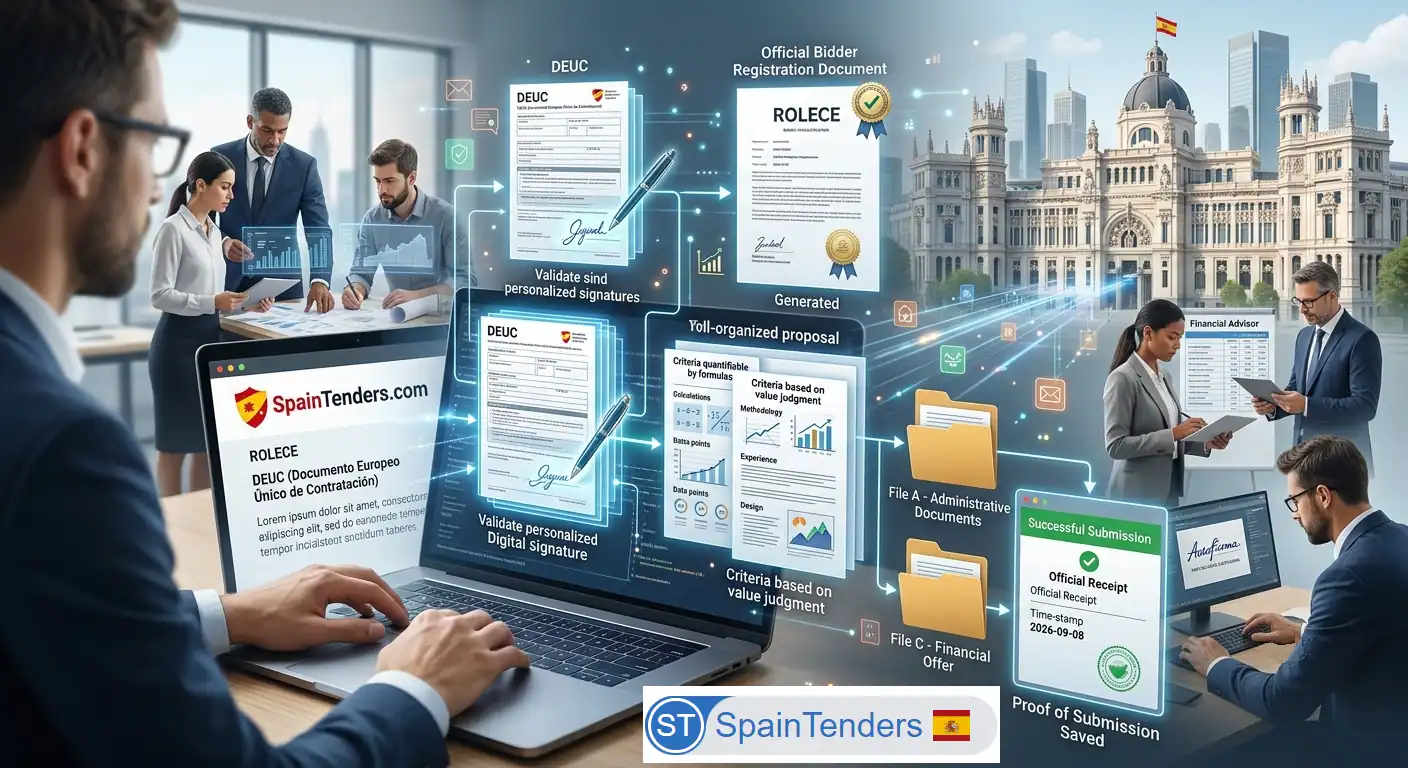
How to Register and Submit a Tender in Spain
08 Sep 2026
Introduction For a contractor, supplier or consultant entering the Spanish public procurement market, knowing how to find a tender is only one part of the process. The next and more important question is how to become ready to participate and how to submit a compliant offer before the deadline. Registering for tenders in Spain can involve several different elements, including company identification, electronic credentials, registration in the appropriate bidder register where required, preparation of administrative declarations, technical documentation, financial information and electronic submission through the system specified for the particular procurement. The process is primarily electronic. Spain's public administration guidance states that tender offers are generally submitted electronically, subject to the exceptions established by law, and that the bidder may need an electronic certificate and, depending on the system, additional software for preparing and submitting the offer. This guide explains the process from the perspective of a business that wants to participate in Spain government tenders, public procurement Spain and licitaciones públicas España. Table of Contents What Does It Mean to Register for Public Tenders in Spain? Who Can Register and Participate in Spanish Tenders? Before Registering: What a Company Should Prepare Step 1: Prepare Your Company Information Step 2: Obtain a Digital Certificate Step 3: Install the Required Electronic Signature Software Step 4: Register in ROLECE Where Applicable Step 5: Create and Maintain Your Bidder Profile Step 6: Understand the Tender Requirements Step 7: Prepare the DEUC or Required Declaration Step 8: Prepare Administrative Documents Step 9: Prepare the Technical Proposal Step 10: Prepare the Financial Offer Step 11: Check Electronic Tender Submission Requirements Step 12: Upload and Submit the Offer Step 13: Confirm Successful Submission What Happens After You Submit a Tender? Common Tender Registration and Submission Mistakes Spain Tender Submission Checklist How SpainTenders Helps Contractors Prepare for Opportunities Conclusion What Does It Mean to Register for Public Tenders in Spain? There is not necessarily one universal registration form that makes a company eligible for every public tender in Spain. Tender participation depends on the requirements of the specific contracting procedure and the bidder's legal, technical and financial position. In practical terms, a company needs to establish its identity, demonstrate its capacity to contract, satisfy the qualification requirements specified in the tender and have the technical means required to submit an electronic offer when electronic bidding applies. Registration in a relevant official bidder register can simplify the process of demonstrating certain company circumstances. However, registration should not be confused with automatic qualification for every procurement opportunity. Who Can Register and Participate in Spanish Tenders? Spanish public procurement can be relevant to a wide range of economic operators, including companies, self-employed professionals, joint ventures and other eligible operators depending on the procurement procedure. Typical participants include: Construction companies Engineering contractors Manufacturers Equipment suppliers Technology companies Consulting companies Healthcare suppliers Maintenance and facility-management providers Transport and logistics companies Professional service providers Companies from other EU Member States International companies seeking eligible Spanish procurement opportunities The specific eligibility conditions are determined by the procurement documents and applicable Spanish and European procurement rules. A company should therefore assess each opportunity individually rather than assuming that general registration is sufficient. Before Registering: What a Company Should Prepare A business can save considerable time by preparing its basic corporate and bidding information before starting the registration or qualification process. Depending on the tender, the preparation may include: Legal company name Registered business information Tax identification details Details of authorised representatives Power of attorney or representation information where applicable Business activity information Professional licences or authorisations where required Financial information Technical experience References for comparable contracts Information about personnel and technical resources Electronic certificate Electronic signature capability Administrative declarations Technical proposal templates Financial proposal templates The exact documents will depend on the procurement. The purpose of preparing this information in advance is to reduce last-minute work when a suitable tender becomes available. Step 1: Prepare Your Company Information The first practical step is to establish which legal entity will participate in the procurement and who is authorised to act on its behalf. This is particularly important where the person preparing the tender is different from the person legally authorised to sign or submit the offer. Businesses should maintain accurate information about their legal entity, representatives, powers of attorney and registration details. Any mismatch between the company information and the person submitting the offer can create avoidable administrative problems. Where the tender requires documentary evidence, the bidder should follow the exact form and timing specified in the procurement documents. Step 2: Obtain a Digital Certificate Electronic identification and signing are central to online public procurement in Spain. An electronic certificate can be used to identify the user and electronically sign documents or applications. The Spanish public administration explains that a certificate-based electronic signature can be used for identification and electronic procedures, and that electronic signature applications may be required for procedures involving signatures. AutoFirma is one of the applications used for this purpose. A company should therefore determine: Which certificate is appropriate for the company or authorised representative Who will use the certificate Whether the certificate is valid Whether the certificate is correctly installed or accessible Whether the certificate can be used by the required procurement platform Whether the authorised representative has the necessary signing authority International businesses should pay particular attention to the electronic identification requirements of the specific tender platform before attempting submission. Step 3: Install the Required Electronic Signature Software Having an electronic certificate is not always the end of the technical preparation. The electronic tendering system used for a procurement may require a particular application, browser configuration, signing component or other technical setup. The Spanish administration explains that electronic tender submission can require an internet connection, an electronic signature mechanism such as a certificate and, depending on the system, an application or tool for configuring and submitting the electronic proposal. Businesses should therefore complete technical preparation before the final day of a tender. A practical test should confirm that the authorised user can access the relevant system, select the correct certificate, sign required documents and complete the submission workflow. Step 4: Register in ROLECE Where Applicable ROLECE is the Registro Oficial de Licitadores y Empresas Clasificadas del Sector Público. It is an important Spanish public-sector register for economic operators participating in public procurement. Registration can provide evidence of certain circumstances relating to the bidder, including matters concerning legal capacity, representation, professional or business authorisation, economic and financial solvency, technical or professional solvency, classification and prohibitions on contracting, to the extent reflected in the register and subject to the applicable legal rules. However, businesses should not interpret ROLECE registration as a universal replacement for every document required in every tender. The tender documents determine what must be demonstrated and how it must be demonstrated. Some procedures can also establish specific registration requirements. For example, the Spanish Public Sector Contracts Law contains particular requirements for bidders in the simplified procedure framework. Before bidding, a company should therefore check whether: ROLECE registration is required A regional bidder register is relevant The registration information is current The authorised representative is correctly recorded The company's activity and solvency information is adequately reflected The tender requires additional evidence beyond the register Step 5: Create and Maintain Your Bidder Profile Once the company's electronic and registration requirements are prepared, it should establish an internal bidder profile containing the information frequently required during public procurement procedures. This does not mean copying the same information into every tender without checking the procurement documents. Instead, the business should maintain a reliable information library that can be updated whenever corporate circumstances change. The internal profile can include: Corporate information Authorised representatives Electronic certificates Company registrations Professional authorisations Financial records Relevant experience Project references Technical personnel information Equipment and technical resources Standard declarations This preparation makes it easier to move quickly when a suitable procurement opportunity is identified. Step 6: Understand the Tender Requirements Before preparing an offer, the bidder should read the procurement documents carefully. The company should not begin by preparing a generic sales proposal. The objective is to understand exactly what the contracting authority is asking the market to deliver and how the submitted offer will be evaluated. Key areas to identify include: Eligibility requirements Technical specifications Economic and financial requirements Technical and professional capacity Required experience Evaluation criteria Contract duration Lots and lot-specific requirements Required declarations Pricing methodology Submission format Deadline Under Spanish procurement law, offers must conform to the tender documents, and submission represents acceptance of the conditions governing the procurement, subject to the legal framework. Step 7: Prepare the DEUC or Required Declaration The DEUC, or Documento Europeo Único de Contratación, is an important self-declaration mechanism used in applicable procurement procedures. Where the tender provides a DEUC, bidders should use the version and instructions associated with that specific procurement. Official guidance emphasises that the particular tender documentation and the contracting authority's instructions determine how the DEUC should be completed. A bidder may need to provide information concerning its exclusion grounds, suitability, economic and financial standing, technical and professional capacity or other matters covered by the declaration. The DEUC can reduce the need to submit the complete set of supporting evidence at the initial stage in procedures where it is used. However, the contracting authority can require supporting documents under the conditions established by law and the procurement documents. Never reuse an old DEUC without checking the requirements of the new tender. Step 8: Prepare Administrative Documents The administrative part of a tender establishes that the bidder satisfies the applicable legal and procedural requirements. Depending on the procurement, the administrative file can involve declarations, company information, representation documents, registration evidence, solvency evidence, professional authorisations and other supporting documents. Where a company relies on the capacity of another entity, forms or supporting evidence relating to that arrangement may also be required. The exact documentation should always be taken from the tender's administrative specifications. A generic document checklist cannot replace the requirements of an individual procurement. Step 9: Prepare the Technical Proposal The technical proposal should respond directly to the technical requirements and evaluation methodology contained in the tender documents. A common mistake is to prepare a general company presentation and assume that it is sufficient as a technical bid. Public procurement evaluation is based on the criteria defined for the particular procedure, so the response should be structured around those criteria. The technical team should map every requested requirement to a specific response. Tender Requirement Bid Response Technical specification Explain how the proposed solution meets the specification Experience requirement Provide relevant evidence and references Personnel requirement Identify proposed resources and qualifications Implementation requirement Describe the proposed methodology and delivery approach Quality requirement Provide the requested procedures, certifications or evidence Evaluation criterion Structure the response so the evaluator can assess the stated criterion The purpose is not simply to produce a lengthy proposal. The objective is to provide a precise, compliant and evidence-based response to the evaluation framework. Step 10: Prepare the Financial Offer The financial offer must be prepared using the format and methodology specified in the tender documents. Depending on the procurement, the financial component can include a total price, unit prices, rates, discounts, cost schedules or other financial information. Pricing should be checked independently before submission. Confirm the correct pricing template. Check all required fields. Verify calculations. Check units and quantities. Confirm taxes and other financial elements according to the tender instructions. Check whether prices must be submitted separately from technical information. Confirm that the final figures match the required format. An arithmetic error or failure to follow the prescribed pricing structure can have serious consequences, so financial quality control should be completed before electronic submission. Step 11: Check Electronic Tender Submission Requirements Not every electronic procurement procedure necessarily uses exactly the same technical environment. The bidder must identify the electronic tendering system specified for the particular procurement. Spain's public administration guidance specifically advises bidders to consult the tender documents or contact the contracting authority to determine which electronic tendering system must be used for a particular procedure. Before uploading an offer, check: Required electronic platform Authentication method Electronic certificate requirements Signature requirements Accepted file formats Maximum file sizes Required electronic envelopes or files Technical submission instructions Deadline and submission time Available technical support This preparation is especially important for international companies that may be unfamiliar with Spanish electronic procurement systems. Step 12: Upload and Submit the Offer After all bid documents have passed internal quality control, the bidder can proceed with electronic submission using the system specified by the procurement. The submission process can vary by platform, but the bidder will generally need to authenticate, select the relevant procurement procedure, upload the required files, complete the required information and electronically sign or otherwise validate the submission according to the system's instructions. Where a tender uses separate electronic envelopes or files, the bidder must place each document in the correct location. The structure of the offer can depend on the evaluation criteria specified in the procurement documents. Spanish procurement law provides for different electronic-file structures depending on whether evaluation includes criteria based on judgement or criteria quantifiable through formulas. Do not assume that uploading files means the tender has already been submitted. Continue through the complete submission process until the platform confirms that the offer has been successfully presented. Step 13: Confirm Successful Submission One of the most important final steps is obtaining evidence that the offer was actually submitted. After completing the submission, the bidder should save the available electronic receipt, registration confirmation or other proof generated by the procurement system. The internal tender record should contain: Tender reference Submission date Submission time Name of submitting company Authorised representative Electronic submission confirmation Receipt or registration evidence Final submitted documents Keeping this evidence is a basic but important bid-management practice. What Happens After You Submit a Tender? Electronic submission does not mean that the procurement process has finished. The contracting authority may subsequently review the submitted documentation, evaluate the offers according to the published criteria and communicate decisions through the applicable procurement system. Depending on the procedure, the contracting authority may also request clarification or supporting documentation in accordance with the applicable rules. A bidder should therefore continue monitoring the relevant procurement record and official communications after submission. The company should also retain the exact version of the submitted offer and the evidence of submission. This creates a reliable internal record of what was actually presented. Can a Company Submit More Than One Offer? Businesses should not assume that they can submit multiple independent offers for the same procurement. The Spanish Public Sector Contracts Law establishes the general rule that a bidder may not submit more than one proposition, subject to the specific legal provisions concerning variants and electronic auctions. Where a procurement is divided into lots or permits variants, the applicable tender documents should be examined carefully before deciding how to structure the company's participation. Can International Companies Submit Tenders in Spain? International companies can participate in Spanish public procurement when they meet the applicable legal and tender-specific requirements. For an international supplier, preparation may require additional attention to legal status, representation, professional authorisations, financial and technical capacity, language requirements and electronic identification. The company should also determine whether documents issued outside Spain require a particular form of recognition, translation or other treatment under the applicable procurement procedure. The tender documents remain the controlling reference for the documentation required from an international bidder. Common Tender Registration and Submission Mistakes Using an expired electronic certificate A certificate problem discovered immediately before the deadline can prevent successful submission. Check validity well in advance. Assuming ROLECE registration is enough ROLECE can provide evidence of registered circumstances, but the procurement documents may require additional information or documentation. Submitting without checking the latest tender documents Amendments and clarifications can change what bidders need to provide. Always use the current procurement information. Uploading documents into the wrong electronic file Where the tender uses multiple electronic files or envelopes, placing a document in the wrong section can create compliance issues. Ignoring file-format requirements A technically correct document may still cause problems if the tender platform specifies a particular format, size or signing method. Waiting until the last few minutes Electronic submission depends on technology, connectivity and successful authentication. Last-minute submission leaves little time to resolve unexpected technical problems. Failing to save the submission receipt The bidder should retain evidence showing that the offer was successfully submitted. Using a generic proposal The technical and financial offer should respond to the requirements and evaluation criteria of the specific procurement. Spain Tender Submission Checklist Stage Check Company readiness Legal entity and authorised representative are correctly identified Electronic identity Valid electronic certificate is available Signature Required electronic-signature software and configuration are working ROLECE Registration requirements have been checked and information is current where applicable Administrative file All required declarations and supporting documents are prepared DEUC Completed according to the specific tender instructions where applicable Technical offer Every applicable evaluation requirement has been addressed Financial offer Pricing has been checked against the tender format and requirements Electronic submission Correct platform, file structure and technical requirements have been confirmed Final QC Documents, signatures, formats and deadlines have been checked Submission Offer has been fully submitted rather than merely uploaded Proof Electronic receipt or submission confirmation has been saved How SpainTenders Helps Contractors Prepare for Opportunities Successful tender participation starts before the submission stage. Contractors need enough time to identify a suitable opportunity, assess the requirements, assemble the necessary information and prepare a compliant bid. SpainTenders.com can support the opportunity-discovery part of this workflow by helping businesses identify Spain tender opportunities relevant to their commercial interests. This is particularly useful when a company wants to establish a repeatable process rather than search for tenders only when its sales pipeline becomes empty. A practical workflow can be: Find opportunity → Check eligibility → Review requirements → Prepare registration and documents → Build bid → Submit electronically → Save confirmation. The role of SpainTenders.com is focused on helping businesses discover opportunities. The official procurement documents and the electronic submission system designated for the individual tender remain the authoritative sources for bidding requirements and submission. How to Prepare Before a Tender Deadline The safest tender process begins well before the closing time. A business should maintain an internal deadline that is earlier than the official procurement deadline. This creates time for final document review, signature problems, file conversion, technical issues or corrections. A useful internal sequence is: Identify the opportunity Complete an eligibility check Download and review all applicable documents Assign administrative and technical responsibilities Prepare the commercial response Complete internal compliance review Sign the required documents Upload the files Validate the submission Submit before the internal deadline Save the electronic receipt This process reduces the chance that a technically suitable bid fails because of an administrative or submission-stage error. Conclusion Learning how to register and submit a tender in Spain requires more than creating an account on a procurement website. Businesses need to prepare their legal and corporate information, establish appropriate electronic identification and signing capabilities, understand ROLECE where applicable, prepare the DEUC or other declarations when required and build technical and financial offers that follow the individual procurement documents. Because Spanish public procurement is predominantly electronic, technical readiness is an essential part of bidder readiness. A valid electronic certificate, working signature setup, correct document formats and familiarity with the required electronic tendering system can make the difference between a completed submission and a missed opportunity. Most importantly, the bidder should treat every tender as an individual procurement procedure. Registration in a bidder register does not automatically make a company eligible for every contract, and a previous bid should not simply be copied into a new procurement without checking its specific requirements. The complete process can be viewed as a chain: Company readiness → Electronic identification → Applicable registration → Tender qualification → Document preparation → Technical and financial offer → Electronic submission → Submission confirmation. For contractors, suppliers, consultants and international businesses targeting the Spanish public sector, building this process in advance makes it easier to respond when the right procurement opportunity appears. Regular opportunity discovery through SpainTenders.com, followed by verification of the official procurement documents and completion of the required electronic submission process, can form a practical foundation for participating in the Spanish public procurement market.
View Details
Valencian Health Authority Awards 8.7 Billion Euro Biosimilars Framework Agreement to Eight Pharmaceutical Suppliers
08 Sep 2026
Standfirst A group of eight pharmaceutical suppliers has been appointed to a major framework agreement for the supply of biological medicines and biosimilars to public health centers in the Valencian region of Spain. The contract, managed by the General Directorate of Economic Management, Contracting and Infrastructure of the Ministry of Health, carries a maximum estimated framework value of approximately 8.73 billion euros across all lots. This procurement highlights the Spanish public sector ongoing commitment to healthcare sustainability and the strategic adoption of cost effective biosimilar alternatives. The award follows a competitive open procedure that balanced clinical quality with financial efficiency, ensuring reliable access to advanced treatments for regional patients. Introduction The modernization of public healthcare procurement represents a critical priority for regional governments across Europe. In Spain, the Valencian health authority has initiated a large scale procurement strategy to supply biological medicines and biosimilars to various public health centers. This specific tender result focuses on the acquisition of essential treatments, including immunosuppressive agents, antineoplastic agents and other specialized biological medications required for chronic and complex disease management. By utilizing a centralized framework agreement model, the contracting authority leverages collective buying power to secure favorable terms and standardized product specifications. The agreement permits both direct awards and reopened competition, providing flexibility to meet the diverse clinical needs of different hospitals while maintaining strict control over public expenditure. This approach ensures that taxpayer funds are deployed efficiently while adhering to European public procurement regulations. Why This Contract Matters This framework agreement is vital for ensuring that public health services have reliable and affordable access to advanced biological treatments. The inclusion of environmental criteria aligns the procurement with broader sustainability goals, pushing the pharmaceutical market toward greener supply chain practices. For the pharmaceutical industry, securing a position on this official Tenders Portal list guarantees access to a massive and stable customer base. The high maximum value indicates significant future revenue potential, although actual spending will depend on the specific call off orders issued by individual health centers. Contract Timeline The procurement process culminated in the formal selection of the winning suppliers on June 4, 2026. Following the mandatory administrative and standstill periods, the framework contracts were officially concluded on August 28, 2026. The contract awards notice was subsequently published in the Official Journal of the European Union on September 8, 2026. This timeline reflects a standard and transparent execution of public procurement regulations in the Spanish healthcare sector. Contract Overview The procurement is structured as a framework agreement that is partly without reopening and partly with reopening of competition. This means that the terms, including pricing, were established during the initial tender evaluation and individual purchase orders will be issued based on these pre agreed conditions or through mini competitions. The maximum estimated value of the framework agreements across all lots is set at 8,735,686,152.30 euros. Eight distinct suppliers were selected across various therapeutic lots, ensuring a wide array of product options for healthcare providers. Key Contract Details Contract Title Suministro respetuoso con el medio ambiente, de medicamentos bilógicos con biosimilares destinado a los centros del ámbito de la sanidad pública valenciana Contracting Authority Dirección General de Gestión Económica, Contratación e Infraestructuras de la Conselleria de Sanidad Maximum Framework Value 8,735,686,152.30 EUR (Total across all lots) Procedure Type Open Procedure Number of Bids Received Varied by lot (1 to 7 bids per lot) Winners AMGEN, S.A., KERN PHARMA, S.L., Celltrion Farmaceutica España SL, SAMSUNG BIOEPIS NL BV, ACCORD HEALTHCARE, SLU, GEDEON RICHTER IBERICA SAU, Sandoz Farmaceutica, ORION PHARMA S.L. Contract Conclusion Date August 28, 2026 Main CPV Code 33652300 (Immunosuppressive agents) Project Scope The scope of this contract covers the environmentally friendly supply of biological medicines with biosimilars intended for public health centers. These products are classified under primary CPV codes for immunosuppressive agents, antineoplastic agents and medicinal products for obstructive airway diseases. The suppliers are responsible for ensuring the timely delivery of these critical items to regional healthcare facilities in accordance with strict pharmaceutical storage and handling regulations. The agreement also mandates a focus on pollution prevention and climate change mitigation throughout the supply chain. About the Contracting Authority The General Directorate of Economic Management, Contracting and Infrastructure of the Ministry of Health is the primary contracting authority. It is a regional public authority responsible for managing healthcare procurement and infrastructure within the Valencian Community, Spain. About the Organisations Involved Dirección General de Gestión Económica, Contratación e Infraestructuras de la Conselleria de Sanidad is the primary contracting authority and buyer. It manages regional healthcare services and drives the procurement of essential medical supplies for public hospitals. AMGEN, S.A. is a successful bidder and a large economic operator. The company secured the contract for LOT 0012, supplying Adalimumab 20mg pre filled syringes or pens. KERN PHARMA, S.L. is a successful bidder and a large economic operator. It won multiple lots, including LOT 0002, LOT 0011, LOT 0013 and LOT 0017, demonstrating strong capacity in immunosuppressive agents. Celltrion Farmaceutica España SL is a successful bidder and a micro, small, or medium enterprise. It secured six lots, including LOT 0007, LOT 0008, LOT 0010, LOT 0015, LOT 0016 and LOT 0018, highlighting its significant role in the biosimilars market. SAMSUNG BIOEPIS NL BV is a successful bidder and a large economic operator based in the Netherlands. It was awarded LOT 0019 for the supply of Eculizumab. ACCORD HEALTHCARE, SLU is a successful bidder and a large economic operator. The company won LOT 0005 and LOT 0022, focusing on antineoplastic and immunomodulating agents. GEDEON RICHTER IBERICA SAU is a successful bidder and a large economic operator. It secured LOT 0023 for the supply of Folitropina alfa. Sandoz Farmaceutica is a successful bidder and a large economic operator. It was awarded LOT 0003 and LOT 0004, supplying Infliximab and Natalizumab. ORION PHARMA S.L. is a successful bidder and a micro, small, or medium enterprise. It won LOT 0006 for the supply of Ranibizumab. Tribunal Administrativo Central de Recurso Contractuales is the review organisation. This Central Administrative Court of Contractual Appeals handles any legal challenges or disputes related to the procurement process. Procurement Analysis The open procedure attracted multiple bids across the various lots, demonstrating healthy competition in the Spanish biosimilars market. The award criteria were split between quality and price, with quality carrying a weight of 50 or 60 points and price carrying 40 or 50 points depending on the specific lot. This balanced evaluation method indicates that the technical and clinical specifications in the bidding documents were stringent, requiring suppliers to prove both clinical efficacy and financial competitiveness. Consequently, the competition focused on delivering optimal value without compromising patient safety or treatment standards. Additional Procurement Facts The procurement is not covered by the Government Procurement Agreement, reflecting its status as a domestic regional contract governed primarily by Spanish national legislation and EU Directive 2014/24/EU. The project is not financed with European Union funds, relying instead on the regional healthcare budget. The framework agreement structure allows for both direct awards and reopened competition, providing flexibility for future purchasing decisions. Market & Industry Perspective The Spanish public pharmaceutical market is highly competitive, with major international manufacturers and local distributors vying for centralized contracts. The presence of eight winners across multiple lots indicates that the contracting authority values supplier diversity to mitigate the risk of supply chain disruptions. This approach ensures that if one manufacturer faces production delays, alternative approved biosimilar products remain immediately available to healthcare providers. The emphasis on environmental criteria also signals a broader industry shift toward sustainable pharmaceutical logistics. Economic Significance A maximum framework value of approximately 8.73 billion euros represents a substantial allocation of public healthcare spending. This investment supports the domestic and regional distribution networks of major pharmaceutical companies, ensuring the continued availability of critical medical supplies. By securing these prices in advance, the region achieves significant budgetary predictability and protects against market volatility in the pricing of biological medicines. Future Procurement Opportunities Suppliers who were not successful should monitor the official Tenders Portal for upcoming framework renewals or new lots covering different therapeutic areas. As clinical guidelines evolve, public institutions will continuously generate new tenders opportunities for medication refreshes. Stakeholders should also track the Latest Active Tenders Procurement notices to anticipate upcoming supply projects in the broader Spanish healthcare sector. The dynamic nature of public procurement means that new Live Notices for Tenders will emerge as regional authorities update their clinical requirements. Opportunities for Suppliers While the primary framework positions have been awarded, specialized logistics providers and cold chain transport companies can find valuable subcontracting opportunities with the primary winners. Additionally, manufacturers of specific generic alternatives may explore partnerships with the appointed distributors to expand their market reach within the public sector. What Businesses Should Watch Industry observers should monitor the activation rate of this framework agreement to gauge actual public sector demand for these specific pharmaceutical products. The balance between direct awards and reopened competitions will reveal how contracting entities value flexibility versus price competition in subsequent phases. Stakeholders should also review Live Notices for Tenders to anticipate upcoming infrastructure projects and supply chain modernizations in the region. Any shifts in clinical guidelines regarding biological treatments will directly influence future RFPs and RFQs in this market. SpainTenders.com Procurement Intelligence This contract represents a clear trend in European public procurement toward the strategic adoption of biosimilars to ensure long term healthcare sustainability. By appointing eight different providers across various therapeutic categories, the Valencian health authority mitigates the risk of stock shortages and manufacturer delays that have historically plagued public healthcare systems. This strategy prioritizes operational continuity and clinical flexibility over the traditional model of selecting a single exclusive supplier for all biological medicines. Strategically, this award is important because it demonstrates a balanced evaluation approach in high value medical tenders. By assigning significant weight to both quality and price, the buyer effectively pre qualified compliant bidders based on their ability to meet stringent clinical and regulatory baselines while remaining cost competitive. Suppliers can learn that meeting these technical minimums is now the primary hurdle, rather than competing solely on marginal price differences during the initial framework establishment. To position themselves for future contracts, relevant suppliers must invest in supply chain transparency and ensure their product catalogs align with national clinical guidelines and environmental standards. Future contracts in this market are likely to feature even stricter supply chain security mandates alongside price competition. Companies that proactively develop resilient distribution networks and can guarantee uninterrupted delivery will hold a distinct advantage when responding to future public procurement solicitations. Supplier Takeaways Multi supplier framework agreements are increasingly used to guarantee supply chain resilience in public healthcare procurement. Meeting strict clinical and regulatory minimums is a primary gateway for winning government pharmaceutical contracts. The real competition often shifts to the call off phase, requiring suppliers to maintain agile response capabilities for reopened competitions. Specialized logistics and cold chain providers can find valuable subcontracting opportunities with primary framework winners. Key Takeaways Eight suppliers were awarded positions on a framework agreement for biological medicines and biosimilars. The maximum estimated value of the framework agreements is approximately 8.73 billion euros. The award criteria balanced quality and price, reflecting a mature market for specialized hospital pharmaceuticals. The framework operates with both direct awards and reopened competition, ensuring flexibility for healthcare providers. Environmental sustainability criteria were integrated into the procurement to promote greener supply chains. Conclusion This framework agreement secures a reliable and diversified supply of critical biological medicines for the Valencian public health system. The multi supplier award structure ensures competitive tension and operational resilience for the duration of the contract. As the region continues to modernize its healthcare delivery, this procurement model will likely serve as a blueprint for future pharmaceutical acquisitions. Source: Tenders Electronic Daily (TED), Contract Award Notice 617533-2026, Official Journal of the European Union, published on 08/09/2026.
View Details